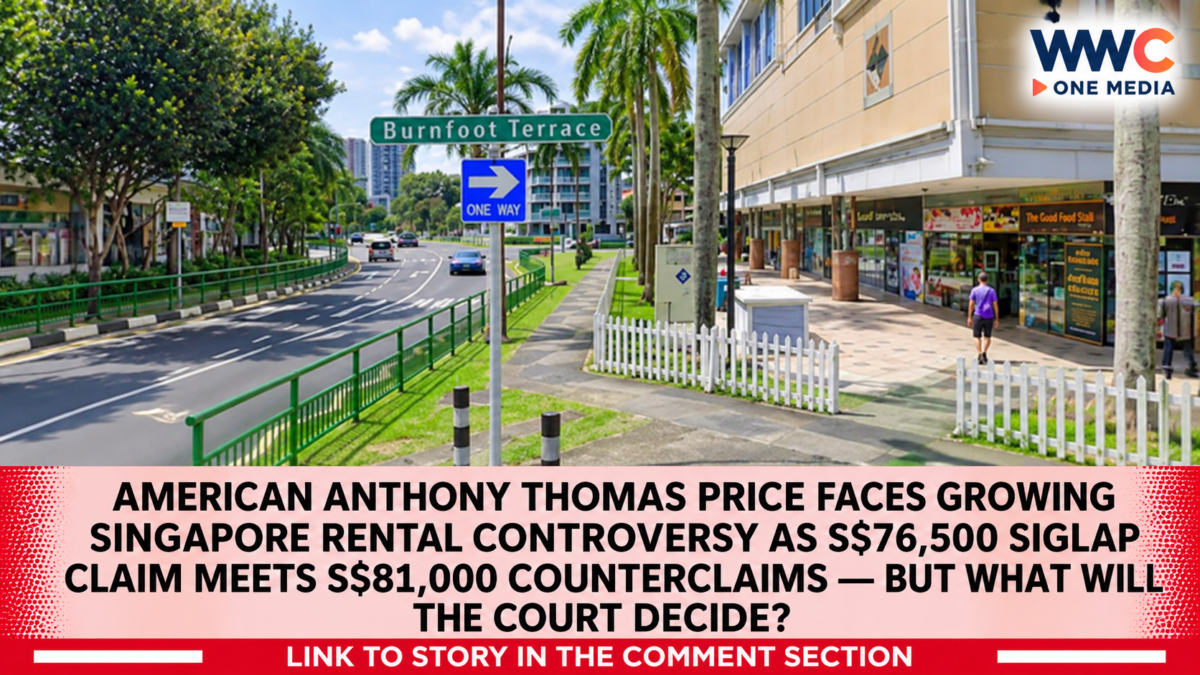
An escalating rental dispute in Singapore has drawn renewed attention after American national Anthony Thomas Price filed a counterclaim against his former landlord, seeking compensation for lost working time and emotional distress following allegations that he and his family occupied a landed property in Siglap for nearly 12 months without paying rent.
The case involves a semi-detached house along Burnfoot Terrace, where Price and four family members lived under a tenancy agreement signed through his company, Bundleluxe Pte Ltd.
According to court documents and reports by Lianhe Zaobao, Price is seeking S$20,000 in damages for lost working time and emotional distress. His company has also filed claims involving alleged property defects, rental reductions and lost business opportunities.
The landlord, Angela Chan Wan Qi, is pursuing a separate claim against Price and Bundleluxe for approximately S$76,500 in unpaid rent, interest and double rent for the period the family allegedly remained in the property after the tenancy expired.
The dispute has become particularly significant because it is not the first rental-related lawsuit involving Price and companies associated with him.
It also comes amid a police investigation into alleged cheating and separate regulatory investigations involving the companies connected to the American businessman.
How the S$8,500-a-Month Siglap Rental Dispute Began
The tenancy agreement was signed on December 29, 2023, with the rental period running from January 1 to December 31, 2024.
Under the agreement, Bundleluxe was required to pay S$8,500 monthly for the semi-detached property. Price and four members of his family were authorised to occupy the house.
However, the landlord alleges that the company stopped paying rent from at least May 2024 after initially making payments.
Despite the alleged rental arrears, Price and his family continued living at the property after the agreement expired.
They eventually moved out on March 18, 2025, approximately two and a half months after the tenancy ended.
According to the landlord’s claim, the family occupied the property without rent being paid for a substantial portion of the tenancy and remained there beyond the agreed rental period.
The landlord subsequently commenced legal proceedings against both Price and Bundleluxe in February 2025, seeking to recover the outstanding amounts.
The dispute remains unresolved.
Price Claims More Than 50 Defects Made the House Almost Uninhabitable
Price’s defence centres on the condition of the property.
He claimed that his family discovered more than 50 defects within the first 120 days of moving into the house. According to his counterclaim, these problems made the property almost uninhabitable and required him to spend considerable time coordinating repairs.
He further alleged that the maintenance issues affected his professional commitments, forcing him to miss important meetings with international companies and business partners.
Price also claimed that the landlord’s alleged failure to maintain the property caused him to become seriously ill between April and December 2024. He said a family member also became seriously ill and suffered work-related losses.
He disputed Chan’s calculation of the rental arrears, arguing that the amount should be S$68,000 rather than S$76,500.
However, these are allegations contained in his counterclaim and have not been established at trial.
His Company Is Seeking Another S$61,000
The financial demands go beyond Price’s personal counterclaim.
Bundleluxe has reportedly sought:
- S$17,000 in rental reduction.
- S$4,000 for alleged damage to electrical appliances.
- S$40,000 for lost business opportunities.
Combined, the company’s claims amount to S$61,000.
Price is separately seeking S$20,000 for lost working time and damages for emotional distress.
Both defendants have also reportedly pursued defamation-related claims against the landlord.
Chan, however, disputes the basis of the counterclaims. Her position is that rental obligations cannot simply be suspended because of disagreements over property maintenance.
She also argues that the security deposit should not be used to offset outstanding rent and should be dealt with according to the tenancy agreement.
The competing claims mean the Siglap dispute involves substantial financial demands from both sides.
Importantly, the court has not yet determined which party is entitled to the damages being claimed.
Court Previously Rejected Price’s Attempt to Remove Him From the Siglap Lawsuit
Another important development occurred in August 2026.
Price had applied to have portions of the landlord’s lawsuit struck out, including allegations concerning his alleged rental arrangements through corporate entities and claims seeking to establish his personal liability.
However, Deputy Registrar Andrew Tan Shao Weng dismissed the application in its entirety.
The August 24 written decision also recorded that Bundleluxe was dormant, with no revenue, assets or bank account at the time of the hearing.
The ruling did not establish that Price was criminally guilty or finally determine the landlord’s allegations. It meant that the challenged portions of the case could proceed rather than being removed at that preliminary stage.
The distinction is important because Price maintains that he was not personally a party to the tenancy agreement, which was signed by Bundleluxe.
The landlord, meanwhile, argues that the company was used to shield him from personal financial responsibility.
The case remains pending, with the substantive claims still to be decided.
A Separate Kembangan Rental Case Raised Even Bigger Questions
The Siglap dispute became more controversial following a separate lawsuit involving an elderly couple in Kembangan.
In that case, Price used another company, Noranth Ventures Pte Ltd, to rent a semi-detached property from a couple in their 80s.
The tenancy began on May 1, 2026, with monthly rent set at S$7,500.
According to the October 7, 2026 judgment, the company paid only the first month’s rent and failed to pay subsequent rental obligations.
Price cited approximately 35 repair, rectification and practical occupation issues as reasons for the dispute.
The landlords sought to recover their property after the rental agreement was breached.
However, the company commenced legal proceedings against them, attempting to prevent the landlords from repossessing the house.
District Judge Chiah Kok Khun dismissed the company’s action and allowed the landlords’ counterclaim.
In a particularly significant finding, the judge concluded that Price had devised a deliberate scheme to rent the property for himself and his family without intending to pay rent.
The court also described the use of legal proceedings to prolong occupation as an abuse of process.
Noranth Ventures was ordered to return the property and pay outstanding rental amounts and other sums, including S$17,031.98 in legal costs and expenses.
The judgment also highlighted the company’s minimal paid-up capital of just S$200, raising concerns about whether the landlords would actually be able to recover the money owed.
The decision is significant because it represents a judicial finding in the separate Kembangan proceedings, not a final judgment in the ongoing Siglap dispute.
Three Rental Properties and a Pattern Identified by the Court
The Kembangan judgment also examined two earlier rental arrangements involving Price.
One involved the Siglap property owned by Angela Chan, while another concerned a landed house along Jalan Selamat.
According to the judge, the cases revealed a recurring approach involving companies used to enter residential tenancy agreements, followed by disputes over rental payments and continued occupation of the properties.
The Jalan Selamat dispute, which involved alleged rental arrears of approximately S$27,160, was eventually settled and withdrawn.
The Siglap case remains ongoing.
The Kembangan judgment therefore brought the three rental disputes into a wider legal discussion about the use of corporate entities in residential property transactions.
For landlords, the issue is particularly concerning because a company can sign a tenancy agreement while the individuals who actually occupy the property may not automatically become personally responsible for its contractual obligations.
Singapore Police and Corporate Regulators Are Now Investigating
The controversy has moved beyond private rental litigation.
On November 4, 2026, Senior Minister of State for Law Murali Pillai told Parliament that police had found grounds to investigate Price for alleged cheating after reviewing the October court judgment in the Kembangan case.
The investigations involve several authorities.
The Singapore Police Force is investigating possible cheating offences.
The Official Receiver is examining possible fraudulent trading and wrongful trading offences.
The Accounting and Corporate Regulatory Authority (ACRA) is also looking into potential breaches of the Companies Act involving the relevant companies and individuals.
Murali Pillai stressed that companies are legally permitted to rent residential properties, including for employees working in Singapore.
However, corporate structures cannot lawfully be used as a cover for fraud or to evade responsibilities through improper conduct.
He also explained that individuals could potentially be held personally liable for company debts in certain circumstances involving fraudulent or wrongful trading.
Under Singapore law, cheating carries a maximum penalty of 10 years’ imprisonment, as well as a fine, caning or both, depending on the applicable offence and circumstances.
Nevertheless, the minister emphasised that investigations are ongoing and that his parliamentary statement should not be interpreted as a determination that an offence has been committed.
Price has not been convicted of cheating in connection with these allegations.
Why This Case Matters to Singapore Landlords and Property Owners
The controversy raises important questions about how landlords should protect themselves when renting properties to companies.
Corporate tenancies are not inherently suspicious. Businesses regularly rent homes to accommodate employees, executives and other authorised occupants.
However, the cases involving Price have highlighted the financial risks that can arise when a landlord enters an agreement with a company that has little or no meaningful financial capacity.
A company may be legally separate from its directors and shareholders. This means landlords cannot automatically assume that an individual occupying a property will personally pay the company’s outstanding debts.
Singapore’s Law Ministry has indicated that making personal guarantees compulsory for every corporate tenancy would create unnecessary burdens for legitimate business arrangements.
Landlords can instead consider requesting personal guarantees, checking the financial standing of corporate tenants and carefully examining the terms of tenancy agreements before handing over their properties.
The issue also connects with Singapore’s wider residential property market, where rental demand, tenant affordability and landlord protections remain important concerns.
For related coverage, WWC ONE MEDIA has also examined Singapore’s rental market slowdown and changing tenant demand, as well as the widening divide in Singapore’s public and private housing markets.
Other relevant reports include Singapore’s illegal worker accommodation enforcement case and Singapore’s upcoming regulatory changes affecting commercial property operators.
The Bigger Question: Who Will Ultimately Bear the Financial Losses?
The Siglap rental dispute is now part of a much wider controversy involving corporate tenancy arrangements, alleged unpaid rent, property maintenance complaints and the potential misuse of company structures.
On one side, the landlord is seeking to recover S$76,500 in rental-related claims.
On the other, Price and Bundleluxe are seeking compensation for alleged defects, lost business opportunities, working time and other damages.
The separate Kembangan judgment has already produced serious judicial findings about Price’s conduct in that particular tenancy dispute, while police and corporate regulators are examining possible offences.
But the Siglap case has yet to reach trial, and the competing claims must still be resolved through the legal process.
For Singapore property owners, the controversy serves as a warning that a signed tenancy agreement and a corporate tenant’s registration may not be enough to guarantee rental payments or an easy recovery of a property.
The outcome could also become an important reference point in discussions about corporate tenancies and landlord protections.
With S$76,500 being claimed by the Siglap homeowner, S$81,000 in combined personal and company counterclaims, and separate government investigations underway, could this rental dispute become one of Singapore’s most closely watched property litigation cases?