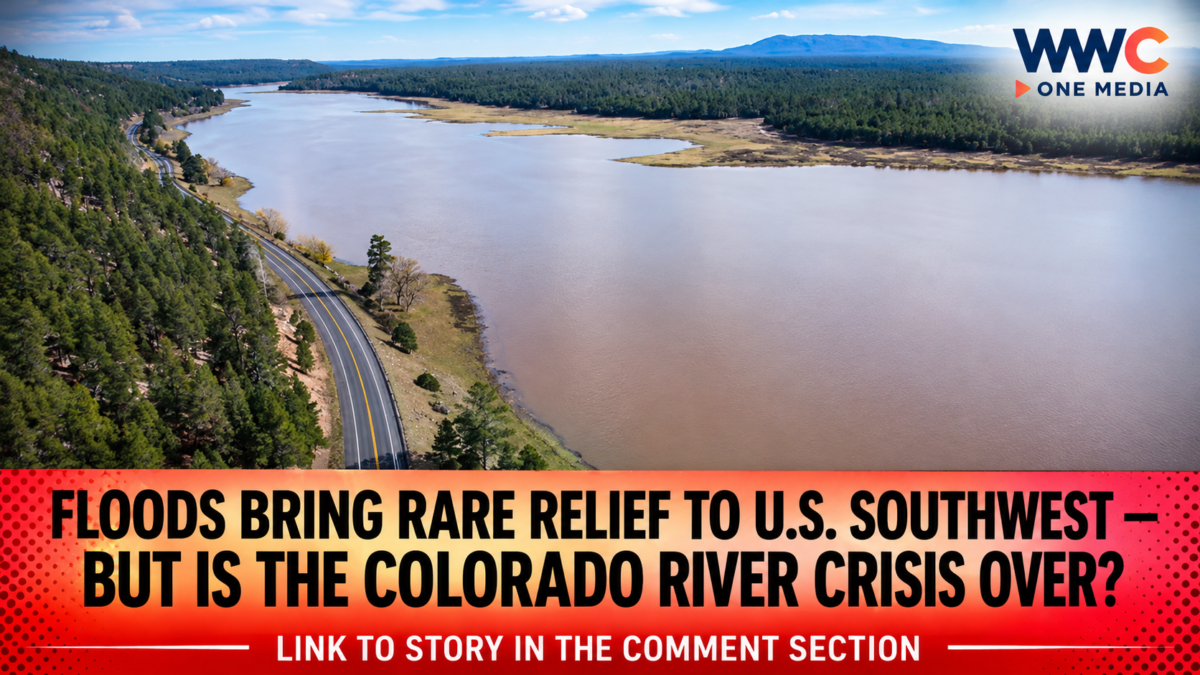
Floods Push Lake Powell Up 20 Feet as El Niño Brings Rare Drought Relief — But Is the Colorado River Crisis Really Over?
PHOENIX, United States — November 10, 2026 — After years of worsening drought, America’s Southwest is receiving an unexpected surge of water. But the rainfall bringing relief to depleted reservoirs is also flooding communities, damaging roads and forcing hundreds of residents to evacuate.
Powerful storms that swept across the region in late October and early November have sent torrents of water through normally dry rivers and creeks, helping replenish reservoirs and underground aquifers that have been severely depleted by years of drought.
One of the biggest beneficiaries is Lake Powell, the massive reservoir along the Arizona-Utah border.
According to the Associated Press, Lake Powell has risen more than 20 feet (6.1 meters) from its mid-September low.
The increase represents an important improvement for a water system that has struggled with declining supplies and unusually weak winter snowfall.
But there is a serious catch.
Despite the recent gains, Lake Powell remains only slightly more than one-quarter full, while the wider Colorado River Basin continues to face long-term water shortages.
The latest rainfall may offer a much-needed opportunity to rebuild water reserves. However, scientists and water officials caution that a few exceptionally wet weeks cannot erase decades of water-management problems.
Lake Powell Rises More Than 20 Feet After Powerful Storms
The recent storms have delivered an unexpected boost to one of America’s most important water-storage systems.
Lake Powell, the country’s second-largest reservoir, has gained more than 20 feet since reaching its mid-September low, according to reporting by the Associated Press.
The increase is especially significant because the previous winter’s relatively weak snowfall produced limited runoff during the spring and summer.
Normally, snow accumulated in the Rocky Mountains melts and supplies rivers that feed major reservoirs throughout the Colorado River Basin.
This year, however, the region received an unusual combination of intense rainfall and flooding that helped deliver additional water into depleted waterways.
Climate scientist and hydrologist Martin Hoerling of the University of Colorado Boulder told AP that much of the floodwater is expected to feed lakes and underground aquifers.
AP also reported that the combined effect of floodwater and additional rainfall could potentially add more than 1.2 million acre-feet to Lake Powell.
That estimated volume is equivalent to roughly 1.2 million acre-feet of water, not an amount already confirmed as fully stored in the reservoir.
Even with the improvement, Lake Powell remains far below its full capacity.
The distinction matters because reservoir levels must recover substantially before the region can consider its water crisis resolved.
Flooding Brings Relief to Arizona and Colorado Communities
While the heavy rainfall has created dangerous flooding conditions, some communities are already experiencing improvements in their local water supplies.
In Pagosa Springs, Colorado, approximately seven inches of rain fell around the area in October.
Before the storms, more than 10,000 people in the town and surrounding communities were subject to water restrictions.
Those restrictions have since been lifted, according to AP.
Flagstaff, Arizona, has also recorded a substantial increase in its surface-water supply.
Upper Lake Mary, which can provide up to 40% of Flagstaff’s water, received more than three billion gallons since early October.
The recent storms reportedly delivered the equivalent of more than two years of water into the city’s surface-water supply.
The increase provides an important buffer for Flagstaff, which also depends heavily on underground aquifers.
Meanwhile, heavy runoff in central Arizona has entered streams feeding the Verde River.
Water managers released water from two nearly full dams into normally dry stretches of the river near metropolitan Phoenix.
These developments show how intense rainfall can provide immediate benefits to water systems that have been struggling with prolonged dry conditions.
However, the improvements are uneven, and not every community affected by the drought will experience the same level of recovery.
El Niño Is Intensifying the Rainfall — But It Is Not the Only Cause
One of the major factors associated with the recent weather pattern is El Niño.
The climate phenomenon develops when sea-surface temperatures become unusually warm across parts of the central and eastern tropical Pacific.
These ocean-temperature changes can influence atmospheric circulation, moisture transport and rainfall patterns across different regions.
In the United States, El Niño often increases the likelihood of wetter conditions across parts of the southern states during certain seasons.
Scientists have linked the current event to an increased likelihood of intense rainfall across parts of the Southwest.
However, El Niño should not be treated as the sole explanation for every storm or flood.
Individual weather systems, atmospheric circulation patterns and regional conditions also contribute to extreme rainfall.
In separate reporting published November 2, the Associated Press examined how the unusually strong El Niño was influencing storms and flash flooding across the Southwest.
The report explained that warmer Pacific waters can provide additional atmospheric moisture that fuels passing storm systems.
The combination is particularly concerning in areas where normally dry landscapes and waterways can quickly become dangerous during intense rainfall.
The latest flooding is therefore both a water-supply development and a serious public-safety concern.
The Colorado River Crisis Is Much Bigger Than Lake Powell
The recent rise in Lake Powell may appear encouraging, but the underlying Colorado River problem remains unresolved.
The river supplies water to seven U.S. states and Mexico, supporting households, farms, businesses and major urban centers throughout the American West.
Its water is also essential to the operation of major reservoirs, including Lake Powell and Lake Mead.
A September 14 investigation by Reuters explained that the Colorado River’s water-allocation system was based on historical flow estimates that overstated how much water the river could reliably provide.
The original allocation framework relied heavily on measurements taken during unusually wet years between 1905 and 1922.
Since then, actual river flows have been lower than those early estimates.
Reuters reported that average river flow between 2000 and 2025 fell to approximately 12.3 million acre-feet annually, compared with an estimated 14.9 million acre-feet during the 20th century.
The prolonged drought has also been intensified by growing demand and water consumption across the basin.
In 16 of the 24 years covered by the analysis, consumption and losses exceeded the river’s natural supply.
The resulting deficit has forced water managers to draw down reservoirs to meet demand.
This means the problem is not simply a lack of rainfall.
The region must also address water consumption, allocation agreements, population growth and the long-term effects of a warming climate.
Three States Face Major Water-Use Reductions
The water shortage has already triggered difficult decisions involving some of the largest water users in the American Southwest.
California, Arizona and Nevada are facing collective reductions of approximately 1.25 million acre-feet in annual water use over the next two years under the federal Lower Basin management plan described by AP.
The reductions are intended to help protect the Colorado River system while officials work toward longer-term water-sharing arrangements.
Reuters has also reported on federal intervention and mandatory reductions affecting the three Lower Basin states.
The dispute has become increasingly complicated because the states must balance competing demands from agriculture, cities, industries and other water users.
Nevada and Arizona are challenging the federal plan in court.
Meanwhile, water officials are exploring ways to capture additional storm runoff and improve storage infrastructure.
Some Arizona communities are considering expanding existing dam facilities along the Verde River to capture more water during periods of heavy rainfall.
These efforts could help improve local water security, but they cannot independently resolve the larger Colorado River allocation problem.
Why the Recent Flooding Does Not Mean the Drought Is Over
One of the biggest misconceptions surrounding the recent storms is that heavy rainfall automatically ends drought conditions.
In reality, drought recovery depends on more than the amount of rain falling over a few days.
Water must reach reservoirs, replenish underground aquifers, improve soil moisture and contribute to sustained river flows.
The timing and location of precipitation also matter.
For example, snowfall in mountain watersheds is particularly important because gradual snowmelt can provide a more predictable supply of water during warmer months.
Intense rainfall can generate large amounts of runoff in a short period, but some of that water may move rapidly through rivers and drainage systems rather than remain available for long-term use.
This is why water experts continue to monitor snowpack, reservoir storage and river conditions even after major rainfall events.
The recent improvement in Lake Powell is encouraging, but the reservoir remains significantly below full capacity.
The region also faces continuing uncertainty over future precipitation and water demand.
What Other News Outlets Are Reporting
The latest developments have drawn attention from several news organizations covering climate, water management and regional infrastructure.
The Associated Press: Its November 8 report documented Lake Powell’s increase of more than 20 feet, the additional water reaching Upper Lake Mary and the lifting of water restrictions in Pagosa Springs.
Reuters: Its September 14 investigation examined the structural problems behind the Colorado River crisis, including historical over-allocation, rising demand and prolonged reductions in natural water supply.
Aspen Public Radio: Its November 2 reporting highlighted how El Niño-related rainfall has provided drought relief in parts of the Rocky Mountains while producing destructive floods across the Four Corners region.
The Washington Post: Its November 2 coverage examined major river flooding, record water levels and the continuing uncertainty surrounding the region’s water crisis.
Together, these reports show that the Southwest is experiencing two interconnected challenges: the immediate danger of extreme flooding and the longer-term struggle to secure dependable water supplies.
Why This Matters Beyond the United States
The developments in the American Southwest offer an important lesson for countries that depend heavily on reservoirs, rivers and seasonal rainfall.
The Philippines, for example, also faces growing water-security challenges as changing climate patterns affect agriculture, household consumption and water infrastructure.
El Niño can increase the likelihood of below-normal rainfall and drought across many Philippine provinces.
However, the phenomenon does not eliminate the possibility of localized heavy rainfall or flooding.
This creates a complicated challenge for water managers: communities must prepare for both water shortages and sudden episodes of extreme rainfall.
WWC One Media has previously reported on the Philippine government’s preparations for El Niño, including water-rationing measures in Davao Oriental and the potential effects on farmers and local water supplies.
The experience of the Colorado River Basin demonstrates why water planning cannot rely solely on short-term rainfall forecasts.
Countries need reliable storage facilities, efficient distribution systems, conservation programs and long-term strategies that account for changing climate conditions.
The Bottom Line: A 20-Foot Rise Is Good News, but the Water Crisis Is Far From Over
The recent storms have delivered something the American Southwest desperately needed: additional water.
Lake Powell’s increase of more than 20 feet, Upper Lake Mary’s gains and the lifting of water restrictions in Pagosa Springs provide encouraging signs after years of drought.
But the region is not out of danger.
Communities continue to recover from destructive floods, reservoirs remain depleted and the Colorado River’s long-term water-allocation problems are still unresolved.
The coming months will be crucial as officials assess snowpack, reservoir storage and the effects of additional precipitation.
The real test will be whether the recent rainfall translates into lasting improvements in water availability.
For now, the American Southwest has received a rare break from its worsening water crisis.
But one question remains: Can these floods provide enough lasting relief to save the Colorado River Basin, or will the region return to another dangerous water shortage once the storms disappear?