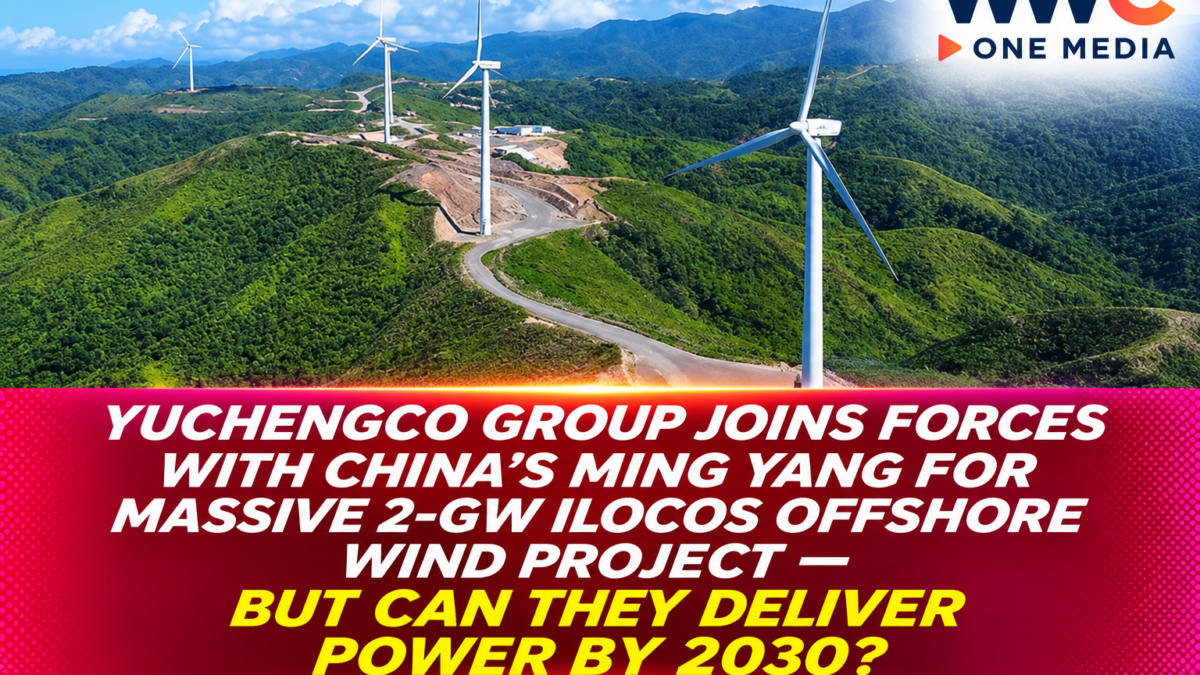
MANILA, PHILIPPINES — November 10, 2026 — The Yuchengco Group is taking a major step toward developing one of the Philippines’ most ambitious offshore wind projects, joining forces with Chinese wind turbine manufacturer Ming Yang Smart Energy Group Ltd. to advance a proposed 2,000-megawatt renewable energy development in Ilocos Norte.
The partnership, announced by Yuchengco-led PetroGreen Energy Corp. (PGEC), could help unlock large-scale wind energy generation in Northern Luzon as the Philippines races to diversify its electricity supply and reduce its dependence on fossil fuels.
But the announcement comes with a critical distinction.
While the companies have agreed to cooperate on the project, there is no finalized investment commitment, announced construction budget or guaranteed completion date.
The project remains in the development and assessment stage.
Under the agreement signed on November 6, 2026, in Zhongshan, China, PetroGreen and Ming Yang will collaborate on technical, logistical and economic evaluations for the Northern Luzon Offshore Wind Project.
The development is being undertaken by Buhawind Energy Northern Luzon Corp., an affiliate of PetroGreen.
The companies intend to explore suitable offshore wind technologies, assess potential electricity generation, estimate development costs and strengthen local expertise.
For the Philippines, the agreement represents another potential step toward commercial offshore wind generation.
But with billions of pesos potentially needed for offshore infrastructure, transmission connections and turbine installations, can the project realistically deliver electricity by its targeted 2030 completion date?
PetroGreen and Ming Yang Sign Strategic Offshore Wind Partnership
According to PetroEnergy Resources Corp.’s November 9 disclosure to the Philippine Stock Exchange, the agreement establishes a framework for cooperation between PetroGreen and Ming Yang.
PetroGreen is the renewable energy arm of publicly listed PetroEnergy Resources Corp., which is associated with the Yuchengco Group.
The agreement was formally signed by PetroGreen president and CEO Francisco Delfin Jr. and Ming Yang president Zhang Qiying.
Yuchengco Group chairperson Helen Dee and Ming Yang chairman and founder Zhang Chuanwei witnessed the signing ceremony.
The partnership initially focuses on the proposed 2-GW Northern Luzon Offshore Wind Project in Ilocos Norte.
The companies will assess several critical aspects of development:
- Offshore wind turbine technologies suitable for the project’s operating conditions.
- Estimated electricity output and generation potential.
- Technical and logistical requirements.
- Construction and development strategies.
- Project cost estimates and commercial viability.
- Local training and professional capacity building.
The agreement also creates opportunities for discussions involving other clean-energy technologies.
However, PetroGreen clarified that specific investment and commercial arrangements remain subject to further negotiations and separate definitive agreements.
This means the partnership should not be interpreted as a final decision to immediately construct the offshore wind facility.
Why the 2,000-MW Ilocos Project Is a Major Energy Development
The project’s proposed capacity of 2 gigawatts makes it a potentially significant addition to the country’s renewable-energy pipeline.
One gigawatt is equivalent to 1,000 megawatts.
At 2,000 MW, the Northern Luzon Offshore Wind Project would have substantial installed generating capacity if completed at its proposed scale.
However, installed capacity does not represent continuous electricity production.
Actual output would depend on offshore wind conditions, turbine availability, maintenance, transmission constraints and other operational factors.
Unlike traditional power plants that can often adjust output according to fuel supply, wind farms depend on available wind resources.
This means the development would also need appropriate grid integration and system planning.
The proposed offshore facility is among the projects targeting the Philippines’ first commercial offshore wind generation.
According to The Philippine Star, PetroGreen, through Buhawind Energy Philippines, is targeting completion of the Northern Luzon project by 2030.
The target represents a development ambition rather than a guaranteed commissioning schedule.
The next major challenge is converting the project from planning and technical assessments into a financeable, permitted and constructible power facility.
Ming Yang Brings Chinese Offshore Wind Technology to the Philippines
Ming Yang Smart Energy Group is a major Chinese manufacturer of wind turbines and renewable-energy technologies.
The company has extensive experience in designing and producing wind-energy equipment, including turbines intended for offshore applications.
Its participation gives PetroGreen access to specialized technical knowledge as the developer evaluates equipment suitable for Philippine conditions.
Offshore wind farms present engineering challenges different from those encountered in conventional land-based renewable-energy projects.
Developers must consider water depth, seabed conditions, marine installation methods, turbine foundations and the effects of severe weather.
The Philippines’ exposure to tropical cyclones makes engineering reliability an especially important consideration.
Turbines and supporting infrastructure must be designed and assessed according to the conditions expected at the project site.
The PetroGreen–Ming Yang agreement provides a framework for examining those requirements.
It does not yet establish which specific turbine model will be installed.
That decision will depend on the outcome of the technical and commercial evaluations.
Yuchengco Group Expands Its Renewable Energy Ambitions
The proposed offshore wind partnership builds on PetroGreen’s existing renewable-energy portfolio.
The company has experience in geothermal energy, solar power and onshore wind development.
Its projects and investments include renewable-energy facilities in different parts of the Philippines.
One recent example is the Limbauan Solar Power Project in Isabela.
In October 2026, PetroGreen secured a financing facility of up to ₱1.24 billion from Rizal Commercial Banking Corp. (RCBC) to partially fund the development of the approximately 40-MW solar facility.
The financing supports PetroGreen’s broader expansion into renewable-electricity generation.
Related WWC ONE MEDIA report: PetroGreen Secures ₱1.24 Billion RCBC Financing for 40-MW Isabela Solar Project
The Limbauan development illustrates how PetroGreen has already been using project financing to advance renewable infrastructure.
However, the proposed Northern Luzon offshore wind project is substantially larger and presents different technical and financial requirements.
Unlike a ground-mounted solar facility, a large offshore wind development requires specialized marine installation capabilities, offshore foundations, high-capacity electrical infrastructure and potentially complex transmission arrangements.
These factors can affect project costs, construction schedules and financing decisions.
For PetroGreen, Ming Yang’s participation could help address part of the technical knowledge required before the project proceeds.
Buhawind Also Eyes Major Offshore Projects in Mindoro and Panay
The Ilocos Norte development is not PetroGreen’s only offshore wind ambition.
Through Buhawind Energy, the company is also pursuing two additional offshore wind developments.
These include a proposed 1,000-MW project in northern Mindoro and another 1,000-MW project in Panay.
Together with the Northern Luzon development, the three proposed projects represent a potential offshore wind portfolio of approximately 4 gigawatts.
That is a substantial amount of proposed generation capacity.
Nevertheless, the combined figure refers to planned projects rather than completed power plants.
Each development must undergo its own technical evaluations, permitting procedures, financing arrangements and construction preparations.
The projects may also face different environmental, marine and transmission conditions.
Successful development in one location would not automatically guarantee the viability of the others.
For investors and electricity consumers, the important milestones will be financial commitments, construction progress, grid readiness and actual commercial operations.
Can the Philippine Power Grid Handle More Offshore Wind?
One of the largest challenges facing offshore wind developers is ensuring that generated electricity can be delivered to the grid.
Building turbines at sea is only part of the investment.
Developers must also consider offshore substations, subsea transmission cables, onshore connections and the availability of sufficient capacity in the existing power network.
Grid studies help determine whether new power facilities can connect without compromising system reliability.
The Philippines is already processing a substantial pipeline of new electricity projects.
According to Department of Energy figures previously reported by WWC ONE MEDIA, projects representing more than 17.8 GW of potential generating and storage capacity received endorsements for system impact studies during the first half of 2026.
Those projects included wind, solar, hydropower and battery energy storage developments.
Related WWC ONE MEDIA report: 17.8 GW of Philippine Energy Projects Cleared for Grid Studies as Power Pipeline Expands
The figures demonstrate the scale of the country’s proposed energy expansion.
However, an endorsement for a system impact study does not mean a project has completed construction or secured all required approvals.
For the Northern Luzon Offshore Wind Project, transmission readiness could become a significant factor in determining when electricity can actually reach consumers.
Why Wind Projects Sometimes Fail Before Construction
While the announcement represents a positive development for PetroGreen, the renewable-energy industry also provides examples of projects that did not proceed after further technical evaluation.
In September 2026, NexGen Energy Corp.’s subsidiary Airstream Renewables Corp. disclosed plans to relinquish development rights for two wind projects in Cavite and Batangas.
The decision followed assessments identifying safety, land-use and geotechnical constraints that affected their feasibility.
One project faced challenges associated with expanding residential development.
The other encountered difficult terrain conditions that made turbine installations economically unattractive.
Related WWC ONE MEDIA report: NexGen Unit Gives Up Cavite and Batangas Wind Project Rights Over Safety and Terrain Risks
The abandoned projects are unrelated to PetroGreen’s offshore wind development.
However, they illustrate why renewable-energy companies conduct feasibility studies before making large financial commitments.
Wind availability alone is not enough to guarantee a successful project.
Developers must also consider land or seabed conditions, safety requirements, logistics, environmental obligations and project economics.
The PetroGreen–Ming Yang cooperation agreement is therefore an important preliminary step.
Its findings will help determine whether the proposed project can advance to more substantial investment decisions.
Chinese Partnership Could Extend to Solar and Battery Storage
Beyond offshore wind, PetroGreen and Ming Yang have discussed possible cooperation in other renewable-energy technologies.
These include solar power and battery energy storage systems.
Battery storage is becoming increasingly important as countries expand renewable-electricity generation.
Solar and wind facilities produce electricity according to weather conditions.
Energy storage can help manage fluctuations by storing electricity and supplying it at different times, subject to the system’s design and available capacity.
For power developers, combining renewable generation with storage can provide additional flexibility.
However, no specific battery storage project, investment amount or commercial agreement was confirmed as part of the PetroGreen–Ming Yang announcement.
Any additional partnership would require further negotiations.
The potential expansion nevertheless reflects a broader trend in Philippine renewable-energy investment.
Major energy companies are no longer focusing exclusively on individual solar or wind installations.
Many are pursuing broader portfolios involving generation, storage, transmission access and long-term power arrangements.
Billions in Renewable Financing Are Already Flowing Into the Philippines
PetroGreen’s offshore wind ambitions come as other developers secure significant funding for renewable-energy expansion.
In October 2026, Citicore Renewable Energy Corp. secured approximately ₱35.014 billion in financing for five major solar developments in Batangas.
The financing supports about 900 MWp of solar capacity alongside 120 MWh of battery energy storage.
The transaction involved major Philippine financial institutions, including BPI, LANDBANK and DBP.
Related WWC ONE MEDIA report: ₱35 Billion for 5 Batangas Solar Farms: Could This Mega-Project Change the Philippines’ Power Future?
The Citicore financing demonstrates that lenders are supporting large-scale renewable-energy projects where appropriate project structures and commercial arrangements are in place.
But PetroGreen’s offshore development is at a different stage.
The November 6 agreement with Ming Yang does not announce a financing package.
Neither company has disclosed a finalized construction budget for the Northern Luzon project under the new partnership.
Before offshore construction can proceed, developers will need to assess how the project will be financed and whether its expected revenues justify the necessary investment.
Philippine Wind Developers Are Moving Toward Larger Projects
The PetroGreen announcement also arrives during a broader expansion of Philippine wind generation.
Renewable-energy developer Alternergy Holdings Corp. has been advancing projects in Rizal and Quezon, including its 128-MW Tanay Wind Project and 64-MW Alabat Wind Project.
The company has also pursued green financing as it develops its renewable-energy portfolio.
Related WWC ONE MEDIA report: Alternergy Is Raising ₱2 Billion at 7.75% — But the Real Bet Is on Its Next 500 MW of Green Power
These developments show that wind energy is attracting interest from multiple Philippine companies.
But offshore wind represents a significantly different scale of engineering and investment complexity.
Whereas onshore wind farms use land-based turbine installations, offshore projects require marine construction, specialized vessels and extensive electrical connections.
The Northern Luzon project could become a major milestone if it successfully reaches commercial operations.
For now, its significance lies in the potential it represents and the technical partnership established to evaluate that potential.
Will the Project Lower Electricity Bills for Filipinos?
A major question surrounding new renewable-energy projects is whether they will eventually translate into cheaper electricity.
Large-scale wind generation can diversify the country’s power mix and reduce dependence on imported fuel over time.
However, the announcement of a proposed offshore wind development does not mean consumer electricity prices will immediately decline.
Electricity tariffs depend on multiple factors, including construction costs, financing, generation performance, power supply agreements, transmission charges and other market arrangements.
Offshore wind can require substantial upfront investment.
The eventual price of electricity from the Northern Luzon development will depend partly on its final capital cost and the commercial arrangements under which its output is sold.
No project-specific electricity tariff was announced in the PetroGreen–Ming Yang agreement.
Therefore, it would be premature to predict how much consumers might save if the project is eventually completed.
The potential long-term benefits include greater energy-source diversification, additional domestic electricity generation and reduced exposure to imported fuel volatility.
Whether those benefits translate into lower retail power prices will depend on how the project is developed and integrated into the electricity market.
Training Filipino Engineers Could Become a Major Benefit
The partnership also contains a significant workforce-development component.
Ming Yang will support training and upskilling initiatives for engineering students, educators and industry professionals in the Ilocos Region.
The objective is to strengthen local expertise in offshore wind technology and project development.
The Philippines has experience in onshore wind generation, but large-scale commercial offshore wind requires additional specialized skills.
These can include marine engineering, turbine installation, offshore electrical systems, maintenance planning and renewable-energy project management.
Developing a local workforce could help support future offshore wind investments.
It may also create opportunities for Filipino engineers and technicians to participate in a growing international industry.
However, the agreement does not provide a confirmed number of jobs to be created or trainees to be enrolled.
Employment outcomes will depend on the scale and implementation of the eventual development.
What Must Happen Before the 2030 Target?
The Northern Luzon project still faces several major development milestones.
Technical and economic studies must establish whether the proposed turbine technologies are suitable for the location.
Developers will need to determine the expected energy output and estimated costs.
They must also address applicable permits, environmental requirements, financing arrangements and grid-connection needs.
Commercial agreements must then be negotiated and finalized.
Only after the necessary conditions are satisfied can the project advance toward full-scale construction and commissioning.
The 2030 timetable provides a target against which future progress can be evaluated.
But there is no guarantee that every stage will proceed according to the intended schedule.
Investors should therefore distinguish between a promising strategic agreement and a project that has reached a final investment decision.
The Bigger Picture: A Major Opportunity, but the Hardest Work Is Still Ahead
The partnership between Yuchengco-led PetroGreen and China’s Ming Yang represents an important development in the Philippines’ ambition to build a competitive offshore wind industry.
The proposed 2-GW Northern Luzon project has the potential to become a substantial source of renewable electricity.
Ming Yang’s technical expertise could help PetroGreen evaluate turbine technology, project costs and marine development requirements.
The collaboration could also create opportunities for local engineering education and possible future partnerships in solar energy and battery storage.
But major challenges remain.
The companies have not yet announced binding investment arrangements, a completed financing package or a finalized construction contract.
The development must still pass through technical, commercial and regulatory stages.
For the Yuchengco Group, the partnership represents an opportunity to expand beyond its existing renewable-energy portfolio.
For the Philippines, it could help advance the country’s first generation of commercial offshore wind facilities.
The agreement has brought a major Chinese turbine manufacturer into PetroGreen’s development strategy—but the real test will come when studies give way to financing, construction and actual electricity generation.
And with the clock ticking toward 2030, the question is whether PetroGreen and Ming Yang can transform a massive offshore wind proposal into one of the Philippines’ most significant renewable-energy achievements—or whether technical challenges and investment costs will delay the country’s offshore wind ambitions.