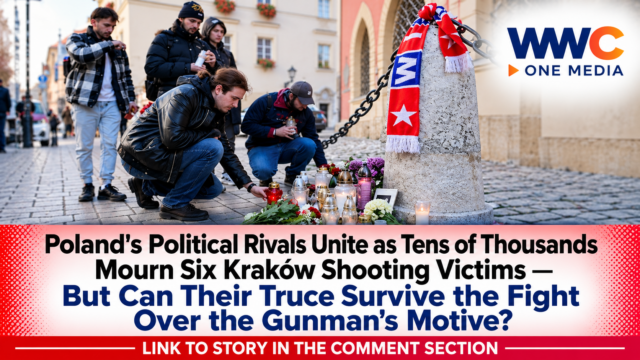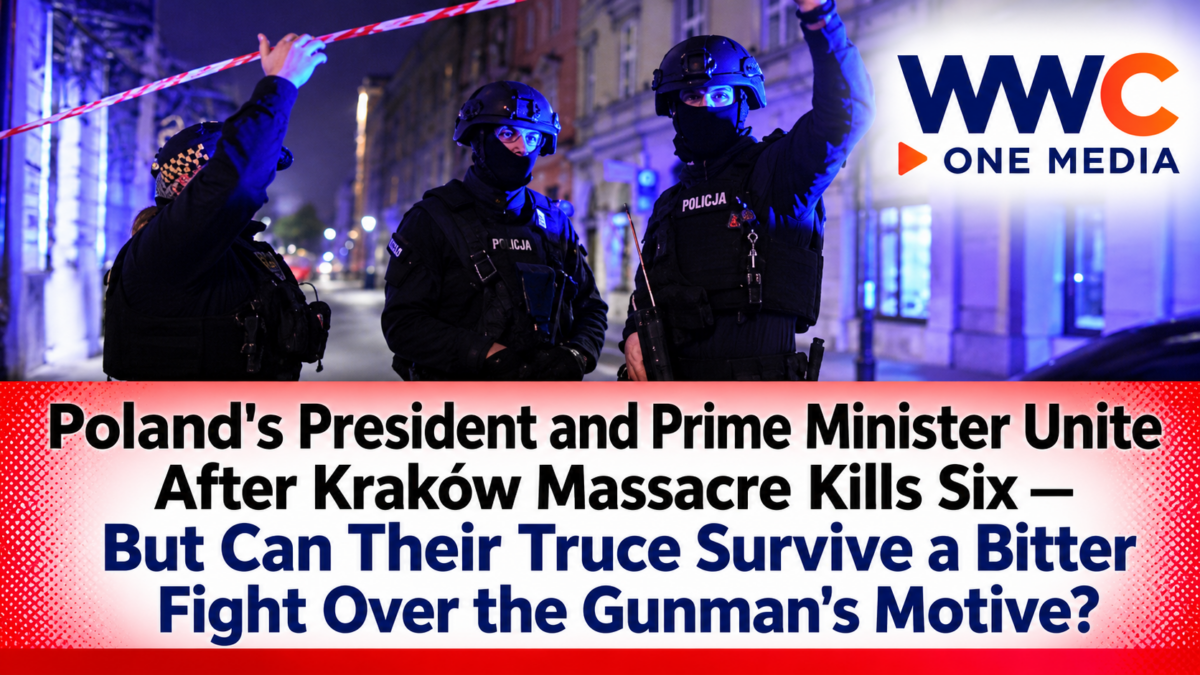
KRAKÓW, POLAND — November 10, 2026 — Poland’s bitterly divided political leadership has made an extraordinary show of national unity after tens of thousands of people marched silently through Kraków to remember six people killed in one of the country’s deadliest modern mass shootings.
President Karol Nawrocki and Prime Minister Donald Tusk, two political rivals locked in a fierce struggle over Poland’s judiciary and constitutional authority, walked together through the historic city on Monday, November 9.
They joined mourners carrying candles and paying tribute to victims of a November 7 shooting at Kraków’s Main Market Square, one of Europe’s most recognizable tourist destinations.
The rare appearance came as Polish authorities confirmed that the suspected gunman, 24-year-old Michał Oksiński, had died in hospital after being wounded during a confrontation with police.
Investigators also discovered the bodies of his parents and sister at the family’s home in another Polish city, raising the number of deaths under investigation to nine, excluding the suspected attacker.
But the tragedy has already triggered a political dispute.
Government officials initially suggested that the suspect had been influenced by far-right or ultranationalist ideology. Opposition leaders rejected that characterization.
Prosecutors subsequently cautioned that the motive remained unconfirmed.
As Poland’s most powerful political rivals stand together to honor the victims, the country faces a difficult question: Will the tragedy produce lasting unity and stronger public safety—or will the battle over the gunman’s motive deepen the divisions already tearing through Polish politics?
Tens of Thousands Join Silent March Through Kraków
The March of Silence began at approximately 8 p.m. on November 9 near the junction of Main Market Square and Sławkowska Street.
The location held particular significance because it was near the site where the first shots were fired during Saturday’s attack.
The procession moved toward St. Mary’s Basilica before concluding near the Town Hall Tower.
Thousands of residents joined representatives of local government, religious institutions and national authorities.
The event was organized at the invitation of Kraków Mayor Łukasz Gibała.
President Nawrocki and Prime Minister Tusk walked alongside the mayor in an unusual display of solidarity.
The procession included no political speeches.
Instead, mourners observed moments of silence, laid candles and paid tribute to those who died.
The absence of speeches helped keep attention on the victims rather than the continuing political confrontation between the country’s leaders.
Deputy Prime Minister Władysław Kosiniak-Kamysz described the event as an expression of Poland’s ability to cooperate despite political disagreements.
For many residents, the march became a way to reclaim a public space that had been transformed into a crime scene just two days earlier.
Six People Killed in Kraków’s Historic Market Square
The attack occurred on Saturday, November 7, in Kraków’s Main Market Square.
According to Polish police and international news agencies, the suspect drove into the square and began firing from his vehicle.
The gunfire caused panic among residents and tourists visiting the historic Old Town.
Six people were killed.
Authorities identified the victims by nationality as four Polish citizens, one British citizen and one Austrian citizen.
Fifteen other people were reported injured, including two police officers who confronted the gunman.
Some initial reports gave higher injury totals because they counted the wounded attacker or used preliminary casualty figures.
The updated figure cited by AFP and later reporting is 15 injured victims, excluding the suspect.
The shooting was particularly shocking because Kraków is widely regarded as one of Poland’s most important cultural and tourism centers.
Its Main Market Square is usually filled with visitors, café customers, residents and performers.
Saturday’s violence shattered that familiar atmosphere.
WWC ONE MEDIA previously examined the attack in Poland Mass Shooting Leaves 6 Dead in Kraków as Police Discover 3 More Bodies at Gunman’s Home — But Was an Even Deadlier Attack Being Planned?.
The earlier report covered the initial shooting, police response and discovery of the additional victims.
Suspected Gunman Dies After Police Shootout
Polish authorities identified the suspected attacker as Michał Oksiński, a 24-year-old resident of Ostrowiec Świętokrzyski.
The suspect was wounded when police confronted him near the shooting scene.
He was taken into custody and hospitalized in critical condition.
On Monday, November 9, regional authorities confirmed that he had died following multiple operations.
His death means investigators can no longer question him directly about his actions.
They must instead reconstruct the sequence of events through forensic evidence, witness testimony, recovered weapons, electronic devices and other investigative material.
Justice Minister Waldemar Żurek said authorities would continue examining whether the suspect acted alone or had been influenced by other individuals or groups.
Officials have not publicly established that the attack involved a wider organization.
The absence of a final motive remains a central issue.
Two Police Officers Praised for Confronting Attacker
The November 7 shooting also left two police officers seriously wounded.
Authorities identified them as Artur Morański, 27, and Jakub Kulik, 24.
Both were among the officers who confronted the armed suspect.
According to officials, their rapid response may have prevented further casualties.
The officers were initially placed in medically induced comas because of their injuries.
By November 9, both had regained consciousness.
Officials said Morański’s condition had improved enough for him to be taken off assisted breathing.
Polish media reported that one of his first questions after regaining consciousness concerned whether his fellow officer had survived.
The officers’ actions became a prominent part of the national mourning.
They have been publicly praised for responding to a dangerous situation while civilians were still attempting to escape.
Their recovery remains a major concern for authorities and their families.
Police Discover Three Additional Deaths at Suspect’s Home
The investigation expanded dramatically after police searched the suspect’s family residence in Ostrowiec Świętokrzyski.
Authorities discovered three bodies.
The deceased were identified as the suspect’s father, mother and sister.
Investigators believe Oksiński may have killed the three family members before traveling to Kraków.
However, the precise circumstances and sequence of their deaths remain under investigation.
The discovery means authorities are investigating nine deaths potentially linked to the suspect’s actions, in addition to the suspect’s own death.
The six people killed in Kraków and the three family members should be distinguished because the circumstances involved different locations and may require separate forensic findings.
Police recovered firearms and ammunition during searches associated with the case.
Investigators are examining whether the suspect’s weapons were legally possessed and whether there were warning signs before the attack.
These questions could influence future decisions about public safety and firearm licensing.
Gunman’s Motive Becomes a Political Flashpoint
The shooting quickly became the subject of a dispute between Poland’s major political camps.
Interior Minister Marcin Kierwiński initially said available information indicated that the suspect was fascinated by far-right or ultranationalist ideas.
Prime Minister Tusk described the attack as terrorism.
However, prosecutors subsequently emphasized that they could not reliably establish that the gunman acted because of a specific political ideology.
National Prosecutor’s Office spokesperson Przemysław Nowak said investigators did not yet have sufficient evidence to reach that conclusion.
Investigators reportedly found a Gadsden flag bearing the phrase “Don’t tread on me” in the suspect’s room.
The flag originated during the American Revolution and has been adopted by different political movements over time.
Its presence is not, by itself, proof of extremist motivation.
Authorities are also examining symbols and patches found on the suspect’s clothing.
Determining the motive requires evidence linking any beliefs or influences to the actual decision to commit violence.
That distinction is essential.
An initial suspicion is not equivalent to a final prosecutorial conclusion.
Opposition Leader Rejects Early Far-Right Claims
Jarosław Kaczyński, leader of the opposition Law and Justice party, strongly criticized government claims about a possible far-right motive.
He accused political opponents of using the tragedy to attack nationalist and conservative groups.
The disagreement reflects existing tensions between Tusk’s governing coalition and Poland’s nationalist opposition.
Government officials have urged people to avoid drawing conclusions before the investigation is complete.
The dispute illustrates how quickly major acts of violence can become politically charged.
Public officials have a responsibility to address possible ideological threats.
But they must also avoid presenting unconfirmed suspicions as established findings.
The investigation may eventually identify an ideological, personal or other motive—or a combination of factors.
For now, the responsible editorial position is that the motive remains unresolved.
Why Tusk and Nawrocki Rarely Appear Together
The November 9 march drew particular attention because of the strained relationship between the president and prime minister.
Tusk leads a pro-European coalition government.
Nawrocki is a nationalist conservative politically aligned with the opposition Law and Justice camp.
The two leaders disagree over judicial appointments, constitutional authority and the direction of Poland’s political institutions.
Their confrontation intensified after a disputed attempt to suspend senior officials of the Constitutional Tribunal.
President Nawrocki responded strongly to that development, while Tusk’s allies argued that reform was needed to restore judicial legitimacy.
WWC ONE MEDIA examined those tensions in Poland’s Constitutional Court Erupts Into Chaos as Top Judges Face Suspension and President Rushes Home — But Is a Bigger Political Crisis Coming?.
The dispute remains unresolved.
That made the leaders’ shared appearance in Kraków especially meaningful.
For one evening, they chose to participate in a common act of mourning rather than exchange political accusations.
Poland’s Constitutional Crisis Has Not Disappeared
The gesture of unity should not be mistaken for a political reconciliation.
The conflict involving the Constitutional Tribunal continues.
Poland’s major political parties remain deeply divided over the legality of judicial appointments and the balance of power between government institutions.
The disagreement has become especially important as the country approaches parliamentary elections expected in 2027.
Both major political camps are already preparing for an intense electoral contest.
The coming months may bring additional disputes over legislation, judicial authority and presidential powers.
The silent march demonstrated that rival leaders can temporarily cooperate during national mourning.
But it did not resolve the issues separating them.
Whether that cooperation extends beyond the tragedy remains uncertain.
Poland’s Security Institutions Face New Questions
The shooting has prompted renewed examination of the country’s internal-security arrangements.
Authorities have recovered multiple firearms and substantial quantities of ammunition connected to the suspect and his family residence.
According to AFP, investigators seized 11 firearms during their searches.
The suspect and his father reportedly held firearm permits and belonged to a shooting club.
Poland’s Interior Ministry has announced a review of firearm-licensing requirements.
Officials have suggested that medical information associated with permit holders may need to be updated more regularly.
The review is intended to determine whether existing safeguards adequately identify individuals who may pose a danger.
However, investigators have not established that a specific licensing failure caused the shooting.
Any proposed reform should be informed by evidence about how the suspect acquired his weapons and whether warning signs were previously available to authorities.
Firearm Licenses Have Increased in Poland
The shooting has also renewed debate about the number of firearms legally held in Poland.
According to police statistics cited by AFP, more than 50,000 new firearm permits were issued in 2025.
That brought the total number of permits to approximately 411,000.
The increase reflects growing participation in lawful firearm ownership, including shooting sports and other permitted activities.
But the number of permits alone does not establish that Poland is becoming more violent.
Nor does it demonstrate a causal connection between rising legal ownership and the Kraków attack.
Officials will need to examine whether the suspect complied with licensing rules and whether there were earlier indications of dangerous behavior.
The tragedy may produce proposals for stronger medical checks, better information sharing and additional monitoring of individuals considered a potential threat.
Those decisions remain under consideration.
Police Investigate Online Threats Following the Shooting
Polish authorities are also examining threatening online activity that followed the massacre.
Reuters reported that the Central Bureau for Combating Cybercrime detained six people over posts considered threatening or alarming.
Authorities said they were monitoring the risk of copycat violence.
Such concerns commonly arise after highly publicized attacks.
Online posts may glorify perpetrators, spread misinformation or encourage further violence.
However, not every disturbing or controversial post constitutes a credible threat.
Investigators must establish whether particular communications violate applicable law.
The broader issue of online radicalization has attracted growing attention internationally.
WWC ONE MEDIA previously examined the subject in Singapore’s Terror Threat Remains High — But the Biggest Warning May Be Hiding Online.
That report explored Singapore’s concerns about self-radicalization and exposure to violent extremist material.
The Singapore and Polish situations are unrelated.
Nevertheless, both highlight the challenge of detecting credible threats without assuming that online interests or political opinions automatically indicate violent intent.
Kraków’s Tourism Industry Confronts a National Tragedy
The attack occurred in the historic center of one of Europe’s most visited cities.
Kraków is known for its medieval architecture, cultural attractions, universities and vibrant public spaces.
Main Market Square is central to the city’s identity and tourism economy.
The shooting transformed a busy visitor destination into an area filled with police, emergency workers and memorial candles.
For local businesses, the tragedy may temporarily affect activity as residents and travelers process what happened.
But the immediate priority remains supporting the victims, their families and the injured.
No reliable figure has been established for the attack’s economic impact on Kraków’s tourism sector.
Claims about major losses or long-term declines in visitors would therefore be speculative.
The silent march was an opportunity for residents to reclaim a place associated with public life and cultural heritage.
It also demonstrated solidarity with foreign visitors affected by the violence.
The Kraków Shooting Raises Wider European Security Concerns
The incident comes during a period of heightened discussion about public safety and political extremism across Europe.
In October, a separate shooting in the suburbs west of Paris left one person dead and five others injured.
French authorities opened an investigation into possible extremist and discriminatory motives.
WWC ONE MEDIA covered that incident in Gunman Unleashes Deadly Shooting Rampage Near Paris, Killing One and Injuring Five, Including a 12-Year-Old Girl — But Was This a Carefully Planned Racist Terror Attack?.
There is no established connection between the French and Polish incidents.
They involved different suspects, locations and investigative circumstances.
However, both have generated debate about protecting crowded public areas and identifying potential threats.
European governments face the difficult task of responding to security concerns while maintaining civil liberties and avoiding unsupported assumptions about communities or political movements.
Political Leaders Face a Test Beyond the Memorial
The November 9 march carried an important message.
Despite their disagreements, Poland’s leaders demonstrated that national mourning can take precedence over political conflict.
But the more difficult test will come afterward.
The government must oversee a thorough investigation.
The opposition has a legitimate role in scrutinizing official claims and proposed policy changes.
Both sides must avoid turning unconfirmed details about the suspect into political weapons.
The country also needs to support the injured officers and civilians, along with the families of those who died.
Those efforts may require cooperation among national authorities, local officials and healthcare institutions.
A single ceremony cannot eliminate years of political mistrust.
But it can provide an example of how rival institutions should respond when a national tragedy requires a common purpose.
What Happens Next in the Kraków Investigation?
Investigators will continue reconstructing the suspect’s actions before and during the attack.
They must establish the sequence of the three deaths at his family home and determine whether the same person was responsible.
They will examine firearms, ammunition and licensing records.
Digital evidence may help establish whether the suspect communicated with others or was influenced by violent material.
Officials will also investigate whether he had previously attracted attention from security authorities.
Because the suspected gunman has died, the investigation must rely heavily on physical and documentary evidence.
Prosecutors have cautioned against premature conclusions.
That is particularly important when examining potential ideological motivation.
No public finding has established that the attack was coordinated by a political organization.
Authorities must determine whether the suspect acted alone and what factors drove the violence.
The Bigger Picture: A Rare Moment of Unity in a Deeply Divided Poland
The Kraków massacre has devastated families and shaken a nation accustomed to relatively low levels of mass gun violence.
Six people were killed in one of Poland’s most famous public spaces.
Fifteen others were wounded.
Three more bodies were discovered at the suspected attacker’s family home.
The suspect later died in hospital.
Those facts have generated grief, public outrage and difficult questions about security.
But the tragedy has also produced an unusual political moment.
President Karol Nawrocki and Prime Minister Donald Tusk, who have repeatedly clashed over Poland’s constitutional institutions, walked together in silence.
Their participation reflected a shared recognition that the victims deserved remembrance beyond partisan divisions.
For a country approaching a contentious election year, the gesture was significant.
Yet the unresolved motive has already produced another dispute between the government and opposition.
The challenge now is to ensure that the search for answers remains grounded in verified evidence rather than political assumptions.
As tens of thousands of Poles mourn six people killed in Kraków and the nation’s president and prime minister briefly set aside their bitter rivalry, the most important question is whether the tragedy can encourage lasting cooperation—or whether the unresolved investigation will become another source of division before Poland’s critical 2027 election.