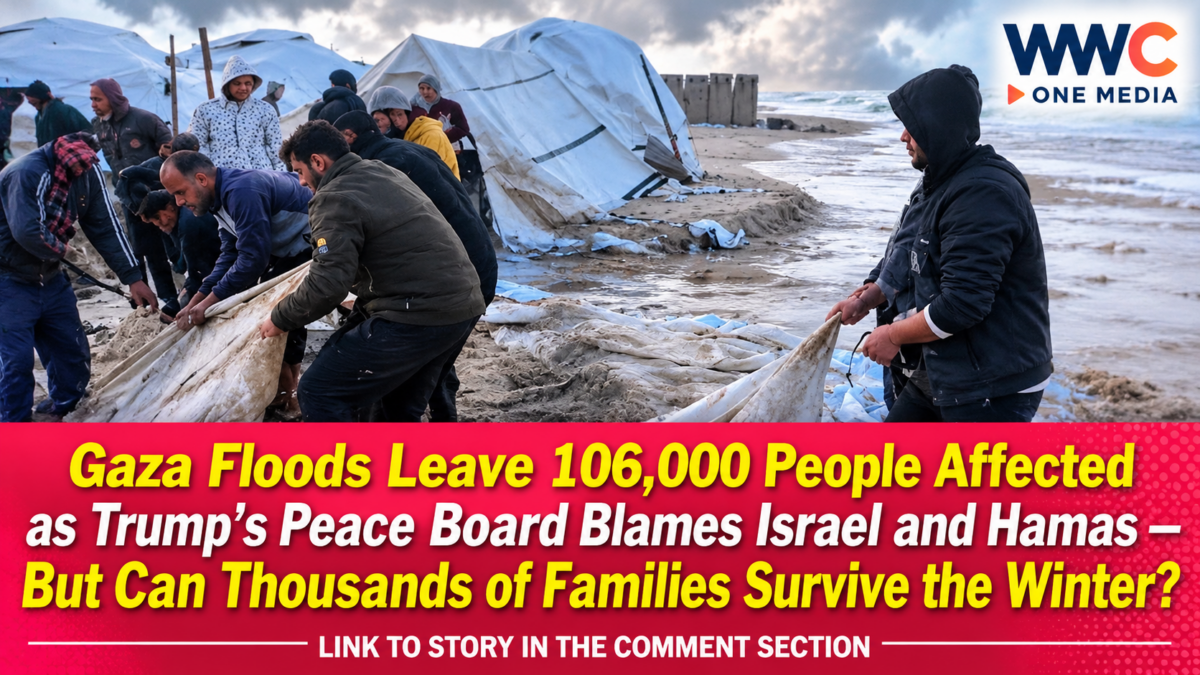
GAZA / JERUSALEM — November 10, 2026 — A deadly wave of flooding has pushed Gaza into another humanitarian emergency, leaving more than 106,000 people directly affected as President Donald Trump’s Board of Peace publicly blamed both Israel and Hamas for delays undermining the territory’s recovery.
Heavy rainfall beginning November 6 inundated displacement camps, destroyed or damaged thousands of makeshift shelters, disrupted medical facilities and exposed vulnerable families to contaminated floodwater and cold weather.
The disaster has also claimed lives.
According to the United Nations Office for the Coordination of Humanitarian Affairs (OCHA), five displaced Palestinians, including three children and two women, were reportedly killed when a sand embankment collapsed onto tents in Deir al-Balah.
A separate incident reportedly resulted in the drowning of an infant.
The deaths come as humanitarian organizations struggle to provide adequate shelter to a population already devastated by years of conflict.
On November 9, the US-backed Board of Peace delivered an unusually forceful warning, criticizing Israel for insufficient progress in allowing critical winter supplies into Gaza while demanding that Hamas fulfill its commitments to disarm and surrender governing authority.
The statement exposed the deep political deadlock threatening implementation of the October 2025 ceasefire agreement.
With nearly one million displaced Palestinians living in flood-exposed areas and essential humanitarian supplies waiting outside Gaza, the question is whether Israel, Hamas and international mediators can move beyond political disputes before winter conditions claim more lives.
Gaza Floods Destroy Thousands of Shelters
The humanitarian consequences of the storms have been severe.
According to OCHA’s report published November 9, humanitarian partners received appeals from more than 26,000 households whose shelters or belongings had been damaged.
Preliminary assessments indicated that more than 6,000 family shelters had been destroyed, while another 17,400 were damaged.
Over 3,900 households were reported to have no shelter remaining.
The disaster affected displacement camps, temporary learning spaces, healthcare facilities and sanitation infrastructure across Gaza’s five governorates.
Rainwater entered makeshift tents where families had been living after losing their homes during the conflict.
For many residents, the flooding destroyed mattresses, clothing and other possessions that were already difficult to replace.
The crisis is particularly dangerous because so much of Gaza’s housing and drainage infrastructure has been damaged.
Heavy rain is therefore not simply a seasonal inconvenience.
It can rapidly become a threat to survival.
UNICEF Warns Nearly One Million People Are Exposed
UNICEF estimated that approximately 950,000 displaced Palestinians live in areas exposed to flooding.
Of those, about 400,000 are in locations classified as extremely high risk.
Nearly half of the people in those highest-risk areas are children.
The agency said more than 106,000 people had been directly affected by the November storms.
Children are especially vulnerable to cold temperatures, contaminated water and the loss of safe shelter.
Flooding can also interrupt access to healthcare, education and emergency support.
UNICEF confirmed that three children aged four, five and eight died alongside their mother when a sand dune collapsed on their tent in central Gaza.
OCHA’s broader reporting described five deaths in that collapse, including another woman, as well as a separately reported infant drowning.
These figures reflect the agencies’ reporting at the time and should not be treated as a finalized overall death toll.
Trump’s Board of Peace Accuses Both Sides of Delaying Recovery
The Board of Peace, established to oversee implementation of the US-backed Gaza peace framework, warned that the flooding had become an immediate humanitarian emergency.
Its statement criticized the failure to implement commitments made under the Sharm El-Sheikh humanitarian arrangements.
The Board said it had repeatedly urged Israel to authorize the entry of essential shelter materials, water infrastructure, sanitation equipment, drainage supplies and waste-management resources.
Although it acknowledged measures being considered by Israeli authorities, it concluded that the response remained insufficient.
At the same time, the Board accused Hamas of failing to meet its obligations under the peace plan.
Those obligations include surrendering its weapons and transferring governing authority to a proposed Palestinian technocratic administration.
The Board argued that delays by both parties were worsening civilian suffering and obstructing progress toward reconstruction.
The statement is particularly notable because the organization is backed by the Trump administration, which has worked closely with Israel.
Its public criticism signals growing frustration with the stalled implementation of the agreement.
Israel Says More Than 91,000 Tents Have Already Entered Gaza
Israeli authorities rejected suggestions that they had failed to facilitate humanitarian relief.
The Israel Defense Forces and the Coordinator of Government Activities in the Territories (COGAT) said that more than 91,000 tents had entered Gaza since implementation of the winter preparedness plan.
They also reported the entry of more than 8,200 trucks carrying supplies including blankets, tarpaulins and winter clothing.
According to the Israeli military, additional measures included support for sanitation infrastructure, medical equipment and healthcare services.
Israel said hundreds of requests for winter-related assistance had been approved.
It argued that some approved supplies had not yet been delivered because of logistical and budgetary difficulties involving aid organizations.
Israeli officials also accused Hamas of diverting resources and using civilian infrastructure for military purposes.
Those accusations are disputed and require independent assessment.
The existence of delivered supplies does not establish that Gaza’s current humanitarian needs have been met.
The UN reports that available stocks inside the territory remain critically inadequate.
Hamas Rejects Responsibility for the Peace-Plan Deadlock
Hamas responded by accusing the Board of Peace of presenting a distorted account of the humanitarian crisis.
The organization argued that Israeli restrictions and delays were primarily responsible for preventing sufficient aid from reaching displaced families.
It rejected the suggestion that it alone was responsible for stalled implementation of the agreement.
Hamas said Palestinian factions had accepted the broader peace framework and demanded a timetable for Israeli withdrawal and the establishment of new governing arrangements.
The dispute reflects a fundamental disagreement over the sequence of the ceasefire’s next steps.
Israel and the United States have insisted that Hamas must disarm.
Hamas has argued that Israeli forces must withdraw and other commitments must be implemented before disarmament can proceed.
Neither side’s position removes the immediate humanitarian need to protect civilians from flooding, unsafe shelters and disease.
The UN Says 150,000 Tents Are Waiting Outside Gaza
One of the clearest indicators of the emergency comes from the UN’s supply assessment.
OCHA reported that more than 150,000 tents purchased by humanitarian organizations and UN member states were outside Gaza awaiting delivery.
The supplies included approximately 117,000 tents positioned in Al-Arish, Egypt, through the Egyptian Relief Committee.
Humanitarian organizations also identified urgent needs for portable pumps, vacuum trucks, hoses, spare parts, fuel and equipment to clear drainage networks.
These items are vital because flooding can overwhelm damaged sewage and stormwater systems.
OCHA reported that Israeli entry restrictions and funding shortfalls had limited humanitarian preparations before the storms arrived.
Relief groups have therefore been unable to stock sufficient materials inside the territory.
The UN’s reporting demonstrates why the number of trucks or tents previously admitted does not by itself establish whether humanitarian needs have been met.
The critical measures are whether families receive suitable shelter, whether dangerous floodwater can be removed and whether essential services remain operational.
Floodwater Creates Serious Disease Risks
Flooding in Gaza poses dangers extending beyond damaged shelters.
Rainwater can mix with untreated sewage where wastewater networks are broken or overwhelmed.
This creates potential exposure to gastrointestinal illnesses, skin infections and other health risks.
OCHA reported that shortages of pumping equipment and spare parts were obstructing sanitation operations.
Some healthcare facilities also experienced flooding, while damaged roads delayed access for medical workers and patients.
Temporary learning facilities serving tens of thousands of children were affected.
Humanitarian agencies are concerned that colder weather and inadequate shelter could increase cases of respiratory illness and other preventable health problems.
The consequences may become more serious if storms continue before drainage systems, shelters and healthcare services can be stabilized.
Gaza’s Reconstruction Plan Remains Stalled
The flooding has exposed the distance between international reconstruction promises and conditions on the ground.
In September, the Board of Peace presented a proposed six-month reconstruction and governance program worth approximately US$2.45 billion.
The plan covered infrastructure, healthcare, education, economic development, governance and security.
WWC ONE MEDIA examined the initiative in Trump’s Board of Peace Proposes $2.45 Billion Gaza Reconstruction Plan as Major Hurdles Remain.
The proposal was an initial rebuilding framework, not evidence that all projects had received financing or begun construction.
The wider rebuilding requirements are substantially larger.
According to the earlier Board proposal, physical reconstruction costs could exceed US$100 billion over the longer term.
But money alone cannot rebuild Gaza.
The process also requires access to construction materials, a workable civilian administration, security arrangements and an agreement on the withdrawal of Israeli forces.
Those issues remain unresolved.
The latest floods show that even temporary shelter and drainage needs are not being met adequately.
International Humanitarian Organizations Are Mobilizing
The emergency has renewed attention on international relief efforts.
On November 5, Singapore launched SG for Humanity, a network designed to strengthen cooperation among government agencies, charities and community organizations supporting Gaza relief.
WWC ONE MEDIA covered the initiative in Singapore Launches ‘SG for Humanity’ Network to Strengthen Gaza Aid — But Can It Solve the Biggest Challenge Facing Relief Efforts?.
The initiative involves organizations including Mercy Relief, Humanity Matters, Rahmatan Lil Alamin Foundation and the Singapore Red Cross.
Its goal is to improve coordination, raise support and help humanitarian resources reach affected communities.
However, international donations and logistical assistance remain dependent on access arrangements.
Governments and charities can mobilize supplies, but they cannot guarantee delivery without safe routes, appropriate authorizations and functioning distribution systems.
The UN has called for greater cooperation among donors, humanitarian agencies and the relevant authorities.
Humanitarian Groups Face Complex Operational Barriers
The difficulties involved in providing aid to Gaza extend beyond securing funding.
Organizations must navigate local registration requirements, security conditions and partnerships with institutions operating inside the territory.
WWC ONE MEDIA previously reported on the challenges in Singapore Clarifies Gilbert Goh’s Love Aid Rules After Gaza Humanitarian Work Draws Attention.
The article explained the distinction between approval from a charity’s home government and the legal requirements imposed by authorities where the organization intends to operate.
Those issues are separate from the current flooding emergency.
Nevertheless, they illustrate why humanitarian assistance can face obstacles even when donors are willing to provide resources.
Organizations require credible operating partners, transparent financial arrangements and reliable access to communities.
The current disaster makes resolving those practical challenges more urgent.
The Ceasefire Has Not Delivered Full Peace
The October 2025 ceasefire reduced large-scale fighting and established a framework for political and security changes.
But key provisions remain incomplete.
The proposed international stabilization force has not been fully deployed.
The planned transfer of administration to a Palestinian technocratic body has not been implemented.
Hamas has not surrendered its weapons.
Israeli forces continue controlling substantial parts of Gaza, and military incidents have persisted despite the ceasefire.
The Board of Peace has repeatedly urged progress.
The latest flooding has intensified its warnings because delays now have immediate consequences for civilians.
International mediators face a difficult challenge.
They must negotiate contentious security and political issues while ensuring that humanitarian protection is not indefinitely postponed.
What Needs to Happen Immediately?
Humanitarian agencies have identified several urgent priorities.
Families who lost shelters need replacement tents and stronger temporary housing materials.
Displacement sites need drainage equipment, pumps and sanitation support to remove standing water.
Healthcare providers need sufficient medicines and safe access to affected communities.
Children require warm clothing, bedding, food and protection from exposure to contaminated water.
Relief workers also need safe access to areas at risk of building collapse or unexploded ordnance.
These activities require cooperation between Israeli authorities, humanitarian organizations, local responders and international donors.
Disagreements over the wider peace process should not prevent emergency measures necessary to protect civilians.
The UN has emphasized that delays in delivering critical materials can lead to avoidable suffering.
The Bigger Picture: Gaza’s Winter Emergency Is a Test of the Peace Plan
The November flooding has become more than a humanitarian disaster.
It is also a test of whether the US-backed peace framework can deliver measurable improvements for civilians.
The Board of Peace has now publicly criticized both Israel and Hamas.
Israel maintains that large quantities of supplies have entered Gaza and that security and logistical concerns complicate aid delivery.
Hamas disputes the Board’s interpretation of the stalled agreement and blames Israeli restrictions.
Meanwhile, UN agencies report that tens of thousands of households need immediate assistance and that essential supplies remain outside the territory.
For families living in damaged tents, these political arguments offer little protection from the next storm.
The immediate test is whether sufficient shelter, sanitation and medical supplies can reach those most at risk.
The longer-term challenge is achieving the security and governance arrangements needed for reconstruction.
As floodwaters sweep through Gaza’s displacement camps and the Board of Peace blames both Israel and Hamas for failing to meet key commitments, one question is becoming increasingly urgent: Can the international peace process deliver real protection for civilians before winter turns an already devastating humanitarian crisis into another catastrophe?