SEOUL, SOUTH KOREA — November 10, 2026 — South Korea is experiencing an extraordinary tourism-driven spending boom, with foreign visitors pouring trillions of won into cosmetics stores, shopping malls, traditional markets and medical-wellness businesses even as the country’s own consumers cut back.
The contrast is creating an unusual economic story.
While international tourists are filling their shopping bags with Korean beauty products, fashion and luxury goods, domestic retail sales are weakening and household consumption is struggling to keep pace with the country’s technology-led economic expansion.
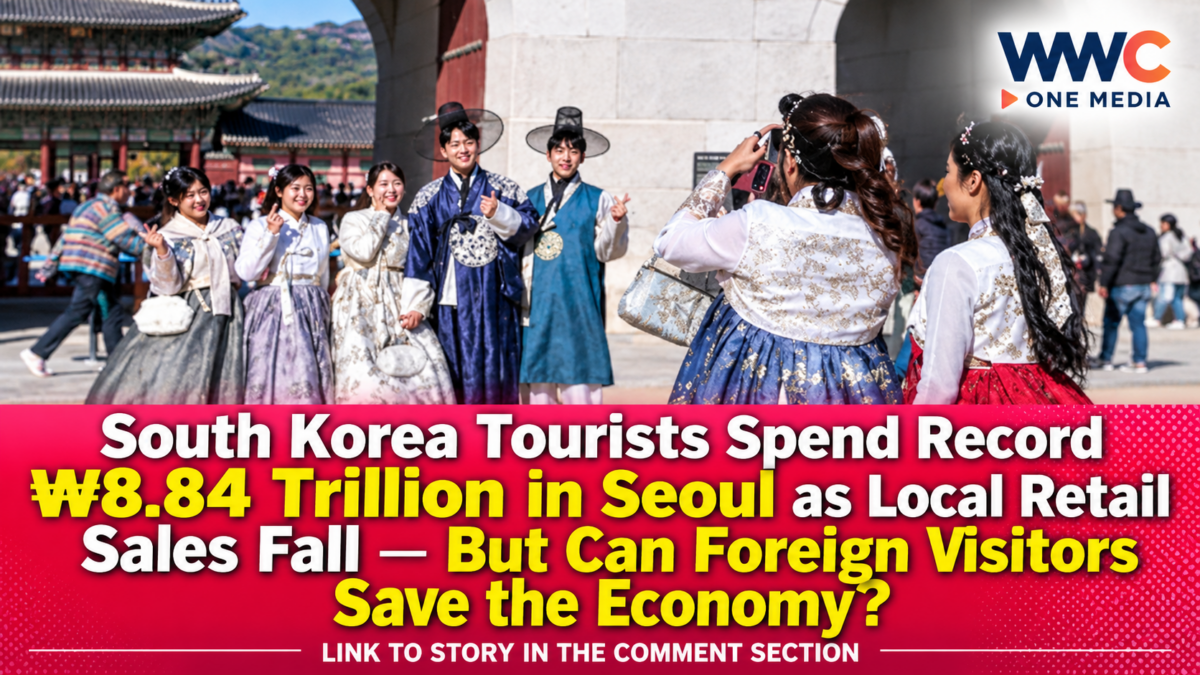
According to figures released by the Seoul Metropolitan Government, foreign visitors spent a record 8.84 trillion won, approximately US$6.5 billion, using credit cards in Seoul during the first nine months of 2026.
That represented a 57.7% increase from the same period in 2025.
The spending surge was so strong that international visitors exceeded their entire 2025 credit-card spending total in just nine months.
Meanwhile, South Korea welcomed approximately 17.11 million international visitors nationwide between January and September, an increase of 21.5%.
But behind the glittering storefronts lies a warning.
Inflation-adjusted domestic retail sales fell 0.5% year over year in the third quarter, while private consumption contracted 0.2% from the previous quarter.
As international tourists turn Seoul into one of Asia’s hottest shopping destinations, could foreign spending become South Korea’s next major economic growth engine—or is the boom masking a deeper crisis among Korean consumers?
Foreign Tourists Spend ₩8.84 Trillion in Seoul in Nine Months
Seoul’s latest tourism figures reveal just how rapidly the spending habits of international visitors are changing.
According to the metropolitan government, foreign tourist credit-card spending reached 8.8435 trillion won between January and September.
That compares with 5.6071 trillion won during the same period in 2025.
The total also surpassed the 7.9375 trillion won recorded throughout all of last year.
Seoul attracted approximately 13.14 million international visitors during the nine-month period, up 21.5% year over year.
Yet spending grew 57.7%, meaning tourist card purchases increased considerably faster than visitor numbers.
The figures suggest visitors are collectively generating substantially more spending for the local economy.
However, the data represent credit-card transactions covered by the city’s analysis, not every form of tourist expenditure.
Cash payments and other transactions may not be fully captured.
The figures should also not be confused with South Korea’s national tourism receipts or the country’s total retail sales.
K-Beauty Giant Olive Young Emerges as a Major Winner
One of the clearest beneficiaries is South Korean beauty retailer Olive Young.
The chain has become a popular destination for international visitors seeking Korean skincare, makeup and wellness products.
Bloomberg reported that foreign shoppers accounted for approximately 33% of Olive Young’s offline sales in August.
That represents an increase of more than 30 percentage points from 2022.
The development highlights how dramatically the retailer’s customer base has changed.
Korean cosmetics have gained global recognition through social media, beauty influencers, Korean entertainment and international online shopping.
But visiting South Korea offers international customers something different from purchasing products abroad.
Tourists can explore the retailer’s stores, discover unfamiliar brands, compare products and take advantage of exclusive local offerings.
The spending can also benefit surrounding businesses as shoppers visit cafés, restaurants and other nearby retailers.
However, Olive Young’s strong performance should not be treated as representative of every Korean retail business.
Some companies are benefiting far more than others from the tourism boom.
Shopping and Medical Tourism Drive Seoul’s Spending Surge
The Seoul Metropolitan Government’s spending breakdown shows that international visitors are purchasing more than souvenirs.
<escape>Foreign tourist credit-card spending in Seoul, January–September 2026:</escape>
| Spending category | Share of total |
|---|---|
| Shopping | 46.0% |
| Medical and wellness services | 23.8% |
| Food and beverages | 13.3% |
| Accommodation | 10.4% |
| Other categories | 6.5% |
Shopping remained the largest spending category.
But medical and wellness services accounted for nearly one-quarter of tourist card expenditure.
This includes spending associated with healthcare, beauty services and other wellness-related activities.
South Korea has built a strong international reputation for skincare, cosmetic treatments and medical services.
The latest figures show that this reputation is generating measurable economic activity.
According to a separate analysis by Yanolja Research, foreign medical spending reached approximately 1.84 trillion won during the first nine months of 2026, up 57.9% year over year.
The growth creates opportunities for clinics, hospitals, pharmacies and businesses serving international patients.
But it also raises questions about whether the economic benefits will extend beyond major metropolitan centers.
Seoul’s Department Stores and Traditional Markets Are Cashing In
The tourist shopping boom is benefiting different types of retailers.
Bloomberg reported that sales to international visitors at Shinsegae’s flagship department store in Myeongdong roughly tripled from a year earlier.
At Gwangjang Market, credit-card spending by foreign visitors more than doubled in the year through September.
The developments suggest that the tourism surge is not confined to luxury brands or large shopping chains.
Traditional markets offering local food, clothing and specialty products are also attracting international customers.
This matters because spending at local businesses may support smaller merchants and community employment.
However, the extent of the economic benefit depends on factors such as operating expenses, supplier costs and where businesses purchase their inventory.
Rising sales do not automatically translate into equivalent increases in profit.
For merchants, the long-term challenge is turning occasional tourist purchases into sustainable business growth.
Foreign Spending Spreads Beyond Seoul’s Famous Shopping Streets
Seoul is also seeing tourism spending expand beyond established districts such as Myeongdong and Gangnam.
The city reported that international tourist card spending in neighborhood commercial districts increased 80.5% during the first nine months of 2026.
In Seongsu, spending rose 100.6% from a year earlier.
Traditional markets recorded a 48.8% increase.
The figures indicate that tourists are exploring a wider range of neighborhoods and shopping experiences.
This trend could benefit smaller retailers that have historically depended heavily on local customers.
WWC ONE MEDIA previously examined one of Seoul’s most popular retail-focused initiatives in Seoul Turns Gotomall Into a K-Fashion Runway — And the Underground Shopping Hub Is Getting a Major Makeover.
That report explored efforts to transform a large underground shopping center into a destination combining fashion, entertainment and visitor experiences.
The strategy reflects a broader shift.
South Korea is increasingly promoting shopping districts as cultural attractions rather than merely places to purchase goods.
Traditional Markets Become Tourist Attractions
Seoul is also using festivals, nighttime experiences and cultural events to attract visitors into neighborhood shopping areas.
These initiatives can benefit restaurants, food vendors and independent merchants.
WWC ONE MEDIA previously covered the approach in Seoul Turns Traditional Markets Into Autumn Night Hotspots With Food, Culture and Local Festivals.
The initiative involved 23 traditional markets and shopping streets across 12 districts.
Such programs aim to encourage visitors to spend more time in neighborhood businesses.
Tourism spending can support local employment, but the results are likely to vary.
Markets located near popular attractions may benefit more quickly than those in less-visited areas.
Business owners also face the challenge of adjusting products, marketing and service capabilities for international customers.
Still, the rising spending in traditional markets suggests foreign visitors are becoming a valuable source of demand beyond major retail chains.
South Korea’s Domestic Consumers Are Pulling Back
While tourists are spending more, South Korea’s domestic retail sector is showing signs of weakness.
Official industrial-activity data indicated that real retail sales fell 0.5% year over year in the third quarter.
The contraction was the first in five quarters.
Sales at large discount stores also declined for the tenth consecutive quarter, according to SBS News.
Durable-goods retail sales decreased 7.0% from a year earlier.
Passenger-car sales fell 11.3%.
The government attributed part of the weakness to temporary factors, including the timing of automobile purchases and comparisons with spending supported by government coupons in 2025.
Nevertheless, the broader figures suggest consumer demand remains fragile.
Many households are navigating higher costs, expensive credit and uncertainty about future income.
As a result, the spending boom among international visitors is taking place alongside weaker demand from Korean residents.
Private Consumption Contracts Despite Strong Economic Growth
South Korea’s economy has benefited enormously from global demand for artificial intelligence and semiconductors.
Real GDP expanded 3.4% year over year during the third quarter, according to the Korea Development Institute.
However, private consumption growth slowed to approximately 1.1% from a year earlier, compared with 2.4% during the preceding quarter.
On a quarter-over-quarter basis, private consumption contracted 0.2%.
These figures are not contradictory.
One measures annual growth, while the other measures the change from the immediately preceding quarter.
They indicate that household spending was higher than a year earlier but weakened relative to the previous quarter.
The result highlights the uneven nature of South Korea’s expansion.
Major technology exporters are performing strongly, but gains have not spread equally across households, local retailers and service providers.
Semiconductor Boom Creates a Two-Speed Economy
South Korea’s semiconductor industry has become one of the biggest beneficiaries of global AI investment.
Manufacturers such as Samsung Electronics and SK Hynix supply memory chips and other important components for data centers and advanced computing systems.
Rising semiconductor demand has strengthened exports and corporate earnings.
But the benefits are concentrated in particular industries and companies.
WWC ONE MEDIA previously examined the country’s extraordinary export performance in South Korea Records Historic Surplus as AI Chip Exports Surge 260% — But Could a Semiconductor Crash Wipe Out the Boom?.
The report highlighted the contrast between strong external earnings and vulnerabilities in other parts of the economy.
The latest tourism figures reveal another part of that contrast.
Foreign visitors are generating demand for restaurants, hotels, cosmetics retailers and medical services—industries that do not necessarily benefit directly from the semiconductor boom.
According to State Street Bank strategist Jiuk Choi, inbound tourism could contribute approximately 0.2 percentage point to South Korea’s economic growth in 2026.
That compares with an average annual contribution of roughly 0.15 percentage point during 2022–2025, based on central-bank analysis cited by Bloomberg.
The additional support is meaningful, but it cannot compensate for every weakness in the domestic economy.
Tourism Is Helping Businesses Outside the Chip Industry
The distribution of tourism spending is economically important.
Large semiconductor exporters can generate significant revenue with highly automated production facilities and specialized supply chains.
By contrast, tourism spending flows into a broad range of labor-intensive businesses.
Hotels need staff to serve guests.
Restaurants employ cooks, servers and managers.
Retail stores require sales assistants, logistics workers and suppliers.
Healthcare and wellness providers need specialized professionals and administrative support.
This means increased tourism activity can support employment and income in sectors that have not experienced the same growth as the technology industry.
However, the latest output data show that the services recovery remains uneven.
Wholesale, retail, accommodation and food-service output grew 1.5% year over year in the third quarter, down from 4% growth during the first half.
Arts, entertainment and other services contracted 2.3%.
Tourism is helping, but it has not produced a broad-based recovery across every consumer-facing industry.
BTS and Korean Dramas Are Supporting Tourism Demand
The global popularity of Korean entertainment remains an important attraction for international visitors.
K-pop, Korean dramas, films, food and fashion have increased awareness of South Korea among overseas audiences.
Travelers may visit filming locations, attend concerts, explore cultural landmarks or shop for products associated with Korean celebrities.
WWC ONE MEDIA recently examined the broader trend in BTS and K-Dramas Send South Korea Tourism Soaring to 15 Million Visitors as Busan Enjoys 46% Surge — But Can K-Pop Save Its Dying Neighborhoods?.
That report covered the earlier January–August total of 15.05 million international visitors.
The updated January–September figure now exceeds 17 million.
The additional visitors underscore the industry’s strong momentum.
However, not every international visitor travels primarily because of entertainment.
Shopping, medical services, business travel, family visits and cultural attractions also contribute to demand.
Filipino Tourists Are Part of South Korea’s Growing Visitor Market
The tourism boom also has implications for the Philippines.
According to South Korea’s Ministry of Culture, Sports and Tourism, approximately 454,000 Filipino travelers visited the country between January and August 2026.
That represented a 16.1% increase from the same period a year earlier.
Filipino visitors contribute to demand for accommodation, restaurants, beauty products and entertainment experiences.
South Korea’s growing appeal may create opportunities for Philippine travel agencies, airlines and tourism service providers.
But the trend also highlights competition among Asian destinations.
Countries seeking more international visitors must offer accessible transportation, attractive experiences and reliable tourism infrastructure.
The comparison is particularly relevant because South Korea has historically been one of the Philippines’ largest sources of international visitors.
The two countries therefore have significant tourism relationships in both directions.
Record Arrivals Do Not Guarantee a Tourism Surplus
Despite the surge in visitor numbers, South Korea continues facing challenges in its tourism balance.
The Korea Tourism Organization reported a tourism deficit of approximately US$498 million in September.
That was the third consecutive monthly deficit.
The deficit reflects the difference between money earned from inbound tourism and spending by South Korean residents traveling abroad.
South Korea can attract record international arrivals while still spending more on outbound tourism during a particular month.
A November 10 analysis from Yanolja Research found that the country’s tourism deficit narrowed 70.9% during the first nine months of 2026, to approximately US$2.21 billion.
Tourism receipts increased about 32% to US$21.18 billion.
These figures show considerable improvement.
But they also demonstrate that a full-year tourism surplus is not guaranteed.
The sector’s financial performance depends on how much visitors spend, how long they stay and how much South Koreans spend overseas.
Tourism’s Next Challenge: Spreading the Benefits Nationwide
One of South Korea’s most important tourism-policy challenges is geographical concentration.
Seoul accounts for approximately 70.9% of foreign visitor card spending covered by the city’s analysis.
That leaves other regions competing for a smaller share of international spending.
Cities such as Busan, Jeju and regional destinations may benefit from promoting local food, culture, natural attractions and specialized visitor experiences.
Improved transportation and regional airport connectivity could also help.
WWC ONE MEDIA previously examined the potential for wider tourism spending in Dongdaemun Draws 700,000 Visitors as Seoul Festival Sparks Overseas Spending Surge.
The report showed how cultural programming can attract visitors and stimulate surrounding commercial activity.
For the broader tourism industry, the challenge is replicating that economic effect across more destinations.
However, building tourism infrastructure requires investment, and regional demand can be seasonal or uneven.
The objective should be sustainable local income rather than simply maximizing arrival numbers.
Could Tourism Become South Korea’s New Economic Safety Net?
The latest figures suggest tourism is becoming an increasingly important source of support for South Korea.
International visitors are spending record amounts in Seoul.
Retailers such as Olive Young are gaining a larger share of revenue from foreign shoppers.
Department stores, traditional markets and medical-wellness providers are benefiting from growing international demand.
But domestic consumers remain cautious.
The nation’s retail sales have weakened despite the semiconductor export boom.
And the tourism sector still faces challenges involving uneven regional benefits and a continuing outbound-travel deficit.
Tourism can help support growth and employment, particularly in services.
It cannot fully replace strong domestic household consumption.
The Bigger Picture: A Tourism Boom Hiding a Consumer Spending Problem
South Korea’s economic recovery is increasingly divided between industries enjoying extraordinary international demand and households still struggling with financial pressures.
Artificial intelligence has powered semiconductor exports to record levels.
Meanwhile, international visitors are turning Korean beauty products, shopping districts, traditional markets and wellness services into major economic opportunities.
But the country’s own shoppers are spending more cautiously.
Third-quarter retail sales declined, private consumption weakened and the services sector has yet to experience a broad-based recovery.
For policymakers, the challenge is ensuring that foreign spending supports lasting growth while domestic consumers regain confidence.
For retailers, the opportunity is to attract international customers without becoming excessively dependent on tourist demand.
For South Korea’s tourism industry, the next test is whether record arrivals can translate into higher profits, regional development and sustainable employment.
With tourists spending a record ₩8.84 trillion in Seoul in just nine months while domestic retail sales continue weakening, South Korea faces a defining question: Can the extraordinary global appetite for K-beauty, shopping and Korean culture help revive its consumer economy—or is the tourism boom merely disguising a deeper domestic slowdown?