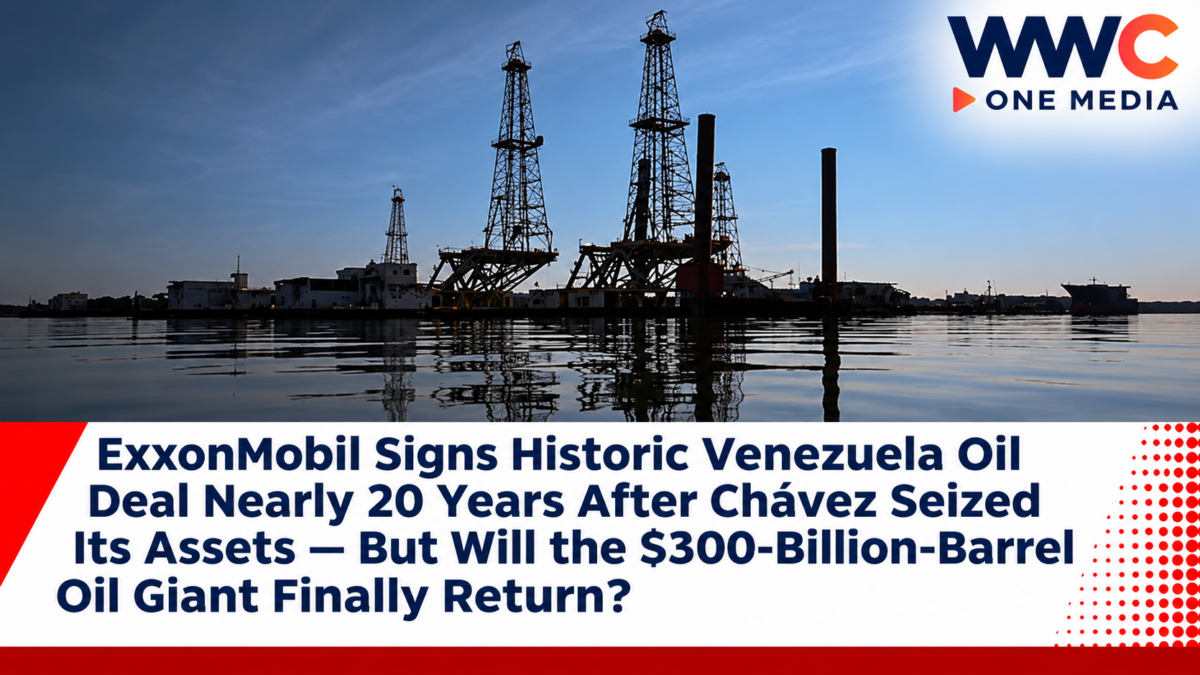
CARACAS / HOUSTON — November 10, 2026 — American oil giant ExxonMobil has taken a major step toward returning to Venezuela nearly two decades after the country seized its assets, signing a preliminary agreement that could reopen access to some of the world’s largest petroleum reserves.
The agreement, announced November 9, involves ExxonMobil, Venezuela’s government and state-owned oil company Petróleos de Venezuela SA (PDVSA).
According to Bloomberg and Reuters, the memorandum of understanding allows the parties to evaluate potential oil exploration and production opportunities.
The development marks a dramatic change in relations between ExxonMobil and Caracas, especially after Chief Executive Officer Darren Woods described Venezuela as an unattractive investment destination earlier this year because of its political, legal and commercial conditions.
Now, with Venezuela’s interim government introducing oil-sector reforms and US President Donald Trump encouraging American energy investment, ExxonMobil appears willing to explore a return.
But there is a major catch.
The agreement is nonbinding, and ExxonMobil has made clear that any actual investment will depend on stronger legal protections, stable regulations and commercially attractive returns.
Could ExxonMobil’s latest agreement unlock Venezuela’s enormous oil reserves—or will the same political and legal risks that drove the company away nearly 20 years ago prevent its return?
ExxonMobil Signs Preliminary Agreement With Venezuela
ExxonMobil confirmed that it signed a memorandum of understanding with the Venezuelan government and PDVSA to assess opportunities in the country’s upstream oil industry.
Upstream activities include finding, developing and producing oil and natural gas.
The agreement formalizes months of discussions between the American energy company and Venezuelan authorities.
According to Bloomberg, ExxonMobil has been negotiating potential access to one or more oil fields.
However, the company has not publicly identified the specific projects covered by the November memorandum.
It has also not announced a final investment commitment, production target or development timetable.
That distinction is critical.
A memorandum of understanding can establish a framework for negotiations without legally obligating the parties to complete a commercial project.
ExxonMobil would still need an appropriate final agreement and applicable authorizations before beginning new exploration or production operations.
The announcement therefore represents a significant diplomatic and commercial development, but not a completed return to Venezuelan oil production.
Why ExxonMobil Left Venezuela in 2007
To understand the significance of the new agreement, it is necessary to examine ExxonMobil’s troubled history in Venezuela.
The company previously operated major petroleum projects in the country, including the Cerro Negro heavy-oil venture and the La Ceiba project.
During the presidency of Hugo Chávez, Venezuela nationalized major oil assets and required foreign companies to accept new state-controlled arrangements.
ExxonMobil rejected the terms affecting its operations and withdrew from the country in 2007.
The expropriation triggered a lengthy international legal dispute.
In 2014, an international arbitration tribunal awarded ExxonMobil approximately US$1.6 billion plus interest in compensation.
Venezuela challenged the award, and related legal proceedings have remained unresolved.
The dispute explains why ExxonMobil has been especially cautious about investing in the country again.
Oil production requires long-term commitments involving drilling equipment, pipelines, processing facilities and other expensive infrastructure.
Companies generally need confidence that contracts will remain enforceable across multiple governments.
For ExxonMobil, the central issue is not simply whether Venezuela possesses valuable petroleum resources.
It is whether the company can invest without exposing itself to another costly nationalization or major contractual dispute.
Darren Woods Previously Called Venezuela ‘Uninvestable’
ExxonMobil’s decision is particularly striking because of comments made by its chief executive earlier this year.
During a January meeting at the White House, Darren Woods described Venezuela as “uninvestable” under its then-existing conditions.
He argued that significant improvements would be necessary before major international energy companies could confidently deploy capital.
Those concerns included the stability of government policy, the strength of legal protections and the commercial terms available to investors.
The comments created tension with President Trump, who was encouraging American oil producers to help rebuild Venezuela’s struggling energy industry.
But Woods did not rule out investing in Venezuela permanently.
Instead, he emphasized that the conditions necessary to justify investment had not yet been established.
The November agreement indicates that ExxonMobil now sees enough potential to pursue formal discussions.
However, the company has not withdrawn its core requirements.
ExxonMobil said future investments would still require a predictable policy environment, transparent regulations, effective investor safeguards and competitive financial returns.
The message is clear: negotiations can resume, but the company is not yet prepared to commit billions without stronger guarantees.
Venezuela’s New Government Is Trying to Win Back Foreign Oil Companies
The agreement follows sweeping political and economic changes in Venezuela.
After US forces captured and removed former President Nicolás Maduro in January 2026, Delcy Rodríguez assumed leadership as interim president.
Her administration has pursued reforms intended to attract foreign investment and revive the country’s oil production.
Venezuela’s National Assembly has approved changes to hydrocarbons legislation, providing greater opportunities for private companies to participate in petroleum projects.
The reforms also create more flexibility in commercial structures, taxation and operational arrangements.
These changes are significant because Venezuela’s oil industry has suffered from years of underinvestment, deteriorating infrastructure, political instability and international sanctions.
Rodríguez welcomed ExxonMobil’s preliminary agreement and expressed hope that it would lead to concrete investment arrangements.
However, political support alone will not guarantee success.
ExxonMobil must still evaluate whether the reforms offer sufficient protection against future changes in government policy.
The ultimate durability of Venezuela’s new investment framework remains a crucial issue.
Venezuela Has Approximately 300 Billion Barrels of Proven Oil Reserves
The economic opportunity is enormous.
Venezuela possesses approximately 300 billion barrels of proven oil reserves, according to commonly cited OPEC estimates.
That places it among the world’s largest petroleum resource holders.
Much of the country’s oil is concentrated in the Orinoco Belt, an extensive region containing heavy and extra-heavy crude.
These resources offer substantial long-term production potential.
But extracting and processing heavy oil presents technical challenges.
The crude often requires specialized equipment, upgrading facilities or blending with lighter petroleum products to make transportation and refining easier.
ExxonMobil has extensive experience producing heavy oil in Canada and managing technically demanding petroleum projects.
That expertise could be valuable if the company returns to Venezuela.
However, having enormous reserves does not mean those barrels can be extracted immediately or profitably.
Infrastructure condition, investment costs, oil prices, transportation and regulatory stability all influence whether development is commercially viable.
For ExxonMobil, these considerations will determine whether Venezuela’s underground resources represent an attractive business opportunity.
ExxonMobil Explored Several Oil Fields Before Signing the Agreement
The November memorandum follows earlier discussions about specific Venezuelan oil assets.
Bloomberg reported in September that ExxonMobil representatives traveled to Caracas to discuss potential access to heavy-oil fields.
The company was reportedly interested in projects including Petromonagas and Petrovictoria, as well as additional acreage in the Carabobo region.
Reuters separately reported Exxon’s interest in Petromonagas and nearby heavy-oil resources.
However, those earlier discussions should not be confused with confirmed terms of the new agreement.
ExxonMobil has not publicly disclosed whether any of those specific fields will be included in a final contract.
Nor has the company announced that it has recovered ownership of previously nationalized assets.
The precise future operating structure remains under negotiation.
Chevron Is Already Making a $7 Billion Venezuela Bet
ExxonMobil’s cautious approach contrasts with that of its American rival Chevron.
In September, Chevron announced plans to invest more than US$7 billion over five years to expand its Venezuelan operations.
The company is targeting production of approximately 600,000 barrels per day through its expanded activities.
Chevron secured updated fiscal, commercial and legal arrangements for existing joint ventures.
Unlike ExxonMobil, Chevron maintained operations in Venezuela through earlier periods of political uncertainty.
That longstanding presence gives the company established infrastructure, operational experience and relationships with local partners.
WWC ONE MEDIA previously examined the expansion in Chevron Makes US$7 Billion Bet on Venezuela Oil as US Pushes Major Energy Expansion.
For ExxonMobil, Chevron’s investment illustrates both the opportunity and the competitive pressure.
If Venezuela’s reforms succeed, other international producers could secure attractive oil assets while ExxonMobil remains in negotiations.
But moving too quickly could expose the company to the same risks that caused its earlier withdrawal.
Trump’s Bigger Plan to Revive Venezuela’s Oil Industry
President Donald Trump has encouraged American energy companies to commit substantial capital toward rebuilding Venezuela’s petroleum sector.
The administration has discussed an investment drive potentially involving as much as US$100 billion.
That figure represents a broader administration ambition, not money already invested by ExxonMobil.
Washington has also supported a separate arrangement involving North American Blue Energy Partners, a company with long-term rights to develop multiple Venezuelan oil fields.
The US government has secured a substantial financial interest in that venture.
WWC ONE MEDIA examined the agreement in Trump’s Venezuela Oil Gamble Just Got Bigger — The U.S. Is Taking a 35% Stake in a 65-Billion-Barrel Prize.
The strategy represents an effort to expand US commercial influence over Venezuela’s energy sector while encouraging production growth.
However, ExxonMobil’s agreement is separate from that venture.
The company has not announced participation in the US government’s 35% investment arrangement.
Any future ExxonMobil project would need to be evaluated according to its own contractual and commercial terms.
Venezuela’s Oil Export Problems Remain a Serious Obstacle
Despite renewed international interest, Venezuela’s oil industry still faces significant operational challenges.
Reuters reported that Venezuela exported approximately 1.08 million barrels per day of oil and related products in October, nearly unchanged from September.
High shipping costs, stagnant production and demand conditions have limited recent export growth.
Venezuela’s heavy crude also requires sufficient supplies of diluents to make it suitable for pipeline transportation and export.
A shortage of equipment, investment or shipping capacity can restrict output even when petroleum reserves are abundant.
WWC ONE MEDIA examined these problems in Venezuela’s Oil Exports Plunge 25% to an Eight-Month Low as Tanker Costs Soar — But Could a Shipping Crisis Derail Its Energy Comeback?.
That report focused on Bloomberg’s crude-loading measurements, which differ in scope from Reuters’ figures for broader oil and product exports.
For ExxonMobil, the lesson is significant.
Successful production requires more than obtaining drilling rights.
The company would need dependable infrastructure, sufficient processing capacity and access to economically viable export routes.
These challenges could take years and billions of dollars to address.
Could ExxonMobil’s Return Affect Global Oil Prices?
Venezuela’s enormous reserves make it an important potential source of future petroleum supply.
If ExxonMobil and other international producers eventually invest substantial amounts, the country could increase production over the longer term.
Additional supply could influence global oil markets, particularly if it becomes available during periods of strong demand.
However, the immediate market implications of Exxon’s memorandum are limited.
No new production has been announced under the agreement.
The company has not specified a drilling schedule or investment amount.
Oil-field development can take years, especially when major infrastructure repairs are necessary.
Consequently, the memorandum should not be presented as an immediate source of additional global crude supplies.
International oil prices are currently being influenced heavily by the conflict involving Iran, shipping disruptions and changes in demand expectations.
WWC ONE MEDIA previously examined the sharp reversal in energy markets in Oil Prices Crash Nearly 9% as Brent Falls Below $95 After Democrats Sweep US Congress — But Could a Failed Iran Peace Deal Send Crude Soaring Again?.
Venezuelan production growth could eventually become another factor in global supply, but its actual contribution remains uncertain.
The Unresolved Arbitration Dispute Could Complicate Negotiations
The financial legacy of Exxon’s earlier nationalization remains important.
The company’s arbitration victory established a substantial compensation claim against Venezuela.
But the dispute has been contested for years.
Any new investment would need to address how ExxonMobil’s historic claims relate to its future commercial relationship with the Venezuelan government.
The company has not confirmed that it has reached a final settlement of those claims as part of the new memorandum.
Investors should therefore avoid assuming that the legal disagreement has disappeared.
The issue is particularly sensitive because a return to Venezuela could involve substantial new commitments of capital.
ExxonMobil must assess both the value of possible new projects and the enforceability of contracts designed to protect those investments.
What Happens Next for ExxonMobil?
The next phase will involve evaluating potential oil projects and negotiating terms that could support a binding agreement.
Important issues include the allocation of production rights, taxation, royalties, dispute-resolution provisions and operational responsibilities.
ExxonMobil will also need to examine the technical condition of potential fields and estimate the cost of developing them.
The company has emphasized that future projects must meet its commercial standards.
That suggests it is unlikely to commit major investment solely because Washington and Caracas want a rapid agreement.
The process could produce a final contract.
It could also lead to prolonged negotiations or no investment at all.
As of November 10, ExxonMobil has not announced a completed re-entry into Venezuelan production.
The Bigger Picture: Can Venezuela Finally Regain Big Oil’s Trust?
ExxonMobil’s preliminary agreement represents an important moment for Venezuela’s energy industry.
Nearly two decades after a nationalization dispute drove the American company out, both sides are willing to explore a renewed commercial relationship.
For Venezuela, the opportunity is significant.
International investment could help restore deteriorating infrastructure, introduce advanced extraction technology and eventually increase production.
For ExxonMobil, the country’s enormous heavy-oil reserves could offer long-term opportunities if the investment environment becomes sufficiently stable.
For President Trump, the agreement supports his broader effort to encourage American participation in rebuilding Venezuela’s oil sector.
But the fundamental risks remain.
The country’s legal reforms are relatively new, old arbitration disputes remain unresolved and substantial infrastructure investment would be necessary before any major expansion in output.
The memorandum represents progress, not a guarantee.
ExxonMobil has opened the door to Venezuela for the first time in nearly 20 years. But with billions of dollars potentially at stake and the memory of previous asset seizures still looming, the biggest question is whether Caracas can finally convince the American oil giant to walk through it.