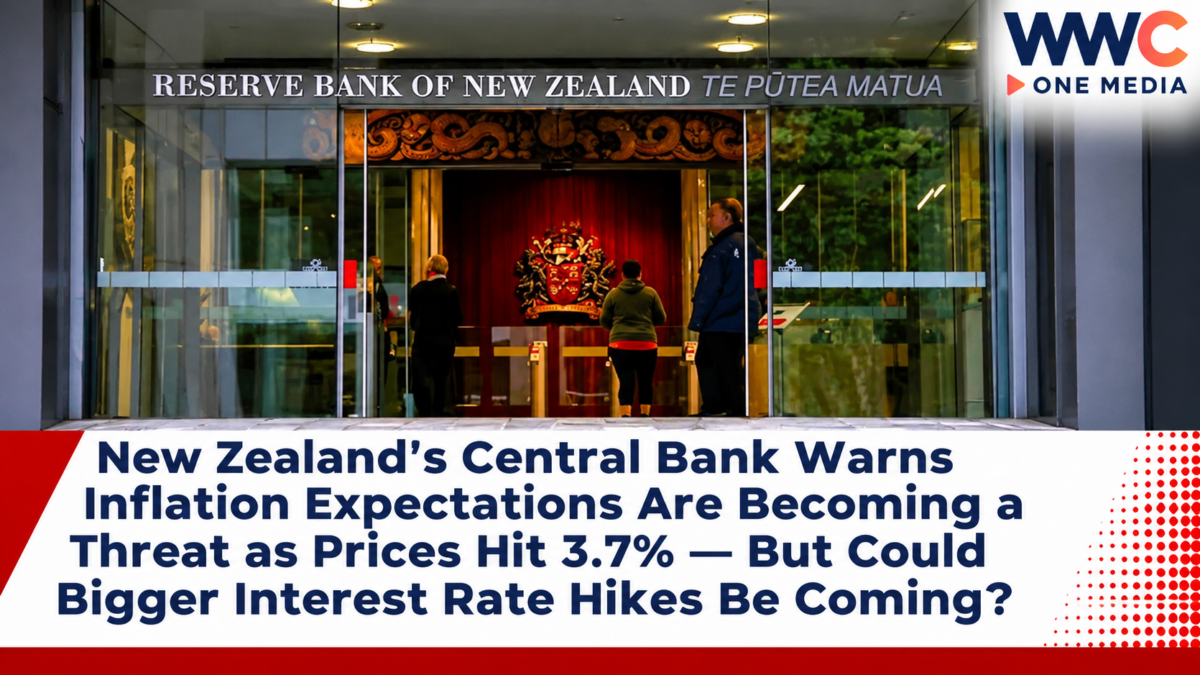
WELLINGTON / SYDNEY — November 10, 2026 — New Zealand’s inflation battle is far from over, with Reserve Bank of New Zealand (RBNZ) Chief Economist Paul Conway raising concerns about inflation expectations as the country struggles with elevated living costs, a fragile economic recovery and the possibility of further interest-rate increases.
Bloomberg reported Tuesday that Conway expressed concern about inflation expectations, highlighting one of the biggest challenges confronting New Zealand’s monetary policymakers: preventing temporary price increases from becoming permanently embedded in the economy.
The warning comes just two weeks after the central bank unexpectedly kept its benchmark interest rate unchanged, despite strong financial-market expectations of another increase.
New Zealand’s annual consumer price inflation stood at 3.7% in the September quarter, exceeding the RBNZ’s target range of 1% to 3%.
More concerning, the central bank expects inflation to accelerate to approximately 4.4% in the December quarter, although that forecast remains highly sensitive to international oil prices.
For households already facing expensive groceries, housing, electricity and transportation, renewed inflation pressure could mean another difficult period.
But the implications extend beyond supermarket prices.
If consumers and businesses begin expecting inflation to remain elevated, could the RBNZ be forced to raise interest rates more aggressively—potentially putting homeowners and New Zealand’s economic recovery under greater pressure?
Paul Conway Warns About the Danger of Persistent Inflation
Paul Conway’s latest comments reflect growing concern about the possibility that inflation expectations could undermine the central bank’s efforts to restore price stability.
Inflation expectations refer to what households, businesses and professional forecasters believe will happen to prices in the future.
These expectations matter because they can influence economic behavior.
When businesses expect costs to rise, they may increase prices earlier or by larger amounts.
Workers anticipating continued inflation may seek higher wages to protect their purchasing power.
Consumers may also change their spending decisions.
If these responses become widespread, inflation can become more persistent, even after the original cause of the price shock begins to fade.
Conway has previously warned that businesses are increasingly willing to pass higher costs to consumers while being less inclined to reduce prices when their expenses decline.
In a July speech published by the RBNZ, he emphasized the importance of preventing temporary cost shocks from developing into sustained inflation.
That concern has become more pressing as energy-market disruptions continue affecting the New Zealand economy.
The precise wording and any new numerical assessments from Conway’s November 10 conference remarks could not be independently verified from the full Bloomberg report.
However, his previously documented warnings and the RBNZ’s latest policy statements confirm that inflation expectations remain a major focus of the central bank.
New Zealand Inflation Remains Above the Central Bank’s Target
New Zealand’s annual inflation rate eased to 3.7% in the September quarter, compared with 4.1% in June.
The decline initially offered some relief after a sharp increase in energy costs earlier in 2026.
It also came in below the central bank’s earlier forecast of 3.9%.
But the improvement did not bring inflation back inside the RBNZ’s target range.
The central bank aims to maintain annual inflation between 1% and 3%, focusing on the 2% midpoint.
At 3.7%, inflation remains 0.7 percentage points above the upper limit.
The RBNZ has also warned that underlying inflation is increasingly broad-based.
Some measures of core inflation are close to the top of its target band.
That suggests price pressures are no longer limited to fuel and other highly volatile products.
Services, transportation, production costs and other domestic prices can contribute to persistent inflation.
According to Reuters’ October 21 report, prices rose 0.7% during the September quarter, while annual non-tradable inflation reached 3.3%.
The figures underscore the central bank’s concern that bringing inflation back to 2% may take longer than previously anticipated.
RBNZ Expects Inflation to Reach 4.4% by December
One of the most worrying developments is the central bank’s near-term inflation forecast.
In its October 28 Monetary Policy Review, the RBNZ projected that annual inflation could increase to approximately 4.4% in the December quarter.
The forecast reflects elevated global fuel prices and the effects of energy supply disruptions.
It is not a confirmed inflation reading.
Actual inflation could differ if oil prices, currency movements or domestic demand change significantly.
The central bank has acknowledged considerable uncertainty around the energy outlook.
BNZ research published on November 9 noted that falling oil prices had already reduced some near-term inflation concerns.
That development illustrates how rapidly forecasts can change.
Nevertheless, the possibility of inflation climbing above 4% remains important for financial markets and borrowers.
If higher prices persist beyond the initial energy shock, the central bank may need to maintain restrictive borrowing conditions for longer than expected.
RBNZ Holds Interest Rates at 2.75% Despite Split Vote
The latest warning follows a closely contested monetary-policy decision.
On October 28, the RBNZ voted four to three to keep its Official Cash Rate at 2.75%.
The outcome surprised economists and investors who had widely expected a 25-basis-point increase.
Governor Anna Breman and three other committee members supported holding rates unchanged.
Conway, together with Hayley Gourley and Karen Silk, favored raising the cash rate to 3%.
The three members supporting an increase were concerned that persistent core inflation and increasingly widespread price pressures could become entrenched.
They believed acting earlier could reduce the risk of more aggressive tightening later.
The majority, however, placed greater weight on weaker domestic demand and the possibility that earlier rate increases would continue restraining inflation.
All seven members agreed that further monetary tightening would probably be necessary, depending on the economic outlook.
WWC ONE MEDIA previously examined the debate in New Zealand Set for Two Straight Interest-Rate Hikes After RBNZ’s Surprise Pause — But Could Inflation Force an Even Bigger Crackdown?.
The central bank’s divided vote reveals the difficult balance between controlling inflation and supporting economic recovery.
Inflation Expectations Are Not Yet Out of Control
Despite Conway’s concerns, official survey data do not show that New Zealand’s inflation expectations have become completely unanchored.
The RBNZ’s most recently available Survey of Expectations showed that professional forecasters and business leaders expected inflation to average 2.60% over the following year and 2.34% over two years.
Both readings had declined from the previous survey.
| Inflation expectations | June 2026 survey | September 2026 survey |
|---|---|---|
| One year ahead | 3.41% | 2.60% |
| Two years ahead | 2.53% | 2.34% |
These readings remain somewhat above the 2% target midpoint but do not establish an uncontrolled rise.
The distinction is important.
Policymakers can be worried about the risk that expectations will rise without claiming that a major increase has already occurred.
The RBNZ’s next quarterly Survey of Expectations is scheduled for November 17, 2026.
That release could provide an important indication of whether recent oil-price movements and broader price pressures have changed how businesses and economists view future inflation.
Middle East Energy Crisis Adds Pressure to New Zealand’s Economy
Much of New Zealand’s inflation problem is connected to international energy markets.
The conflict involving Iran and the wider Middle East has disrupted global fuel supplies and contributed to volatile oil prices.
New Zealand imports petroleum products, making its economy sensitive to changes in global energy costs.
Higher fuel prices affect more than motorists.
Agricultural producers, shipping operators, logistics providers and manufacturers can face increasing operating expenses.
Some businesses may attempt to recover those expenses through higher prices for goods and services.
A weakening New Zealand dollar can add to the problem by increasing the local-currency cost of imports.
In its October policy statement, the RBNZ reported that the country’s trade-weighted exchange rate had declined by approximately 3% since September.
But energy-driven inflation creates a difficult problem for central banks.
Higher interest rates cannot directly restore oil production or reopen disrupted shipping routes.
Instead, monetary policy works by restraining domestic demand and reducing the likelihood that temporary price increases will spread throughout the economy.
WWC ONE MEDIA examined similar international pressures in Global Rate Hikes Are Back in View — And Central Banks May Not Be Done Yet.
The broader challenge is that central banks must respond to inflation without unnecessarily weakening economic growth.
Why Homeowners Could Face Higher Mortgage Costs
Further increases in the RBNZ’s cash rate could eventually affect New Zealand mortgage borrowers.
When the benchmark rate rises, banks may increase the interest rates charged on some home loans.
However, the effect depends on individual mortgage arrangements.
Many New Zealand borrowers use fixed-rate mortgages.
Their contractual rates generally remain unchanged until the agreed fixed-rate period expires.
Floating-rate borrowers may experience changes sooner, depending on their bank’s pricing decisions.
Financial institutions also consider wholesale funding costs, competition and expectations for future monetary policy when setting mortgage rates.
Consequently, a 25-basis-point increase in the OCR does not guarantee an identical immediate increase in every mortgage rate.
Still, higher refinancing costs can create financial pressure for households.
Consider a hypothetical NZ$600,000 mortgage with 25 years remaining.
At an annual rate of 5%, the monthly payment would be approximately NZ$3,508.
At 5.5%, the monthly payment would rise to approximately NZ$3,685.
That represents roughly NZ$177 in additional monthly repayments.
These figures are illustrative rather than a forecast of actual bank mortgage rates.
For households with substantial debt, even modest increases can reduce money available for other expenses.
New Zealand’s Fragile Economy Complicates the Inflation Fight
The RBNZ’s caution reflects the economy’s uneven recovery.
Household spending has remained subdued, while job insecurity and weak housing-market conditions have weighed on confidence.
New Zealand’s unemployment rate reached approximately 5.7% in the September quarter, its highest level in more than a decade.
Higher unemployment can restrain consumer spending and wage growth.
That may eventually reduce inflation pressure.
But it also means additional interest-rate increases could weaken demand further.
This creates a difficult policy dilemma.
If the RBNZ tightens too slowly, inflation could become more persistent.
If it raises rates too aggressively, businesses could reduce investment and employment, making the recovery harder to sustain.
The situation has become politically sensitive following New Zealand’s November 7 general election.
Preliminary election results left uncertainty about the country’s next government, with special votes still to be counted.
WWC ONE MEDIA covered the political and economic backdrop in New Zealand Election Shock: Luxon’s Coalition Clings to 67 Seats as 399,000 Votes Remain Uncounted — But Could November 27 Turn Victory Into Defeat?.
Whatever government eventually takes office will inherit an economy facing stubborn inflation, elevated unemployment and difficult monetary-policy decisions.
Economists Expect Further Rate Increases
Financial-market analysts continue anticipating additional tightening.
After the October surprise pause, economists surveyed by Bloomberg expected the RBNZ to raise interest rates at its December 9, 2026, and February 10, 2027 meetings.
Two increases of 25 basis points would lift the Official Cash Rate from 2.75% to 3.25%.
Some bank economists have projected a higher eventual peak.
Those forecasts reflect concerns that inflation will remain elevated and that the central bank may need to respond more forcefully.
However, the forecasts are not commitments from the RBNZ.
The committee has explicitly stated that future decisions depend on incoming economic information.
A sustained decline in oil prices, weaker consumption or improved inflation expectations could reduce the need for further tightening.
By contrast, accelerating core inflation or rising expectations could strengthen the case for higher rates.
The December decision will therefore depend on how policymakers assess the balance of risks at that time.
Australia’s Rate Hikes Highlight a Wider Regional Challenge
New Zealand is not the only major economy in the region struggling with persistent inflation.
Australia’s Reserve Bank raised its benchmark interest rate to 4.85% on November 3, the highest level in 18 years.
Australian inflation has also remained above the central bank’s target.
The two countries have different economic structures and monetary-policy settings, but both are facing challenges created by rising prices and the need to preserve economic growth.
WWC ONE MEDIA examined Australia’s situation in Australia Raises Interest Rates to 18-Year High of 4.85% as Inflation Surges — But Could a Housing Crash Be the Price of Victory?.
The comparison illustrates why central banks across the region are carefully monitoring domestic price pressures and international energy costs.
It does not mean New Zealand must follow Australia’s interest-rate decisions.
Each central bank makes policy based on its own inflation, employment and financial conditions.
What Investors Should Watch Next
The immediate focus is on whether New Zealand’s inflation expectations remain relatively stable or begin climbing again.
The next RBNZ Survey of Expectations, scheduled for November 17, could provide fresh evidence.
Other important indicators include household spending, employment, business pricing decisions and movements in the New Zealand dollar.
International oil prices remain especially important because energy costs have contributed substantially to the recent inflation shock.
The RBNZ’s next policy meeting is scheduled for December 9.
Investors will be watching not only whether the central bank raises rates but also how it describes the future policy outlook.
A stronger warning about persistent inflation could push market expectations toward additional increases.
A more cautious assessment could signal that policymakers are still concerned about the economy’s weak recovery.
The central bank’s decision will likely have implications for mortgage pricing, bond yields and the New Zealand dollar.
The Bigger Picture: Is New Zealand Facing Another Inflation Shock?
New Zealand’s latest monetary-policy debate underscores an uncomfortable economic reality.
Inflation has eased from its June peak but remains above the central bank’s target range.
Price pressures have broadened, and the RBNZ expects another increase in annual inflation toward the end of 2026.
At the same time, the economy remains vulnerable to weak consumer spending, unemployment and higher borrowing costs.
Conway’s concerns about inflation expectations highlight why the central bank cannot focus exclusively on current headline inflation.
The risk is that businesses and households begin adjusting their decisions around an expectation that high inflation will persist.
If that happens, restoring price stability could require more sustained monetary tightening.
But that outcome is not inevitable.
Official survey data still show medium-term expectations relatively close to the RBNZ’s target, while weaker demand and easing energy prices could help contain inflation.
With New Zealand’s inflation forecast to climb toward 4.4% and the central bank divided over how aggressively to respond, the biggest question is whether policymakers can keep expectations under control with gradual rate increases—or whether another inflation shock will force households and businesses to endure a much more painful tightening cycle.