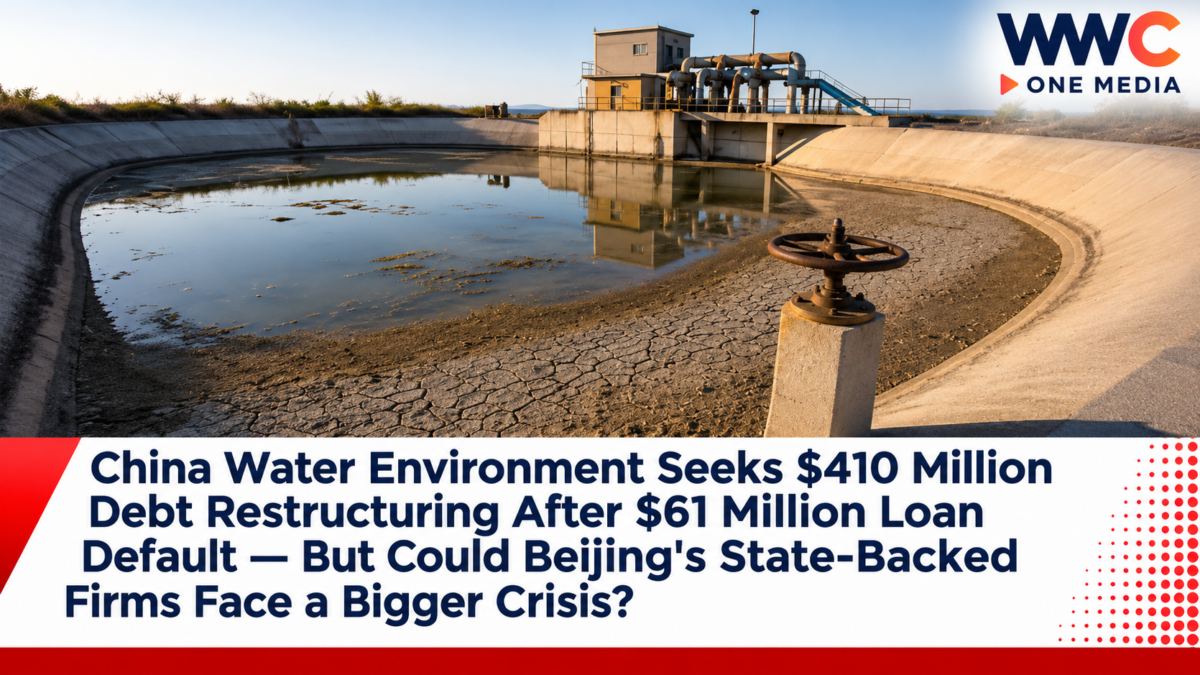
BEIJING, China — November 10, 2026 — China’s mounting corporate debt troubles are drawing fresh attention to an essential public-service industry after China Water Environment Group, one of the country’s major wastewater treatment operators, was reported by Bloomberg to be seeking a restructuring involving approximately US$410 million in loans.
The development follows an offshore debt default earlier this year and raises questions about the financial resilience of Chinese infrastructure operators that have traditionally benefited from government-linked shareholders.
Unlike struggling property developers, wastewater companies provide services that communities depend on daily. Their financial difficulties therefore present a more complicated challenge for lenders, local authorities and policymakers.
China Water Environment’s reported restructuring request also highlights a broader concern: could financial pressure previously associated with China’s property crisis be affecting businesses responsible for critical public infrastructure?
$410 Million Restructuring Request Follows Earlier Loan Default
Bloomberg’s November 10 report identifies approximately $410 million in loans as the subject of China Water Environment’s restructuring effort.
The precise repayment changes being requested, the identity of all participating creditors and whether lenders have agreed to revised terms could not be independently established from the accessible reporting.
However, the company’s earlier financial problems are documented.
In September, Bloomberg reported that China Water Environment had failed to repay approximately $61 million in outstanding principal on an offshore loan due in late August.
According to people familiar with the matter, creditors had rejected a request to extend that loan’s maturity by several months.
The reported default represented a significant warning for lenders because the company was not an ordinary private-sector borrower without government connections.
It was backed by State Development and Investment Corp., or SDIC, a major Chinese state-owned investment group.
A separate $130 million loan due in 2028 also came under scrutiny after lenders were informed of the earlier default and asked whether they wanted to invoke cross-default provisions.
A cross-default clause can allow creditors to take action on one borrowing arrangement when a borrower defaults on another qualifying obligation.
It does not automatically establish that every outstanding loan has defaulted.
The latest restructuring effort therefore comes against a backdrop of previously reported creditor concerns rather than emerging in isolation.
Why China Water Environment Matters to Millions
China Water Environment is a major operator in China’s wastewater treatment and environmental infrastructure sector.
According to Bloomberg’s September reporting, the company provides services covering approximately 45 million people across 22 provincial-level regions.
Its activities include wastewater treatment and projects supporting China’s environmental protection objectives.
This makes the company’s financial position particularly important.
Wastewater treatment facilities require continuous operations, maintenance, technical expertise and capital investment. Unlike businesses that can easily suspend production when demand weakens, essential water infrastructure must remain functional to protect public health and environmental standards.
The company’s state-linked ownership adds another dimension.
SDIC acquired a 43% stake in China Water Environment in 2018, becoming its largest individual shareholder, according to a public filing cited by Bloomberg.
State ownership can improve market confidence, particularly when investors expect strategic infrastructure businesses to receive support during financial difficulties.
But government-linked ownership does not provide an unconditional guarantee that every corporate debt will be repaid.
China Water Environment’s experience illustrates that distinction.
China’s Local Government Financial Strain Adds to the Pressure
The difficulties confronting infrastructure operators must be understood against the wider financial pressures affecting Chinese local governments.
Many municipal authorities have historically relied on land sales, property-related revenue and borrowing to fund infrastructure development and public services.
China’s prolonged property downturn has weakened some of those revenue sources.
That creates challenges for companies with significant exposure to government contracts, infrastructure concessions and payments from public-sector counterparties.
Bloomberg’s earlier reporting noted that some Chinese public-service businesses have faced pressure because amounts owed by local governments and other business partners have remained elevated.
For a wastewater operator, delayed receivables can create a difficult financial mismatch.
The company may be required to continue operating treatment facilities and meeting financing obligations while waiting for payments from customers or counterparties.
The result can be a liquidity squeeze even when the underlying infrastructure remains necessary.
There is, however, an important distinction: delayed public-sector payments are a documented broader sector problem, but their precise contribution to China Water Environment’s latest restructuring request has not been established.
The wider financial picture has also been examined by WWC ONE MEDIA in China’s Zhuhai Huafa Faces Fitch Negative Watch Amid $62-Billion Debt Pressure.
That report examined how refinancing pressures are challenging confidence in other state-backed Chinese businesses.
China’s Debt Crisis Is No Longer Just a Property Market Story
China’s property-sector downturn remains an important source of financial uncertainty.
But concerns have increasingly extended to companies with government links and businesses outside traditional residential development.
In September, Reuters reported that Chinese regulators had informally encouraged certain banks to extend repayment terms and avoid classifying some overdue loans to property developer China Vanke as non-performing.
The reported measures reflected authorities’ efforts to manage financial stress without triggering a destabilizing default.
China Water Environment presents a different corporate situation, but the cases share a broader financing question.
How long can creditors extend repayment deadlines before temporary liquidity problems become persistent balance-sheet weaknesses?
Restructuring can provide additional breathing room for borrowers.
Banks may agree to longer loan maturities, revised repayment schedules or changes to financing terms.
Such arrangements can prevent sudden financial disruption when the borrower has a realistic path toward restoring liquidity.
But restructuring does not automatically eliminate the underlying debt or guarantee recovery.
If cash flow remains insufficient, creditors may eventually face additional negotiations, losses or further defaults.
WWC ONE MEDIA previously examined the changing risk environment in Chinese Junk Dollar Bonds Face Worst Week Since April 2025 as Huafa Debt Fears Spread.
That report explored how concerns about government-linked borrowers have affected investor confidence in China’s offshore credit market.
Could Beijing Step In to Support the Water Company?
China’s government has strong reasons to maintain reliable wastewater treatment services.
Infrastructure operators help cities manage pollution, protect waterways and meet environmental standards.
A disorderly financial failure at a major treatment company could complicate project financing, construction and long-term service delivery.
However, operational importance does not automatically translate into a direct government rescue.
Authorities and shareholders have several potential options when dealing with financially stressed infrastructure businesses.
These could include negotiated debt extensions, shareholder financing, asset disposals, new investment or changes to project payment arrangements.
Each approach carries costs and trade-offs.
Extending loans may buy time but leave creditors exposed for longer.
Selling assets could generate liquidity but reduce future earnings capacity.
Providing additional capital could stabilize operations while placing more financial responsibility on investors or public-sector shareholders.
As of the information independently verified for this report, no specific rescue package for China Water Environment’s reported $410 million restructuring had been confirmed.
The company’s ultimate outcome will depend on creditor negotiations, available liquidity, shareholder decisions and its ability to maintain sustainable cash flow.
China’s Banking System Faces a Difficult Balancing Act
China’s financial authorities have been working to strengthen the country’s banking system against a challenging economic environment.
In September, WWC ONE MEDIA reported on a 360-billion-yuan, approximately US$54-billion, capital support initiative in China Pumps US$54 Billion Into Banks and Insurers in Major Financial Powerhouse Push.
The broader policy effort illustrates Beijing’s interest in maintaining financial stability and ensuring that major institutions can continue supporting economic activity.
But stronger bank capital does not automatically resolve the problems of individual corporate borrowers.
Banks must decide which borrowers can recover with additional time and which require more fundamental restructuring.
That distinction is crucial for companies operating essential infrastructure.
Lenders may be reluctant to force immediate repayment if aggressive action risks disrupting commercially viable projects.
On the other hand, repeatedly extending debt without improving cash flow could delay the recognition of financial losses.
For Beijing, the challenge is balancing credit discipline with the need to maintain public-service investment.
China Water Environment’s negotiations could become another example of how difficult that balance has become.
Why the Water Industry’s Financial Health Matters
Water infrastructure is often viewed as a relatively defensive industry because demand for essential services continues regardless of the economic cycle.
Yet predictable demand does not guarantee predictable cash flow.
Operators may depend on long-term contracts, public-sector payments, borrowing and infrastructure investment.
A company can therefore face refinancing stress despite having substantial operating assets and continuing service obligations.
The potential implications extend beyond one company’s lenders.
Persistent financial difficulties among infrastructure operators could make banks more cautious about financing new treatment plants, pipelines and environmental projects.
Higher financing costs or stricter loan conditions could also affect investment decisions.
For China, this would be particularly sensitive because wastewater treatment remains an important component of environmental management and urban development.
The financing challenge also intersects with the broader sustainable-finance market.
WWC ONE MEDIA previously examined that connection in Green Debt Fees Near $3 Billion as Banks Beat Fossil Fuels for Fifth Straight Year.
That coverage highlights the growing commercial significance of financing environmentally focused projects.
However, strong investor interest in green financing does not mean all environmental infrastructure companies have equal financial strength or access to credit.
Lenders still need to evaluate repayment capacity, project economics and counterparty risks.
Could the Restructuring Affect Asia’s Credit Markets?
China remains a major influence on Asian trade, investment and financial sentiment.
Consequently, repeated credit difficulties involving Chinese companies can affect how investors assess broader regional risks.
But the implications should not be overstated.
The reported restructuring request does not establish that China is facing a new system-wide banking crisis.
Nor does it demonstrate that wastewater services have been interrupted or that investors across Asia will suffer direct losses.
The more immediate question is whether China Water Environment can negotiate an arrangement that satisfies creditors while allowing its essential operations to continue.
A successful agreement could reassure lenders that the company can manage its outstanding obligations through revised financial terms.
Unsuccessful talks could intensify concerns about additional defaults and the reliability of implicit state support.
Other infrastructure borrowers may also face closer scrutiny if lenders conclude that government links offer less protection than previously assumed.
The Bigger Question: Is State Backing Still Enough?
China Water Environment’s reported $410 million restructuring effort underscores an increasingly important reality in Chinese corporate finance.
Companies carrying out essential public functions can still experience significant debt problems.
A large government-linked shareholder may provide financial flexibility, but that support is not unlimited.
The company’s previously reported $61 million offshore default and subsequent restructuring initiative also illustrate the consequences when creditors become unwilling to extend financing on existing terms.
For China Water Environment, the immediate priority is securing sustainable repayment arrangements without undermining the business.
For lenders, the challenge is determining whether revised terms will produce a durable solution.
And for Beijing, the issue extends beyond one wastewater operator.
China must maintain vital infrastructure while managing debt pressures across a slowing, financially stretched economy.
The next phase of creditor negotiations could reveal whether China Water Environment’s difficulties are manageable through restructuring—or whether state-backed infrastructure borrowers are entering a more demanding era of financial discipline.