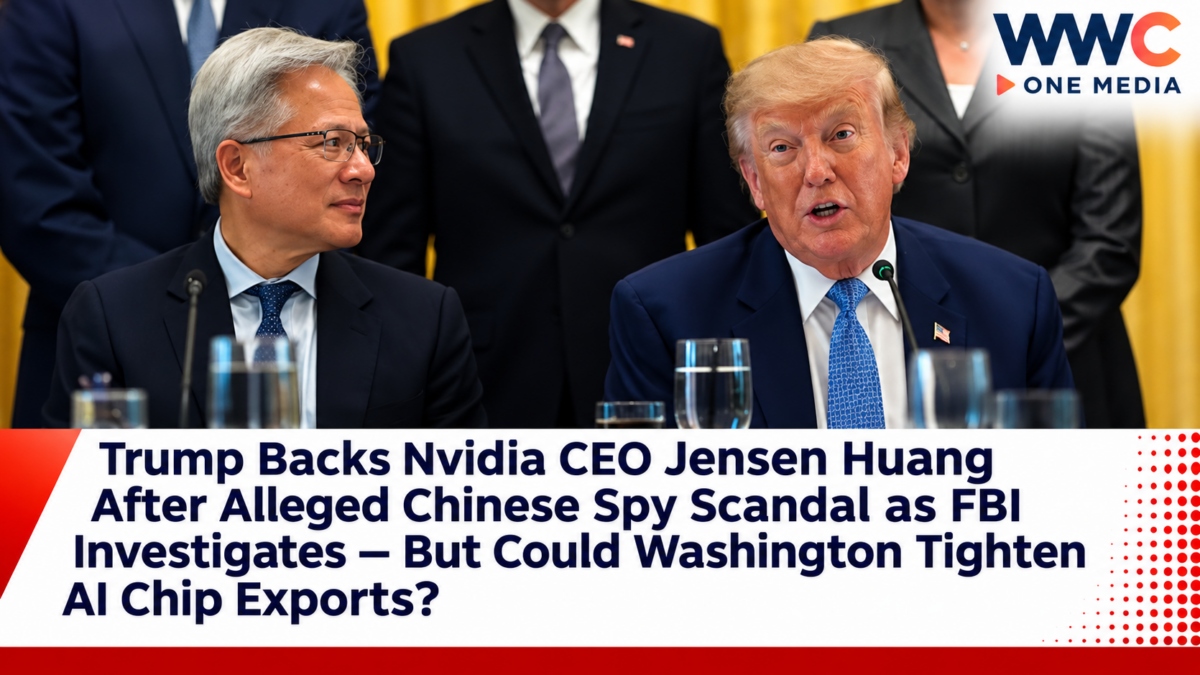
WASHINGTON, D.C. — November 10, 2026 — President Donald Trump has publicly defended Nvidia chief executive Jensen Huang after speaking directly with the technology billionaire about allegations involving a suspected Chinese intelligence operative, saying he believes Huang’s denial that he knew the woman was allegedly spying for Beijing.
The intervention came on Monday, November 9, as Nvidia faced growing scrutiny over its chief executive’s relationship with Alice Huang, a Chinese businesswoman formerly associated with Singapore-based AI infrastructure company Megaspeed International.
According to Reuters, Trump confirmed that he had contacted Huang personally and questioned him about whether he knew the woman was involved in alleged intelligence activity.
Huang denied having that knowledge, the president said.
Trump also disclosed that the Federal Bureau of Investigation was looking into the matter, adding a new dimension to a controversy already being reviewed by Nvidia’s independent directors.
Meanwhile, Nvidia shares fell more than 4% on November 9 as investors assessed the possible consequences for one of the world’s most influential artificial intelligence companies.
The controversy has intensified questions about US semiconductor export controls, Nvidia’s business relationships in Asia and Huang’s influential position in Washington.
But there is a crucial distinction.
No public finding has established that Jensen Huang knowingly assisted Chinese intelligence, disclosed classified information or violated US export-control laws.
Nvidia’s board says it currently has no reason to believe sensitive company information or American national-security secrets were compromised.
China has rejected the espionage allegations.
Yet with Washington considering tighter restrictions on advanced AI chips, could the allegations surrounding Nvidia’s CEO reshape America’s technology relationship with China—or will the investigation ultimately clear Huang of wrongdoing?
Trump Says Jensen Huang Denied Knowing About Alleged Espionage
The latest developments unfolded during a White House briefing on November 9.
Trump confirmed that he had spoken with Huang earlier in the day to ask how the executive was coping with the controversy.
The president said he directly questioned Huang about whether he had known the woman was allegedly connected to Chinese intelligence.
Huang said he had not known, according to Trump’s account.
Trump told reporters he believed the explanation and expected the Nvidia chief executive to emerge from the controversy in good condition.
The comments marked an important shift from November 8, when Trump said he had not yet discussed the allegations with Huang.
On Sunday, the president called Huang an honorable person and praised his contributions to the United States.
By Monday, Trump was offering a more direct public defense following their conversation.
However, the president’s confidence does not replace the findings of an investigation.
Any determination about potential security breaches, legal violations or misconduct would require an appropriate examination of the evidence.
Trump Confirms FBI Interest in the Nvidia Controversy
One of the most consequential elements of Trump’s remarks involved the FBI.
The president said the federal agency was examining the situation.
Reuters, CNN and South Korea’s Yonhap News Agency independently reported that statement.
But the exact scope of the FBI’s involvement has not been publicly established.
Trump’s comments should not be interpreted as confirmation that Huang has been charged with a crime or formally accused of espionage by federal prosecutors.
An investigation can examine potential threats, contacts, financial transactions or other matters without establishing wrongdoing by a particular individual.
For Nvidia, the distinction is especially important.
The company operates in an industry where advanced chips have commercial, economic and national-security significance.
Any allegations involving foreign intelligence can attract attention from US authorities.
But investigation and guilt are not the same thing.
Who Is Alice Huang, the Woman at the Center of the Allegations?
The controversy involves Alice Huang, also known as Huang Le, a former executive associated with Megaspeed International.
Megaspeed is a Singapore-based business involved in AI computing infrastructure.
According to reporting by The New York Times, US intelligence officials suspected Alice Huang of collecting information for Beijing.
The report raised concerns about whether her relationship with Jensen Huang could have provided access to information involving Nvidia, its customers or US technology policy.
Jensen Huang and Alice Huang are not reported to be related despite sharing a surname.
The Nvidia CEO has acknowledged having an extramarital relationship and apologized for the personal harm it caused his family.
That admission, however, does not establish the separate allegation that Alice Huang was engaged in espionage.
China’s Foreign Ministry has rejected the spying accusations as unsubstantiated.
Nvidia has also emphasized that ordinary customer interactions do not provide outsiders with unrestricted access to sensitive corporate or government information.
The allegations remain contested.
Nvidia Board Launches Independent Investigation
On November 8, Nvidia announced that its board had initiated an independent investigation into whether Huang had been targeted by a foreign intelligence operation.
The review is being overseen by independent directors with external legal support.
Nvidia said it takes the protection of company information and US national-security interests seriously.
The board also expressed confidence in Huang and his management team.
The investigation remains ongoing.
Huang has pledged to cooperate.
There has been no announcement that he is stepping down or that Nvidia has selected a replacement chief executive.
The company has also said it currently has no reason to believe sensitive information was compromised.
As previously reported by WWC ONE MEDIA, Nvidia’s board investigation has become a major source of uncertainty for investors.
Related WWC ONE MEDIA coverage: Nvidia Loses Billions in Market Value as Board Investigates Jensen Huang Over Alleged Chinese Spy Links — But Could the AI Giant Lose Its Irreplaceable CEO?
The latest development is Trump’s confirmation of a direct conversation with Huang and his statement about FBI involvement.
Those details distinguish the November 9 political response from the initial board-investigation announcement.
Megaspeed’s Chip Business Raises Export-Control Concerns
The controversy also involves the international movement of advanced AI processors.
Megaspeed and related companies have previously faced scrutiny over questions about where Nvidia-powered computing equipment was ultimately being used.
US authorities have restricted exports of certain advanced semiconductor products to China because the technology can support sophisticated artificial intelligence applications.
Some products require government authorization before being supplied to specified customers or destinations.
Investigators have examined whether overseas data-center arrangements might allow restricted Chinese customers to access advanced computing equipment.
However, purchasing Nvidia chips or operating data centers for international customers is not inherently illegal.
The legal questions depend on the specific products, recipients, transactions and applicable restrictions.
As WWC ONE MEDIA previously reported, the allegations involving Megaspeed and Alice Huang had already attracted scrutiny before Nvidia announced its latest independent investigation.
Related WWC ONE MEDIA coverage: US Intelligence Investigates Alleged Chinese Spy With Links to Nvidia’s CEO — Could Singapore’s AI Data-Centre Industry Face Tougher Scrutiny Next?
The earlier reporting provides important background on the business relationships and intelligence concerns.
But neither that reporting nor Nvidia’s current investigation establishes that Huang knowingly authorized an illegal chip transfer.
Trump’s Relationship With Huang Creates Political Questions
Trump’s defense of Huang is politically significant because the two men have maintained a close working relationship.
Huang has become one of the administration’s most prominent technology-industry contacts.
He has advocated policies intended to preserve Nvidia’s access to international markets, including China.
The administration has also weighed how to balance commercial semiconductor exports with national-security restrictions.
Reuters reported that Huang has regularly participated in discussions involving Washington’s technology agenda.
That access has become more controversial following the intelligence allegations.
The New York Times previously reported that Trump had been briefed about intelligence concerns involving Alice Huang roughly a year earlier.
Trump has said he only recently became aware of the matter and could not clearly recall when any earlier concerns were raised with him.
Those differing accounts have not been reconciled publicly.
The timing of intelligence briefings and the actions taken afterward could become questions for congressional oversight.
However, a close relationship between a president and a technology executive is not, by itself, evidence of improper conduct.
Congress Could Respond With Tougher AI Chip Legislation
The allegations are emerging as lawmakers consider stronger controls on advanced semiconductor technology.
Reuters reported on November 9 that three proposals could be considered as part of the US defense authorization process.
They include the AI Overwatch Act, which would expand congressional involvement in certain advanced chip-export decisions.
The Chip Security Act would strengthen requirements designed to track advanced chips and combat illegal diversion.
The MATCH Act would encourage closer restrictions on certain chipmaking equipment and technology transfers involving China.
Supporters argue that advanced AI hardware can have national-security implications and requires effective oversight.
Critics of overly restrictive policies warn that limiting American companies’ overseas business could weaken US competitiveness or encourage foreign alternatives.
For now, these measures are legislative proposals under discussion.
They have not all become law merely because of the controversy.
Their future will depend on congressional negotiations and final legislative decisions.
Taiwan’s AI Server Export Case Shows the Wider Enforcement Challenge
The difficulty of tracking AI equipment extends beyond Nvidia and Megaspeed.
In August, Taiwanese authorities announced indictments involving nine individuals in a separate case concerning alleged illegal exports of high-performance AI servers to China.
The equipment reportedly included advanced processors subject to export restrictions.
Prosecutors alleged that participants used improper arrangements to move restricted technology.
As WWC ONE MEDIA previously reported, the Taiwanese investigation demonstrated the complexity of monitoring global semiconductor supply chains.
Related WWC ONE MEDIA coverage: Taiwan Indicts 9 in AI Server Export Case — But Where Were the Powerful Machines Really Headed?
That case is separate from the allegations surrounding Jensen Huang.
It should not be treated as evidence against him.
But it helps explain why US authorities are concerned about the ultimate destinations of advanced AI equipment.
Modern technology supply chains can involve multiple countries, contractors, server suppliers and cloud-service operators.
Tracking how sophisticated processors are used after purchase can be considerably more difficult than monitoring their initial sale.
US–China AI Rivalry Makes Nvidia Strategically Important
Nvidia’s role in advanced computing has made it central to the competition between the United States and China.
Its processors are widely used to train and operate sophisticated AI models.
Washington has restricted access to some advanced semiconductor products because of concerns about their potential military applications.
China has meanwhile invested heavily in domestic chip development and AI systems.
The conflict has become a major issue in trade and diplomatic relations between the two countries.
As WWC ONE MEDIA previously examined, artificial intelligence and semiconductor controls have played an increasingly important role in discussions between Trump and Chinese President Xi Jinping.
Related WWC ONE MEDIA coverage: AI Rivalry Set to Feature in Trump-Xi Talks
Huang has argued that American technology companies should remain competitive internationally.
Some lawmakers disagree with his approach to China-related semiconductor sales.
The latest allegations could intensify that disagreement.
But decisions about future exports should be based on applicable law, technical assessments and verified security risks rather than unsupported personal accusations.
Nvidia Shares Fall as Investors Weigh Leadership Risk
Nvidia’s shares declined more than 4% on November 9 following the reports and the announcement of its board investigation.
The company’s market value is particularly sensitive to investor expectations because Nvidia is a major beneficiary of the AI infrastructure boom.
Huang has also become closely associated with its growth strategy.
That creates what investors describe as key-person risk.
When a founder plays a major role in technology strategy, customer relationships and public confidence, uncertainty surrounding that executive can affect perceptions of the company’s future.
But stock-market declines should not be confused with realized corporate losses of the same amount.
Market capitalization reflects the value investors place on a company’s shares.
It does not represent cash removed from Nvidia’s bank accounts.
The company continues developing and selling AI computing technology.
The investigation’s consequences remain uncertain.
Could Trump Face Pressure Over His Support for Huang?
Trump’s comments may create political challenges if new information emerges from the investigations.
His defense of Huang reinforces the administration’s close relationship with the Nvidia chief executive.
But it also puts the president’s judgment under public scrutiny.
Lawmakers could question whether the White House handled earlier intelligence concerns appropriately.
They may also examine whether business relationships influenced discussions about chip exports.
However, the existence of those questions does not establish that Trump knowingly ignored a verified security threat or improperly intervened in an investigation.
Trump says he believes Huang’s denial.
Nvidia’s board continues expressing confidence in its CEO.
And China disputes the underlying espionage allegations.
The eventual political consequences will depend on evidence, official findings and decisions by the relevant authorities.
What Happens Next for Nvidia and the Investigations?
Several developments could determine the outcome.
Nvidia’s independent directors must complete their review of the reported intelligence concerns.
Federal authorities may provide further information about the scope of any investigation.
Congress could pursue additional briefings or hearings involving semiconductor exports and national-security policy.
The administration may also face pressure to clarify its approach to restricted chip sales.
For shareholders, the next important financial question is whether the controversy affects Nvidia’s business operations, customers or management.
There is currently no confirmed public finding that Huang knowingly cooperated with Chinese intelligence.
Nor has Nvidia announced that its chief executive will leave office.
The investigation must be allowed to establish the facts.
The Bigger Picture: Can Trump Protect an AI Ally Without Undermining Security Concerns?
The controversy surrounding Jensen Huang has become much larger than a personal scandal involving a prominent technology executive.
It now touches on American industrial policy, foreign intelligence, semiconductor exports and the relationship between Silicon Valley and the White House.
Trump says he believes Huang had no knowledge of the alleged intelligence connection.
Nvidia’s board says it has no current reason to believe sensitive information was compromised.
China rejects the spying allegations.
Yet congressional interest in tighter semiconductor controls continues growing, and investors remain alert to potential disruption at Nvidia.
The fundamental issue is whether investigators can determine what happened and whether any laws or security obligations were breached.
Public allegations deserve careful examination, but they must not be treated as established guilt.
For Nvidia, maintaining confidence will require transparency about the investigation and continued compliance with applicable technology controls.
For Washington, the challenge is balancing economic competitiveness with genuine national-security concerns.
And as Trump stands behind Jensen Huang while the FBI and Nvidia’s board examine the controversy, one question remains: Will the investigations clear the AI industry’s most influential CEO—or could the allegations accelerate a new crackdown on America’s multibillion-dollar chip trade with China?