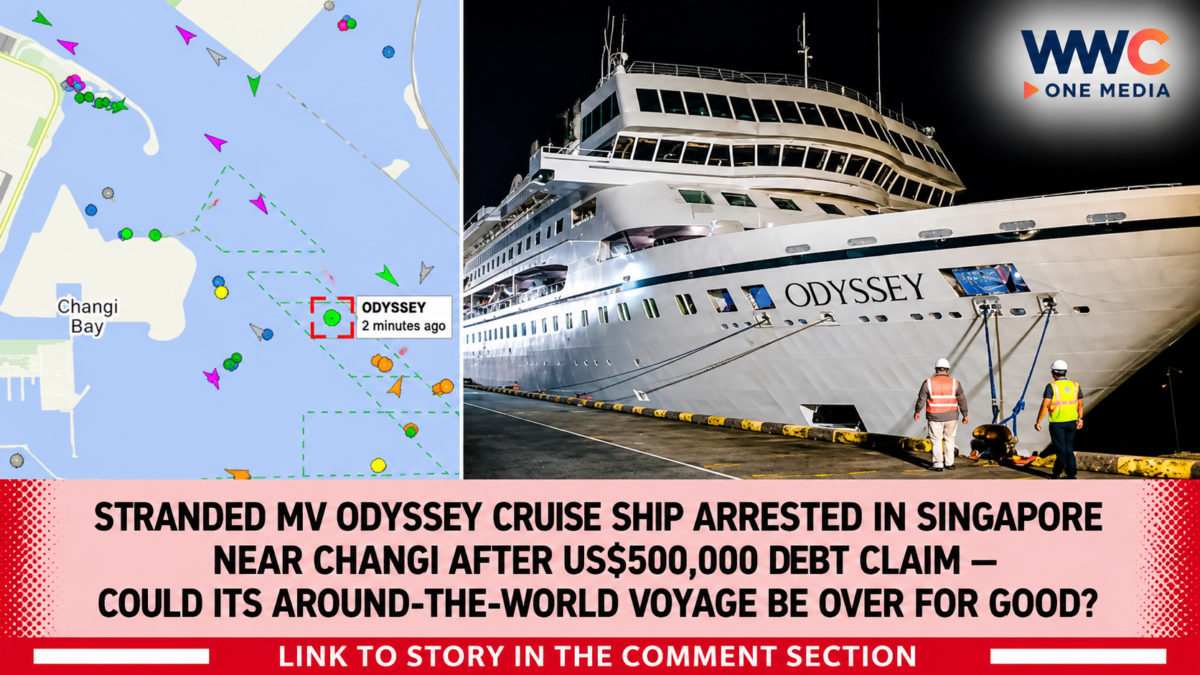
The troubled Villa Vie Odyssey, the residential cruise ship that abruptly abandoned its around-the-world voyage and left more than 200 passengers scrambling for accommodation in Cambodia, has now been placed under arrest in Singapore following a court order.
The vessel arrived in Singapore from Cambodia on Sunday, November 8, 2026, and was arrested at Changi General Purpose Anchorage. It is currently anchored in Singapore port waters, according to the Maritime and Port Authority of Singapore (MPA).
The arrest marks another major setback for the ship’s financially troubled US-based operator, Villa Vie Residences, whose ambitious promise of a floating home travelling around the world has unravelled following soaring fuel costs and mounting financial difficulties.
Singapore court records list Helmsman LLC as the arresting solicitor. CBS News reported that the operator allegedly owes one supplier approximately US$500,000, equivalent to around S$640,000.
However, the identity of the party behind the arrest has not been officially confirmed, and it remains unclear whether the reported supplier debt is the specific claim that triggered the court action.
The development has raised a critical question: What happens to a cruise ship when its operator can no longer meet its financial obligations, and could the Odyssey eventually be sold to settle outstanding debts?
MV Odyssey Arrested at Singapore’s Changi Anchorage
The MPA confirmed on November 9 that the Odyssey had been placed under arrest pursuant to a court order.
The authority said the vessel was anchored in Singapore port waters and that there were no passengers aboard.
The crew members remaining on the ship were reported to be well, with arrangements for their welfare and wellbeing being managed by the vessel’s creditors.
Singapore court records identified the arresting solicitor as Helmsman LLC and listed the vessel at Changi General Purpose Anchorage.
The legal action is significant because a ship arrest is not simply a routine port inspection or an administrative detention.
It is a formal maritime legal process through which a vessel can be detained under a court order to secure a claim against it or an associated maritime obligation.
Depending on the circumstances, the arrest may involve unpaid fuel bills, port charges, financing obligations or other maritime claims.
The vessel generally cannot continue its voyage while the arrest remains in force unless the legal requirements for its release are satisfied.
Importantly, a ship arrest does not automatically mean the vessel has been permanently confiscated or sold. The legal process may still allow the relevant parties to settle the claim or provide acceptable security.
Who Is Behind the Arrest of the Luxury Cruise Ship?
One of the biggest unanswered questions is who initiated the legal action against the Odyssey.
Court records identify Singapore law firm Helmsman LLC as the arresting solicitor, but the publicly available information does not establish the identity of the client it represents.
CBS News reported that a source familiar with the matter believed the claimant was likely a fuel supplier.
The report also stated that Villa Vie Residences was said to owe one supplier approximately US$500,000.
That amount is substantial for a residential cruise operator already struggling to cover its operating expenses.
However, the reported debt should not be treated as a confirmed judgment or proof that the supplier named in the report was responsible for the arrest.
The precise claim, creditor and legal basis have not been fully disclosed publicly.
The vessel’s detention nevertheless places additional pressure on a company that has already suspended its passenger operations and faced questions about its ability to continue the business.
How a Dream Around-the-World Cruise Collapsed in Cambodia
The Odyssey’s latest legal troubles follow a dramatic breakdown in Cambodia in late October.
The ship was docked at Sihanoukville for a scheduled stop when Villa Vie Residences announced on October 27 that it was suspending operations.
The company attributed the decision to extraordinary increases in fuel expenses linked to the conflict involving Iran.
On October 28, approximately 203 passengers were told to disembark, with reports that they had only around seven hours to leave the vessel.
For many residents, the announcement was devastating.
The Odyssey had not been marketed as an ordinary cruise ship offering short holidays. Villa Vie promoted it as a residential vessel where people could purchase or rent cabins and live aboard while travelling around the world.
Some passengers had spent substantial amounts of money to secure long-term accommodation at sea. Others had reorganised their lives around the promise of continuous international travel.
Instead of continuing to their next destination, they suddenly had to arrange hotels, flights and other accommodation in Cambodia.
The incident attracted international attention because some passengers reportedly had paid hundreds of thousands of dollars for their residential arrangements.
The Ship Left Cambodia Without Its Passengers
After the suspension, the Odyssey remained in Cambodia while arrangements were made for its departure.
The vessel eventually left Sihanoukville on November 4 without passengers.
Cambodian tourism officials said approximately 50 crew members remained aboard when it departed.
Around 100 former passengers were still in Cambodia at that time, while others had travelled to different destinations across the region.
The ship’s departure was another indication that the original residential cruise operation had effectively stopped.
Reports suggested that creditors or the vessel’s lender had taken control of its movement before it headed towards Singapore.
The subsequent arrest in Singapore has now added another layer of uncertainty to the vessel’s future.
WWC ONE MEDIA previously reported the sudden suspension in MV Odyssey Cruise Suspends World Voyage in Cambodia, Leaving 203 Passengers Stranded After Fuel Costs Skyrocket.
Our follow-up coverage also examined the ship’s departure without its residents in Cruise Ship Leaves Cambodia Without 203 Passengers After World Voyage Collapses.
Fuel Costs Soared From US$1,800 to as Much as US$8,000 Per Cabin
Villa Vie Residences has blamed rising fuel costs for the suspension of the Odyssey’s voyage.
According to the company, monthly fuel expenses that previously averaged approximately US$1,800 per cabin increased to an estimated US$6,000 to US$8,000 in some parts of Asia.
That represents more than a threefold increase in the fuel expense allocated per cabin.
The company said it attempted to reduce fuel consumption by slowing the ship’s itinerary and spending more time in ports rather than continuously sailing.
However, those measures were insufficient to offset the additional costs.
The operator also said passing the entire increase on to residents was not a realistic solution.
The conflict involving Iran has disrupted energy markets and shipping activity, including traffic through the strategically important Strait of Hormuz. Higher fuel prices have placed pressure on transport and shipping businesses that rely heavily on marine fuel.
The Odyssey’s financial problems have also attracted scrutiny beyond the company’s explanation.
CBS News previously reported that internal documents and accounts from people familiar with the business pointed to financial difficulties months before the Cambodian suspension. Those reports described concerns involving outstanding payments, operating expenses and attempts to raise additional funds.
The broader financial situation has not been fully established through publicly available audited accounts, but the reporting suggests the fuel crisis may have compounded problems that were already developing.
WWC ONE MEDIA also examined the wider impact of rising energy expenses on cruise operators in Cruise Giants Face $1.1-Billion Quarterly Fuel Bill as Oil Prices Surge.
Some Passengers Paid More Than US$300,000 for Their Floating Homes
The Odyssey’s business model was built around a different kind of cruise experience.
Rather than selling only conventional holiday packages, Villa Vie Residences offered customers the opportunity to purchase or rent cabins for extended periods.
The company marketed the ship as a floating residential community that would travel internationally while allowing residents to maintain their own accommodation aboard.
Some passengers reportedly paid more than US$300,000 for lifetime suites.
The vessel’s around-the-world journey began in Belfast, Northern Ireland, in October 2024, with a planned itinerary covering more than 150 countries and destinations.
The ship itself was built in 1993 and had operated under different names and cruise companies before Villa Vie acquired it in 2023.
For residents, the appeal was the possibility of combining long-term accommodation with continuous travel.
But the sudden suspension has raised difficult questions about the financial protection available to customers who purchase residential cruise arrangements.
Unlike buying a conventional property, purchasing a cabin or long-term residence aboard a cruise ship does not necessarily provide the same ownership rights or protections.
The rights of individual passengers will depend on their contracts, the structure of their arrangements and the applicable legal proceedings.
Could the Odyssey Be Sold at Auction?
One possible outcome is a judicial sale of the vessel if the financial claims cannot be resolved.
A ship arrest can provide creditors with a legal mechanism to secure a maritime claim. Depending on the proceedings and applicable court orders, the vessel may eventually be sold to satisfy outstanding obligations.
CBS News previously reported that the Odyssey had been taken over by a lender and moved from Cambodia to Singapore ahead of a possible auction.
However, an auction has not been confirmed as the final outcome.
The vessel could potentially be released if the relevant claim is settled or acceptable security is provided.
A new investor or operator could also explore taking over the ship, although that would require resolving its financial and operational difficulties.
Any future passenger service would likely depend on the vessel’s ownership, financing, maintenance, insurance and ability to meet maritime regulatory requirements.
For now, its arrest means the Odyssey cannot simply resume its original around-the-world voyage as though nothing happened.
What Happens to the Crew Still Aboard?
The MPA said the crew members remaining on the vessel were reported to be well and that their welfare arrangements were being managed by the creditors.
This is an important development because the ship departed Cambodia with a reduced crew after its passenger operations were suspended.
The original vessel carried 203 guests and 156 crew members, according to reports from the time of the suspension.
Approximately 50 crew members were reported to have remained aboard when the Odyssey left Cambodia on November 4.
The MPA has not publicly detailed the full arrangements for the crew, including their eventual repatriation or the duration of their stay aboard the detained vessel.
The situation highlights another consequence of the cruise operator’s financial problems: the uncertainty does not affect only passengers who paid to live aboard the ship, but also workers responsible for operating and maintaining it.
Why Singapore Is a Key Location in the Odyssey’s Legal Battle
Singapore is one of the world’s major maritime and shipping centres, making it an important location for resolving international vessel-related disputes.
Its courts handle maritime claims involving ships, shipping companies, lenders, suppliers and other parties with legal interests in vessels.
The Odyssey’s arrest at Changi General Purpose Anchorage places the dispute within Singapore’s maritime legal framework.
The incident also highlights the importance of the country’s port infrastructure and maritime services.
Singapore continues to invest in its cruise and passenger facilities as regional travel grows. Its new HarbourFront cruise and ferry terminal, for example, introduced upgraded self-service check-in and automated immigration facilities.
WWC ONE MEDIA covered the development in Singapore’s New HarbourFront Cruise Terminal Opens With Self-Service Check-In and Passport-Less Clearance.
The Odyssey’s situation is different from a conventional cruise arrival: the vessel is not in Singapore to carry holidaymakers or begin another scheduled itinerary. It is anchored following a court-ordered arrest.
Four Major Questions About the Ship’s Future
Despite the latest development, several important issues remain unresolved.
Who filed the claim that led to the arrest?
Helmsman LLC is listed as the arresting solicitor, but the identity of the client and the exact claim have not been publicly confirmed.
Will the reported US$500,000 debt be settled?
The reported amount could be connected to a supplier claim, but the exact relationship between that debt and the court-ordered arrest remains unclear.
Will the vessel be auctioned?
A judicial sale is one possible outcome, but the arrest does not automatically mean the ship will be sold.
Will the Odyssey ever carry passengers again?
The company has discussed restructuring and recapitalisation, but there is no confirmed date for the resumption of the original voyage.
The answers will determine whether the Odyssey can return to service, operate under a new owner or become the subject of further maritime proceedings.
The End of the Floating-Home Dream?
The arrest of the Villa Vie Odyssey in Singapore marks another dramatic chapter in the collapse of its ambitious residential cruise operation.
What began as a promise of years of uninterrupted travel has turned into a financial and legal dispute involving a stranded vessel, hundreds of affected passengers, outstanding supplier claims and an uncertain future.
The ship is now anchored near Changi under a court order, with no passengers aboard and its remaining crew reported to be well.
The operator’s financial difficulties, the reported US$500,000 supplier debt and the possibility of a judicial sale have placed the vessel’s future in doubt.
For the former residents, the most urgent concern is what happens to the money they invested and whether the company can provide a meaningful solution.
For the maritime industry, the case is a reminder that even an ambitious international cruise operation can be brought to a halt when operating costs and financial obligations become unsustainable.
The Odyssey may still have a future under a new financial arrangement or owner, but its original voyage has already suffered a major collapse.
Will Singapore’s court proceedings lead to the sale of the once-luxurious floating home, or can a new investor rescue the Odyssey before its around-the-world dream disappears for good?