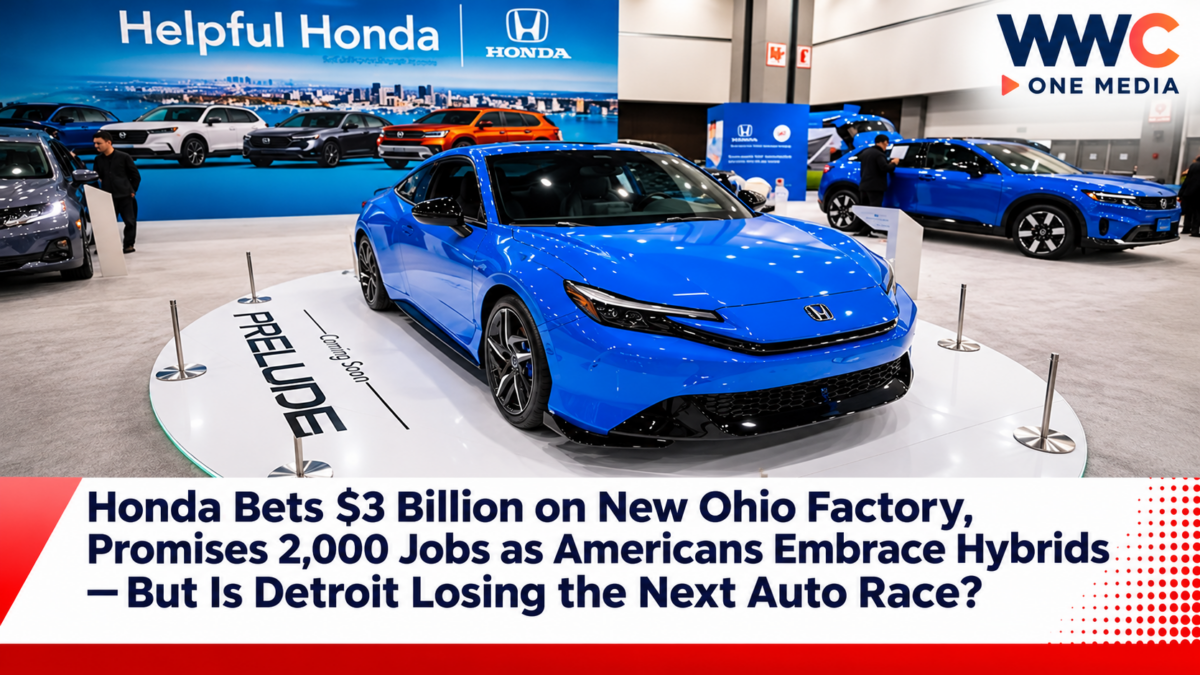
MARYSVILLE, OHIO — November 10, 2026 — Japanese automotive giant Honda Motor is making one of its biggest manufacturing bets in the United States, announcing plans to build a $3-billion vehicle assembly plant in Ohio as American carbuyers increasingly embrace hybrids while demand for fully electric vehicles remains uncertain.
The new factory, located between Honda’s existing Marysville and East Liberty automobile plants in central Ohio, is expected to create more than 2,000 jobs and produce up to 240,000 vehicles annually when fully operational.
Production is scheduled to begin in 2029, subject to final government approvals.
The investment will help increase Honda’s total US automobile manufacturing capacity to approximately 1.3 million vehicles a year.
But the announcement represents more than another factory expansion.
It highlights a major shift in the American automotive market.
While manufacturers have invested billions of dollars in battery-electric vehicles, customers are increasingly choosing hybrids that offer improved fuel economy without requiring access to charging stations.
Honda plans to capitalize on that demand while maintaining the flexibility to manufacture gasoline-powered, hybrid and fully electric vehicles at the new facility.
The company is also upgrading production operations across Ohio, Alabama and Georgia, while making additional investments in Canada.
According to CNBC, Reuters and Honda’s official November 9 announcement, the expansion forms part of a wider strategy to strengthen North American manufacturing and prepare for next-generation vehicles.
But as Honda commits billions to hybrid production while Detroit’s established automakers rethink their electrification strategies, a critical question emerges: Is the Japanese carmaker positioning itself for the next era of American vehicle demand—or could another shift in consumer preferences undermine its $3-billion gamble?
Honda Announces $3-Billion Factory in Central Ohio
Honda confirmed that its new assembly plant will be constructed on land between its existing factories in Marysville and East Liberty.
The location places the project near established vehicle-manufacturing operations, research facilities and a large automotive supplier network.
The company expects the plant to begin producing vehicles in 2029.
At its planned capacity, the factory could manufacture 240,000 vehicles annually.
That represents roughly 20,000 vehicles per month if production were evenly distributed across a full year.
However, this is a capacity calculation, not a confirmed monthly production schedule.
Actual output will depend on demand, staffing, production schedules and the timing of the plant’s ramp-up.
Honda also confirmed that the project is expected to create more than 2,000 American jobs.
The new factory will be designed to produce multiple models and powertrain technologies, allowing Honda to adjust manufacturing as market conditions change.
Why Honda Is Betting Billions on Hybrid Vehicles
The most important feature of Honda’s announcement is its emphasis on hybrid technology.
Hybrids combine an internal combustion engine with electric propulsion.
Conventional hybrids generally do not require external charging because their batteries are replenished through the engine and regenerative braking.
That makes them attractive to drivers who want better fuel economy without relying on public charging infrastructure.
In the United States, buyers have become increasingly sensitive to vehicle affordability, fuel expenses and charging convenience.
Traditional hybrids address several of those concerns.
Consumers can refuel at ordinary gasoline stations while benefiting from electric assistance during driving.
Honda already offers hybrid versions of popular models including the Civic, Accord and CR-V.
The company sees room to expand its lineup further.
In May 2026, Honda announced plans to introduce 15 new Honda and Acura hybrid models globally by 2030, with North America expected to serve as a major market for many of them.
The Ohio investment will support that strategy.
But Honda is not declaring that fully electric vehicles have no future.
The new facility is being designed to manufacture battery-electric models as well, giving the automaker flexibility if demand changes again.
Hybrid Demand Is Reshaping the American Car Market
Honda’s decision comes at a time when hybrid vehicles are gaining market share in the United States.
Research from Cox Automotive, previously covered by WWC ONE MEDIA, showed that conventional hybrids accounted for approximately 16.3% of US new-vehicle sales in the second quarter of 2026, compared with 13% a year earlier.
Battery-electric vehicles, meanwhile, faced a more uncertain demand environment following changes in federal incentives.
The result is a growing competitive advantage for manufacturers with established hybrid technology.
Toyota and Honda have spent years developing hybrid systems and integrating them into mainstream models.
General Motors, by contrast, has been reconsidering how much emphasis to place on hybrids alongside its electric-vehicle strategy.
Related WWC ONE MEDIA coverage: GM Finally Embraces Hybrids as EV Demand Slows — But Toyota May Already Have a Huge Head Start
The shift matters because customers are not choosing vehicles based on environmental considerations alone.
Purchase price, financing costs, fuel efficiency and convenience remain important.
A manufacturer able to supply several powertrain choices may be better positioned to respond to those changing preferences.
Ohio Officials Announce a Broader $3.38-Billion Investment Package
Honda’s $3-billion plant announcement is part of a larger investment commitment in Ohio.
Governor Mike DeWine and JobsOhio reported that the state’s overall Honda investment package totals approximately $3.38 billion, with commitments involving 2,390 new jobs.
The broader figures include the new assembly plant and associated investments at existing facilities, including engine and transmission operations.
This distinction is important.
The $3.38-billion figure should not be added to the $3-billion factory budget as if they were separate, unrelated projects.
Similarly, the 2,390 statewide jobs include the broader Ohio commitment, rather than representing additional jobs on top of the 2,000-plus positions announced for the new assembly facility.
The package strengthens Honda’s long-established relationship with Ohio.
The company began automobile production in the United States at Marysville in 1982.
The new project represents another major expansion of that manufacturing presence.
Honda to Expand Hybrid Production Capacity by 250%
Honda is not investing only in a new assembly building.
The company also plans extensive improvements to the manufacturing systems that produce engines, transmissions and hybrid components.
One major initiative involves its Ohio transmission plant.
The facility is being retooled to support the production of two next-generation hybrid systems.
Honda says the changes will increase hybrid powertrain-system capacity in Ohio by 250% in the coming years.
That is a substantial increase.
The plant already produces the company’s two-motor hybrid system for US-built vehicles such as the CR-V, Accord and Civic.
Under the new program, Honda will expand its capabilities to support both compact and midsize vehicles and larger models.
The company expects production of one next-generation hybrid system to begin in 2027.
The expansion indicates that Honda is investing in the components needed to support a broader range of hybrid vehicles rather than relying solely on existing products.
Alabama and Georgia Factories Will Also Be Upgraded
Honda’s strategy extends beyond Ohio.
At its Alabama Auto Plant, the manufacturer plans to renovate vehicle and engine operations.
The investment includes preparation for production of a new V6 hybrid engine.
Honda also intends to upgrade one of the plant’s vehicle assembly lines to increase manufacturing flexibility.
At the company’s Georgia transmission facility, new equipment will be introduced to support next-generation hybrid systems for larger vehicles.
These investments are designed to create a more integrated production network.
Instead of relying on isolated facilities, Honda wants its North American operations to work together across vehicle assembly, engines and hybrid components.
This may improve manufacturing flexibility and reduce the difficulty of introducing new models.
However, each project will still require successful equipment installation, workforce training and production validation.
The New Factory Will Also Be Capable of Building EVs
Although the project is being promoted primarily as a response to hybrid demand, Honda confirmed that the new Ohio plant will not be limited to hybrids.
The facility is intended to support gasoline-powered vehicles, hybrid-electric models and battery-electric vehicles.
This flexibility could prove important.
Automakers cannot predict with certainty how consumer demand, energy prices and government policies will evolve over the next decade.
A factory designed for only one type of vehicle may become less competitive if demand shifts.
Honda is seeking to avoid that problem by investing in flexible production systems.
The company plans to use advanced automation, data-driven technology and adaptable assembly processes.
But the ability to manufacture different vehicle types does not mean Honda has already announced exactly which models will be built there.
Specific vehicle allocations have not yet been confirmed.
Why Honda Chose Ohio Instead of Another State
The location offers several advantages.
Honda already operates major facilities in the region.
The company has access to an experienced automotive workforce, engineering operations and a well-established supplier network.
Its North American Automotive Development Center and the nearby Transportation Research Center provide additional engineering and testing capabilities.
The region also benefits from supporting infrastructure and workforce-training partnerships.
Honda has invested in research relationships with Ohio State University and other educational institutions.
These connections can help provide the specialized employees needed for advanced automotive manufacturing.
Locating a new factory near existing operations may also reduce logistical complexity.
Components can potentially move between facilities more efficiently than if the new operation were established in an entirely separate manufacturing region.
But proximity alone does not guarantee success.
The investment must still deliver competitive manufacturing costs, reliable production and vehicles that customers want to purchase.
Honda’s Decision Adds Pressure on Detroit Automakers
The expansion comes as competition intensifies among Japanese, American and South Korean automakers.
Toyota has benefited from its established hybrid lineup.
Honda is expanding production capacity to respond to similar demand.
Hyundai and Kia have also gained ground in the American market through a combination of fuel-efficient vehicles, competitive pricing and new models.
As previously reported by WWC ONE MEDIA, Hyundai Motor Group came close to overtaking Ford in US quarterly vehicle sales during the third quarter of 2026.
Related WWC ONE MEDIA coverage: Hyundai Nearly Overtakes Ford in U.S. Sales as Hybrid Boom Reshapes America’s Auto Market — But Detroit’s Bigger Problem Is What Buyers Want Next
These competitive pressures help explain Honda’s investment strategy.
Manufacturers increasingly need to offer vehicles that meet customers’ actual affordability and efficiency needs rather than assuming that every buyer is ready to switch to an all-electric model.
Still, the new Honda factory will not begin production until 2029.
That means its competitive impact will depend on what happens in the market over the next several years.
Honda’s Strategy Follows a Costly EV Rethink
The investment also comes after Honda reassessed parts of its electric-vehicle expansion strategy.
Reuters reported that the automaker had suspended a major Canadian EV investment project valued at approximately $11 billion and recognized substantial EV-related impairment charges.
Those developments reflected changing assumptions about the pace of battery-electric vehicle adoption.
Honda is not alone in revising its strategy.
Several automakers have adjusted spending plans, delayed EV programs or placed greater emphasis on hybrid models.
Such decisions do not necessarily indicate that the global transition toward electric vehicles has ended.
Instead, they show that manufacturers are trying to respond to differences in demand across markets.
Honda’s new Ohio facility is designed to preserve several options.
It can support hybrids while retaining the possibility of future battery-electric vehicle production.
Tariffs Add Another Reason to Expand US Manufacturing
The US trade environment provides additional context.
Automakers face uncertainty involving tariffs on imported vehicles, components and industrial materials.
Domestic manufacturing can help companies manage some of those risks, although vehicles assembled in the United States may still rely on imported parts.
Reuters noted that foreign manufacturers have been increasing US investment amid the tariff policies of President Donald Trump’s administration.
For Honda, local production has been a central part of its strategy for decades.
According to the company, nearly 99% of Honda and Acura automobiles sold in the United States during 2025 were manufactured in North America.
That measure covers North America, not exclusively the United States.
The new Ohio investment builds on that established manufacturing presence.
It would be inaccurate, however, to claim that tariffs alone caused the $3-billion decision.
Honda’s own announcement emphasizes hybrid demand, production flexibility, supplier access and long-term competitiveness.
Honda’s Expansion Comes as Global Automakers Face Rising Costs
Despite the optimism surrounding the investment, the worldwide automotive industry faces significant pressure.
Manufacturers are confronting higher commodity prices, logistics expenses, trade uncertainty and intense competition.
Some have reduced earnings forecasts or reconsidered previously announced investments.
As WWC ONE MEDIA recently reported, global light-vehicle production is expected to remain close to 92 million vehicles in 2027, with limited growth projected.
Related WWC ONE MEDIA coverage: Global Car Production Stalls Near 92 Million Vehicles as GM Faces $2-Billion Cost Shock — But Could 2027 Bring an Auto Industry Profit Crisis?
That broader industry outlook creates an important question.
Honda is expanding capacity even as some automakers become more cautious about costs and profitability.
Management is betting that a more flexible product lineup and stronger hybrid capabilities will allow it to capture sufficient demand.
But planned manufacturing capacity does not automatically translate into actual sales.
If the market weakens or production costs rise, achieving attractive returns could become more difficult.
Canada’s Honda Operations Will Also Receive Investment
Honda’s North American strategy includes manufacturing facilities outside the United States.
Reuters reported that Honda plans approximately C$867 million in Canadian investment, including spending at its operations in Alliston, Ontario.
The Canadian program will support plant upgrades and future production capabilities.
Honda’s official statement also identifies work to reintroduce engine manufacturing and prepare for next-generation hybrid and gasoline-powered models.
This demonstrates that the company’s strategy remains regional.
Factories in the United States and Canada form part of an interconnected manufacturing network.
Honda is seeking to strengthen production capabilities throughout that system rather than relocate every operation into Ohio.
The announcement should therefore not be interpreted as a complete withdrawal from Canadian manufacturing.
What Honda’s Investment Could Mean for the Philippines
The new Ohio plant is a US manufacturing project.
Honda has not announced that the factory will directly create jobs in the Philippines or that Philippine suppliers have been awarded specific contracts.
Nevertheless, the development is relevant to the Philippine automotive industry.
Hybrid vehicles are becoming more common, creating demand for technicians capable of handling advanced electric systems alongside conventional engines.
Manufacturers, dealerships and automotive schools must adapt to that transition.
As previously reported by WWC ONE MEDIA, Toyota Motor Philippines has expanded its training programs to prepare Filipino technicians for hybrid and other advanced automotive technologies.
Related WWC ONE MEDIA coverage: Toyota Expands Pipeline for Filipino Auto Technicians as PH Skills Gain Regional Recognition
The Philippine comparison is about workforce development rather than a confirmed connection to Honda’s Ohio project.
Automotive technicians increasingly require knowledge of high-voltage electrical systems, computerized diagnostics and safety procedures.
Those capabilities may become more valuable as global manufacturers introduce a wider range of electrified vehicles.
What Happens Before Production Begins in 2029?
Several major steps remain before Honda can begin building vehicles at the new plant.
The project must receive final government approvals.
Honda must complete construction, install production equipment and establish manufacturing processes.
The company will also need to recruit and train workers.
Supplier operations must be prepared to deliver components at the required volume and quality.
After that, the plant will need to validate its production systems before moving toward full manufacturing capacity.
The announced 2029 start date is therefore a target, not a guarantee.
Honda has also not identified every vehicle model the facility will produce.
Further announcements concerning construction, hiring and vehicle programs will provide a clearer picture of the factory’s eventual role.
The Bigger Picture: Is Honda Betting on the Right Automotive Future?
Honda’s $3-billion Ohio announcement is a significant vote of confidence in American automobile manufacturing.
The company plans to create more than 2,000 jobs, add annual production capacity for 240,000 vehicles and strengthen its hybrid supply chain.
Its broader Ohio investment package includes $3.38 billion and commitments involving 2,390 new jobs.
The project comes as conventional hybrids gain popularity among consumers seeking fuel efficiency without the inconvenience of regular charging.
Honda is responding by increasing capacity for hybrid systems while preserving the ability to manufacture gasoline-powered and fully electric vehicles.
That flexibility may prove valuable.
But the investment also presents risks.
The factory will not start production until 2029.
Consumer preferences could change.
Trade policies may evolve.
And competition among automakers will remain intense.
Honda’s strategy is not a declaration that the EV era is over. It is a calculated bet that the future of the automobile market will require more than one powertrain technology.
And as Honda commits billions to a new American factory while its rivals rethink hybrid and electric-vehicle investments, the question facing Detroit and the global auto industry is becoming increasingly urgent: Will Honda’s flexible manufacturing strategy capture the next wave of demand—or could another unexpected shift in the market leave even the strongest carmakers racing to catch up?