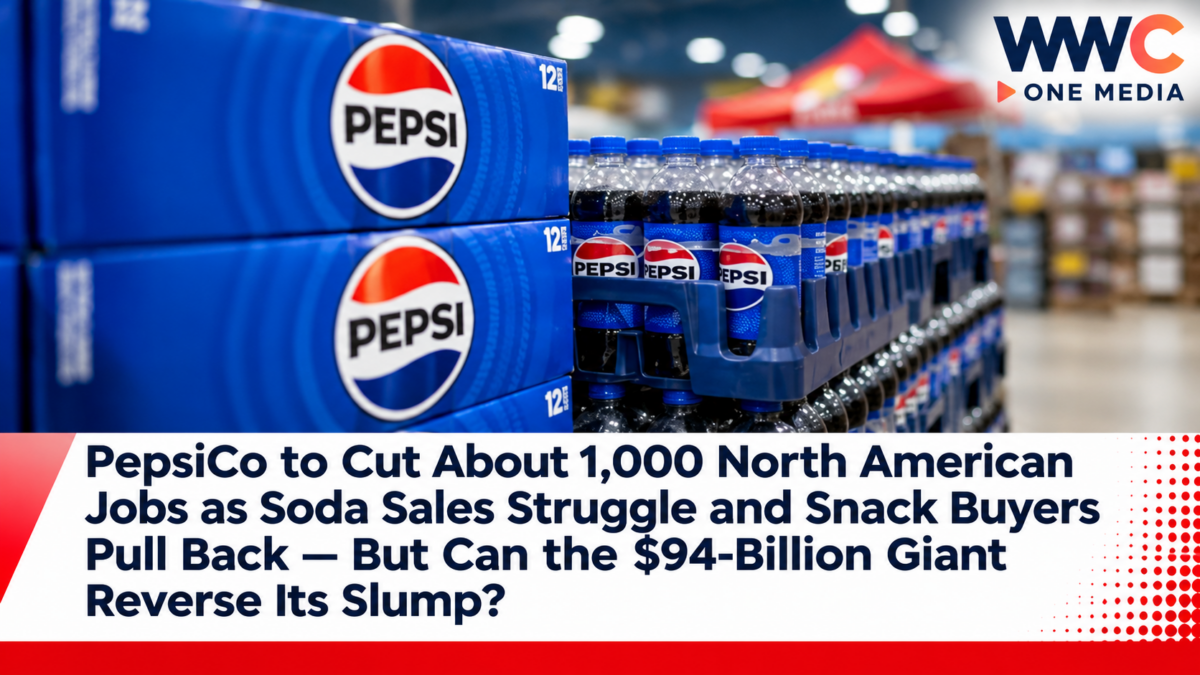
PURCHASE, NEW YORK — November 10, 2026 — One of the world’s largest food and beverage companies is preparing to eliminate approximately 1,000 positions across North America as weak demand for its drinks, slowing snack sales and pressure to improve profitability force a major organizational shake-up.
PepsiCo Inc., the multinational giant behind Pepsi, Mountain Dew, Gatorade, Lay’s, Doritos and Cheetos, announced the changes internally on Monday, November 9.
According to CNBC, Reuters and The Wall Street Journal, the job reductions are expected to take place over the following week as the company simplifies its North American food and beverage operations.
The move comes barely a month after PepsiCo lowered its 2026 earnings outlook and acknowledged that its turnaround in North America was progressing more slowly than expected.
During the third quarter, the company’s North American beverage business recorded a 2% decline in sales volume, while its North American food operations reported flat volumes.
Those numbers reveal a central problem: PepsiCo’s famous brands continue generating billions of dollars in revenue, but consumers are not buying more products at the pace management wants.
The restructuring also comes amid pressure from activist investor Elliott Investment Management, which built a roughly $4-billion position in PepsiCo in 2025 and has pushed for stronger operating performance.
With the company seeking substantial productivity savings, the announcement has raised questions about the future of its workforce and whether organizational changes can revive consumer demand.
But as PepsiCo prepares to cut about 1,000 jobs while fighting to win back shoppers, a bigger question emerges: Will eliminating positions make the business more competitive—or is the slowdown in America’s food and beverage market deeper than management anticipated?
PepsiCo Announces Approximately 1,000 North American Job Cuts
PepsiCo North America CEO Ram Krishnan informed employees of the coming restructuring in a November 9 letter reviewed by CNBC and Reuters.
The company intends to simplify its organizational structure, improve coordination between teams and make decisions more quickly.
Krishnan indicated that the organization had become overly complicated, with processes and responsibilities spread across multiple parts of the business.
The planned changes are designed to eliminate unnecessary complexity and strengthen accountability.
According to The Wall Street Journal and Bloomberg, approximately 1,000 positions are expected to be affected.
However, the company has not publicly confirmed a final, comprehensive breakdown of the roles being eliminated.
It has also not disclosed exactly how the job cuts will be divided among offices, factories, sales operations and other departments.
The distinction matters.
An announcement involving approximately 1,000 planned reductions does not establish that the same number of employees have already been dismissed.
The precise impact will become clearer as PepsiCo implements the restructuring.
Why PepsiCo Is Restructuring Its North American Business
PepsiCo’s announcement reflects a wider effort to improve its performance in the United States and Canada.
The company is confronting several commercial challenges at the same time.
Consumer spending has become more selective.
Higher prices have made some packaged snacks less attractive.
Beverage competition has intensified.
And the costs of manufacturing, distributing and promoting products remain elevated.
PepsiCo has responded by adjusting prices, increasing marketing investment and changing its product portfolio.
But those measures have not yet produced the recovery management expected.
The company is now looking for structural savings to support further investments in its brands.
In practical terms, PepsiCo is trying to reduce spending on internal complexity while directing more resources toward products, customers and distribution.
That strategy may improve operating efficiency.
However, cost cutting alone does not guarantee that consumers will buy more soda, chips or other packaged foods.
North American Beverage Volume Drops 2%
One of the clearest warning signs appeared in PepsiCo’s third-quarter results.
The company’s North American beverage operations reported a 2% year-on-year decline in volume.
That means fewer units were sold on the applicable comparable-volume measure.
Volume is important because revenue can increase even when fewer products are purchased.
For example, higher selling prices or changes in product mix can support revenue despite weaker physical sales.
But persistent volume declines may indicate that customers are reducing consumption, switching brands or choosing different products.
PepsiCo has been trying to strengthen the competitiveness of its beverage portfolio.
Its brands include Pepsi, Mountain Dew, Gatorade, Propel, bubly and other drinks.
However, the business faces strong competition from Coca-Cola, Keurig Dr Pepper and emerging beverage companies.
Consumers are also increasingly interested in products associated with functional benefits, reduced sugar or other changing preferences.
For PepsiCo, restoring volume growth is an important part of its turnaround.
Snack Sales Remain Flat Despite Price Adjustments
The company’s North American food business also faces challenges.
Third-quarter food volume was essentially unchanged from a year earlier.
That represents stabilization rather than meaningful growth.
PepsiCo has sought to improve demand for brands such as Lay’s and Doritos through pricing adjustments and marketing programs.
Reuters previously reported that the company reduced prices on selected snack products by as much as 15% earlier in 2026.
But some of those initiatives have taken longer than expected to improve sales.
The problem is especially difficult because lower prices may encourage purchases while reducing the revenue earned per unit.
Higher ingredient, packaging and distribution costs can also pressure margins.
Management must therefore determine which price points can attract shoppers without making the business less profitable.
The challenge extends beyond PepsiCo.
Other major packaged-food manufacturers are increasing promotions and emphasizing affordability as households reconsider discretionary purchases.
PepsiCo Cuts Its 2026 Earnings Forecast
The November layoffs follow an important financial warning issued on October 8.
PepsiCo reduced its forecast for 2026 core earnings-per-share growth on a constant-currency basis.
The company now expects growth of approximately 1% to 2%, compared with its previous expectation near the lower end of a 4% to 6% range.
The revision reflects pressure on North American profitability.
Management also warned that improvement in the region’s core operating margin was taking longer than expected.
PepsiCo reported approximately $25.27 billion in consolidated net revenue during the third quarter, an increase of 5.6% year over year.
That means the broader company was still generating revenue growth.
The problem was that growth in the international business and certain other areas was not eliminating weakness in its North American operations.
This is an important distinction.
PepsiCo is not reporting a companywide collapse in sales.
It is restructuring because some major parts of the business are underperforming while operating costs remain significant.
Elliott Investment Management Adds Pressure
The turnaround also comes under scrutiny from Elliott Investment Management.
The activist investment firm built a stake worth approximately $4 billion in PepsiCo in 2025.
Elliott has pushed for measures intended to improve performance, sharpen the company’s operating strategy and strengthen shareholder returns.
The investment firm’s involvement has added pressure on PepsiCo’s leadership to demonstrate that it can improve the company’s financial results.
Activist investors often seek changes in strategy, spending or organizational structure when they believe a company’s market valuation does not reflect its potential.
However, the November 9 reporting does not establish that Elliott directly selected the 1,000 positions targeted for elimination.
The workforce restructuring is being implemented by PepsiCo management.
The company’s stated objective is to make its organization simpler and more effective while continuing to invest in growth.
How Large Are the Job Cuts Compared With PepsiCo’s Workforce?
PepsiCo employed approximately 306,000 people worldwide as of December 27, 2025.
Of that number, roughly 125,000 were based in the United States.
The planned 1,000 job reductions represent about 0.33% of the reported global workforce.
But this comparison has limitations.
The reductions cover North America, while the 125,000-person figure refers specifically to the United States.
The company has also not confirmed the exact distribution of affected employees between the United States and Canada.
Therefore, the 1,000 positions should not be presented as a verified 0.8% reduction of PepsiCo’s current North American workforce.
The broader employment figures provide scale, but the actual impact on individual teams and locations may be more concentrated.
For those losing their jobs, even a comparatively small percentage reduction can have significant financial and personal consequences.
PepsiCo Has Already Closed US Facilities in 2026
The latest restructuring follows earlier operational changes involving production facilities.
In September, PepsiCo shut down manufacturing and related operations at a facility in Cheverly, Maryland.
The closure affected approximately 143 jobs, according to reporting by The Washington Post.
Local officials and longtime employees expressed concern about the economic effects on the surrounding community.
PepsiCo cited changing demand and the need to modernize its operating network.
The company also announced the immediate closure of its Knoxville, Tennessee, beverage plant on October 19.
In its official announcement, PepsiCo said affected employees would receive continued pay and benefits during a notice period, along with transition resources.
These facility closures are separate announcements from the roughly 1,000 North American positions reported on November 9.
The available reporting does not establish whether any affected roles overlap with the new restructuring total.
Consequently, the figures should not simply be added together as though they represent confirmed, entirely separate layoffs.
Starbucks Offers Another Example of Corporate Restructuring
PepsiCo is not the only major consumer-facing company making difficult workforce and operating decisions.
Starbucks has also been reorganizing its North American business as it attempts to improve profitability and customer experience.
In September 2026, the coffee chain announced another wave of store closures under CEO Brian Niccol.
As previously reported by WWC ONE MEDIA, Starbucks planned to shut approximately 250 North American coffeehouses while continuing to invest in stronger locations.
Related WWC ONE MEDIA coverage: Starbucks to Close 250 North American Stores in Second Major Wave of Closures
The Starbucks closures are unrelated to PepsiCo’s restructuring.
They illustrate how major consumer companies may simultaneously reduce costs and invest in business areas they believe can deliver better growth.
However, the consequences differ depending on whether companies close locations, eliminate management positions or modify production and distribution networks.
Why Layoffs Do Not Automatically Fix Weak Consumer Demand
Reducing payroll can improve a company’s cost structure.
But the effects on sales are less predictable.
A business may become more efficient if it eliminates overlapping responsibilities and simplifies decision-making.
It may also struggle if it removes employees who contribute to product development, sales or customer relationships.
PepsiCo’s restructuring is intended to improve execution.
That objective will require more than eliminating positions.
The company must continue offering products that consumers want at prices they are willing to pay.
It also needs effective distribution, competitive promotions and strong relationships with retailers.
A successful turnaround would ideally produce both better operating margins and sustainable growth in sales volumes.
If sales remain weak, cost reductions may deliver only temporary financial improvements.
That is why investors will be watching the company’s next earnings reports closely.
US Consumer Companies Face a Broader Financial Squeeze
PepsiCo’s announcement comes during a difficult period for several American consumer businesses.
Some companies are restructuring to protect profitability.
Others face more severe financial distress.
The Children’s Place, for example, entered Chapter 11 bankruptcy protection on November 8 after a prolonged decline in sales and liquidity.
Earlier reporting from WWC ONE MEDIA examined the retailer’s financial difficulties, falling revenue and potential liquidation.
Related WWC ONE MEDIA coverage: Children’s Place Faces Possible Liquidation as Sales Plunge 19% and Cash Falls to $7.2 Million — But Can a Last-Minute Buyer Save 514 Stores?
The two companies are in very different financial positions.
PepsiCo remains a major profitable multinational company.
The Children’s Place entered bankruptcy protection.
Their situations should not be treated as equivalent.
The relevant comparison is that both have had to respond to pressure on consumer demand and operating costs.
Inflation, Tariffs and Operating Costs Complicate Turnarounds
Another challenge affecting consumer businesses is the cost of imported products, materials and other inputs.
Companies may face higher prices for ingredients, packaging, transportation and merchandise.
Tariffs can add further uncertainty where goods or components cross international borders.
Those costs can influence retail prices, margins and investment decisions.
As WWC ONE MEDIA previously reported, fitness company FitLab entered bankruptcy protection after facing a combination of financing difficulties, supply-chain problems and tariff-related pressures.
Related WWC ONE MEDIA coverage: Nike’s $20-Million Fitness Bet Unravels as FitLab Files Bankruptcy With Up to $500 Million in Debt — But Could Trump’s Tariffs Push More Fitness Brands to the Brink?
FitLab’s circumstances are separate from PepsiCo’s.
There is no evidence that the two restructurings are connected.
But the example illustrates why companies must manage several financial pressures at once rather than assuming a single cost-cutting measure will resolve all their problems.
Why the Layoffs Matter to the Global Workforce
The PepsiCo announcement is relevant beyond the United States.
Multinational companies increasingly face pressure to simplify operations, increase productivity and adapt to changing consumer behavior.
Such restructurings can affect corporate employees, factory workers, distribution teams and suppliers.
But their consequences depend on the specific business model and the departments being reorganized.
In the Philippines, the media industry has also experienced difficult employment adjustments.
ABS-CBN announced additional retrenchments in September 2026 despite securing commitments for new capital.
As WWC ONE MEDIA previously reported, the broadcaster’s restructuring reflected the challenge of reducing losses while financing a new operating model.
Related WWC ONE MEDIA coverage: ABS-CBN Just Secured ₱6 Billion in Fresh Capital — So Why Is It Cutting About 230 More Jobs?
The ABS-CBN layoffs are unrelated to PepsiCo’s North American job cuts.
However, both situations show that business restructuring can involve significant employment decisions even when management intends to continue investing in future growth.
There has been no verified announcement that PepsiCo’s November 9 North American restructuring includes layoffs in the Philippines.
Will PepsiCo Cut More Jobs After the First 1,000?
That remains unknown.
The November 9 announcement described changes expected over the following week.
It did not establish that the reported 1,000 positions represent every cost reduction PepsiCo might pursue in the future.
During its October earnings announcement, management said additional structural savings initiatives would be identified and implemented in the coming months.
That broader statement suggests the company’s turnaround is an ongoing process.
However, it does not authorize predictions about a second wave of layoffs or a specific additional headcount reduction.
Further employment decisions would need to be confirmed through official announcements or credible reporting.
For now, the reported figure remains approximately 1,000 planned North American job cuts.
What Investors Should Watch Next
PepsiCo’s next earnings reports will provide important evidence about the success of the restructuring.
Investors will want to see whether beverage sales volumes begin recovering.
They will also examine whether lower prices and promotional activity translate into stronger demand for snacks.
Another important measure will be operating margins.
If costs decline without damaging revenue growth, PepsiCo may begin demonstrating that its turnaround is working.
However, restructuring itself can create expenses, including severance and transition costs.
The company has not publicly provided a verified total savings estimate specifically attributable to the November 9 layoffs.
Therefore, investors should not assume that eliminating approximately 1,000 positions will automatically save a particular dollar amount.
Management will also need to show that international growth remains strong while the North American business improves.
The Bigger Picture: Can PepsiCo Cut Costs Without Losing More Customers?
PepsiCo’s latest job cuts mark a new phase in its effort to revive North American performance.
The company remains one of the world’s biggest food and beverage producers, with nearly $94 billion in global revenue in 2025.
Its products reach consumers in more than 200 countries and territories.
But size alone does not protect a business from changing purchasing habits.
Soda volumes are under pressure.
Snack sales have struggled to grow.
Operating costs remain elevated.
And investors are demanding stronger results.
The company is responding by simplifying its organizational structure, eliminating approximately 1,000 positions and redirecting resources toward growth opportunities.
Yet the restructuring comes with an unavoidable tradeoff.
Reducing costs may improve short-term efficiency, but PepsiCo must still rebuild consumer demand.
That requires competitive pricing, effective product innovation and stronger execution across its North American operations.
The layoffs demonstrate that PepsiCo is taking its slowdown seriously. They do not yet prove that its turnaround will succeed.
And as the maker of Pepsi, Gatorade, Lay’s and Doritos prepares to eliminate roughly 1,000 jobs, a critical question remains: Will a leaner PepsiCo finally win back American consumers—or could continued weakness in soda and snack sales force the company into even deeper restructuring?