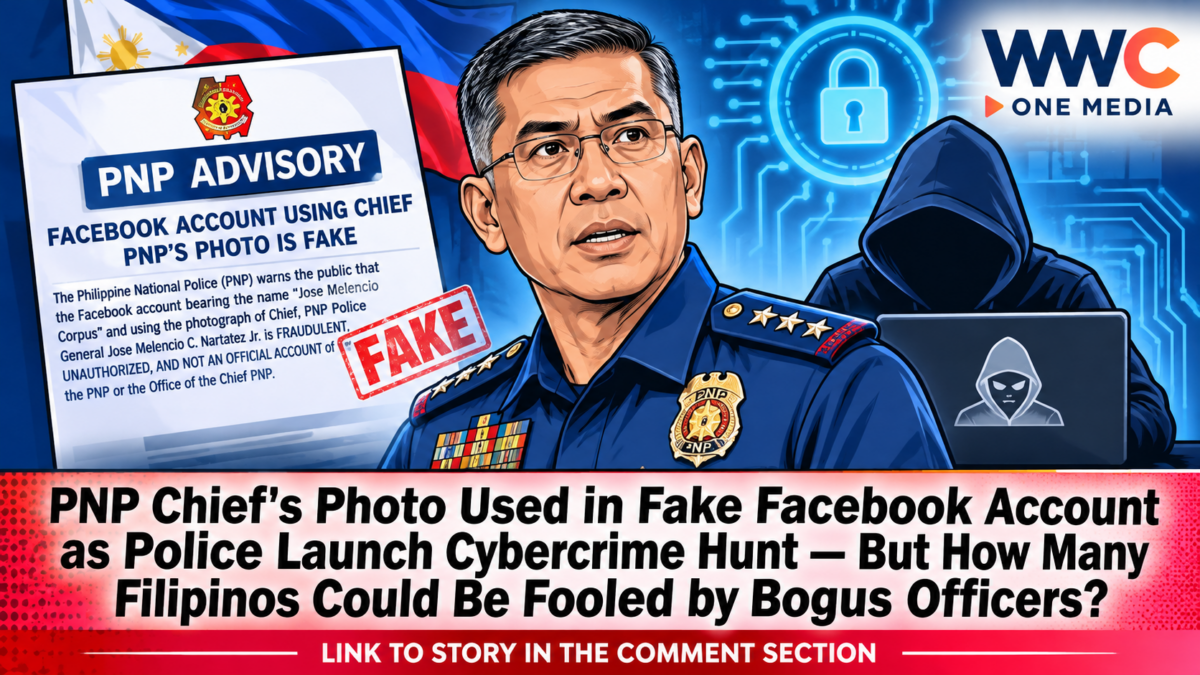
MANILA, PHILIPPINES — November 8, 2026 — A new warning from the Philippine National Police (PNP) is putting Filipinos on alert after authorities uncovered a fraudulent Facebook account using the photograph of the country’s top police official.
PNP chief Police General Jose Melencio Nartatez Jr. has condemned the unauthorized use of his identity, warning that fake social media profiles impersonating law enforcement personnel can be used to deceive, intimidate and exploit unsuspecting members of the public.
The PNP identified a Facebook profile using the name “Jose Melencio Corpus,” although some news reports render the surname as “Corpuz.”
The account allegedly uses Nartatez’s photograph to create the appearance of a legitimate police-related profile.
Authorities have clarified that the account is not affiliated with the PNP or the Office of the Chief PNP.
Any messages, instructions or transactions originating from it should not be considered official police communications.
The warning was reported by ABS-CBN News on November 8 and independently covered by SunStar, the Daily Tribune and The Manila Times.
Nartatez has instructed the PNP Anti-Cybercrime Group to investigate the account, identify its operator and coordinate with Facebook’s parent company, Meta, to secure relevant evidence and pursue the account’s removal.
The discovery highlights a growing concern involving social media impersonation.
If criminals can use the photograph of the country’s highest-ranking police officer to appear credible online, how can ordinary Filipinos distinguish genuine authorities from scammers seeking their money and personal information?
PNP Discovers Fake Facebook Account Using Police Chief’s Photograph
The latest alert follows the discovery of an unauthorized Facebook profile presenting itself through the name and photograph of a senior police official.
The PNP identified the account as fraudulent and emphasized that it has no connection to official police operations.
Nartatez condemned the unauthorized use of his identity.
He warned that individuals who exploit police names, photographs and official positions to deceive the public will face investigation.
The issue is particularly serious because police officials occupy positions of public authority.
A message appearing to come from a police general may be treated differently from an ordinary unsolicited message.
Recipients might believe they are communicating with someone who can initiate an investigation, issue instructions or influence a legal matter.
That appearance of authority can make impersonation attempts dangerous.
However, the existence of a fake profile does not itself establish that anyone has already transferred money to its operator.
The reports reviewed do not identify a confirmed number of financial victims or a specific amount stolen through this account.
Nartatez Orders Anti-Cybercrime Group to Investigate
Following the discovery, Nartatez directed the PNP Anti-Cybercrime Group (ACG) to investigate the unauthorized profile.
Investigators have been instructed to identify the individual or group responsible for operating the account.
They must also coordinate with Meta regarding account verification, evidence preservation and possible takedown measures.
These steps are important because fraudulent accounts can be deleted, renamed or altered.
Digital evidence may include profile details, messages, account identifiers and other information relevant to determining who operated the page.
Preserving that evidence can support a criminal investigation.
The PNP has also directed police regional offices and local units to intensify monitoring of social media impersonation involving police personnel.
The objective is to identify suspicious profiles before more people are exposed to potential fraud.
However, no publicly confirmed arrest of the operator was identified in the available November 8 reporting.
The investigation should therefore be described as ongoing.
How Fake Police Accounts Could Trick Ordinary Filipinos
Criminals impersonating police officials may attempt to exploit the authority associated with law enforcement.
A fraudulent profile could send friend requests or private messages designed to make the recipient believe that the sender is an authentic police officer.
The scammer might then seek personal details, financial assistance or compliance with unauthorized instructions.
Potential warning signs include requests to transfer money, disclose identification information or provide sensitive account details.
A person claiming to be a police officer may also attempt to create urgency or fear.
For example, a scammer might claim that the recipient is under investigation and must immediately pay a fee to resolve the matter.
This is a known police-impersonation scam pattern.
It should not be mistaken for confirmation that the newly identified fake Nartatez account has used every one of these tactics.
The PNP has not publicly established the full contents of any communications made through that particular profile.
Nevertheless, authorities are warning people not to accept friend requests or engage with suspicious accounts claiming to represent police personnel.
PNP Earlier Warned About Fake Police Calls Demanding Money
The latest Facebook warning is part of a wider pattern of fraudulent activity involving the misuse of police authority.
In April 2026, the Philippine Information Agency reported that the PNP Anti-Cybercrime Group had warned the public about scam calls involving individuals pretending to be police officers.
According to ACG chief Police Brigadier General Wilson Asueta, scammers had contacted potential victims and claimed they were facing criminal cases.
The callers allegedly demanded money in exchange for avoiding detention.
Asueta emphasized that police personnel are prohibited from soliciting money in exchange for not arresting someone.
The warning provides important context for the latest incident.
A person receiving a suspicious message should not assume that it is legitimate merely because the sender displays a police photograph, rank or supposed official title.
Real police communications should be verified independently through established channels.
The recipient should not rely exclusively on contact information supplied by the suspicious account.
Fake Police Station in Pasay Exposes a More Elaborate Impersonation Scheme
The online impersonation warning comes only days after Philippine authorities uncovered an alleged international scam operation in Pasay City.
On November 3, investigators raided a facility that allegedly used staged police offices, uniforms and law-enforcement equipment to make fraudulent communications appear authentic.
According to police accounts, the alleged operation involved fake parcel-related investigations and video calls intended to convince foreign victims that they were dealing with actual authorities.
One Chinese national and two Malaysian nationals were arrested in connection with the operation, while authorities found 159 foreign nationals inside the facility.
Police are investigating the roles of the arrested suspects and possible connections to other individuals.
As previously reported by WWC ONE MEDIA, the facility allegedly contained rooms designed to resemble genuine police offices.
Related WWC ONE MEDIA coverage: Chinese National and 2 Malaysians Arrested in Pasay Scam Hub Raid — 159 Foreigners Rescued as Fake Police Station Exposed
The Pasay operation is a separate investigation.
Authorities have not established that it is connected to the fake Facebook profile using Nartatez’s photograph.
However, both cases illustrate how criminals can exploit the perceived authority of police institutions.
One scheme allegedly used physical props and staged offices.
The other involves a social media profile using the photograph of a senior police official.
Both demonstrate why appearances alone are not sufficient proof of authenticity.
Fake Facebook Profiles Can Also Be Used for Financial Scams
The misuse of familiar names and photographs is not limited to police officials.
Fraudsters also impersonate investors, business executives, celebrities and financial institutions.
In October 2026, the Singapore Police Force warned about Facebook advertisements impersonating prominent investors to promote fraudulent investment opportunities.
The advertisements reportedly directed victims toward suspicious financial platforms or messaging groups.
As covered by WWC ONE MEDIA, the scheme relied on well-known identities to make investment offers appear credible.
Related WWC ONE MEDIA coverage: Singapore Police Warn of Fake Facebook Investment Ads Impersonating Popular Investors: How to Spot the Scam
That Singapore warning is unrelated to the Philippine police chief’s fake account.
But the underlying mechanism is similar.
Criminals borrow the reputation of a legitimate person or institution and use it to gain a victim’s trust.
Once trust is established, a fraudulent request may become more convincing.
That is why social media users should verify unexpected financial requests through independent channels before responding.
Could Artificial Intelligence Make Police Impersonation More Dangerous?
Advances in artificial intelligence have made digital impersonation an increasingly important cybersecurity concern.
AI tools can generate convincing text, synthetic images and manipulated voices.
These technologies may make fraudulent messages look more professional or help criminals imitate the manner of communication associated with real individuals.
However, the PNP has not confirmed that AI was used to create the newly identified fake Facebook account.
The current case involves the reported misuse of an actual police official’s photograph.
The broader AI threat is a separate concern.
In March 2026, the PNP warned about AI-generated videos falsely portraying police officers.
Authorities said misleading digital content could damage public trust and create confusion about genuine police activities.
International law-enforcement organizations have also warned that AI could increase the scale and sophistication of fraud.
As WWC ONE MEDIA previously reported, INTERPOL cybersecurity officials have highlighted how AI can strengthen existing phishing and impersonation techniques.
Related WWC ONE MEDIA coverage: INTERPOL Warns Agentic AI Could Automate Cyberattacks as Criminals Scale Scams at Machine Speed
These developments underline a critical point.
A convincing photograph, natural-sounding voice or professional-looking message should not automatically be treated as proof of someone’s identity.
Independent verification remains essential.
Could Fake Police Accounts Violate Philippine Cybercrime Laws?
Individuals who create fraudulent accounts using another person’s identity may face criminal liability, depending on the evidence and circumstances.
The Cybercrime Prevention Act of 2012, or Republic Act No. 10175, includes provisions addressing computer-related identity theft.
Section 4(b)(3) covers specified unauthorized activities involving another person’s identifying information.
A fraudulent police profile could also raise issues involving usurpation of authority under Article 177 of the Revised Penal Code.
That provision concerns individuals who falsely represent themselves as government officers or unlawfully perform official functions.
If an account is used to obtain money or property through deception, investigators may examine whether the elements of estafa are present.
But criminal liability is not established simply because a fake account has been reported.
Investigators must identify the operator, determine what actions occurred and assess whether the available evidence satisfies the requirements of a specific offense.
The Daily Tribune reported that authorities are examining possible legal consequences arising from the fraudulent Nartatez profile.
No final criminal judgment against its unknown operator has been reported.
PNP Intensifies Broader Crackdown on Cybercrime
The warning comes as Philippine authorities continue investigating a range of online scams.
These include financial fraud, identity theft, fraudulent investment offers and the misuse of digital accounts.
Earlier PNP operations have resulted in arrests and criminal complaints involving alleged cybercrime activities.
As WWC ONE MEDIA previously reported, a separate anti-cybercrime enforcement update documented 86 arrests and 201 filed cases during a reported enforcement period.
Related WWC ONE MEDIA coverage: PNP’s Cybercrime War Is Escalating: 86 Arrested, 201 Cases Filed — But What Are Scammers Doing Next?
Those historical enforcement figures are unrelated to the specific investigation into the fake Nartatez account.
They nevertheless provide context for the PNP’s broader efforts against online criminal activity.
Effective enforcement depends on preserving evidence, tracing digital transactions and coordinating with online platforms.
It also depends on the public reporting suspicious activity quickly.
How to Recognize a Fake Police Social Media Account
A social media profile should not be considered authentic simply because it contains the name and photograph of a police official.
Criminals may copy publicly available photographs, ranks and agency logos.
The following warning signs deserve particular attention:
- Unexpected friend requests: A senior police official or supposedly official account contacts you without a clear reason.
- Requests for money: The sender asks for payment, donations, processing fees or financial assistance.
- Demands for sensitive information: The account requests passwords, one-time PINs, identity-document images or financial account details.
- Threatening language: The sender claims you will be arrested unless you immediately comply with instructions.
- Unverified account details: The profile lacks a clear connection to legitimate PNP channels.
- Pressure to act immediately: The sender discourages you from consulting relatives, banks or actual police offices.
A verification badge can be one useful signal, but it should not be treated as absolute proof of legitimacy.
Users should confirm suspicious claims through the agency’s independently located official website or established contact numbers.
What to Do If a Fake Police Officer Messages You
The PNP recommends that individuals who encounter suspicious accounts preserve relevant information and report the activity.
A practical response involves several steps.
First, do not send money or personal information.
Avoid providing banking details, passwords, identification documents or verification codes to an unverified account.
Second, do not follow suspicious links.
A link presented as a police form or official notice may lead to a fraudulent website.
Third, preserve evidence.
Keep screenshots of the profile, messages, requests and relevant account details.
Fourth, report the account to Facebook.
Use the platform’s reporting features to identify impersonation or potentially fraudulent activity.
Fifth, contact the PNP Anti-Cybercrime Group.
If money has already been transferred, the recipient should immediately contact the relevant bank or payment provider and request assistance.
Reporting promptly may improve the chances of limiting further losses, although recovery cannot be guaranteed.
People should not confront or threaten suspected account operators.
Identifying the person responsible is a matter for investigators and the appropriate legal process.
Social Media Scams Are Becoming a Public Trust Problem
The latest incident illustrates a broader issue affecting digital communications.
Social media allows public officials and government agencies to communicate quickly with millions of users.
But the same platforms can also be exploited by individuals who copy official names, photographs and branding.
A fraudulent account may appear credible because it resembles a legitimate public-service channel.
This creates two risks.
The first is direct harm to individuals who respond to deceptive requests.
The second is the erosion of trust in authentic government communications.
If people cannot confidently identify genuine police announcements, they may become less willing to engage with legitimate authorities.
That makes account verification, timely public warnings and platform cooperation particularly important.
Police agencies must also maintain clear, consistent official communication channels so the public knows where to verify information.
What Happens Next in the Nartatez Facebook Investigation?
The PNP Anti-Cybercrime Group has been ordered to determine who created and operated the unauthorized account.
Authorities are also coordinating with Meta regarding the removal of the profile and preservation of relevant evidence.
Police regional offices and local units have been instructed to strengthen monitoring of similar impersonation attempts.
The investigation could eventually establish whether the account operator contacted potential victims, sought money or obtained personal information.
But those findings have not yet been publicly confirmed.
There is also no verified disclosure of a suspect’s identity or a confirmed financial-loss total connected specifically to this Facebook account.
The PNP’s warning therefore serves primarily as a preventive public advisory while the investigation continues.
The Bigger Picture: Can Filipinos Still Trust a Police Badge Online?
The discovery of a fake Facebook account using the photograph of PNP chief Jose Melencio Nartatez Jr. demonstrates how easily public authority can be imitated on social media.
A name, photograph or police insignia may create an impression of legitimacy.
But none of those elements independently proves that a digital account belongs to a genuine law-enforcement officer.
The PNP has confirmed that the suspicious profile is unauthorized and has directed investigators to trace its operator.
The case follows earlier warnings about fraudulent police calls, AI-generated police imagery and other attempts to misuse official identities.
For Filipino internet users, the essential lesson is straightforward.
Never send money or disclose sensitive information solely because a message appears to come from a police officer. Verify the identity and the request through independent official channels.
For authorities, the challenge is ensuring that impersonation attempts are detected, investigated and addressed before they cause further harm.
And as the PNP moves to identify the person behind the fake profile, one urgent question remains: If scammers can borrow the face of the country’s top police officer, how many unsuspecting Filipinos could be persuaded to trust the next fake account they encounter?