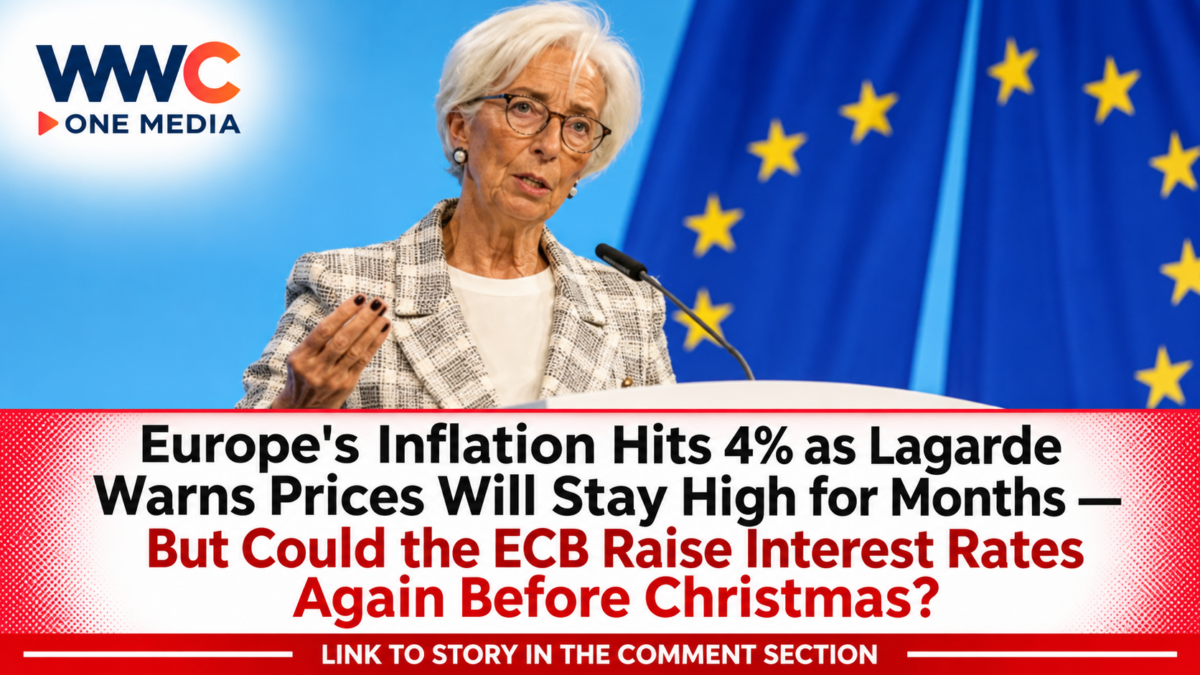
FRANKFURT, GERMANY — November 8, 2026 — Europe’s inflation crisis is far from over.
European Central Bank President Christine Lagarde has warned that consumer prices across the eurozone will remain under pressure for several quarters, intensifying debate over whether policymakers will raise interest rates again in December despite mounting risks to economic growth.
The warning comes after annual inflation across the 21 countries using the euro surged to 4.0% in October, twice the ECB’s 2% medium-term target and the highest level in approximately three years.
Energy prices are at the center of the problem.
Annual energy inflation reached 20.8%, driven by the effects of the Middle East conflict, high fuel prices and constraints in refining capacity.
Food prices are also rising, adding pressure to household budgets across Europe.
In an interview with Japan’s Yomiuri Shimbun, conducted on November 4 and published by the ECB on November 7, Lagarde said inflation would remain elevated in the coming quarters.
Her remarks reinforced concerns that Europe’s latest energy shock could prove more persistent than central bankers previously anticipated.
But the ECB faces a difficult decision.
Higher interest rates may help prevent energy-driven inflation from spreading throughout the economy. They can also make mortgages, business loans and government borrowing more expensive.
With inflation running at double the ECB’s target and economic growth still vulnerable, could another interest-rate increase help contain Europe’s price pressures—or create a new financial squeeze for millions of households and businesses?
Lagarde Warns Inflation Could Stay High for Several Quarters
Lagarde’s latest comments represent an important signal about the ECB’s assessment of the inflation outlook.
The central bank president said the rise in headline inflation was particularly concerning because persistent price pressures could eventually influence wages, business pricing decisions and household expectations.
She emphasized that the longer inflation remains elevated, the greater the danger that it becomes difficult to return sustainably to the ECB’s 2% objective.
However, Lagarde also distinguished between the immediate effects of higher energy prices and broader inflation pressures.
The ECB’s latest figures show that core inflation, which excludes energy, food, alcohol and tobacco, remained at 2.5% in October.
Services inflation increased slightly to 3.3%.
These figures suggest that the sharp rise in energy prices has not yet triggered a broad acceleration across every major component of consumer inflation.
That distinction is crucial to the ECB’s next decision.
If inflation remains concentrated in energy, policymakers may be reluctant to respond with aggressive rate increases.
But if businesses begin passing higher costs into more products and workers demand substantially larger wage increases, the central bank could face stronger pressure to act.
Eurozone Inflation Reaches 4% as Energy Costs Surge
October’s inflation figures have intensified concerns about the cost of living in Europe.
According to Eurostat data discussed by Lagarde and reported by Reuters and The Wall Street Journal, annual eurozone inflation rose from 3.8% in September to 4.0% in October.
Energy prices were the dominant contributor, climbing 20.8% from a year earlier.
The increase reflects a combination of elevated oil and natural gas prices, disrupted energy markets and the economic effects of the Middle East conflict.
The burden extends beyond fuel purchases.
Higher energy costs can affect transportation, manufacturing, electricity generation, agriculture and distribution.
Businesses exposed to these costs may eventually raise their own prices.
Consumers can then experience additional pressure through groceries, commuting expenses and household utilities.
But the process is not automatic.
Some businesses absorb higher costs, while others have contracts or competitive conditions that limit immediate price increases.
The ECB is therefore watching how quickly the energy shock spreads into the wider economy.
As previously covered by WWC ONE MEDIA, Europe’s economic recovery has been complicated by renewed inflation, high government debt and uneven growth among major economies.
Related WWC ONE MEDIA coverage: Eurozone Economy Defies Forecasts With 0.4% Growth as France Shrinks — But Could Europe’s Debt Crisis Derail the Recovery?
The latest inflation data increases the difficulty of maintaining economic growth without allowing prices to accelerate further.
Why the ECB Kept Interest Rates at 2.50%
Despite rising inflation, the European Central Bank decided on October 29 to keep its key policy rates unchanged.
The deposit facility rate remained at 2.50%.
The rate on main refinancing operations stayed at 2.65%, while the marginal lending facility rate remained at 2.90%.
The decision followed earlier interest-rate increases in 2026 as policymakers responded to the renewed energy shock.
The ECB explained that higher energy costs were creating upside risks to inflation and downside risks to growth.
However, it also observed that underlying inflation remained broadly stable and that wages were not yet responding strongly to the latest price increases.
Central bankers face a difficult tradeoff.
Raising interest rates generally discourages borrowing and spending, which can help reduce inflationary pressure.
But tighter monetary policy cannot directly produce additional oil, expand refinery capacity or resolve geopolitical supply disruptions.
That limitation matters because the current inflation surge is heavily influenced by energy supply conditions.
The ECB must determine whether to act preemptively or wait for stronger evidence that inflation is becoming entrenched.
December Rate Hike Is Possible, but Not Guaranteed
The ECB’s next major policy decision is expected on December 17, when policymakers will also have updated economic projections.
Lagarde has left another rate increase open.
However, she has not formally announced one.
In her November 7 interview, she indicated that current information points toward a continuation of the ECB’s expected policy direction unless economic conditions change substantially.
The remarks were interpreted by some analysts as supporting expectations of a December increase.
A 25-basis-point increase would raise the deposit facility rate from 2.50% to 2.75%.
But that is a possible scenario, not a completed or guaranteed decision.
The central bank will examine inflation, wages, economic activity, financing conditions and expectations before voting.
The outcome could also be influenced by developments in global energy markets.
If energy prices ease and underlying inflation remains stable, the urgency for another increase may weaken.
If inflation broadens into wages and services, policymakers may find stronger grounds for additional tightening.
As WWC ONE MEDIA previously reported, central banks around the world have been reconsidering their monetary policies as renewed inflation pressure complicates economic planning.
Related WWC ONE MEDIA coverage: Global Rate Hikes Are Back in View — And Central Banks May Not Be Done Yet
The ECB’s December meeting will be an important test of whether the global tightening trend continues.
Why Europe Fears Another Wage-Price Spiral
One of the ECB’s biggest concerns is the possibility of second-round inflation effects.
These occur when an initial increase in prices—such as a surge in fuel costs—begins influencing wages and the pricing of other goods and services.
For example, workers facing higher household expenses may seek larger pay increases.
Businesses may then raise prices further to offset additional wage costs.
If that process becomes widespread and persistent, inflation can become more difficult to control.
Lagarde said the ECB has not yet found evidence of second-round effects beyond those already anticipated in its forecasts.
Core inflation remains stable, and forward-looking wage indicators have not shown an unexpected acceleration.
That is an important qualification.
Europe is experiencing a serious inflation shock, but the available indicators do not establish that a full wage-price spiral is underway.
The ECB will monitor labor agreements, wage expectations and other measures to determine whether the pressure is spreading.
Its aim is to prevent inflation expectations from becoming detached from the 2% medium-term target.
Europe’s Energy Crisis Is Creating a Growth Dilemma
The inflation problem is especially challenging because higher energy prices can simultaneously push consumer prices upward and weaken economic activity.
Expensive fuel reduces households’ purchasing power.
Businesses facing higher electricity and transportation costs may postpone investment or reduce output.
Some industries are particularly exposed because energy represents a large share of their operating expenses.
Higher interest rates add another burden.
Companies may face greater financing costs, while households may spend more on borrowing.
This combination of elevated inflation and weak growth is sometimes associated with stagflation.
However, the current figures do not establish that the entire eurozone has entered a sustained stagflationary period.
Recent economic data indicate that activity has remained more resilient than some analysts expected.
The challenge for the ECB is determining how to restrain inflation without unnecessarily weakening that resilience.
Lagarde has emphasized that central banks must carefully distinguish between supply-driven and demand-driven economic pressures.
That means interest rates should be adjusted according to the available evidence rather than automatically following every increase in oil and gas prices.
Global Bond Yields Add Another Financial Threat
Lagarde also highlighted the effects of rising long-term borrowing costs.
Government bond yields have increased in several major markets.
The trend reflects a combination of inflation concerns, sovereign borrowing requirements and competition for investment capital.
Countries with large debt burdens are particularly sensitive to higher financing costs.
France is among the European economies facing scrutiny because of its fiscal position.
Higher government borrowing costs can make debt servicing more expensive and reduce the resources available for public services.
They can also increase financing costs for businesses and households.
Lagarde stressed the importance of governments following the European Union’s fiscal rules and maintaining credible public finances.
The ECB has instruments designed to address certain forms of unwarranted financial fragmentation.
However, those instruments operate under specific requirements and are not an unconditional guarantee that the bank will purchase bonds whenever yields rise.
The broader concern is that inflation could keep financing conditions tight even before another official rate increase.
AI Investment Is Creating a New Challenge for Central Banks
Artificial intelligence is becoming a significant part of Europe’s economic outlook.
Investment in data centers, computing infrastructure and related technologies can support construction activity, equipment demand and business investment.
Lagarde has acknowledged that AI-related investment is helping sustain economic resilience.
But the boom is also creating competition for electricity, financing and infrastructure.
Large technology companies and governments are seeking substantial amounts of capital to finance long-term projects.
That competition can contribute to higher borrowing costs in financial markets.
Energy demand from large computing facilities may also require major investment in electricity generation and transmission.
The relationship between AI investment and inflation is complex.
Some technologies can improve productivity and potentially reduce costs over time.
Others require substantial upfront spending on physical infrastructure.
The ECB must account for both effects when assessing economic conditions.
AI-related investment does not automatically cause inflation, but its scale can influence demand, financing conditions and energy markets.
Lagarde’s Early Departure Adds Uncertainty to the ECB Outlook
Another important development is the approaching departure of Christine Lagarde.
The ECB president announced that she will leave office on February 7, 2027, approximately nine months before the scheduled conclusion of her term.
The announcement has intensified attention on the selection of her successor.
Lagarde has led the central bank through extraordinary economic conditions, including the pandemic, inflation shocks and major geopolitical disruptions.
Her early departure comes as Europe faces renewed uncertainty about energy prices, growth and monetary policy.
Potential successors discussed in reporting include central bankers with extensive experience in European and international finance.
However, a successor has not yet been confirmed.
The choice will be made through the relevant European institutional process.
As WWC ONE MEDIA previously examined, Lagarde’s departure creates a major leadership transition at a particularly sensitive moment for Europe’s economy.
Related WWC ONE MEDIA coverage: Christine Lagarde to Leave ECB Nine Months Early as Inflation Hits 3.8% — But Who Will Save Europe From Its Next Economic Crisis?
The ECB’s institutional decision-making process will continue after Lagarde leaves.
Nevertheless, markets will closely examine how the next president approaches inflation, economic growth and financial stability.
What Europe’s Inflation Problem Means for the Philippines
The European inflation outlook also matters to economies outside the eurozone.
Europe is an important market for international trade, investment and financial services.
Higher European borrowing costs can influence global capital flows, currency markets and investor risk appetite.
Changes in energy prices can also have international consequences.
The Philippines imports a substantial share of its petroleum needs, making global fuel-price developments economically significant.
If energy prices remain elevated, Philippine transport and production costs may face additional pressure.
However, an ECB interest-rate increase would not automatically cause Philippine inflation to rise.
The effects would depend on global commodity prices, exchange rates, domestic demand and the monetary-policy response of the Bangko Sentral ng Pilipinas.
European economic conditions may also influence demand for certain exports and services.
For investors, the relevant issue is how tighter monetary policy could affect financing conditions and international financial markets.
As previously reported by WWC ONE MEDIA, the return of interest-rate increases in major economies has raised questions about whether global borrowing costs will remain elevated longer than previously expected.
Related WWC ONE MEDIA coverage: Fed Raises Rates and Signals Another 2026 Hike — The Global Economy May Be Entering a New Tightening Era
The eurozone’s next decision could become another important development in that broader monetary-policy environment.
What Investors and Households Should Watch Next
The next several weeks will provide important evidence about whether the inflation shock is broadening.
The ECB will receive more detailed inflation data, wage information and economic indicators before its December meeting.
Energy prices will remain particularly important.
A sustained decline in oil and gas prices could reduce some near-term inflation pressure.
Conversely, further supply disruptions could increase costs for households and businesses.
Core inflation and wage developments will help determine whether underlying price pressures are accelerating.
Financial markets will also monitor government bond yields and borrowing conditions.
The ECB’s new economic projections will provide a clearer assessment of growth and inflation risks.
For households, the central concern is how long elevated prices will continue to erode purchasing power.
For businesses, the question is whether financing costs will rise further while operating expenses remain high.
For policymakers, the challenge is controlling inflation without unnecessarily damaging economic activity.
The Bigger Picture: Can Europe Escape Another Inflation Squeeze?
Europe’s latest inflation figures present a serious test for the European Central Bank.
Annual consumer-price growth has reached 4.0%, twice its medium-term target.
Energy inflation has climbed to 20.8%.
And Lagarde expects headline inflation to remain elevated over the coming quarters.
At the same time, underlying inflation has remained relatively stable, and wages have not yet shown the unexpected acceleration that could make the problem more persistent.
These competing signals explain why the ECB has not committed to another interest-rate increase.
Raising rates could help keep inflation expectations anchored and prevent price pressures from spreading.
But tighter monetary policy could also slow investment, increase borrowing costs and weaken an economy already exposed to high energy prices.
The central bank must therefore decide whether current conditions justify another move in December.
Lagarde’s approaching departure makes the decision even more closely watched.
The next ECB president will inherit the challenge of restoring inflation to target while navigating energy uncertainty, high government debt and uneven economic growth.
Europe’s inflation problem is not simply about one month’s price data. It concerns whether another prolonged energy shock will spread throughout the economy and make borrowing more expensive for years to come.
With consumer prices climbing, financial markets preparing for another possible rate increase and millions of European households facing persistent cost-of-living pressure, one question now dominates the outlook:
Will the ECB’s next move finally contain Europe’s inflation problem—or could another interest-rate hike deepen the financial strain before prices begin to fall?