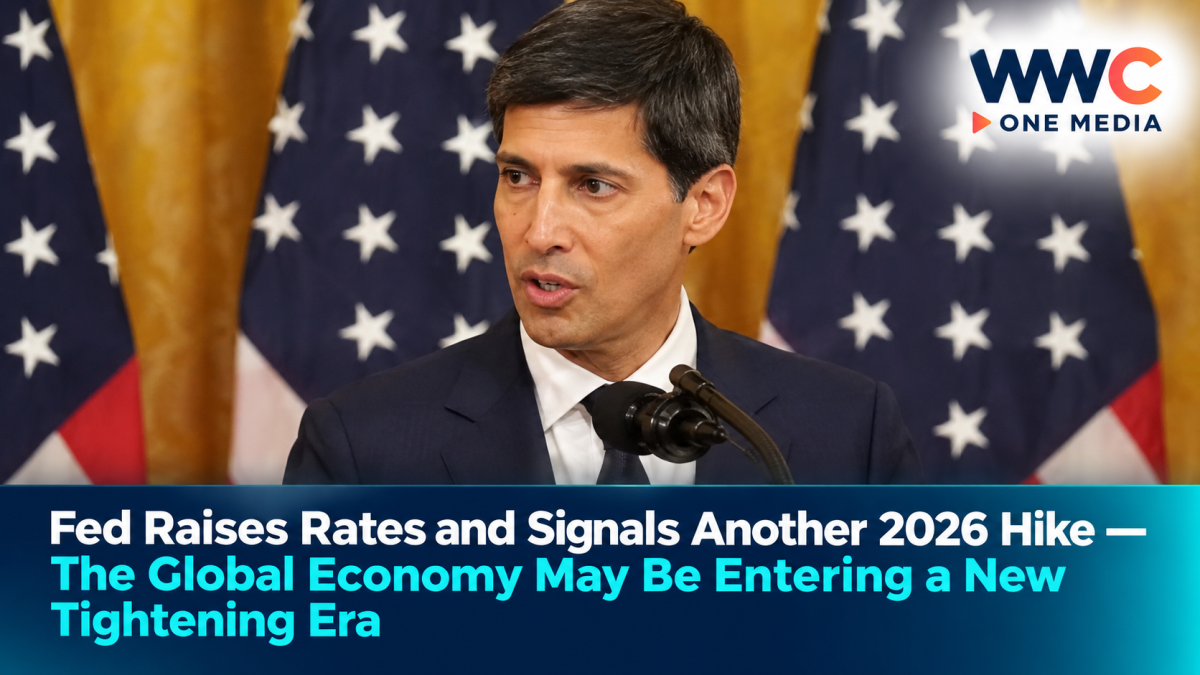
The U.S. Federal Reserve has raised interest rates for the first time in more than three years—and signaled that borrowing costs could rise again before the end of 2026—as stubborn inflation, higher energy prices and strong economic activity keep policymakers on alert.
The Federal Open Market Committee voted unanimously on Sept. 16 to increase the federal funds target range by 25 basis points to 3.75%–4%.
But the rate increase itself was only half of the story.
The Fed’s latest projections showed that 16 of 18 policymakers expect at least one more quarter-point increase before the end of 2026.
That has put markets on notice that the world’s most influential central bank may be entering a new phase of monetary tightening rather than treating September’s increase as a one-off move.
The Fed Has Reopened the Rate-Hike Debate
The September decision marked a major shift in U.S. monetary policy.
The Fed had not increased its benchmark rate since July 2023.
Now, under Chairman Kevin Warsh, policymakers have delivered a unanimous increase and indicated that another hike remains part of the baseline outlook for many officials.
The Fed said economic activity was expanding at a solid pace, domestic spending remained resilient, productivity growth was strong and capital investment was robust.
But inflation remains elevated.
The central bank said the latest policy move was intended to support a “timelier” return to its 2% inflation target.
That combination—solid economic activity alongside persistent inflation—is making the policy decision particularly consequential.
The Fed is no longer simply balancing weak growth against falling inflation.
It is trying to prevent elevated price pressures from becoming entrenched while the economy continues to expand.
Sixteen of 18 Policymakers See Another Hike
The Fed’s so-called dot plot provides the clearest indication of where policymakers currently stand.
Of the 18 officials submitting projections, 16 see at least one additional rate increase by the end of 2026.
That does not mean another hike is certain.
Fed officials make decisions meeting by meeting based on incoming economic data, and their projections can change.
But the distribution of forecasts shows that another quarter-point increase is currently the dominant view among policymakers.
The median projection for the federal funds rate at the end of 2026 is consistent with one more quarter-point increase from the new 3.75%–4% target range.
The projections also show policymakers expecting the federal funds rate to decline later, with the median rate projected at around 3.4% in 2027 and 3.1% in 2028.
In other words, the Fed’s message is not that rates will rise indefinitely.
It is that policymakers believe additional restraint may be necessary before inflation is firmly brought under control.
Inflation Is Still the Fed’s Biggest Problem
The central bank’s September statement was unusually direct about inflation.
It said inflation remains elevated and that the latest rate increase is designed to accelerate the return toward the 2% objective.
The Fed’s updated projections also raised the outlook for core personal consumption expenditures inflation.
The median core PCE inflation projection for 2026 increased to 3.4%, while the median projections were 2.5% for 2027 and 2.1% for 2028.
That is significant because core inflation strips out food and energy prices and is closely watched by policymakers when assessing underlying price pressures.
The implication is that officials do not expect inflation to disappear quickly.
Energy Prices Are Making the Problem Harder
The inflation outlook is also being complicated by the global energy shock.
Reuters reported that the war involving Iran has contributed to a sharp increase in oil prices, adding to inflation pressure across economies.
At the same time, governments and businesses are dealing with higher borrowing costs and increased uncertainty.
That creates a difficult policy environment.
Higher energy prices can push inflation upward while simultaneously reducing consumers’ purchasing power.
Central banks then face a difficult choice: tighten monetary policy to prevent inflation expectations from becoming embedded, while avoiding unnecessary damage to economic activity.
The Fed Says the Economy Is Still Holding Up
Despite the inflation problem, the Fed’s latest assessment of the U.S. economy is not one of collapse.
The central bank said domestic spending remained resilient and productivity growth was strong.
It also said capital investment was robust and job gains had kept pace with the workforce.
The unemployment rate, meanwhile, had changed little.
The Fed’s median projection for real GDP growth was also revised upward.
Officials now see 2.3% growth in 2026, compared with 2.2% in the June projections.
The median projection for 2027 was raised to 2.4%, from 2.3%.
That matters because it gives policymakers more room to concentrate on inflation.
A central bank is generally more constrained in raising rates when the economy is already contracting sharply.
The current projections instead point to continued growth alongside above-target inflation.
Wall Street Is Watching the Next Move
Financial markets had largely anticipated the September rate increase.
The more important question became what the Fed would signal about subsequent moves.
Reuters reported that U.S. stocks initially reacted negatively after the decision, while investors digested the prospect of additional tightening.
The dollar strengthened after the Fed’s announcement, while Treasury yields also reflected the changing interest-rate outlook.
Markets therefore have to price not only today’s interest rate but the likely path of rates over the coming months.
That can influence:
- Mortgage rates
- Corporate borrowing costs
- Government bond yields
- Stock valuations
- Currency markets
- Emerging-market capital flows
- Commodity prices
- Consumer credit
The effects can extend far beyond the United States.
The Global Economy Is Feeling the Shock
The Fed’s move comes at a remarkable moment for global monetary policy.
The European Central Bank has already raised rates this month, while the Bank of Japan increased its policy rate to 1.25% on Sept. 18, its highest level in 31 years.
The Bank of England, meanwhile, held rates steady but warned that persistent inflation could eventually require further action.
Reuters described the developments as evidence that a new global rate-tightening cycle may be emerging.
The common thread is inflation pressure, particularly from higher energy prices and strong demand in certain sectors.
This is a major reversal from the period when investors expected major central banks to move steadily toward lower rates.
Japan Just Joined the Tightening Push
The Bank of Japan’s move is especially significant because Japan has spent decades operating with exceptionally low interest rates.
The BOJ raised its policy rate from 1% to 1.25% in a 7–2 vote on Sept. 18.
The move brought rates to their highest level in 31 years.
But the reaction was complicated.
The yen initially weakened despite the increase because two policymakers dissented and investors saw the accompanying guidance as less aggressive than expected.
That illustrates an important feature of today’s global rate environment:
Markets are not reacting solely to whether a central bank raises rates.
They are also reacting to what policymakers say about the next move.
Europe Is Facing Its Own Inflation Problem
The ECB has also been navigating renewed inflation concerns.
Energy costs have pushed investors to price in additional European rate increases.
But ECB President Christine Lagarde cautioned against assuming that interest rates will automatically move in lockstep with oil and gas prices.
She said policymakers would consider the broader effects on inflation, growth and consumption.
That distinction matters.
A temporary energy-price surge can raise headline inflation without necessarily producing the same persistent inflation dynamics that would require aggressive monetary tightening.
Central banks therefore face the challenge of determining whether an energy shock is temporary or becoming embedded in wages, services and consumer expectations.
The Philippines Is Not Immune
The Fed’s decision is particularly important for emerging markets such as the Philippines.
The Bangko Sentral ng Pilipinas has already been tightening.
On Aug. 27, the BSP raised its target reverse repurchase rate by another 25 basis points to 5%, citing persistent inflation risks.
The overnight deposit and lending facility rates were raised to 4.5% and 5.5%, respectively.
That means the gap between U.S. and Philippine policy rates has narrowed.
The peso has also been under pressure.
The Philippine currency approached P63 per U.S. dollar earlier in the week as higher U.S. Treasury yields and expectations of tighter U.S. monetary policy supported the dollar.
Philippine analysts have therefore been watching the Fed closely because U.S. rates can affect capital flows, the peso and domestic inflation conditions.
The BSP May Not Simply Copy the Fed
A U.S. rate hike does not automatically mean the BSP must make the same move.
Philippine monetary policy is determined by domestic conditions, including inflation, economic activity, currency movements and financial stability.
The Philippine Daily Inquirer reported that analysts expect the BSP to take a measured approach rather than automatically matching every Federal Reserve move.
That distinction is important.
The Philippines has its own inflation dynamics and economic conditions.
But a stronger dollar and higher global yields can increase the pressure on emerging-market currencies and make imported goods, particularly commodities priced in dollars, more expensive.
Borrowing Costs Could Stay Higher for Longer
For consumers and companies, the most immediate implication is that the era of rapidly falling borrowing costs may be ending.
Higher policy rates can feed into:
- Mortgage rates
- Auto loans
- Credit-card interest
- Corporate debt
- Business investment
- Government borrowing
Even if the Fed raises rates only once more, markets price expectations well in advance.
Companies planning major investments therefore have to consider financing costs that may remain elevated for longer than previously expected.
For households, the effect can appear through more expensive refinancing and consumer credit.
Bond Markets Are Already Under Pressure
The global bond market is another important transmission channel.
Reuters reported that long-term government bond yields have been rising across major markets as investors demand compensation for persistent inflation, heavy government borrowing and uncertainty about monetary policy.
This is particularly significant because long-term borrowing costs do not depend exclusively on central-bank policy rates.
Investors also consider expected inflation, government debt issuance, economic growth and the credibility of monetary policy.
A central bank can raise its short-term policy rate by 25 basis points while long-term borrowing costs move by a different amount.
AI Is Adding Another Complication
The Federal Reserve’s latest decision also comes against the backdrop of enormous investment in artificial intelligence.
AI-related capital spending has become an important source of economic demand.
That investment can boost productivity and economic growth.
But it can also add to demand for equipment, construction, electricity, data centers and financing.
Reuters identified AI investment as one factor contributing to persistent price pressures alongside tariffs and the energy shock.
This creates an unusual situation in which one of the economy’s most promising growth engines may simultaneously complicate the inflation outlook.
The Fed Is Walking a Narrow Line
The central bank now faces a difficult balancing act.
Raise rates too little and inflation could remain above target for longer.
Raise them too aggressively and borrowing costs could weaken investment, housing and employment.
The Fed’s September projections suggest policymakers currently believe the economy can withstand another increase if necessary.
But officials will continue to watch incoming data.
The Fed’s own projections are not promises.
They are estimates based on information available at the time of the meeting and can change when economic conditions change.
What Markets Need to Watch Now
The next phase will be driven by economic data rather than headlines alone.
Investors will closely monitor:
Inflation: Whether price pressures begin moving convincingly toward 2%.
Labor markets: Whether employment remains resilient or begins weakening.
Consumer spending: Whether households continue supporting economic growth.
Energy prices: Whether the current oil shock persists.
Wage growth: Whether higher prices begin feeding into compensation.
Treasury yields: Whether long-term borrowing costs continue rising.
The dollar: Whether higher U.S. yields continue attracting capital toward dollar assets.
Fed communication: Whether policymakers maintain their current expectation of another 2026 increase.
The Bigger Story Is a Global Policy Shift
The September Fed decision is significant not simply because U.S. rates increased.
It is significant because it happened alongside a broader change in the international monetary landscape.
The ECB has raised rates.
The BOJ has raised rates to a three-decade high.
The Bank of England has warned that inflation could require further action.
And the Fed has delivered its first increase in more than three years while signaling that another hike is possible.
The world economy is therefore moving into an environment in which inflation, energy prices and borrowing costs are again becoming dominant forces.
That has implications for governments, businesses, investors and households everywhere.
The Next Fed Move Could Matter More Than This One
The Sept. 16 increase was widely expected.
The bigger question is whether it marks the beginning of a sustained tightening phase or simply a short adjustment before the Fed eventually stabilizes policy.
Right now, the projections point toward another increase in 2026.
But inflation data, energy markets and economic growth will determine whether that projection becomes reality.
For the global economy, the stakes are considerable.
If inflation remains stubborn, central banks may have to keep borrowing costs elevated.
If growth weakens sharply, policymakers could face pressure to reverse course.
And if both inflation and growth remain strong enough, the world could be entering a prolonged period of higher-for-longer interest rates.
For consumers and businesses already dealing with expensive financing, the next few months may reveal whether September’s rate hike was the beginning of a new monetary era—or simply the first warning shot.