Canada is trying something more commonly associated with emerging economies: aggressively courting capital, building strategic infrastructure, developing domestic industries and using government policy to reshape where investment flows.
The difference is that Canada is doing it as a wealthy G7 economy that has spent decades deeply integrated with the United States.
Prime Minister Mark Carney’s government is now betting that the country can attract as much as C$1 trillion in new investment over five years by combining tax incentives, infrastructure development, critical-mineral projects, energy expansion, artificial intelligence and a push to diversify Canada’s international economic relationships.
The strategy has taken on greater urgency as trade tensions with Washington expose the risks of Canada’s dependence on its largest economic partner.
Canada Is Trying to Rewrite Its Economic Playbook
The Bloomberg analysis behind the original report framed Canada’s approach as borrowing elements of an emerging-market strategy: create an investment-friendly environment, identify sectors considered strategically important, attract large pools of capital and use infrastructure to expand economic capacity.
That approach is increasingly visible in Ottawa’s policies.
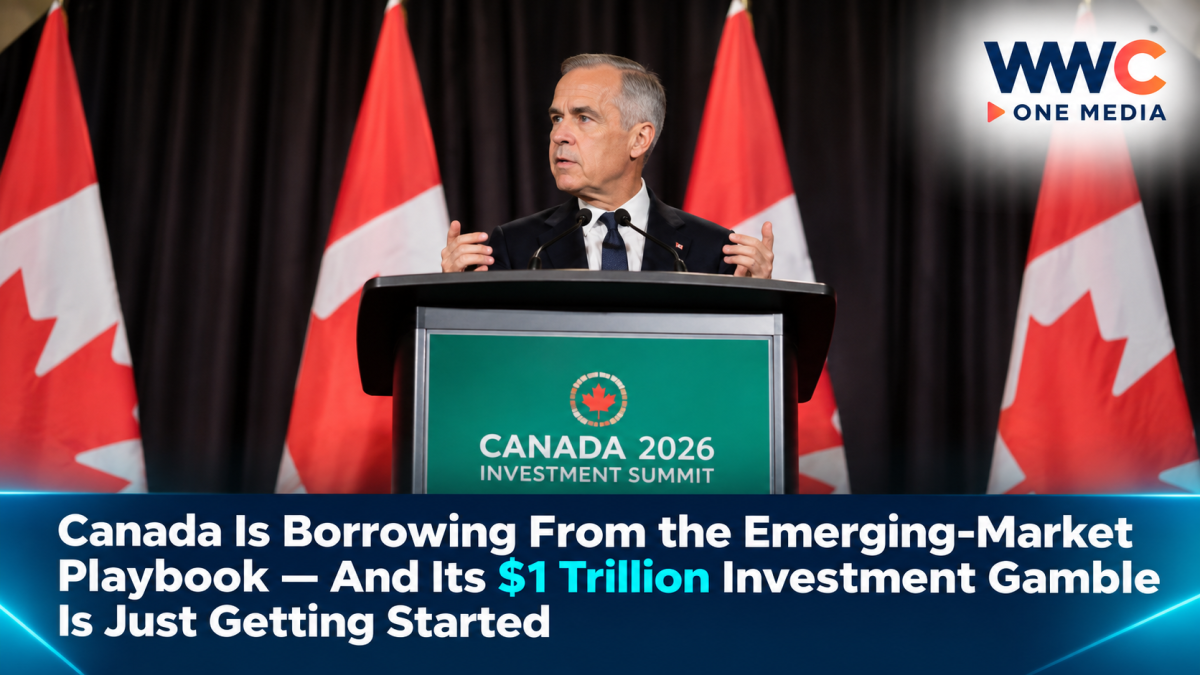
At Canada’s first-ever Investment Summit in Toronto on Sept. 14–15, the government brought together hundreds of investors and executives to examine more than 160 projects across sectors including energy, infrastructure, critical minerals, technology and advanced manufacturing.
The government says the objective is not simply to attract foreign money.
It wants to increase Canada’s overall capital investment, build domestic productive capacity and create industries capable of competing globally.
The C$1 Trillion Target
Carney’s government has set a headline target of catalyzing C$1 trillion in total investment over five years.
That figure includes public, private and institutional capital rather than representing C$1 trillion in foreign direct investment alone.
The Canadian government says approximately C$280 billion in federal capital investment and incentives over five years are expected to help enable more than C$1 trillion of total investment from public, private and institutional partners.
That distinction matters.
Canada is not claiming that foreign investors have already committed C$1 trillion.
Rather, Ottawa is attempting to create the conditions under which a much larger pool of capital can be deployed into Canadian projects.
Reuters reported before the summit that major investments could take 12 to 18 months to materialize, underscoring the gap between announcing opportunities and actually breaking ground.
The Investment Summit Put Canada’s Strategy on Display
The Toronto summit was designed as a matchmaking exercise between international investors, Canadian businesses and government officials.
Among those attending were executives from major global financial institutions, including BlackRock and Blackstone.
The government presented projects ranging from data centers and AI infrastructure to energy, mining and transportation.
One of the most prominent announcements involved Bell Canada and Saskatchewan.
Bell said it was expanding a previously announced AI infrastructure project to a 1.2-gigawatt facility requiring more than C$50 billion in capital investment at full buildout.
That project illustrates the type of investment Ottawa is trying to attract: large-scale infrastructure connected to technologies expected to reshape the economy.
AI Is Becoming Part of Canada’s Industrial Strategy
Artificial intelligence is no longer being treated simply as a technology-sector issue.
Ottawa increasingly sees AI infrastructure as part of Canada’s economic and strategic capacity.
The government says Canada needs domestic computing infrastructure, data centers, research capacity and companies capable of scaling internationally.
At the investment summit, Radical Ventures announced plans to invest and mobilize C$4 billion for a new fund aimed at helping Canadian AI companies expand while remaining headquartered in Canada.
The government has also developed a broader national AI strategy built around AI adoption, sovereign infrastructure, Canadian technology companies and international partnerships.
That makes AI one of the clearest examples of Canada’s attempt to move from being primarily a resource-rich economy toward a more diversified, technology-intensive model.
Critical Minerals Are Another Major Piece
Canada’s natural-resource base is also central to the strategy.
The country possesses significant deposits of minerals considered important for batteries, advanced manufacturing, defense and clean-energy technologies.
The government is attempting to develop those resources domestically rather than simply exporting raw materials.
That means investment in mines must increasingly be connected to processing, transportation, electricity infrastructure and manufacturing.
The broader strategy is therefore not simply about digging more minerals out of the ground.
It is about building the supply chains around them.
Energy Remains at the Center
Canada’s energy resources remain another major part of the investment pitch.
Ottawa has emphasized both conventional and low-carbon energy, while presenting Canada as a potential supplier to markets seeking to diversify their energy sources.
Energy infrastructure also intersects with the country’s plans for AI and industrial expansion.
Data centers, advanced manufacturing and mining operations require reliable electricity.
That creates a feedback loop: attracting new industries requires infrastructure, while building infrastructure requires large-scale investment.
The Government Is Changing the Tax Equation
One of the most significant policy moves came on Sept. 15, when Carney announced a new Productivity Mega Deduction.
The measure expands the range of assets eligible for accelerated tax treatment from roughly 15% of assets to more than 65%.
Eligible investments include areas such as fiber-optic infrastructure, mining property, pipelines, software, research and development, computer equipment, aircraft, vehicles, rail infrastructure, bridges and roads.
Ottawa says the changes will reduce Canada’s marginal effective tax rate on new business investment from roughly 13% to 6.4%.
The government describes that as the lowest rate among major economies, although such comparisons depend on methodology and assumptions.
The objective is straightforward: make it financially more attractive for companies to build productive assets inside Canada.
Canada’s Banks Are Also Being Pulled Into the Strategy
The investment push is not relying exclusively on overseas capital.
Canadian financial institutions have announced large financing commitments.
At the summit, Carney said Canada’s largest pension funds, insurers and institutional investors had committed nearly C$100 billion in new capital for Canadian assets.
Canadian banks, meanwhile, committed nearly C$325 billion in new financing for Canadian businesses and infrastructure, according to the prime minister’s office.
Reuters separately reported that TD had announced a C$150 billion five-year lending and financing commitment, while Scotiabank pledged C$100 billion toward projects connected to Canada’s growth agenda.
The numbers show the strategy is designed to mobilize Canada’s own enormous pools of institutional capital alongside international investors.
But C$500 Billion in Commitments Is Not the Same as C$500 Billion in New Foreign Investment
This is one of the most important distinctions in the story.
The Canadian government said the investment summit helped lay the foundation for nearly C$500 billion in new investment commitments.
But reporting by the Financial Times noted that much of the announced capital came from Canadian institutions, while there were comparatively few immediate announcements of new foreign investment.
That does not make the commitments insignificant.
It does mean that the headline numbers should not be interpreted as C$500 billion of fresh foreign direct investment arriving immediately.
The real economic impact will depend on how much of the announced capital turns into actual projects, new facilities, employment and productive capacity.
Canada’s Foreign Investment Numbers Have Their Own Complication
Canada has already seen foreign investment flows increase.
Reuters reported that quarterly average foreign direct investment flows were around C$23 billion in 2024 and 2025, compared with C$16.3 billion in 2023 and C$15 billion in 2022.
But there is an important caveat.
A significant portion of Canada’s inbound investment has involved mergers and acquisitions rather than the construction of entirely new productive facilities.
That distinction matters because buying an existing Canadian company does not necessarily increase the country’s productive capacity in the same way that building a new factory, mine, data center or processing plant does.
RBC’s recent analysis similarly argues that Canada needs to focus on greenfield investment and capital expenditure, rather than relying solely on headline FDI numbers.
The U.S. Relationship Is the Elephant in the Room
Canada’s economic transformation is occurring against the backdrop of its enormous dependence on the United States.
The two countries remain deeply integrated through trade, manufacturing, energy and supply chains.
That relationship cannot simply be replaced overnight.
But the recent trade tensions have encouraged Ottawa to look for additional markets and partnerships.
Carney has pursued stronger economic ties with Europe while also seeking greater engagement with countries in Asia and the Middle East.
The European Union has also signaled interest in deepening its relationship with Canada.
The two sides are discussing broader cooperation in areas including energy, critical minerals, defense and artificial intelligence.
The goal is diversification rather than an immediate replacement of the U.S. market.
Canada Is Looking More Like an Investment Platform
The emerging strategy is increasingly built around several connected pillars:
Energy. Expand production and infrastructure while developing new energy opportunities.
Critical minerals. Develop mines and processing capacity for strategically important materials.
AI and technology. Build domestic computing infrastructure and scale Canadian technology companies.
Infrastructure. Expand electricity grids, transportation networks, ports, pipelines and data centers.
Institutional capital. Mobilize Canada’s pension funds, banks and other large investors.
Trade diversification. Develop stronger economic relationships outside the United States.
Together, these policies amount to something larger than a conventional investment promotion campaign.
They represent an attempt to increase Canada’s productive capacity.
The Bank of Canada Sees Investment as Part of the Growth Equation
The country’s central bank has also identified business investment as an important component of the economic outlook.
In its July 2026 projection, the Bank of Canada said GDP growth had been weak and volatile but was expected to strengthen, with business investment supporting growth. It also said potential output growth could improve as investment—including AI investment—expands.
But the central bank also highlighted constraints.
Canada’s productive capacity was expected to grow slowly in 2026 because of tariff-related structural adjustments and subdued population growth.
That means investment alone cannot instantly solve Canada’s productivity challenge.
The Biggest Obstacle May Be Inside Canada
Attracting capital is only one side of the equation.
Canada also has to make it possible to deploy that capital efficiently.
Investors have long cited regulatory complexity, lengthy approvals and differences between provincial and federal rules as obstacles.
Reuters reported that the government has been trying to address these concerns, including by prioritizing advance tax rulings for investments of C$1 billion or more.
The Financial Times likewise reported that investors still face regulatory, tax and interprovincial barriers.
In other words, Ottawa can announce a tax incentive tomorrow, but a major mine, pipeline, data center or transportation project can still take years to permit and construct.
Even Airport Privatization Is Part of the New Approach
Another striking element of the strategy is the government’s interest in attracting private capital into major infrastructure assets.
The government is considering long-term private concessions for Canada’s four largest airports.
The move is designed to bring additional capital into infrastructure while changing how some major public assets are financed and operated.
The proposal has also attracted criticism from labor, Indigenous and environmental groups, who have raised concerns about privatization and the distribution of the benefits from the investment strategy. Reuters reported protests around the investment summit, including objections from unions, Indigenous groups and housing and climate advocates.
Those criticisms are part of the domestic debate over how Canada should pursue growth and infrastructure development.
Why Bloomberg’s Emerging-Markets Comparison Matters
The emerging-market comparison is less about saying Canada has suddenly become an emerging economy.
It hasn’t.
Canada remains a wealthy, diversified G7 economy with sophisticated financial institutions and deep capital markets.
The comparison instead concerns the economic playbook.
Emerging economies have often relied heavily on infrastructure investment, industrial policy, strategic resource development and aggressive competition for international capital.
Canada is now adopting some of those techniques while attempting to preserve the advantages of an advanced economy.
That combination is unusual—and potentially consequential.
The $1 Trillion Question
The headline number is enormous.
But the harder question is what happens after the summit.
Can Canada turn investor interest into mines that actually open, factories that actually operate, data centers that actually come online, energy projects that actually get built and infrastructure that actually increases productivity?
That is where the strategy will ultimately be measured.
The Canadian government has put forward a clear ambition: mobilize C$1 trillion in investment over five years.
Investors have shown interest.
Financial institutions have announced major financing commitments.
Tax incentives have been expanded.
But the transformation will depend on execution.
What Happens Next Could Define Canada’s New Economy
Canada is attempting to turn a period of geopolitical and trade uncertainty into an investment opportunity.
Its pitch is that the country has what global investors increasingly need: energy, critical minerals, infrastructure opportunities, skilled workers, financial stability and access to multiple international markets.
The strategy also reflects a major change in the global economic environment.
For decades, Canada’s proximity to and integration with the United States was one of its greatest economic advantages.
Now Ottawa is trying to ensure that dependence on one market does not become a vulnerability.
The result is a distinctly different economic playbook—one centered on capital mobilization, nation-building infrastructure, strategic resources, technology and diversification.
Whether it becomes a durable economic transformation will not be decided by the size of the investment summit.
It will be decided by what gets built after the cameras leave.