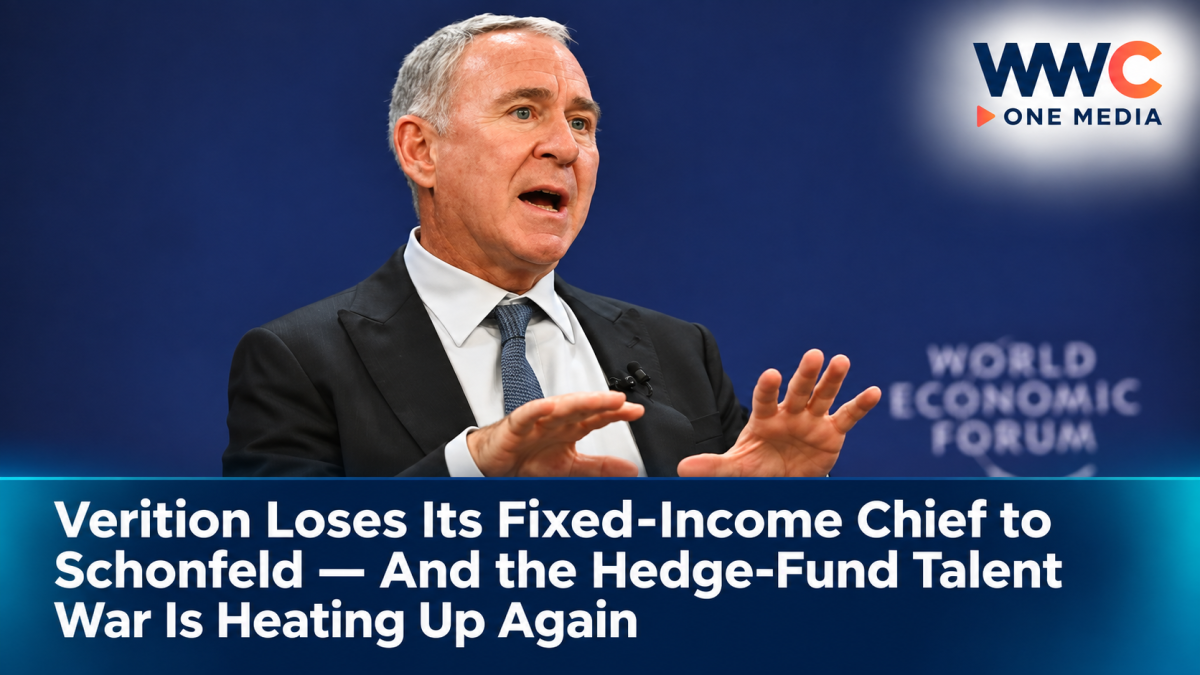
Verition Fund Management has lost one of its senior investment executives as Jonathan Raiff, the hedge fund’s head of fixed-income strategies, departs for rival Schonfeld Strategic Advisors, according to people familiar with the matter.
Raiff’s move comes at a particularly consequential moment for global bond and macro markets.
Central banks are recalibrating policy, inflation remains a major concern, energy prices are creating fresh uncertainty, and fixed-income investors are navigating unusually sharp shifts in interest-rate expectations.
But the move is also part of a broader trend reshaping the hedge-fund industry: large multi-strategy firms are aggressively recruiting experienced portfolio managers and expanding their fixed-income and macro businesses.
Raiff Leaves Verition After More Than Four Years
Raiff joined Verition in January 2022 and was appointed Head of Fixed Income Strategies, overseeing a broad collection of strategies including relative value, rates, macro, foreign exchange and structured products.
Verition announced his appointment at the time as part of a broader expansion of its senior investment leadership.
The firm said Raiff would help strengthen its fixed-income capabilities and build out strategies designed to complement Verition’s wider multi-strategy portfolio.
His departure therefore represents the loss of a senior figure who had been responsible for a broad portion of Verition’s fixed-income operation.
Bloomberg reported that Raiff has now left Verition and is moving to Schonfeld.
The Destination Is Just as Important as the Departure
Raiff’s next stop is significant.
Schonfeld has spent the past several years building out its Discretionary Macro and Fixed Income business.
The firm’s current leadership structure lists Colin Lancaster and Mitesh Parikh as global co-heads of the strategy, with Andrew Silverman heading credit within the business.
Schonfeld launched its discretionary macro and fixed-income business in 2022 and subsequently expanded into other strategies, including Delta One and emerging markets.
That makes Raiff’s move part of a continuing build-out rather than an isolated hiring decision.
Schonfeld Is Expanding While the Hedge-Fund Industry Gets More Competitive
Schonfeld’s macro operation has been expanding rapidly.
Business Insider reported earlier this month that the firm’s macro investment staff had grown to nearly 150 people, more than twice its size the previous year.
The unit had also added 15 portfolio managers during 2026, according to people familiar with the firm.
Business Insider reported that the macro division now accounts for roughly one-fifth of Schonfeld’s overall market activity.
That expansion provides important context for Raiff’s move.
Schonfeld is not simply replacing an executive.
It is building a larger platform capable of deploying capital across interest rates, currencies, credit and other macro-driven markets.
Why Fixed Income Has Become a Hot Hiring Ground
The timing of the move is especially notable because bond markets have entered another period of intense uncertainty.
The Federal Reserve raised interest rates in September for the first time since July 2023, taking the federal-funds target range to 3.75%–4%.
Fed projections also showed that most policymakers expect at least one more increase before the end of 2026, although the central bank has emphasized that future decisions depend on incoming economic data.
At the same time, other major central banks are also navigating renewed inflation pressure and higher energy costs.
That creates opportunities—and risks—for macro and fixed-income traders.
Interest-rate moves can generate large opportunities in government bonds, swaps, currencies and related derivatives when markets rapidly reprice the path of monetary policy.
Energy Prices Are Adding Another Layer of Complexity
The bond market is also responding to a new source of inflation uncertainty: energy.
The conflict in the Middle East has disrupted energy markets and complicated central-bank calculations.
Higher oil prices can push inflation higher while simultaneously weakening consumer purchasing power and economic growth.
For macro investors, that creates a particularly complicated environment.
A central bank may be forced to consider higher inflation even as economic growth comes under pressure.
Schonfeld’s own Mitesh Parikh wrote this month that higher energy prices, persistent inflation and resilient economic activity were forcing markets to reconsider how restrictive monetary policy really is.
That is precisely the kind of environment in which sophisticated macro and fixed-income strategies can become particularly active.
Raiff’s Background Fits Schonfeld’s Strategy
Raiff’s previous mandate at Verition covered a wide range of markets.
Verition said when he joined that he would oversee relative value, rates, macro, foreign exchange and structured products.
Those areas overlap closely with the types of opportunities targeted by a large discretionary macro and fixed-income platform.
The move therefore places an experienced fixed-income investor inside a firm that has been deliberately expanding its presence in macro markets.
Verition Is Also in the Middle of a Major Expansion
The departure comes as Verition itself has grown substantially.
The firm says it now manages approximately $15 billion in capital, with more than 500 investment professionals globally as of June 30, 2026.
Its investment platform spans fixed income and macro, event and multi-asset relative value, equity long/short and capital markets, and quantitative trading.
Earlier this year, Business Insider reported that Verition had reached approximately $14 billion and employed more than 500 investment professionals.
The firm has also been expanding its long/short equity business, illustrating how multi-strategy managers are continuing to diversify their investment platforms.
Raiff’s departure therefore comes from a firm that is itself in the middle of significant growth.
This Is Not Necessarily a Sign of Trouble at Verition
There is an important distinction between losing a senior portfolio manager and evidence of problems at a hedge fund.
The available reporting does not establish that Raiff left because of poor performance, internal conflict or investor withdrawals.
Nor does his move by itself indicate weakness at Verition.
Verition continues to operate a broad multi-strategy platform and reported $15 billion in capital as of July 1, 2026.
The hedge-fund industry is known for frequent movement of senior investment talent.
Portfolio managers can move between platforms when firms offer different capital arrangements, risk limits, infrastructure, compensation structures or opportunities to build new strategies.
Without a public explanation from the parties, the reason for Raiff’s move should not be assumed.
The Bigger Story Is the Hedge-Fund Talent War
The Raiff move highlights a broader structural change in the hedge-fund industry.
The largest multi-manager firms increasingly compete not only for investor capital but also for the people capable of generating returns.
That competition has pushed firms to build increasingly sophisticated infrastructure around portfolio managers.
Instead of relying on one star investor to manage an enormous pool of capital, multi-manager firms can divide risk across dozens of specialized trading teams.
This approach allows firms to recruit specialists in areas such as rates, credit, currencies, commodities, equities and quantitative strategies.
Schonfeld’s rapid macro expansion is a clear example.
Scale Is Becoming a Competitive Weapon
Large multi-strategy firms can offer portfolio managers something smaller hedge funds may struggle to match: scale.
That can include:
- Dedicated risk-management systems
- Large pools of trading capital
- Global trading infrastructure
- Prime-broker relationships
- Data and technology
- Specialized research teams
- Portfolio-construction support
- Access to multiple markets
For an experienced fixed-income investor, those resources can be attractive when markets become more complex.
The competition is therefore increasingly about more than compensation.
It is about the entire investment platform surrounding the portfolio manager.
Schonfeld’s Macro Business Has Already Been Expanding Rapidly
Business Insider’s recent reporting provides an important backdrop.
Schonfeld’s discretionary macro operation had grown to approximately 150 investment employees despite significant turnover among some of its earlier hires.
The firm added multiple portfolio managers during 2026, including professionals from Point72, JPMorgan and Balyasny, according to the report.
That suggests Schonfeld has been willing to continue hiring even as personnel changes occur within the existing team.
The firm’s current leadership page also shows the depth of its macro and fixed-income structure, including global co-heads, credit leadership and other senior investment professionals.
The Macro Business Has Been a Major Part of Schonfeld’s Growth
Schonfeld’s macro division has also become increasingly important to the firm’s overall investment operation.
Business Insider reported that the division had 45 trading pods and generated positive results in 84% of its trading months, based on information from a person close to the firm.
The firm’s flagship Partners fund was reported to be up 6.8% for the year through August.
Those figures are firm-reported or based on people familiar with the operation and should not be treated as independently audited performance statistics.
Still, they help explain why Schonfeld continues to invest heavily in the business.
The Fixed-Income Opportunity Is Expanding Beyond Government Bonds
Today’s fixed-income environment is also much broader than simply betting on whether Treasury yields rise or fall.
Institutional investors and hedge funds can trade:
Government bonds: U.S. Treasuries and sovereign debt markets around the world.
Interest-rate derivatives: Futures, swaps and options tied to central-bank policy.
Credit: Corporate bonds, loans and credit derivatives.
Currencies: FX markets often move sharply when interest-rate expectations change.
Structured products: Securities whose returns depend on multiple underlying variables.
Relative-value strategies: Trades designed to capture pricing differences between related instruments.
Raiff’s former mandate at Verition covered many of these areas.
That breadth is one reason experienced fixed-income specialists remain valuable to multi-strategy firms.
AI Is Changing the Fixed-Income Landscape Too
Another emerging issue is the effect of artificial intelligence on interest rates and economic growth.
Schonfeld’s Parikh recently argued that AI could influence the economy’s longer-term equilibrium interest rate because investment in AI infrastructure is competing for capital, electricity, infrastructure and labor before the productivity gains are fully realized.
That creates another major question for fixed-income investors.
If AI investment boosts productivity significantly, it could support faster economic growth.
But if the investment boom drives up demand for capital and resources faster than productivity improves, inflation and interest rates could remain higher for longer.
For macro investors, that is a major policy variable.
The Bond Market Is Entering a New Regime
The broader environment is increasingly challenging for investors who became accustomed to the low-rate era that followed the global financial crisis.
Central banks are once again dealing with inflation.
Government borrowing remains substantial.
Energy markets are volatile.
AI is driving enormous capital spending.
And geopolitical tensions can rapidly alter inflation expectations.
These forces make fixed-income markets unusually sensitive to incoming data.
A single inflation report or energy-market shock can dramatically change expectations for the next central-bank decision.
That volatility can create opportunities for hedge funds with flexible mandates.
What Raiff’s Move Could Mean for Both Firms
For Schonfeld, bringing in Raiff adds another experienced professional to an already expanding macro and fixed-income operation.
For Verition, the move creates an opening to reshape its fixed-income leadership or redistribute responsibilities across its existing team.
Verition has not publicly indicated that the departure changes its broader investment strategy.
The firm continues to describe itself as a diversified multi-strategy manager with fixed income and macro among its core businesses.
The next question will therefore be how Verition fills the leadership gap.
The Bigger Question Is Where Talent Is Moving
Raiff’s departure is one transaction in a much larger movement of investment professionals between major hedge funds.
The industry’s biggest firms are competing for experienced traders at precisely the moment when market complexity is increasing.
The movement of senior talent between firms can reveal where managers believe future opportunities exist—but it does not, by itself, prove that one firm or strategy will outperform another.
What it does demonstrate is that fixed income and macro remain central battlegrounds in the competition among multi-strategy hedge funds.
What Happens Next
The immediate focus will be on Verition’s succession plans and Raiff’s role at Schonfeld.
Investors will also be watching whether Schonfeld continues expanding its macro and fixed-income teams.
At Verition, the question will be how the firm maintains continuity across the strategies Raiff previously oversaw.
Meanwhile, the market environment itself could make both firms’ fixed-income operations increasingly important.
The Federal Reserve’s rate path remains uncertain.
Energy prices are volatile.
Inflation has not fully returned to target.
And investors are reassessing how high interest rates may ultimately settle.
For hedge funds specializing in rates and macro trading, that means the opportunity set is potentially enormous—but so is the risk.
The Final Takeaway
Jonathan Raiff’s move from Verition to Schonfeld is more than a personnel change in the hedge-fund world.
It arrives as Schonfeld is rapidly expanding its macro and fixed-income platform while Verition continues to operate one of the industry’s larger multi-strategy investment businesses.
The move also illustrates how valuable experienced fixed-income talent has become in a market dominated by shifting central-bank policy, energy shocks and uncertainty over the long-term economic effects of AI investment.
There is no public evidence establishing that Raiff’s departure reflects a problem at Verition.
What is clear is where he is going next—and the timing is notable.
Schonfeld is building.
Fixed income is becoming more complex.
And the battle for the people who can navigate those markets is getting more intense.
The question now is whether Raiff’s arrival will become another building block in Schonfeld’s expanding macro empire—or the beginning of a new chapter for Verition’s own fixed-income operation.