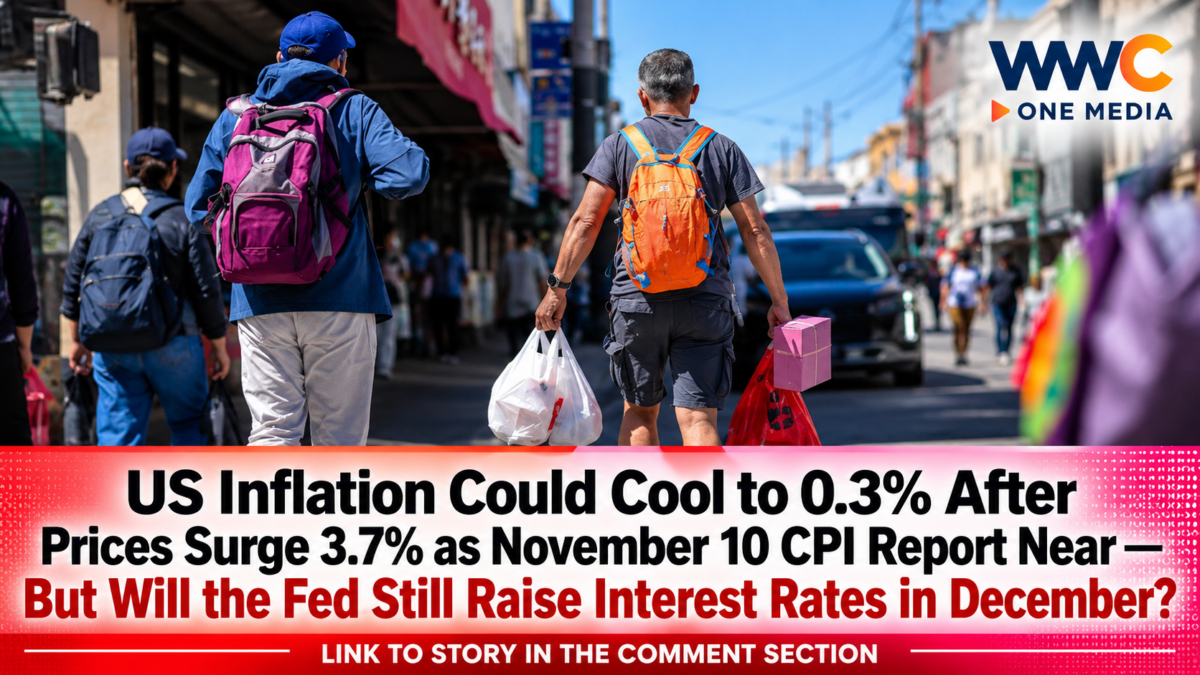
WASHINGTON, D.C. — November 8, 2026 — America’s inflation crisis may finally be showing signs of easing after two painful months of rising consumer prices, but the Federal Reserve could still deliver another interest-rate increase before the year ends.
Economists expect the upcoming October Consumer Price Index (CPI) report, scheduled for Tuesday, November 10, to reveal a slower pace of monthly price increases following September’s energy-driven inflation surge.
According to Bloomberg’s November 7 economic outlook, consumer prices likely increased more slowly in October as gasoline pressures moderated and some underlying price categories showed signs of stabilization.
A Bloomberg survey of economists anticipates a 0.3% monthly rise in headline consumer prices and a 0.2% increase in core CPI, which excludes volatile food and energy costs.
That would represent a substantial slowdown from September’s 0.6% monthly headline increase.
But the improving outlook comes with a warning.
The Federal Reserve remains concerned that inflation is running above its 2% objective, while the US economy continues to demonstrate resilience despite elevated borrowing costs.
Could Tuesday’s inflation report finally deliver relief to American households—or will the Federal Reserve decide that another interest-rate increase is necessary to prevent inflation from accelerating again?
US Inflation Expected to Slow After September’s 3.7% Surge
The United States experienced a renewed inflation shock in September, with consumer prices increasing 3.7% from a year earlier.
According to the US Bureau of Labor Statistics, the monthly CPI rose 0.6%, accelerating from August’s 0.4% increase.
Gasoline prices were responsible for much of the acceleration.
The gasoline index surged 9.1% in September, accounting for more than half of the overall monthly increase.
Energy prices climbed 5.2% during the same period.
Core inflation, which excludes food and energy, increased 0.3% for the month and 2.6% from September 2025.
The figures demonstrated that inflationary pressures were not confined entirely to fuel markets.
However, economists now expect some of those pressures to moderate.
Forecasts published ahead of the November 10 release point to slower gasoline-price increases, easing vehicle prices and potentially softer inflation in selected services.
As previously reported by WWC ONE MEDIA, September’s inflation acceleration placed renewed pressure on households already struggling with expensive fuel, borrowing costs and everyday necessities.
Related WWC ONE MEDIA coverage: US Inflation Hits 3.7% as Gasoline Prices Surge 34% in a Year — But Could the Real Cost-of-Living Crisis Be Far From Over?
The crucial question is whether October’s expected moderation represents the beginning of a lasting improvement or merely a temporary pause in price pressures.
Gasoline Prices Could Deliver the Biggest Inflation Relief
Energy costs have become one of the most important drivers of America’s inflation outlook.
In September, gasoline prices increased 9.1% from the previous month and 34.2% compared with a year earlier.
The broader energy index rose 20.4% annually.
Those increases affected transportation expenses and added pressure to industries that depend on fuel.
Retailers, manufacturers, logistics companies and airlines all face higher operating costs when energy becomes more expensive.
Some businesses absorb those costs through lower profit margins, while others eventually pass increases on to consumers.
October appears to have brought some relief.
Economists at Barclays expect headline CPI to increase approximately 0.2% during October, partly reflecting more favorable gasoline-price trends.
Other forecasters anticipate a monthly increase closer to 0.3%.
The differences underscore the uncertainty surrounding the final inflation reading.
The US energy outlook also remains closely connected to developments in the Middle East.
Supply disruptions associated with the conflict involving Iran have contributed to elevated oil and refined-fuel prices during 2026.
A sustained reduction in energy-market pressure could help contain future inflation, but a renewed supply disruption could reverse the improvement.
WWC ONE MEDIA previously examined how rising gasoline costs threatened to push US inflation higher and complicate Federal Reserve policy.
Related WWC ONE MEDIA coverage: US Inflation Set to Surge as Gasoline Prices Climb — But a Bigger Fed Interest Rate Shock Could Be Coming
Importantly, slower inflation does not necessarily mean gasoline or grocery prices have returned to their previous levels.
It means the overall pace of price increases may be moderating.
Core Inflation Will Be the Number Wall Street Watches Most Closely
Although headline inflation attracts the most public attention, financial markets will closely examine core CPI.
Core inflation removes food and energy because those categories often experience large short-term price fluctuations.
That makes it useful for assessing whether underlying inflation pressures are spreading throughout the economy.
In September, core CPI increased 0.3% from August.
Economists surveyed by Bloomberg expect October’s core index to increase approximately 0.2%.
A lower reading could strengthen arguments that the Federal Reserve should hold interest rates steady while it evaluates whether inflation is moving toward its target.
However, other economists expect core inflation to remain around 0.3%.
Housing, services, transportation and technology-related products remain important areas to monitor.
MUFG’s November 6 research noted that unusually strong September price increases in housing, hotels and airfares could moderate in October.
But it also warned that underlying inflation pressures remain elevated.
An additional complication is the growing cost of technology.
Bloomberg Economics’ independent price-tracking project has found substantial price increases in some computer-related products, partly associated with demand for memory chips used in artificial intelligence infrastructure.
The findings suggest that the global AI investment boom may be contributing to price pressure in selected markets.
This is not evidence that AI is responsible for most US inflation.
Rather, it illustrates how inflation can emerge from multiple sources simultaneously.
Federal Reserve Faces a December Interest-Rate Dilemma
The latest inflation forecasts arrive after the Federal Reserve decided to keep interest rates unchanged at its October policy meeting.
The central bank had raised its benchmark federal funds rate by 25 basis points in September, bringing its target range to 3.75%–4.00%.
The October pause reflected uncertainty about the inflation outlook and the effects of earlier monetary tightening.
Some officials believe additional interest-rate increases may be necessary to bring inflation back toward the Fed’s long-term target.
Others prefer to gather more economic evidence before tightening monetary policy again.
On November 6, Federal Reserve Bank of New York President John Williams warned that inflation remains too high.
Reuters reported that Williams emphasized the importance of bringing inflation sustainably back to 2% while preventing temporary price shocks from becoming persistent.
He did not commit to a particular decision for December.
Meanwhile, San Francisco Fed President Mary Daly has signaled that further monetary tightening may ultimately be necessary.
WWC ONE MEDIA examined Daly’s comments and the potential implications for financial markets.
Related WWC ONE MEDIA coverage: Fed’s Mary Daly Warns More US Interest Rate Hikes Are Coming as Inflation Hits 3.7% — But Could Wall Street Face Another Major Selloff?
The Fed’s next monetary policy meeting is scheduled for December 8–9.
Investors will be watching whether the November 10 inflation report strengthens the case for another quarter-percentage-point increase.
Recent market pricing has indicated that a December rate hike remains a significant possibility.
However, market probabilities fluctuate and are not a guarantee of Federal Reserve action.
Why a Lower CPI Reading Could Still Disappoint American Families
A slowdown in inflation might provide financial-market relief without immediately reducing the cost of living.
That distinction is particularly important for households dealing with years of accumulated price increases.
If a product costs $100 and its price rises 10%, it reaches $110.
If inflation subsequently slows to 3%, that same product increases to $113.30.
The inflation rate has fallen sharply, but the product has become more expensive.
This explains why consumers may remain dissatisfied even when official inflation figures begin improving.
Housing expenses, medical services, insurance premiums, fuel and groceries can continue consuming substantial portions of household budgets.
The financial strain can become more severe when wage growth fails to keep pace with rising expenses.
For lower-income households, higher essential costs can leave less money available for savings and discretionary purchases.
The Federal Reserve therefore faces a difficult balancing act.
It must bring inflation under control without unnecessarily weakening employment, consumer spending and broader economic activity.
Americans Are Borrowing More as Inflation Pressures Persist
The inflation outlook also comes at a time when household borrowing is increasing.
US consumer credit expanded by approximately $27.8 billion in September, according to Federal Reserve data released on November 6.
The increase was substantially larger than economists had anticipated.
Rising consumer credit can reflect confidence in future income and spending.
However, it can also indicate that households are relying more heavily on borrowing to finance purchases.
Credit card balances and other borrowing arrangements may become particularly expensive when interest rates remain elevated.
As previously reported by WWC ONE MEDIA, the sharp expansion in consumer credit has raised questions about whether American households are becoming increasingly dependent on debt.
Related WWC ONE MEDIA coverage: US Consumer Debt Surges $27.8 Billion in Biggest Jump in Nearly 4 Years as Credit Card Borrowing Explodes — But Are Americans Heading Toward a Debt Crisis?
Higher interest rates can increase the burden on borrowers, depending on the terms of their loans.
That makes the Federal Reserve’s December decision important for consumers as well as investors.
Inflation Forecasts Come With an Unusual Data Warning
The October CPI report will also contain an important statistical limitation.
Because the Bureau of Labor Statistics did not collect the necessary October 2025 prices during the previous year’s government shutdown, it cannot calculate standard year-over-year changes for many October 2026 CPI indexes.
That means the November 10 release is expected to place unusual emphasis on monthly price changes.
Economists and investors will need to exercise care when comparing the new figures with historical inflation trends.
The absence of a comparable annual index does not mean inflation has disappeared or that October prices cannot be measured.
It means the missing historical observation prevents calculation of certain normal 12-month comparisons.
The latest monthly figures, component indexes and other economic indicators will therefore be particularly important.
The distinction also means September’s 3.7% annual inflation reading should not be directly compared with October’s projected 0.3% monthly increase as though they represented the same measurement.
Wall Street Could Face Another Volatile Week
The inflation report arrives during a period of significant stock-market uncertainty.
Technology stocks have experienced heavy selling pressure as investors reassess the enormous spending commitments associated with artificial intelligence infrastructure.
Higher borrowing costs can create additional difficulties for companies financing expansion.
They can also influence how investors value future corporate earnings.
If inflation remains unexpectedly strong, investors may increase expectations for further Federal Reserve tightening.
That could place upward pressure on Treasury yields and create renewed volatility in equities.
Conversely, a softer inflation reading could reduce some immediate concern over interest-rate increases.
However, market reactions will depend on whether the results differ from expectations.
A number that appears favorable in isolation may still disappoint investors if they had anticipated an even larger slowdown.
The October Producer Price Index, scheduled for Friday, November 13, will offer another perspective on inflation pressures affecting businesses.
Together, the CPI and PPI releases could significantly influence market expectations ahead of December’s Federal Reserve meeting.
What US Inflation Means for the Philippines and Asia
The US inflation outlook has implications beyond American households.
Federal Reserve policy influences international interest rates, exchange rates and investment flows.
If US inflation remains high and the Fed raises rates again, dollar-denominated financial assets may become more attractive to investors.
That could contribute to pressure on emerging-market currencies, including the Philippine peso, although exchange-rate movements depend on many other factors.
A stronger dollar can increase the local-currency cost of imported goods priced in US dollars.
For the Philippines, energy imports are particularly important because fuel costs influence transportation, electricity and logistics.
Higher US interest rates can also affect international financing conditions for governments and corporations.
Conversely, a more stable US inflation outlook could reduce some of the uncertainty facing Asian markets.
However, lower American inflation would not automatically produce lower Philippine inflation or guarantee peso appreciation.
Domestic factors, including food supplies, energy pricing, monetary policy and economic growth, remain essential.
The Bigger Picture: Is America’s Inflation Crisis Finally Turning a Corner?
The upcoming October inflation report could deliver an encouraging signal for the US economy.
After September’s 0.6% monthly CPI increase and 3.7% annual inflation rate, economists expect price growth to moderate.
Lower gasoline pressure and easing prices in some categories could provide evidence that the latest inflation acceleration is losing momentum.
But the Federal Reserve is unlikely to declare victory based on one report.
Energy-market volatility, persistent services inflation and unexpectedly resilient economic activity could continue complicating the outlook.
The central bank must also consider the economic costs of maintaining elevated interest rates.
For households, meaningful relief will require more than a temporary decline in monthly inflation.
Consumers need a sustained improvement in purchasing power, supported by stable prices, employment and income growth.
The November 10 CPI report will offer an important test of whether those conditions are becoming more achievable.
The decisive question is not simply whether inflation slows in October, but whether the slowdown is strong enough to change the Federal Reserve’s next move.
And with a December interest-rate decision approaching, could one inflation report determine whether American borrowers finally receive a break—or face another round of higher borrowing costs before the year ends?