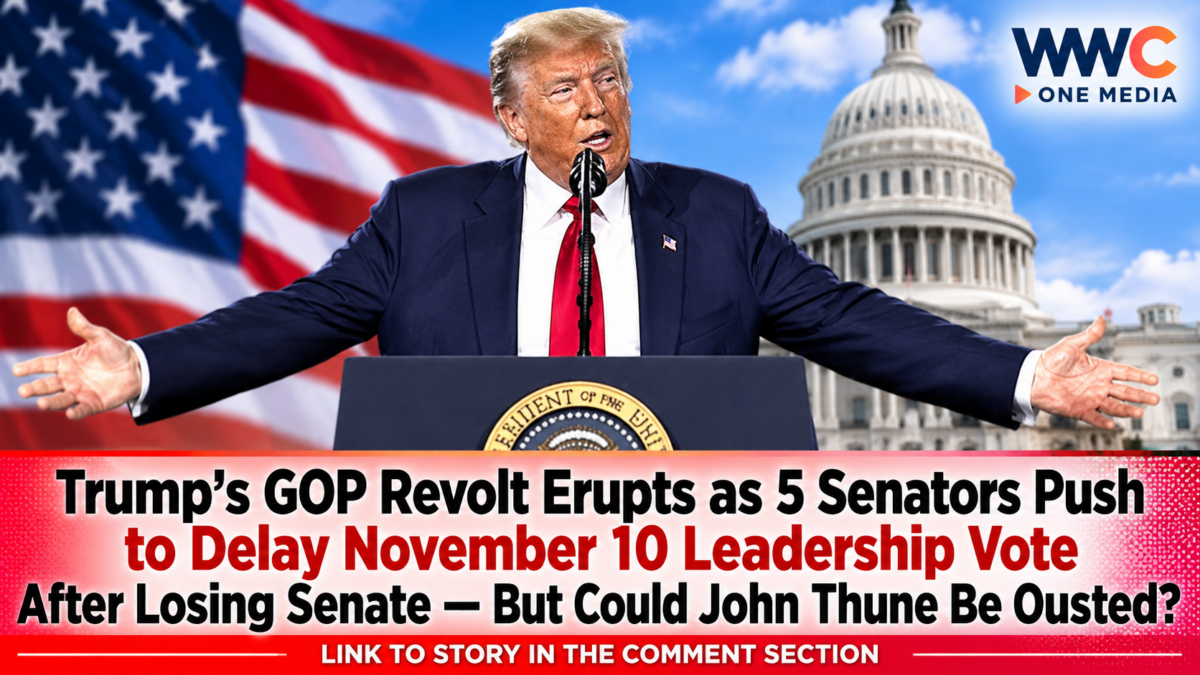
WASHINGTON, D.C. — November 8, 2026 — A rebellion is brewing inside the Republican Party after its devastating performance in the 2026 US midterm elections, with a group of conservative senators demanding a delay in next week’s leadership vote and openly questioning whether the party should continue under Senate Majority Leader John Thune.
The push comes just days after Democrats captured control of the US Senate in the November 3 elections, dealing President Donald Trump and congressional Republicans a major political defeat.
According to Bloomberg, several Republican senators want to postpone the leadership election scheduled for Tuesday, November 10, arguing that the party must first examine why it lost its majority and determine how to rebuild its political strength.
Wisconsin Senator Ron Johnson is leading the effort.
Johnson has secured the five Republican signatures needed to request a special meeting of the Senate Republican Conference to discuss delaying the vote.
The move has intensified pressure on Thune, the South Dakota Republican who has led the Senate GOP since January 2025 and intends to seek another term as party leader.
But while the rebellion has exposed divisions within the Republican Party, no senator has publicly announced a challenge against Thune.
The question now is whether the conservative push represents a temporary protest against the election results—or the beginning of a larger battle over who will lead Trump’s weakened Republican Party.
Republicans Lose Senate Majority as Leadership Fight Explodes
The November 3 midterm elections dramatically changed the balance of power in Washington.
Democrats won enough Republican-held Senate seats to regain control of the chamber, ending the GOP’s majority and strengthening the opposition’s ability to challenge Trump’s legislative agenda during the remaining two years of his presidency.
Republicans lost at least seven Senate seats, according to reporting by The Hill and other US news organizations as results continued to be finalized.
The magnitude of the defeat has triggered demands for accountability within the party.
Some conservatives argue that Republicans should not immediately reelect the same leadership team without first examining the campaign’s failures.
Others maintain that changing leaders would do little to address the factors behind the midterm losses.
The dispute comes as Republicans face a difficult transition from controlling the Senate to becoming its minority party when the new Congress convenes on January 3, 2027.
As previously reported by WWC ONE MEDIA, the Democratic victory also means Republicans have a limited window to advance major legislative priorities before losing their congressional majorities.
Related coverage: Trump’s Republicans Have Just 57 Days to Push Through Final Agenda After Democrats Seize Congress — But Could a Last-Minute Power Play Change America’s Future?
The leadership dispute could complicate the GOP’s efforts to remain united during that final legislative period.
Ron Johnson Secures Five Signatures to Challenge the Election Timetable
Senator Ron Johnson, a prominent conservative and ally of President Trump, is spearheading the effort to postpone the Republican leadership election.
The Hill reported on November 6 that Johnson obtained the five signatures required to request a meeting of the broader Senate Republican Conference.
Under Republican conference rules, a written request supported by at least five senators can trigger a special conference meeting.
However, those signatures do not automatically postpone the leadership election.
The party would still need to decide whether to change the scheduled vote.
Johnson has argued that Republicans should conduct a serious examination of their midterm defeat before choosing their next leaders.
In a letter addressed to Senate Republican Conference Chairman Tom Cotton, Johnson described the election result as a major political setback requiring careful discussion.
He warned that proceeding immediately with leadership elections would be “political malpractice.”
Johnson wants senators to examine the party’s performance, hear from leadership candidates and consider a more collaborative approach to internal decision-making.
He also wants Republicans to develop a clearer strategy for opposing the newly strengthened Democratic Party.
The leadership vote is currently scheduled for November 10 at 9 a.m. in the Old Senate Chamber.
Whether the conservative effort can force a postponement remains uncertain.
Mike Lee, Rick Scott and John Kennedy Support the Delay
Johnson’s campaign has attracted support from other Republican conservatives.
Utah Senator Mike Lee publicly endorsed postponing the leadership election, arguing that Republicans should review the midterm results before deciding who will lead them.
Florida Senator Rick Scott also expressed support for delaying the vote.
Scott previously competed in Republican leadership elections but has indicated that he does not intend to run again this year.
Louisiana Senator John Kennedy has likewise been identified among those backing the effort.
The senators have emphasized the importance of understanding the causes of the party’s defeat before making long-term leadership decisions.
Their concerns reflect a broader disagreement over how Republicans should respond to a changing political environment.
One approach favors maintaining experienced congressional leaders and concentrating on legislative strategy.
Another calls for internal reform, greater consultation among senators and a more confrontational political response to Democrats.
The dispute is especially important because party leaders influence legislative negotiations, committee assignments, messaging and the coordination of congressional priorities.
But support for delaying an election should not be interpreted as a commitment to remove Thune.
Some senators could support further discussion while ultimately voting to retain him.
John Thune Faces Questions About His Future After Senate Defeat
John Thune succeeded longtime Republican leader Mitch McConnell after winning the Senate GOP leadership election in November 2024.
He became Senate majority leader when Republicans assumed control of the chamber in January 2025.
Thune now intends to seek another two-year term leading Senate Republicans.
But because Democrats have won control of the Senate, he would serve as minority leader beginning in January 2027 if reelected.
The Washington Post reported on November 4 that Thune had confirmed his intention to seek another term regardless of the election outcome.
As of November 8, no Republican senator has publicly declared a campaign to challenge him.
Thune continues to enjoy substantial support within the Republican conference.
Supporters argue that he has considerable legislative experience and understands the procedural challenges involved in leading a minority party.
They also note that a national electoral defeat cannot automatically be attributed to one congressional leader.
Opponents and critics, however, question whether the party needs a different political strategy after losing control of Congress.
The November 10 election could therefore become a test not only of Thune’s support but also of how Republican senators want their conference to operate.
Trump Ally Questions Whether Republicans Should Reward Their Leaders
The leadership controversy intensified after Alex Bruesewitz, a political adviser and ally of President Trump, publicly questioned whether Thune should remain the party’s leader.
Bruesewitz criticized the prospect of Thune advancing into the Senate minority leader position following the party’s election defeat.
His remarks added momentum to conservative dissatisfaction with the existing leadership.
However, criticism from a Trump adviser should not be treated as an official endorsement by President Trump of an alternative candidate.
Trump has not been shown, in the reporting reviewed, to have formally directed Senate Republicans to replace Thune.
The disagreement also reflects existing tensions between parts of the Republican conference and the president’s political allies.
Thune has supported major elements of Trump’s agenda while occasionally differing with him over legislative procedure and Senate rules.
One notable dispute has concerned the SAVE America Act and proposals to change Senate procedures to advance legislation.
Thune has defended preserving the legislative filibuster, arguing that the rule could later protect Republicans when Democrats control the chamber.
Some Trump-aligned conservatives have criticized that position.
The current leadership fight therefore involves more than dissatisfaction over election results.
It also concerns how aggressively Senate Republicans should pursue political confrontation and whether procedural compromise remains an acceptable strategy.
Democrats’ Midterm Victory Changes the Political Balance in Washington
The Republican leadership dispute is unfolding against the backdrop of a major Democratic victory.
Democrats gained control of both chambers of Congress in the November 3 midterms, giving them greater authority over legislation, congressional investigations and government oversight beginning in January.
The results reflect voter concerns over economic pressures, the cost of living, national security and the administration’s policies.
As WWC ONE MEDIA reported, the election significantly weakened Trump’s congressional position and increased the likelihood of political confrontation during the final two years of his presidency.
Related coverage: Democrats Seize Control of US Congress in Historic Midterm Upset as Trump Accepts Defeat — Two Years of Political Showdown Loom
The new Democratic majority is expected to exercise greater influence over government spending, committee hearings and legislative priorities.
Democratic control of the Senate could also complicate Trump’s efforts to confirm certain executive-branch and judicial nominees.
Republicans will continue to hold their existing congressional majorities until the new Congress begins.
But after January 3, they will need to adapt to operating without majority control.
That transition makes the choice of Senate Republican leader particularly important.
The next GOP leader will be responsible for coordinating the party’s response to Democratic legislation and negotiating with the incoming majority.
Republican Losses Extend Beyond the Senate Leadership Question
The outcome of individual Senate contests has intensified the Republican Party’s internal debate.
In Georgia, Democratic Senator Jon Ossoff secured reelection against Republican Mike Collins, a candidate endorsed by Trump.
Although Ossoff’s victory preserved an existing Democratic seat rather than flipping a Republican-held position, it represented another disappointment for Republicans hoping to expand their electoral map.
WWC ONE MEDIA previously examined the Georgia race and its broader implications for congressional control.
Related coverage: Democrat Jon Ossoff Defeats Trump’s Senate Pick in Georgia, Securing a Crucial Battleground Victory — But Can Democrats Turn It Into Control of Congress?
Democrats also made gains in several states where Republicans had expected to remain competitive or maintain advantages.
The results have prompted questions about candidate selection, campaign messaging, voter turnout and the effectiveness of Trump’s endorsements.
However, these questions cannot be answered solely by changing the Senate Republican leadership.
The causes of a nationwide electoral defeat can include local political conditions, candidate quality, economic sentiment and presidential approval.
A credible Republican review would need to consider those factors rather than assume a single explanation.
Democrats Face Their Own Senate Leadership Debate
Republicans are not the only party experiencing disagreement over congressional leadership.
On the Democratic side, Senator Chris Van Hollen has argued that the party should discuss its policy priorities and expectations before selecting its next Senate leader.
His remarks have increased scrutiny of Senator Chuck Schumer, who is seeking to lead Democrats as they return to the majority.
Some progressives have called for stronger commitments on economic policy and congressional accountability.
Other Democratic senators have expressed support for Schumer’s continued leadership.
The Washington Post reported on November 7 that Van Hollen does not currently intend to seek the leadership position himself.
The parallel debates illustrate how both parties are adjusting to the results of the midterm elections.
Republicans must determine how to operate as the opposition, while Democrats must decide how to use their newly acquired congressional power.
WWC ONE MEDIA previously reported on the debate over Schumer’s leadership and the demands emerging from within the Democratic Party.
Related coverage: Democrats Win Back US Congress, but Progressive Senator Challenges Chuck Schumer’s Leadership — Could a Party Rebellion Derail Their 2027 Agenda?
Both leadership contests could influence the tone of congressional politics throughout 2027 and beyond.
Could the Leadership Fight Affect Trump’s Final Two Years?
The debate over Senate Republican leadership has implications for the remainder of Trump’s presidency.
Beginning in January, congressional Republicans will need to operate without majority control in either chamber.
A minority leader must coordinate party strategy, manage legislative negotiations and decide when to cooperate with or oppose the governing majority.
In the Senate, Republicans will still possess important procedural tools.
Depending on the legislation and applicable rules, they may be able to block or delay measures requiring 60 votes to overcome a filibuster.
However, many nominations and certain budget-related measures operate under different procedures.
Democrats’ Senate majority will give them significant control over floor scheduling, committee operations and the confirmation process.
That makes the Republican leadership position influential even without majority control.
A leader with strong relationships inside the conference may be better positioned to maintain unity.
A more confrontational leader could appeal to conservatives demanding a tougher approach toward Democrats.
Neither strategy guarantees political success.
The party will also have to prepare for the 2028 presidential election, when Trump’s successor will be chosen.
Republican senators are already considering how their current decisions could affect the party’s future political fortunes.
What Happens on November 10?
As of November 8, the Republican Senate leadership election remains scheduled for Tuesday, November 10.
Johnson and his allies have obtained enough signatures to seek a special conference meeting.
That creates an opportunity to discuss postponement before the leadership vote.
But the request does not automatically change the election date.
If the conference proceeds as scheduled, Republican senators will vote privately for their leadership team.
Thune remains the only publicly announced candidate for the top position.
A challenger could still emerge, although current reporting suggests that Thune remains favored to win another term.
If the conference agrees to delay the election, senators would have additional time to assess candidates and debate the party’s political direction.
The next decisive development will therefore be whether Johnson’s supporters can persuade a broader group of Republican senators that postponement is necessary.
The Bigger Picture: Is the Republican Party Heading Toward a Leadership Crisis?
The effort to delay the Senate Republican leadership election reveals the growing frustration inside a party struggling to understand its defeat.
Republicans entered the 2026 midterms controlling the White House and both chambers of Congress.
They will begin 2027 with President Trump still in office but Democrats holding congressional majorities.
That shift creates new challenges for the Republican Party’s leadership, legislative strategy and electoral future.
Senator Ron Johnson and his allies want the party to examine those failures before choosing its next Senate leaders.
Thune’s supporters believe his experience and established relationships make him well positioned to guide Republicans through the transition.
The disagreement may ultimately be resolved without a formal leadership challenge.
But even if Thune wins reelection, the debate could continue over how the GOP should govern, oppose Democrats and prepare for the 2028 elections.
The political stakes extend beyond one Senate leadership vote.
They concern whether Republicans can restore internal unity after a major defeat while balancing the demands of Trump-aligned conservatives and the party’s established congressional leadership.
For now, five Republican signatures have opened the door to an internal confrontation.
But with the November 10 vote approaching and no declared challenger to John Thune, one question remains: Will the Republican conference rally behind its current leader—or could the fallout from Trump’s midterm defeat produce an unexpected power struggle at the top of the GOP?