SÃO PAULO, BRAZIL / NEW YORK / MANILA — November 7, 2026 | WWC ONE MEDIA | Global Business, Corporate Debt, Petrochemicals and Financial Markets
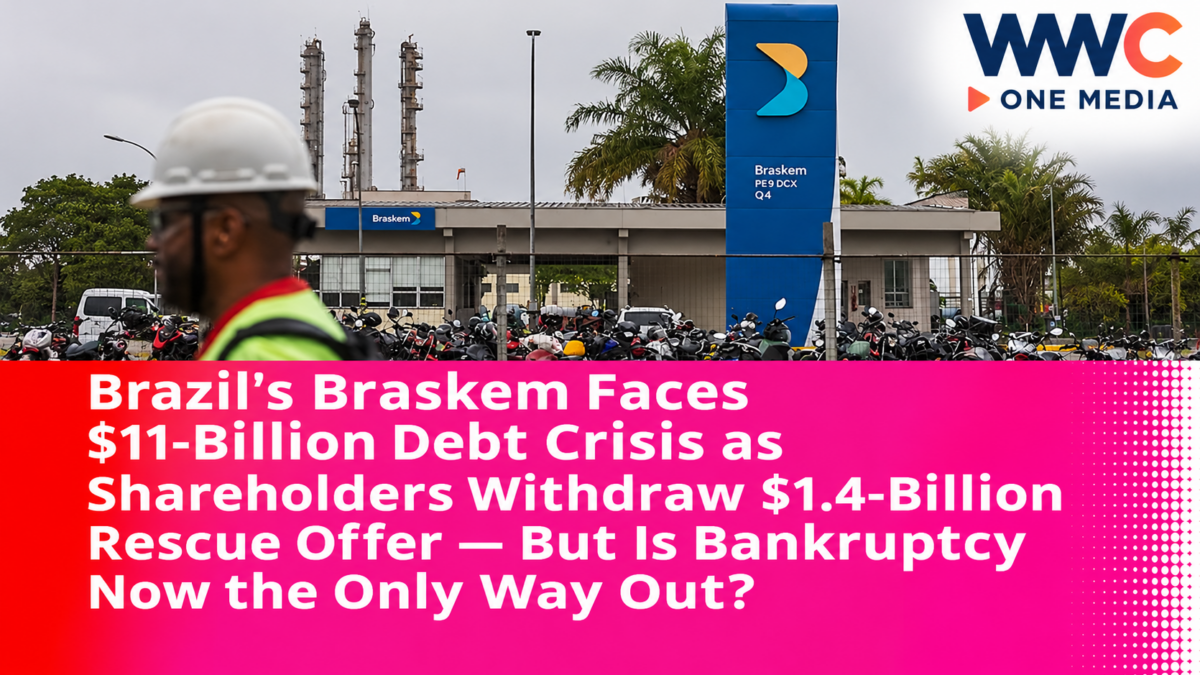
One of the world’s major petrochemical producers is facing a worsening financial crisis after its principal shareholders reportedly withdrew a proposed $1.4-billion capital injection, dealing a serious blow to negotiations aimed at restructuring approximately $11 billion in debt.
Brazilian chemical giant Braskem SA, a major producer of polyethylene, polypropylene and other industrial chemicals, is struggling to secure an agreement with creditors after months of negotiations over how to reduce its enormous debt burden.
According to Bloomberg’s November 6 report, shareholders Petrobras and IG4 Capital Group withdrew a nonbinding proposal to provide fresh capital after bondholders rejected a restructuring arrangement involving the conversion of approximately $3.8 billion in debt into equity.
The development marks a significant reversal from late October, when reports suggested that Braskem and its creditors were moving closer to a comprehensive agreement.
Instead, negotiations have deteriorated, increasing the possibility that the company could seek a broader court-supervised restructuring if the existing process fails.
The crisis has implications extending beyond Brazil.
Braskem operates in major international petrochemical markets, supplying materials used in packaging, automotive components, construction products and numerous consumer goods.
Its financial difficulties could affect lenders, investors, employees and companies linked to the global plastics supply chain.
But the central question is whether Braskem’s shareholders and creditors can revive the rescue negotiations before the November 22 restructuring deadline—or whether one of Latin America’s largest chemical companies will face an even more disruptive financial reckoning.
$1.4-Billion Rescue Offer Withdrawn After New York Debt Talks
The latest setback followed meetings between Braskem’s shareholders and creditors in New York during the first week of November.
People familiar with the private discussions told Bloomberg that shareholders decided to withdraw their proposed capital contribution after bondholders rejected key restructuring terms.
The withdrawn offer involved approximately $1.4 billion in proposed funding from shareholders Petrobras and IG4 Capital.
However, the capital commitment was conditional.
It depended on creditors accepting an arrangement that would convert approximately $3.8 billion in outstanding debt into equity.
Debt-for-equity conversions allow creditors to exchange some or all of their claims against a company for ownership stakes.
Such transactions can reduce debt and associated interest expenses, but they also dilute existing shareholders.
For Braskem, the proposed transaction could have substantially changed the company’s ownership and capital structure.
The disagreement reflects the competing financial interests of the parties.
Creditors want sufficient new investment to support the business after restructuring.
Shareholders want to limit how much additional money they must contribute while preserving value in their existing investments.
Neither group wants to absorb an unnecessarily large share of the financial losses.
The resulting impasse has placed the proposed capital injection back on the sidelines.
The $1.4 billion was a proposed contribution, not money already delivered to Braskem and subsequently removed from its accounts.
That distinction is important when evaluating the company’s immediate liquidity position.
How Braskem Accumulated an $11-Billion Debt Problem
Braskem’s financial difficulties have developed over several years.
The company operates in the global petrochemical industry, where profitability is strongly influenced by crude oil and natural gas feedstock prices, manufacturing costs, global supply and demand, and economic conditions.
Producers frequently invest substantial amounts in industrial facilities that require significant ongoing maintenance and operating expenses.
These businesses can become financially vulnerable when profitability declines while debt obligations remain high.
Braskem has also faced company-specific challenges, including environmental liabilities, international operations and investments requiring substantial financing.
The company began exploring ways to reorganize its capital structure before seeking formal protection for negotiations with creditors.
On August 24, 2026, Braskem announced that its board had approved a petition for an extrajudicial reorganization under Brazilian law.
The restructuring covers approximately $10.9 billion in unsecured financial obligations.
The company emphasized that the process was limited to its financial restructuring and did not automatically cover obligations to suppliers, customers and other commercial counterparties.
That distinction was intended to help preserve normal business operations while negotiations continued.
But the debt negotiations have been complicated by disagreements over how much capital shareholders should provide and how much debt creditors should convert into shares.
Creditors Initially Demanded $3 Billion in Fresh Capital
The dispute over funding has been central to the negotiations.
Reuters reported on October 2 that creditors had sought approximately $3 billion in new capital from Braskem’s controlling shareholders.
The shareholders considered that amount excessive relative to the company’s prevailing market valuation.
At the time, Braskem’s reported market value was approximately 3.25 billion Brazilian reais, equivalent to about $622 million.
That meant creditors were seeking fresh capital substantially larger than the company’s market capitalization.
The shareholders were reluctant to make such a commitment without significant concessions.
Braskem’s financial situation therefore created a difficult negotiation.
Creditors wanted assurance that the business would emerge with sufficient liquidity to operate.
Shareholders wanted a debt reduction large enough to justify contributing more funds.
The company needed both groups to agree on a plan capable of stabilizing its finances.
Reuters also reported that Petrobras Chief Executive Magda Chambriard had indicated the Brazilian energy company would not increase its ownership exposure without participation from other investors.
The resulting disagreements explain why the latest withdrawal is particularly consequential.
The parties have been arguing not only about how much debt should be reduced, but also about who must finance Braskem’s future operations.
October’s Apparent Breakthrough Has Now Unraveled
Just two weeks earlier, negotiations appeared to be making progress.
On October 24, Bloomberg reported that Braskem and its creditors were moving toward an agreement involving a substantial equity offering and debt conversions.
Under one proposal, creditors would convert approximately $2.8 billion in debt into shares.
Shareholders and other investors would contribute approximately $1.2 billion toward a proposed $2.25-billion equity offering.
Creditors supported the general concept of a new share offering but wanted approximately $1.85 billion guaranteed by shareholders or approved third parties.
Their proposal also involved converting approximately $1.85 billion in debt into equity immediately, with the possibility of further conversion later.
The proposals revealed that creditors and shareholders agreed on the broad need for a financial restructuring.
But they remained divided over how much money should be committed, when it should arrive and how losses would be distributed.
By November 6, those disagreements had intensified.
The new Bloomberg report indicated that a revised proposal involving $1.4 billion in shareholder capital and $3.8 billion in debt conversion was no longer being offered.
The reversal illustrates how fragile restructuring negotiations can become when billions of dollars are at stake.
Why a Debt-for-Equity Swap Matters
One of the most important components of Braskem’s proposed rescue involves converting outstanding debt into company shares.
The financial mechanics are relatively straightforward.
Instead of receiving repayment of a portion of their loans or bonds, creditors agree to receive ownership interests.
The company’s outstanding debt declines.
Its interest obligations may also decrease.
But existing shareholders experience dilution because additional shares are issued.
The challenge is determining how much ownership creditors should receive in exchange for their claims.
If creditors believe the proposed equity is worth substantially less than the debt surrendered, they may reject the arrangement.
Similarly, existing shareholders may resist a conversion that leaves them with too little ownership or control.
The disagreements become even more complicated when the company requires new cash.
A debt conversion reduces financial obligations but does not necessarily provide the liquidity needed to fund daily operations.
That is why Braskem’s proposed rescue combines debt reduction with fresh equity investment.
The parties must reach agreement on both.
Without adequate working capital, a company could reduce its reported debt burden yet continue struggling financially.
Petrobras and IG4 Face a Difficult Investment Decision
Petrobras and IG4 Capital are central participants in Braskem’s restructuring discussions.
Petrobras is Brazil’s major state-controlled oil producer.
IG4 is an investment firm involved in Braskem’s changing ownership structure.
Their interests in the business are economically significant.
But their willingness to contribute additional capital has limits.
For Petrobras, the decision involves whether investing more money in a petrochemical producer is justified by the potential financial return.
For IG4, the challenge involves the value of maintaining an ownership and management position in a company requiring a substantial financial rescue.
Any capital injection could support Braskem’s operations and help creditors agree to a restructuring.
But it could also expose shareholders to additional losses if the company’s financial performance does not improve.
The negotiations therefore involve more than an immediate cash shortage.
They concern the future allocation of ownership, financial risk and corporate control.
The withdrawal of the reported $1.4-billion proposal does not necessarily mean shareholders will refuse every future financing arrangement.
It means the particular proposal was reportedly taken off the table after creditors rejected the associated restructuring terms.
Braskem’s CEO Had Expected a Deal by Year-End
The latest setback contrasts sharply with comments made by Braskem Chief Executive Helcio Tokeshi in late October.
Speaking to chemical-industry publication ICIS at a Latin American petrochemical conference in Buenos Aires, Tokeshi expressed optimism that negotiations could produce an acceptable agreement.
He indicated that Braskem hoped to complete its restructuring process before the end of 2026.
The CEO acknowledged that creditors and shareholders were negotiating difficult financial terms.
Nevertheless, he suggested that both sides were working toward a viable solution.
His comments came as the company approached the end of a 90-day negotiation period under Brazil’s extrajudicial restructuring framework.
That period is currently scheduled to conclude on November 22.
The November 6 reports therefore represent a deterioration from the more optimistic picture presented in October.
However, the reported breakdown does not prove that negotiations have ended permanently.
Restructuring talks can involve repeated proposals, rejections and revised commitments before an agreement emerges.
The remaining question is whether the parties can bridge their differences quickly enough.
Could Braskem Be Forced Into Judicial Restructuring?
The possibility of a broader court-supervised restructuring has returned to the discussion.
Bloomberg reported that judicial recovery is again being considered as an alternative if the current negotiations fail.
Brazilian law distinguishes between extrajudicial and judicial restructuring procedures.
An extrajudicial reorganization generally involves negotiating an agreement with creditors outside a full judicial recovery process, subject to applicable legal procedures and court involvement.
Judicial recovery provides a more extensive court-supervised framework for reorganizing a financially distressed company.
A judicial restructuring could give Braskem a different mechanism for negotiating repayment obligations and protecting its operations.
But it could also create additional uncertainty for investors, suppliers and other stakeholders.
The outcome would depend on the company’s financial position, creditor support and decisions by management and the courts.
Importantly, Braskem’s August extrajudicial filing does not mean that the parent company has already entered a new full judicial recovery proceeding because of the November 6 setback.
Any such development would require a separate confirmed announcement or court filing.
Braskem’s Mexican Business Adds Another Complication
Braskem’s financial problems are not confined to its Brazilian parent-company restructuring.
Its Mexican joint venture, Braskem Idesa, has separately experienced financial difficulties.
The business reached a restructuring agreement with major stakeholders in August.
Its situation includes proceedings under Chapter 11 of the US Bankruptcy Code.
Reuters reported in October that disputes involving transfers of funds between Braskem and its Mexican operations had complicated the broader financial picture.
The company had challenged restrictions affecting such transfers.
These developments highlight the complexity of restructuring an international chemical producer with multiple legal entities and creditor groups.
A financial solution for one subsidiary does not automatically resolve all the obligations of the parent company.
Similarly, the Mexican business’s Chapter 11 proceedings should not be confused with the Brazilian parent company’s current extrajudicial restructuring.
The two processes have different legal structures and parties.
Why Braskem’s Crisis Matters to Global Manufacturing
Braskem is an important participant in the global plastics and petrochemicals industry.
Its products are used to manufacture materials found in packaging, consumer goods, automobile components and industrial applications.
Polyethylene and polypropylene are especially important because they are widely used in everyday manufacturing.
Financial problems at a major petrochemical producer can therefore attract attention beyond financial markets.
Customers may evaluate their supply arrangements.
Suppliers may monitor payment conditions.
Lenders may reconsider credit exposure.
Investors may examine the broader industry’s profitability and debt burdens.
However, a debt restructuring does not automatically mean production must stop or that customers will lose access to materials.
Braskem has stated that its extrajudicial restructuring is intended to address financial obligations while preserving ordinary commercial commitments.
There is currently no verified basis to claim that the November 6 negotiations have caused a global plastics shortage.
The immediate issue is financial rather than a confirmed collapse of manufacturing operations.
Wall Street’s Wider Debt Problems Offer a Warning
Braskem’s difficulties are emerging during a challenging period for some heavily indebted companies.
Investors have become increasingly selective about providing new financing to borrowers facing significant refinancing or operational risks.
The proposed transaction did not proceed despite revisions designed to make its terms more attractive to lenders.
Autokiniton’s situation is different from Braskem’s.
But both cases illustrate the importance of obtaining creditor support when a company needs to change its financing arrangements.
Another example involves investment funds exposed to distressed corporate debt.
As WWC ONE MEDIA examined in its coverage of Arini Capital’s 32% decline amid pressure on a $7-billion credit portfolio, financial stress can affect not only companies that owe money but also investors holding their debt.
Losses may be particularly severe when markets reassess how much creditors can recover from distressed borrowers.
These examples do not establish that Braskem caused problems elsewhere in the credit market.
They demonstrate that large corporate debt restructurings are becoming important events for investors assessing financial risk.
Why Creditors Demand More Than Optimistic Business Projections
Restructuring creditors generally want evidence that a proposed financial rescue is achievable.
That can involve examining cash-flow forecasts, capital commitments, debt repayments, security arrangements and the company’s ability to meet future obligations.
Financial transparency is critical.
A restructuring proposal may appear attractive on paper but fail if creditors do not believe the proposed cash injections are enforceable or sufficient.
As WWC ONE MEDIA reported in its coverage of Acrisure’s financial disclosure controversy involving lenders, access to reliable financial information plays an important role in how creditors evaluate heavily indebted businesses.
Acrisure and Braskem are unrelated companies facing different circumstances.
But the underlying financial principle is relevant.
Creditors must be able to assess the value of what they are being asked to surrender.
For Braskem, the central dispute is whether the proposed combination of shareholder investment and debt conversion offers an acceptable financial outcome.
What the Crisis Means for Workers and Suppliers
The consequences of a prolonged restructuring could extend to employees and companies doing business with Braskem.
Petrochemical manufacturing facilities require skilled workers, specialized equipment and complex supply chains.
Their operations depend on reliable access to raw materials, electricity, transportation and industrial maintenance services.
A successful restructuring could help Braskem preserve jobs and continue commercial activity.
But persistent uncertainty may complicate investment decisions and relationships with financial counterparties.
Similar challenges arise in other industries when companies enter formal restructuring proceedings.
For instance, WWC ONE MEDIA reported on Redeemer Health’s bankruptcy filing involving approximately $441 million in liabilities.
Although healthcare and petrochemicals have different operating models, the cases illustrate why restructuring often aims to preserve ongoing businesses while resolving financial obligations.
Bankruptcy protection or judicial reorganization does not necessarily mean immediate liquidation.
Depending on the circumstances, those procedures can also support continued operations and a negotiated financial recovery.
What Could Happen Before November 22?
The immediate focus is the approaching negotiation deadline.
Three broad outcomes are possible.
Scenario 1: Shareholders and creditors reach a revised agreement.
The parties could return to negotiations with a different combination of fresh capital, debt conversion and ownership arrangements.
Such an agreement could allow Braskem to pursue its restructuring without immediately entering a broader judicial recovery process.
Scenario 2: Negotiations remain unresolved.
If creditors and shareholders cannot agree, Braskem may need to consider extending or adapting its legal and financial strategy where permitted.
That could create additional uncertainty regarding future financing and repayment obligations.
Scenario 3: Braskem pursues judicial recovery.
A more comprehensive court-supervised restructuring could become necessary if the existing negotiations fail.
Such proceedings could materially affect creditors and shareholders.
However, the exact treatment of their claims would depend on the applicable legal process and any approved restructuring plan.
None of these scenarios is guaranteed.
The company’s next formal disclosures will be important in determining its actual direction.
What Braskem’s Crisis Means for Philippine Businesses
Although Braskem is headquartered in Brazil, its difficulties highlight financial risks relevant to manufacturers and industrial companies worldwide.
Businesses operating in capital-intensive sectors must frequently manage substantial investments in equipment, facilities and working capital.
When profitability weakens, debt burdens can become difficult to support.
The challenge can be especially severe if borrowing costs rise or lenders become less willing to extend financing.
Philippine companies involved in plastics, packaging and petrochemical-related manufacturing operate within international supply chains.
Developments affecting a major overseas producer may be relevant to their assessment of supplier reliability and product availability.
However, there is no verified evidence that Braskem’s latest debt negotiations have caused an immediate shortage of petrochemical products in the Philippines.
Any direct effect would depend on trade relationships, product inventories, alternative suppliers and Braskem’s ability to maintain operations.
The broader business lesson concerns capital discipline.
Companies must ensure that borrowing levels remain manageable even when industry conditions deteriorate.
And when financial restructuring becomes necessary, the willingness of both creditors and shareholders to share the burden can determine whether a rescue succeeds.
The Bigger Question: Can Braskem Escape an $11-Billion Debt Trap?
Braskem’s latest setback highlights how rapidly corporate rescue negotiations can unravel.
Just two weeks ago, creditors and shareholders appeared to be approaching an agreement.
Now, a proposed $1.4-billion capital contribution has reportedly been withdrawn after bondholders rejected a debt conversion involving approximately $3.8 billion.
The disagreement has revived concerns about whether Braskem can complete an out-of-court restructuring before its current negotiation period ends on November 22.
For shareholders, the challenge is deciding how much more capital they are willing to put at risk.
For creditors, the question is how much debt they can reasonably convert or forgive while still expecting a meaningful recovery.
For Braskem, the priority is securing a sustainable financial structure that supports continued operations.
The company remains an important participant in the international petrochemical industry.
But its future financial stability depends on reaching an agreement that its investors and lenders will support.
The withdrawal of the proposed rescue funding does not mean Braskem has already collapsed. It means one of the central elements of its restructuring negotiations has failed to secure agreement.
With billions of dollars in debt still unresolved, the pressure on all sides is increasing.
And as the November 22 deadline approaches, one question could determine the future of Brazil’s petrochemical giant: Will Petrobras, IG4 and creditors negotiate a last-minute financial rescue—or could Braskem’s $11-billion debt crisis force a far more disruptive restructuring?