WASHINGTON / TEXAS / MANILA — November 7, 2026 | WWC ONE MEDIA | Global Energy, US Politics, Oil Markets and Business
A major energy announcement by the Trump administration is facing new scrutiny after the chief executive of Delek US Holdings revealed that the company’s Texas refinery will not increase its crude oil processing capacity, despite an earlier White House-backed announcement promoting an expansion.
Delek President and Chief Executive Officer Avigal Soreq told investors on November 6 that the company’s Tyler refinery would remain at approximately 75,000 barrels of crude oil per day, contradicting expectations that the facility would significantly expand its overall processing capacity.
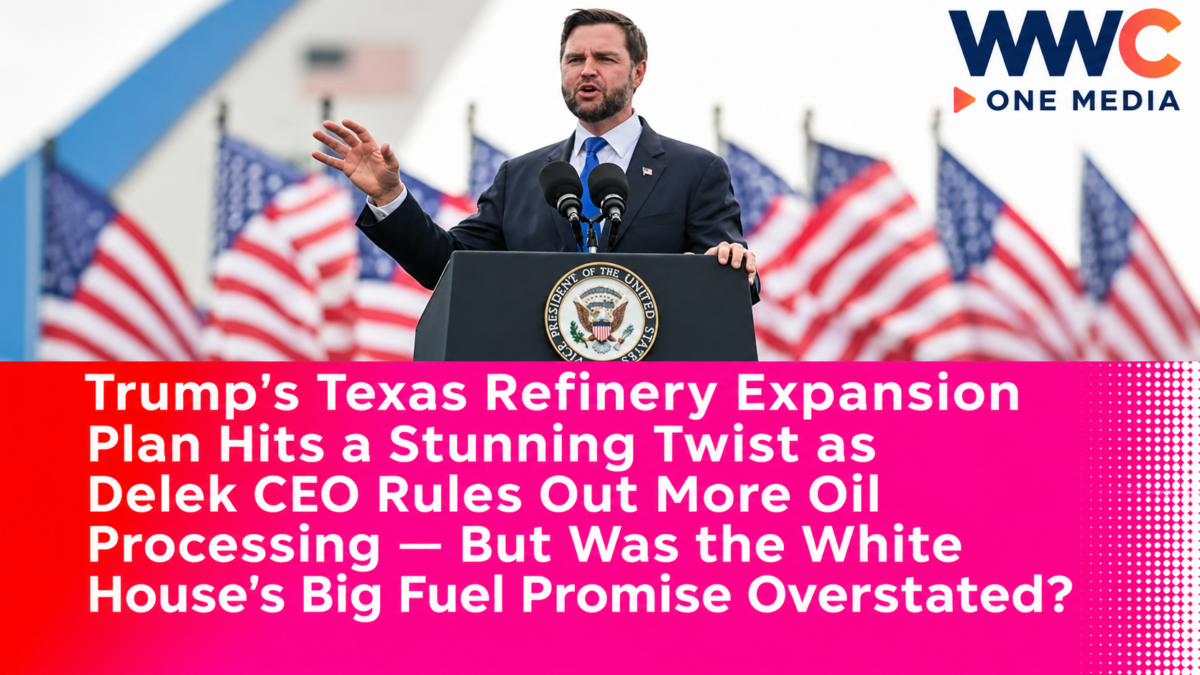
The revelation comes less than a month after US Vice President JD Vance announced that the administration would use the Defense Production Act, a Cold War-era industrial authority, to support an expansion of the Tyler facility.
The October announcement was promoted as part of President Donald Trump’s broader campaign to increase American fuel production, strengthen energy security and reduce the cost of gasoline and diesel.
But during Delek’s third-quarter earnings conference call, Soreq made clear that the company was not planning a major increase in crude throughput.
“We are still talking to the administration, but to make it very, very clear, Tyler is going to stay at 75,000 barrels a day,” Soreq said.
The CEO also indicated that the company had no material capital expenditure to disclose in connection with the discussions.
Instead, Delek is considering potential changes to the types of petroleum products produced at the refinery.
The distinction is significant.
Increasing the amount of crude oil a refinery can process is not the same as adjusting its production mix to manufacture more diesel, jet fuel or other refined products.
And while the latter could improve the availability of certain fuels, it does not necessarily mean a substantial increase in America’s total refining capacity.
The development raises questions about the scope of the administration’s original announcement—and whether its energy strategy can deliver the fuel-price relief promised to American consumers.
JD Vance Announced a Texas Refinery Expansion in October
The controversy began on October 13, when Vice President JD Vance visited Tyler, Texas, and announced that the Trump administration would work with Delek to expand the refinery.
According to Reuters and Bloomberg, the administration intended to use the Defense Production Act of 1950 to support the project.
The law provides federal authorities with tools to strengthen industrial production and supply chains considered important to national defense.
Vance said the planned initiative would increase the availability of commercial-grade and military-specification fuels.
The announcement came as the White House faced growing pressure over high fuel prices, particularly diesel.
The administration argued that increasing domestic refining output would help reduce transportation expenses, improve fuel availability and strengthen America’s energy independence.
The Tyler refinery was identified as one of the facilities potentially benefiting from the federal initiative.
However, the administration did not publicly disclose the precise amount of funding that would be allocated to Delek or specify how much additional crude-processing capacity would be created.
That lack of detail became increasingly important after Soreq’s November 6 remarks.
The earlier announcement suggested an expansion of refining activity, but the company’s latest explanation points toward a more limited operational adjustment.
Delek CEO Says Tyler Will Stay at 75,000 Barrels Per Day
During the November 6 conference call, TD Cowen analyst Jason Gabelman asked Delek executives whether the company was receiving Defense Production Act funding and pursuing projects to expand refining capacity.
Soreq responded by emphasizing that discussions with the administration were continuing.
He then clarified that the refinery’s crude-processing capacity would remain unchanged.
He said the conversations concerned changing the mix of petroleum products produced by the facility rather than significantly increasing crude throughput.
The CEO also explained that the potential initiative did not meet the company’s financial materiality threshold for disclosure.
In corporate reporting, materiality generally concerns whether information is significant enough to influence investors’ decisions.
That does not necessarily mean the project has no operational value.
It means management does not currently consider the proposed activity financially significant enough to require separate capital-expenditure disclosure.
Soreq nevertheless expressed appreciation for the administration’s support for small refineries, rural communities and energy affordability.
His comments therefore should not be interpreted as a complete rejection of cooperation with the White House.
Delek is still communicating with federal officials. What the CEO rejected was the expectation of a major increase in Tyler’s crude-processing capacity.
What Is the Difference Between Refinery Expansion and Producing More Fuel?
The distinction matters because crude oil refining involves several stages.
A refinery first processes crude oil through equipment that separates and converts it into usable petroleum products.
Those products can include gasoline, diesel, jet fuel, heating oil and other industrial materials.
Crude-processing capacity measures how much crude oil a refinery can handle over a given period.
At Tyler, that capacity is approximately 75,000 barrels per day.
However, the refinery can potentially adjust its operating conditions to change how much of each refined product it produces.
For example, depending on equipment capabilities, crude characteristics and operating constraints, a refinery may be able to prioritize more diesel or jet fuel relative to other products.
That type of adjustment can help address shortages in specific fuel markets.
But it does not automatically increase the amount of crude oil processed.
Nor does it guarantee that total finished-product output will rise substantially.
Refining efficiency, maintenance schedules, product yields and equipment limitations all influence the outcome.
For consumers, this distinction is important because a refinery can produce more of one type of fuel without meaningfully expanding its total capacity.
The White House may therefore still pursue an initiative to improve fuel availability at Tyler, but the precise mechanism and expected production gains remain unconfirmed.
Trump Turns to a Cold War Law to Fight America’s Fuel Shortage
The Tyler announcement is part of a broader effort to increase petroleum refining and strengthen American fuel supplies.
In April 2026, President Trump issued a determination under Section 303 of the Defense Production Act identifying domestic petroleum production, refining and logistics as industrial capabilities essential to national defense.
The determination authorized federal support mechanisms intended to address shortages and industrial bottlenecks.
These mechanisms can include purchases, purchase commitments and financing assistance.
On October 22, the US Department of Energy announced plans to provide up to $150 million in Defense Production Act Title III funding for projects involving domestic petroleum production, storage, refining and logistics.
The department said the initiative could support higher output of gasoline, diesel, jet fuel and other petroleum products.
However, the $150-million figure refers to the broader federal initiative.
It is not a confirmed award to Delek.
The Energy Department said its project selection process remained ongoing.
Therefore, it would be inaccurate to claim that Delek has already received $150 million or that a specific amount has been committed to expanding the Tyler refinery.
The distinction is crucial as Washington attempts to demonstrate progress in addressing fuel affordability.
Why Diesel Prices Have Become a Major Political Problem
One of the main reasons the administration has emphasized refinery output is the extraordinary pressure on diesel markets.
Diesel is essential to large parts of the economy.
It powers trucks transporting food, agricultural machinery, construction equipment and numerous industrial operations.
Higher diesel prices can therefore affect consumers even when they do not personally own diesel-powered vehicles.
Trucking companies may face higher operating expenses.
Farmers may spend more on planting and harvesting operations.
Manufacturers and distributors can incur higher transportation costs.
Those expenses can eventually flow through to retail prices.
According to Reuters, US diesel prices climbed to approximately $6.32 per gallon in October as global supply disruptions intensified.
The administration has sought to increase fuel availability through refinery initiatives, emergency measures and negotiations with international partners.
As WWC ONE MEDIA reported in its investigation into Trump’s pressure on European governments during the global diesel crisis, the shortage has been intensified by refinery disruptions in the Middle East and Russia, tight inventories and international trade complications.
Those pressures help explain why Washington wants domestic refineries to produce more fuel.
But Delek’s clarification illustrates the practical limitations of translating political announcements into immediate industrial expansion.
America’s Refineries Are Already Operating Near Their Limits
A central obstacle to the White House strategy is that many US refineries are already operating at high utilization rates.
Reuters reported in September and October that American refining facilities were running at approximately 95% to 100% utilization during periods of severe market tightness.
When refineries operate near capacity, opportunities for significant production increases can become limited.
Companies may improve efficiency, adjust maintenance schedules or modify product yields.
But adding substantial crude-processing capacity often requires expensive equipment, engineering work, permits and construction.
Those investments can take months or years to complete.
Refinery operators must also consider whether additional capacity will remain profitable once current market conditions change.
A project that appears attractive during a period of exceptionally high diesel prices may become less compelling if fuel markets normalize.
This creates a difficult policy challenge.
The government wants more refined products quickly.
But private companies must evaluate long-term returns, equipment limitations and financial risks before committing to major investments.
For Delek, the current focus appears to be optimizing its existing Tyler facility rather than undertaking a large crude-processing expansion.
Delek Reports Record $1.13-Billion Quarterly Profit
The refinery controversy emerged on the same day Delek announced exceptionally strong third-quarter financial results.
The company reported net income attributable to Delek of approximately $1.13 billion, equivalent to $18.22 per diluted share.
Revenue reached approximately $4.39 billion, compared with $2.89 billion in the comparable period a year earlier.
Adjusted earnings before interest, taxes, depreciation and amortization, or adjusted EBITDA, totaled approximately $1.28 billion.
However, the results require an important qualification.
Delek benefited significantly from regulatory and accounting effects involving federal small refinery exemptions and renewable fuel obligations.
Excluding the effects identified by the company, adjusted EBITDA was approximately $1.04 billion.
Adjusted earnings per share, excluding those effects, reached $10.53.
These figures demonstrate substantial profitability but also show that the headline net income should not be interpreted as entirely recurring operating profit.
Delek said strong refining margins, improved operating performance and favorable product yields contributed to its financial results.
The company also increased its annual run-rate cash-flow improvement target under its Enterprise Optimization Plan to at least $250 million.
Management expects to repay an outstanding $850-million term loan during the fourth quarter.
The results indicate that Delek is focused on strengthening its balance sheet, improving operational efficiency and returning capital to shareholders.
The company also increased its regular quarterly dividend to $0.30 per share.
For investors, this makes the Tyler refinery clarification particularly interesting.
Delek is enjoying strong financial performance, but it is not announcing a major capital-intensive expansion at the refinery highlighted by the administration.
Delek Operates Four US Refineries With 302,000 Barrels of Daily Capacity
Delek is an established American downstream energy company with operations in refining, logistics and related petroleum businesses.
Its four refineries are located in Tyler and Big Spring, Texas; El Dorado, Arkansas; and Krotz Springs, Louisiana.
Together, the facilities have approximately 302,000 barrels per day of nameplate crude-processing capacity, according to the company’s investor information.
Tyler accounts for roughly one-quarter of that total.
The company employs more than 2,000 people and plays an important economic role in the communities surrounding its operations.
That regional employment impact was part of the rationale behind the administration’s support for smaller American refineries.
Keeping existing facilities economically viable can help protect jobs, maintain fuel supplies and support regional economies.
But protecting existing operations is different from increasing total national refining capacity.
The administration’s broader policy may pursue both objectives.
The evidence available from Delek’s November 6 earnings call establishes that no major increase in Tyler’s crude-processing capacity is currently planned.
Small Refinery Exemptions Are Another Part of the Story
The Trump administration has also supported smaller refineries through exemptions involving the Renewable Fuel Standard.
Under the program, refiners generally must meet specified renewable fuel requirements.
Eligible small refineries can receive exemptions when compliance would create disproportionate economic hardship.
Delek announced in August that it welcomed federal decisions granting small refinery exemptions for the 2025 compliance year.
The company said the exemptions would help protect jobs and support investment in refinery operations.
During its November earnings call, management discussed the financial benefits of those decisions.
The company indicated that it expected approximately $425 million in fourth-quarter proceeds related to its renewable-fuel compliance strategy.
Those benefits are separate from any potential Defense Production Act support for the Tyler facility.
They should not be described as direct funding for a Tyler refinery expansion.
The distinction matters because Delek’s improved financial position reflects several operational, regulatory and market factors.
Its earnings cannot be attributed solely to the administration’s proposed refinery initiative.
Could the White House Announcement Have Created Unrealistic Expectations?
The apparent gap between the October announcement and Delek’s November explanation raises a broader question about how industrial projects are communicated.
Political leaders often describe proposed investments in terms of their intended economic benefits.
Companies, however, must ultimately translate those announcements into engineering plans, budgets, production targets and operational schedules.
In the Tyler case, the administration emphasized refinery expansion and additional fuel output.
Delek’s chief executive subsequently clarified that crude-processing capacity would remain at 75,000 barrels daily.
Both statements could potentially be reconciled if the proposed initiative involves changes to the refinery’s product mix rather than additional crude throughput.
But the administration has not provided sufficient public technical details to establish exactly how much additional fuel would be produced.
Nor has Delek announced a major capital project corresponding to a significant expansion in its crude-processing capacity.
That makes it premature to conclude that the original initiative has been canceled.
It is equally premature to conclude that the administration has secured a major increase in refining capacity at Tyler.
The confirmed development is narrower: Delek is discussing changes in fuel production with federal officials, while ruling out increased crude-processing capacity at the facility.
Could the US Really Lower Fuel Prices Through Refinery Optimization?
Increasing diesel production could provide some relief when supplies are tight.
But fuel prices depend on much more than output from a single refinery.
Global crude oil prices, transportation costs, inventory levels, refinery maintenance and international fuel demand all influence prices.
The location of a refinery also matters.
A facility may produce additional diesel, but that fuel still needs to reach the markets where shortages are most severe.
Pipelines, storage facilities, trucking capacity and distribution networks can affect the cost and timing of delivery.
Global developments remain especially important.
Disruptions to Middle Eastern energy supplies and Russian refining infrastructure have created uncertainty in petroleum markets.
As WWC ONE MEDIA reported when oil prices plunged more than 8% following the US midterm elections, international crude prices can change sharply in response to political and diplomatic developments.
A decline in crude prices can eventually relieve pressure on fuel markets.
However, diesel and gasoline prices do not always move in direct proportion to crude benchmarks.
Refining margins, product shortages and transportation constraints can cause refined-product prices to remain elevated.
That means the benefits of changes at Tyler would depend on the amount and type of additional fuel produced, the timing of delivery and wider market conditions.
What the US Refinery Debate Means for the Philippines
The controversy also carries lessons for energy-importing economies such as the Philippines.
The country relies heavily on imported petroleum and refined products.
Global refinery disruptions can therefore influence domestic gasoline and diesel prices.
When diesel prices rise, Philippine transportation operators, logistics companies, agricultural producers and manufacturers can face higher costs.
Those expenses may eventually affect consumer prices.
As WWC ONE MEDIA recently reported on Petron’s 44% decline in nine-month profit despite higher revenue, oil companies can experience considerable financial pressure even when sales rise.
Refining margins, crude acquisition costs, transportation expenses and market disruptions all affect profitability.
Petron’s results illustrate how the economics of producing and distributing petroleum products can be more complicated than headline oil-price movements suggest.
For Filipino motorists, this complexity is visible in weekly pump-price adjustments.
Gasoline prices may increase while diesel prices fall, or the opposite may occur.
The movements depend partly on regional refined-product prices and exchange-rate conditions.
In Singapore, WWC ONE MEDIA reported that Caltex lowered petrol and diesel prices for the first time in nearly seven weeks.
That development illustrates how retail prices respond to changing international conditions.
But one American refinery’s operating plans would not, by themselves, determine fuel prices in the Philippines or Singapore.
The significance is broader: improving refining efficiency can help fuel availability, but consumers ultimately depend on a complex international supply chain.
What Happens Next for Delek and the White House?
Several questions remain unresolved.
First, will the administration provide financial support to Delek?
The company has confirmed ongoing discussions, but no specific Defense Production Act funding amount for Tyler was established in the reviewed disclosures.
Second, what products could the refinery produce in greater quantities?
Management referred to shifting between petroleum products but did not provide detailed production forecasts.
Third, could the company undertake additional refinery investments later?
Soreq’s November remarks indicate that Tyler’s crude-processing capacity will remain unchanged under the initiative currently being discussed.
They do not establish that Delek will never consider future improvements.
Fourth, how will the administration demonstrate that its refining initiative is lowering fuel prices?
Future production data, project announcements and product-market conditions will be necessary to assess the results.
The Energy Department’s broader $150-million funding initiative could also reveal more about Washington’s priorities as project selections are announced.
Investors will be watching for updates from Delek and federal officials concerning capital spending, production changes and actual fuel output.
The Bigger Question: Can Political Promises Overcome America’s Refining Bottleneck?
The Delek controversy illustrates a central challenge facing the Trump administration’s energy strategy.
Washington wants to increase fuel production quickly, protect domestic refining jobs and reduce the prices paid by consumers.
But refineries are complicated industrial facilities.
They cannot necessarily expand crude-processing capacity simply because the federal government announces support.
Operators must consider engineering constraints, long-term economics, equipment reliability and available markets.
At Tyler, Delek’s chief executive has made clear that crude-processing capacity will remain at approximately 75,000 barrels per day.
The company may still participate in efforts to adjust its output of specific refined products.
But that is a different undertaking from the large-scale capacity expansion some observers may have expected following Vice President Vance’s announcement.
For consumers, the stakes are significant.
Diesel prices affect transportation, food distribution and industrial activity.
Refining shortages can amplify inflation and increase operating costs throughout the economy.
The White House’s effort to address those pressures is therefore economically consequential.
Yet the effectiveness of the initiative will depend on measurable increases in fuel availability—not announcements alone.
Delek’s November 6 clarification does not prove that Trump’s refinery strategy has failed. But it exposes a significant gap between the expectation of expanded crude-processing capacity and the limited changes the company is currently discussing.
For now, the administration’s promise of more affordable fuel remains a policy objective rather than a demonstrated result of the Tyler project.
And as Americans continue facing expensive gasoline and diesel, one question is becoming increasingly difficult to ignore: Can Trump’s refinery expansion strategy deliver meaningful relief—or will the reality of America’s aging refining infrastructure prove far more difficult than Washington anticipated?