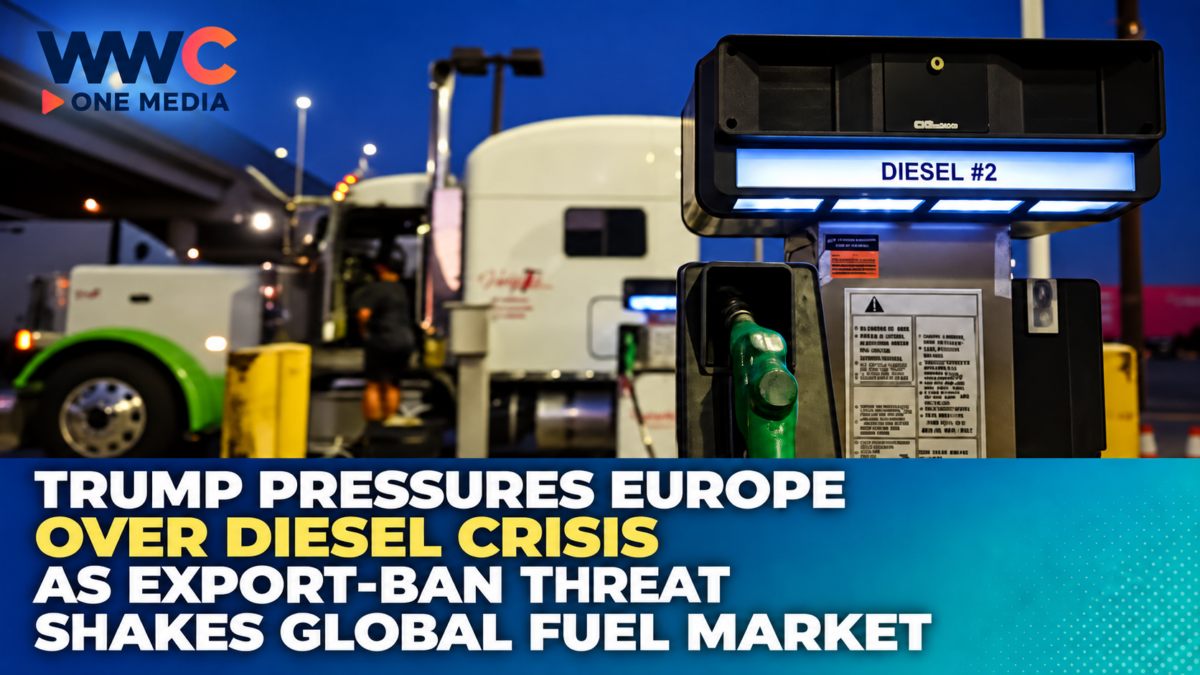
WASHINGTON/BRUSSELS — U.S. President Donald Trump has turned diesel into the latest pressure point between Washington and Europe, threatening to restrict American fuel exports unless major European countries release emergency reserves to cool soaring prices — a move that briefly raised fears of making an already severe global diesel shortage even worse.
The Trump administration told France and Germany to draw down emergency diesel inventories or risk facing restrictions on U.S. diesel exports, according to Reuters.
The warning came as diesel prices surged globally following refinery disruptions in the Middle East and Russia, reduced fuel exports from China and exceptionally tight inventories heading into winter.
But within a day, the diplomatic pressure produced a major response.
On October 2, the Group of Seven agreed to release 100 million barrels of diesel and crude oil from emergency reserves, while also pledging to avoid export restrictions that could further fragment global energy markets.
That agreement reduced the immediate likelihood of a U.S. diesel export ban.
But it does not eliminate the underlying supply problem.
TRUMP’S MESSAGE TO EUROPE: RELEASE YOUR DIESEL
The dispute centered primarily on France and Germany because the two countries hold a substantial share of Europe’s emergency diesel inventories.
Together they account for around 35% of the European Union’s diesel reserves, according to Eurostat data cited by Reuters.
Germany held roughly 5.6 million metric tons of diesel in emergency stocks, while France held around 8.2 million tons.
The Trump administration argued that European countries had not released enough of those reserves under an earlier coordinated International Energy Agency response to the global energy crisis.
Washington therefore increased the pressure.
The message was essentially:
release more emergency diesel—or risk losing access to additional U.S. supply.
EUROPE INITIALLY PUSHED BACK
The European Commission publicly rejected the threat of a U.S. export restriction.
Commission spokesperson Anna-Kaisa Itkonen said an export ban would not benefit either side and warned that restricting supplies could undermine confidence in the United States as a reliable energy partner.
European officials instead pushed for a coordinated solution.
French President Emmanuel Macron called for G7 leaders to cooperate on emergency reserve releases and argued against trade restrictions that could worsen fuel shortages.
France proposed a combined response involving:
50 million barrels of diesel released by European countries
and
50 million barrels of crude released by International Energy Agency members.
That eventually became the basis of the broader G7 agreement.
G7 AGREES TO RELEASE 100 MILLION BARRELS
The final agreement calls for 100 million barrels of diesel and crude oil to be released from emergency inventories.
The release will begin immediately and extend over approximately four months, with significant diesel volumes expected to reach the market within about 20 days.
The G7 also pledged to refrain from imposing energy-export restrictions.
That provision is important because export bans can create unintended consequences.
Restricting U.S. diesel exports might temporarily increase supply inside the United States.
But it could also create severe shortages elsewhere, disrupt refining economics and eventually distort prices back in the U.S. market.
WHY DIESEL HAS BECOME THE REAL ENERGY PROBLEM
Much of the public conversation about energy focuses on crude oil.
But in late 2026, the more serious shortage has increasingly been in refined fuels—especially diesel.
Industry executives estimate that disruptions in Russia and the Middle East have removed roughly 4 million barrels per day of diesel production or supply from normal global flows.
Crude oil can still be available.
The problem is turning that crude into enough diesel.
Refineries must process oil before it becomes transportation fuel, and global refining capacity has become increasingly constrained.
That is why the diesel market can remain tight even when crude supplies appear relatively adequate.
MIDDLE EAST CONFLICT HIT REFINING CAPACITY
One of the biggest shocks came from the Middle East.
Conflict involving Iran disrupted refining and energy infrastructure across the region, reducing exports of diesel and other refined products.
Middle Eastern countries normally supply enormous quantities of fuel to Europe, Asia and Africa.
When those refinery exports fell, buyers turned increasingly toward the United States.
That increased pressure on U.S. inventories.
At the same time, geopolitical tensions pushed crude prices back above $100 per barrel.
Brent crude settled at $102.25 a barrel on October 2, while U.S. West Texas Intermediate closed at $91.11.
RUSSIA HAS ALSO CUT DIESEL EXPORTS
Russia has compounded the shortage.
Moscow extended restrictions on diesel exports through the end of October after Ukrainian attacks damaged refinery infrastructure.
Russia was previously one of the world’s largest diesel exporters.
Deputy Prime Minister Alexander Novak said Moscow could partially lift the restrictions if domestic production exceeds local demand, but the ban remained in place as of October 2.
The loss of Russian exports has been particularly difficult for Europe.
Before Russia’s invasion of Ukraine and subsequent sanctions, Europe depended heavily on Russian refined fuels.
It has since replaced much of that supply with cargoes from the United States, Middle East and other markets.
CHINA ADDED ANOTHER SHOCK
Global fuel markets tightened further when China suspended most fuel-product exports outside Hong Kong and Macau.
That removed another potential source of diesel and gasoline from the international market at precisely the moment buyers were searching for replacement barrels.
Together, the disruptions created a highly unusual situation:
Russia restricting exports
China reducing exports
Middle Eastern refinery output disrupted
and
Europe increasingly dependent on American fuel.
That combination helps explain why even the possibility of a U.S. export ban generated such concern.
EUROPE NOW GETS 41% OF SOME DIESEL IMPORTS FROM THE U.S.
Europe’s dependence on American diesel has increased dramatically.
Reuters Breakingviews reported that around 41% of Europe’s imported diesel supply in September came from the United States.
That makes the U.S. an increasingly important supplier at a time when European domestic refinery capacity has also declined.
Europe and surrounding countries had approximately 17.5 million barrels per day of refining capacity in 2009.
By 2025, that had fallen to around 14.4 million barrels per day after dozens of refinery closures or conversions.
That structural decline has made Europe more dependent on imported refined fuels.
EUROPE HAS LOST ABOUT 30 REFINERIES
Since 2009, roughly 30 of Europe’s approximately 100 refineries have closed or been converted, according to industry estimates reported by Reuters.
For years, that appeared manageable.
Europe was reducing diesel-car usage, investing in electrification and relying on international fuel markets.
But geopolitical shocks have exposed the risk of depending heavily on imported refined products.
Diesel remains essential for:
Trucking
Agriculture
Construction
Industrial machinery
Shipping
Backup generators
and
Military operations.
Electric vehicles may be reducing petroleum demand in passenger transport, but they cannot immediately replace diesel across all of those sectors.
U.S. INVENTORIES ARE TIGHT TOO
Trump’s concern about domestic prices is not purely political rhetoric.
U.S. distillate inventories—which include diesel and heating oil—stood at about 105.2 million barrels on September 25, according to the U.S. Energy Information Administration.
Stocks had fallen from approximately 107.9 million barrels two weeks earlier.
That decline matters because the United States is entering the colder months, when heating-oil demand normally increases.
U.S. refineries have been operating at high utilization rates, but global demand for American diesel has continued pulling barrels overseas.
AMERICAN DIESEL PRICES HAVE HIT EXTREME LEVELS
U.S. retail diesel prices climbed above $6.50 per gallon during the recent spike, according to Reuters reporting on the fuel crisis.
That creates serious economic pressure.
Diesel is embedded throughout the supply chain.
Higher diesel prices raise the cost of:
Moving food
Delivering packages
Running farms
Operating construction equipment
Moving manufactured products
and
Public transportation.
Businesses can eventually pass part of those costs to consumers.
That means diesel inflation can spread into grocery prices, freight rates and other everyday expenses.
THE POLITICAL TIMING MATTERS
The crisis comes only weeks before the November 3 U.S. midterm elections.
Trump has faced growing political pressure over fuel prices and the economic impact of the Iran conflict.
Reuters reported that the administration’s pressure on Europe was partly aimed at lowering U.S. diesel prices ahead of the election.
That does not change the underlying supply shortage.
But it helps explain why the White House has pushed so aggressively for emergency stock releases.
The administration is also considering other measures to reduce domestic diesel costs, including changes involving tax-exempt dyed diesel.
THE U.S. HAS ALREADY TAPPED ITS OWN EMERGENCY OIL STOCKPILE
Washington has also been using its Strategic Petroleum Reserve.
On September 29, the U.S. announced that it would offer loans of up to 40 million barrels of crude oil from the SPR.
That forms part of a much larger international emergency release agreed earlier in the year.
The U.S. had committed around 172 million barrels under a global 400-million-barrel IEA reserve release following the Iran war.
However, some European countries released less than their allocated share, one reason Washington intensified pressure this week.
U.S. Strategic Petroleum Reserve holdings have now fallen below 284 million barrels, their lowest level since 1982.
That creates another dilemma:
emergency reserves can stabilize prices now, but every barrel released reduces the cushion available for the next crisis.
MARKETS RESPONDED IMMEDIATELY
Fuel and crude prices fell after news emerged that Europe would tap reserves.
European gasoil futures dropped sharply, while crude prices also retreated.
Brent ultimately settled nearly unchanged at $102.25, while WTI fell almost 2% to $91.11.
The reaction shows how sensitive markets are to even relatively small changes in available supply.
But reserve releases do not create new refining capacity.
They simply move fuel that has already been produced out of storage and into the market.
100 MILLION BARRELS BUYS TIME — NOT A PERMANENT FIX
That is the central limitation of the G7 agreement.
Emergency stocks are designed to absorb temporary supply shocks.
They cannot permanently replace missing refinery production.
Global diesel supply is expected to remain tight through the coming winter, according to executives from major energy traders and refiners.
The market ultimately needs one or more of the following:
Middle Eastern refineries returning to full operation
Russian diesel exports recovering
China restoring fuel exports
More refinery capacity elsewhere
or
Lower global demand.
Until one of those conditions changes, stock releases can only reduce the pressure temporarily.
AN EXPORT BAN COULD HAVE BACKFIRED ON THE UNITED STATES
Trump’s threatened export ban might seem straightforward:
keep U.S.-produced diesel inside America and domestic prices should fall.
Energy markets are more complicated.
U.S. Gulf Coast refiners are designed to serve both domestic and export markets.
If exports are restricted, refiners could eventually reduce production because they cannot economically sell every barrel domestically.
That could shrink total supply.
Restrictions could also push global prices significantly higher, damaging U.S. allies and disrupting other energy flows.
This is why the G7 agreement’s pledge to avoid export restrictions is important.
The countries are attempting to increase available supply instead of dividing the market into national pools.
THE BIGGER STORY: THE WORLD HAS ENOUGH CRUDE — BUT NOT ENOUGH DIESEL
The latest crisis reveals an important weakness in the global energy system.
Oil markets are often judged by how many barrels of crude are available.
But crude oil cannot power a truck, tractor or generator until it passes through a refinery.
Right now, the bottleneck is increasingly the refinery.
War has disrupted Middle Eastern output.
Ukrainian attacks have damaged Russian plants.
China has pulled fuel away from export markets.
Europe has permanently closed dozens of refineries.
And the United States is being asked to supply more of the world while trying to keep domestic prices under control.
The G7’s 100-million-barrel emergency release may stop the immediate political confrontation over American exports.
But it does not solve the underlying shortage.
That leaves one uncomfortable question hanging over the global economy as winter approaches:
What happens when emergency reserves run lower—but the refineries still cannot produce enough diesel?