SEOUL / TOKYO / TAIPEI / MANILA — Asia’s biggest technology-driven stock markets suffered a brutal selloff on Friday, November 6, as fears surrounding artificial intelligence investments swept from Wall Street into the world’s most important semiconductor manufacturing economies.
Wall Street’s AI Panic Spreads Across Asia
South Korea was among the hardest hit.
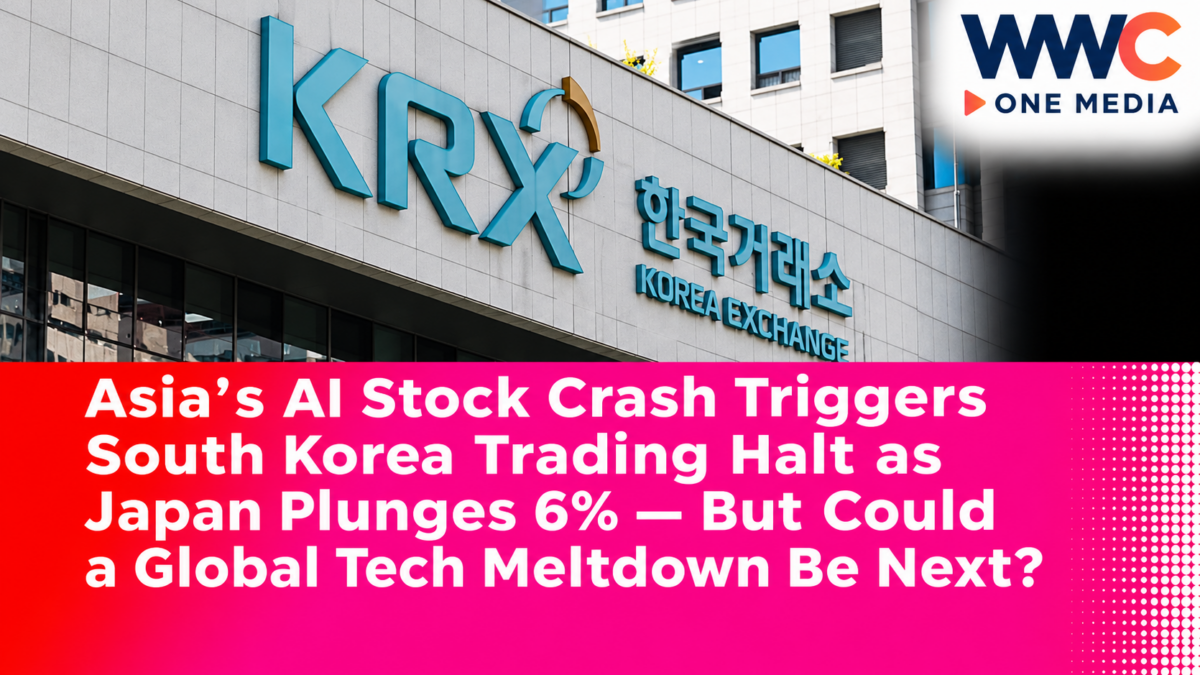
The country’s benchmark KOSPI plunged as much as approximately 8.8% during early trading, triggering a 20-minute trading suspension as authorities moved to contain extreme volatility.
Although the market recovered part of its initial losses, the index still closed 6.02% lower at 5,059.69.
Japan’s Nikkei 225 plunged approximately 6%, while Taiwan’s TAIEX fell around 4.5%.
Some of Asia’s most influential technology companies experienced double-digit or near-double-digit declines.
SK Hynix, a major supplier of high-bandwidth memory used in advanced AI computing systems, lost 10.4%.
Samsung Electronics declined 6.4%.
Japan’s SoftBank Group, an influential investor in the global AI industry, fell approximately 10.8%.
Taiwan Semiconductor Manufacturing Company, the chipmaker responsible for manufacturing advanced processors for leading technology companies, declined around 4.7%.
The market rout followed a severe decline in US technology shares on November 5, when the Nasdaq Composite lost 5.5% and the S&P 500 fell 4.4%.
Reuters estimated that approximately $3 trillion in US equity market value was wiped out during the Wall Street selloff.
The losses raise a critical question: if investors are losing confidence in the companies building AI infrastructure, what happens to the Asian manufacturers supplying the chips, memory and equipment that power the entire industry?
South Korea Halts Trading After KOSPI Plunges Nearly 9%
The most dramatic moment came in Seoul.
South Korea’s KOSPI fell more than 8% shortly after trading opened, activating an exchange circuit breaker.
The mechanism temporarily suspended trading for 20 minutes.
Circuit breakers are designed to interrupt trading during exceptionally sharp market moves, giving participants an opportunity to reassess orders and reduce disorderly conditions.
They do not guarantee that prices will rebound.
Following the halt, South Korean shares recovered some of their earlier losses.
But the final decline remained severe.
The KOSPI ended the session down 6.02%, with chipmakers suffering some of the heaviest selling.
The index lost approximately 11.7% over the full week.
Foreign investors sold roughly 2.8 trillion won in South Korean equities during Friday’s session, according to Reuters.
The scale of the withdrawals highlighted the exposure of Asian semiconductor markets to changes in global investment sentiment.
South Korea’s financial authorities convened emergency discussions and announced temporary adjustments intended to reduce the risk of forced selling by highly leveraged investors.
Those actions were aimed at limiting market disruption, not guaranteeing higher share prices.
Samsung and SK Hynix Become Major Victims of the AI Selloff
Samsung Electronics and SK Hynix sit near the center of the global semiconductor industry.
Both companies supply advanced memory technology used in data centers, smartphones, servers and other computing systems.
SK Hynix has become especially important because of its role in producing high-bandwidth memory, or HBM, for AI accelerators.
HBM helps advanced processors access large amounts of data at high speed.
This technology is critical for many modern AI systems.
Samsung also supplies memory and semiconductor products used throughout the global electronics industry.
As artificial intelligence investment accelerated, investors expected demand for advanced memory to remain exceptionally strong.
Those expectations contributed to increased interest in semiconductor shares.
But elevated expectations can create vulnerability.
If investors begin questioning whether data-center construction will proceed as quickly as previously forecast, they may also revise projections for chip demand.
That does not mean orders have already disappeared.
It means investors are reassessing future earnings before all the underlying business effects become visible.
The distinction matters.
A decline in SK Hynix’s market value does not establish that its existing customer contracts have been canceled.
Similarly, Samsung’s falling share price does not prove that semiconductor demand has entered a permanent decline.
Japan’s Nikkei Drops 6% as SoftBank Faces Heavy Selling
The pressure extended to Japan.
The Nikkei 225 declined approximately 6% on November 6, its worst daily performance since April 2025, according to The Wall Street Journal.
SoftBank Group was among the companies hit particularly hard.
Its shares declined about 10.8%.
SoftBank has extensive exposure to technology and artificial intelligence through its investments, partnerships and financing activities.
Consequently, changes in investor expectations about the AI economy can significantly influence its valuation.
Japan also has an important role in the semiconductor manufacturing ecosystem.
Japanese companies provide chipmaking equipment, specialized materials, electronic components and industrial technology.
These businesses can benefit from investment by semiconductor manufacturers in Taiwan, South Korea and other regions.
But the relationship creates exposure to potential reductions in capital spending.
If major chipmakers postpone factory expansions or equipment orders, some Japanese suppliers could face slower growth.
Still, no single stock-market session establishes that those reductions will occur.
The selloff reflected changing expectations rather than a verified collapse in Japanese semiconductor production.
Taiwan’s TAIEX Falls as TSMC Comes Under Pressure
Taiwan’s stock market also suffered a significant decline.
The TAIEX finished November 6 approximately 4.5% lower after a far steeper intraday selloff.
Taiwan Semiconductor Manufacturing Company declined about 4.7%.
TSMC occupies a crucial position in the global technology industry.
It manufactures advanced chips designed by major companies, including Nvidia and other semiconductor developers.
Those chips power AI data centers, smartphones, computers and other electronic systems.
The company’s importance makes Taiwan particularly sensitive to changes in expectations about global technology investment.
When investors expect AI companies to expand computing infrastructure rapidly, they may anticipate stronger demand for TSMC’s manufacturing services.
When confidence weakens, valuations can fall even before production forecasts are revised.
The recent selloff demonstrates how closely Taiwan’s financial market has become connected to the growth expectations surrounding artificial intelligence.
But it does not establish that TSMC has lost its manufacturing leadership or that demand for advanced chips has vanished.
Why Wall Street Triggered the Asian Market Crash
The immediate catalyst came from the United States.
On November 5, American technology shares suffered a severe selloff.
The Nasdaq Composite lost 5.5%.
The S&P 500 fell 4.4%.
Nvidia declined 9.3%, while AMD fell 17.3%.
The Philadelphia Semiconductor Index dropped approximately 12.2%.
Investors were increasingly worried that artificial intelligence infrastructure spending could slow.
The November 3 US midterm elections intensified those concerns.
Democratic victories raised expectations that lawmakers and newly elected state officials could introduce tighter oversight of data-center projects.
But the selloff also reflected deeper financial concerns that existed before the election.
AI companies have been committing enormous sums to computing hardware, electricity infrastructure and data-center construction.
Investors are asking whether those investments will generate enough future revenue to justify the costs.
WWC ONE MEDIA previously examined the development in Wall Street’s AI Stock Selloff Enters Third Straight Week as Nasdaq 100 Plunges 3.5% — But Is the Tech Bubble Finally Bursting?.
That earlier report highlighted the growing tension between expectations of rapid AI growth and the financial performance needed to sustain high stock valuations.
The latest decline suggests investors are demanding stronger evidence that the AI boom can produce sustainable returns.
US Elections Add a New Political Risk to AI Investments
The November 3 elections changed expectations about the American political environment.
Democrats gained control of Congress and secured important state-level victories.
Some candidates campaigned on tighter restrictions or greater scrutiny of data-center development.
Their concerns include electricity prices, water availability, environmental impacts and the use of public incentives.
One particularly significant development occurred in Texas.
The incoming administration of Governor-elect Gina Hinojosa has supported stronger restrictions on new data-center construction.
Texas is important because it has become a major location for planned computing infrastructure.
A slowdown in approvals could affect demand for equipment used in future projects.
However, it would be inaccurate to claim that the election automatically canceled every proposed data center.
Political proposals must be translated into actual laws, regulations, permitting decisions or other enforceable actions.
Some projects may continue.
Others may encounter delays or revised requirements.
WWC ONE MEDIA previously examined this political risk in Trump Is Betting Big on AI Data Centers — But His Own Voters Could Turn Them Into a GOP Midterm Nightmare.
The political pressure is important because data-center development has become an increasingly visible issue for local communities, not merely a financial-market story.
The $3-Trillion Wall Street Loss Needs Context
The enormous market-value loss reported during the US selloff is striking.
Reuters estimated that approximately $3 trillion in market capitalization was erased from S&P 500 companies.
However, market capitalization is the market value of a company’s outstanding shares.
A decline in that figure does not mean the same amount of cash physically disappeared from bank accounts.
It represents a reduction in the market’s valuation of those businesses.
The total also does not establish how much individual investors realized in losses.
Some investors sold shares.
Others retained their holdings.
Still others may have purchased shares at lower prices.
This distinction is important when interpreting headlines about trillions of dollars being wiped from financial markets.
The losses nevertheless matter because lower valuations can influence investor confidence, corporate financing and willingness to fund future expansion.
A prolonged decline may make it more expensive for some companies to raise capital.
That can have consequences beyond the stock market.
Asia’s Semiconductor Supply Chain Is Exposed to AI Investment Decisions
Artificial intelligence infrastructure depends on a complex network of international suppliers.
Nvidia and other chip developers design advanced processors.
TSMC manufactures many of those chips.
South Korean manufacturers supply memory.
Japanese companies provide specialized equipment and materials.
Other Asian economies contribute electronic components, manufacturing services and logistics.
The supply chain has benefited from rapid investment in data centers.
But the benefits also create exposure.
If customers delay new infrastructure, suppliers may eventually encounter slower order growth.
Those effects can differ significantly between companies.
A manufacturer with long-term supply agreements and strong competitive advantages may remain resilient.
A business with substantial dependence on speculative new projects may be more vulnerable.
Investors must therefore examine each company’s actual customer relationships, financial strength and order visibility.
A broad decline in semiconductor shares does not mean every business faces identical risks.
China’s AI Hardware Market Was Already Facing Valuation Pressure
The correction is not limited to South Korea, Japan and Taiwan.
Chinese AI-related shares have also experienced volatility as investors reassess valuations and earnings expectations.
WWC ONE MEDIA examined the earlier retreat in China’s AI Hardware Selloff Deepens as Valuation Fears Hit Tech Darlings — But the Earnings Boom Isn’t Over Yet.
That report examined companies involved in optical networking, semiconductors, robotics and other technologies supporting the AI industry.
Some businesses had experienced substantial increases in share prices as investors anticipated extraordinary future growth.
The challenge is determining whether earnings can grow quickly enough to justify those valuations.
China’s technology sector also operates under different regulatory and financing conditions from US and other Asian markets.
Its stock-market performance should not automatically be expected to match movements elsewhere.
Indeed, some Hong Kong-listed internet companies attracted investment interest during the latest selloff as traders sought alternatives to more expensive AI hardware shares.
That demonstrates how investors can shift funds between technology sectors rather than abandoning the entire industry.
China Warns About Too Much Money Flowing Into AI
Chinese financial officials have raised concerns about the concentration of investment capital in rapidly expanding technology industries.
WWC ONE MEDIA covered those warnings in China Warns AI Investment Is Becoming Too Concentrated — But Is the Bigger Risk a New Tech Bubble?.
The concern is that heavy investment can create feedback loops.
Rising share prices attract more capital.
Additional funding encourages companies to expand.
Expansion fuels expectations of even stronger future earnings.
Those expectations can push valuations higher.
The process can continue while investors remain confident.
But it becomes vulnerable when earnings, demand or financing conditions disappoint.
The latest Asian selloff illustrates how quickly expectations can reverse.
This does not prove that artificial intelligence is a speculative technology without commercial value.
It means investors may have difficulty determining how much future profitability is already reflected in share prices.
Authorities in South Korea and Taiwan Move to Stabilize Markets
The selloff prompted responses from financial authorities.
In South Korea, officials held emergency discussions and introduced temporary measures intended to reduce forced selling.
Authorities also sought to reassure investors about the country’s underlying financial and economic position.
Taiwanese officials indicated that the country’s National Financial Stabilization Fund could provide support if market volatility threatened orderly trading.
The fund has resources intended to help address severe financial-market instability.
However, a statement that authorities are prepared to intervene does not establish that all available funds have already been deployed.
Regulators may also adjust market rules or encourage measures intended to reduce volatility.
Such actions can help support market functioning.
They cannot guarantee that the price of semiconductor shares will return to previous levels.
Market stabilization and a sustained recovery are different outcomes.
Why Investors Are Worried About Data-Center Debt
Beyond political concerns, financing is another major vulnerability.
AI computing facilities require large investments before they can begin generating substantial revenue.
Operators must purchase processors, install networking equipment and secure electricity.
Construction can take significant time.
Some companies finance expansion through substantial borrowing.
The strategy can work if customer demand grows as expected.
But debt can amplify financial pressure if projects are delayed or operating income falls short.
Higher borrowing costs can reduce profitability.
Companies may also need to replace computing hardware as technology advances.
Investors are therefore examining whether infrastructure operators have sufficient cash flow and durable customer contracts.
The financial health of those operators matters to Asian manufacturers because it can influence future equipment purchases.
But a slowdown in speculative spending may not necessarily eliminate long-term demand for AI services.
The more important question is how quickly profitable demand develops.
Could the AI Selloff Become a Global Financial Crisis?
A broad technology correction can affect investment funds, household wealth and corporate financing.
But a major stock-market decline is not automatically a systemic financial crisis.
Systemic instability generally involves broader disruptions to financing, banking institutions or the functioning of major financial markets.
The November selloff has generated intense volatility.
However, the evidence reviewed does not establish that major Asian banking systems have failed because of AI stocks.
Nor does it show that the global semiconductor industry has stopped operating.
The risk is that declining valuations and financial pressure could produce wider consequences if they persist.
Highly leveraged investors may be forced to reduce positions.
Companies may postpone capital expenditures.
And weakened confidence could affect borrowing costs.
The severity of those effects will depend on how far the correction continues and whether businesses can sustain profitability.
What This Means for Philippine Investors and Technology Companies
The Philippines is connected to regional technology markets through electronics manufacturing, business services, telecommunications and investment flows.
Changes in global semiconductor spending can influence expectations for electronics exporters.
A prolonged slowdown in AI infrastructure investment could affect some companies linked to international supply chains.
But direct effects must be assessed carefully.
There is no verified evidence that the November 6 stock-market selloff alone caused a specific Philippine semiconductor factory to close or an investment project to be canceled.
For investors holding international technology funds, the decline highlights the risks of concentrated exposure to a small group of high-growth companies.
Currency movements can also influence returns for Philippine investors holding foreign assets.
A diversified portfolio may reduce some risks, but diversification does not guarantee protection against losses.
For businesses, the relevant question is whether customer demand and financing conditions are changing, rather than simply whether share prices have fallen.
Five Signals That Could Determine the Next Market Move
Several developments will influence whether Asian technology shares recover.
First, AI company earnings. Investors will want evidence that spending on advanced computing is generating sustainable commercial revenue.
Second, semiconductor orders. Guidance from manufacturers such as TSMC, Samsung and SK Hynix will help clarify whether demand is slowing.
Third, data-center regulation. Actual policy decisions in the United States will matter more than speculation about what the incoming Congress or governors might do.
Fourth, credit conditions. Borrowing costs and access to financing will influence how quickly infrastructure operators can expand.
Fifth, market positioning. Additional forced selling could intensify losses, while renewed buying might help stabilize shares.
The next direction of Asian markets will depend on how these factors evolve together.
No single trading session can establish that the AI boom has permanently ended.
The Bigger Question: Is Asia’s AI Boom Entering a New Era?
The November 6 selloff has exposed the extraordinary financial importance of artificial intelligence to Asian stock markets.
South Korea’s KOSPI suffered a trading halt after an intraday plunge of roughly 8.8%.
Japan’s Nikkei lost about 6%.
Taiwan’s TAIEX closed roughly 4.5% lower.
Some of the world’s most important semiconductor suppliers suffered severe losses.
The downturn followed a Wall Street selloff that erased approximately $3 trillion in US equity market capitalization and intensified concerns about the sustainability of AI investment.
Investors are now reconsidering the valuations of businesses supplying chips, memory, equipment and electricity infrastructure.
Yet the underlying demand for AI computing has not been proven to have disappeared.
The challenge is determining how much capital the industry can profitably absorb—and how quickly companies can earn adequate returns from it.
The coming months will test whether the selloff represents a temporary market correction or a more fundamental change in expectations.
As South Korea halts trading, Japan suffers its worst stock-market day in more than a year and Taiwan’s chipmakers face heavy selling, one question could define Asia’s financial future: Will the region’s semiconductor giants recover as AI spending stabilizes—or could the world’s biggest technology supply chain face an even deeper correction if the data-center boom begins to slow?