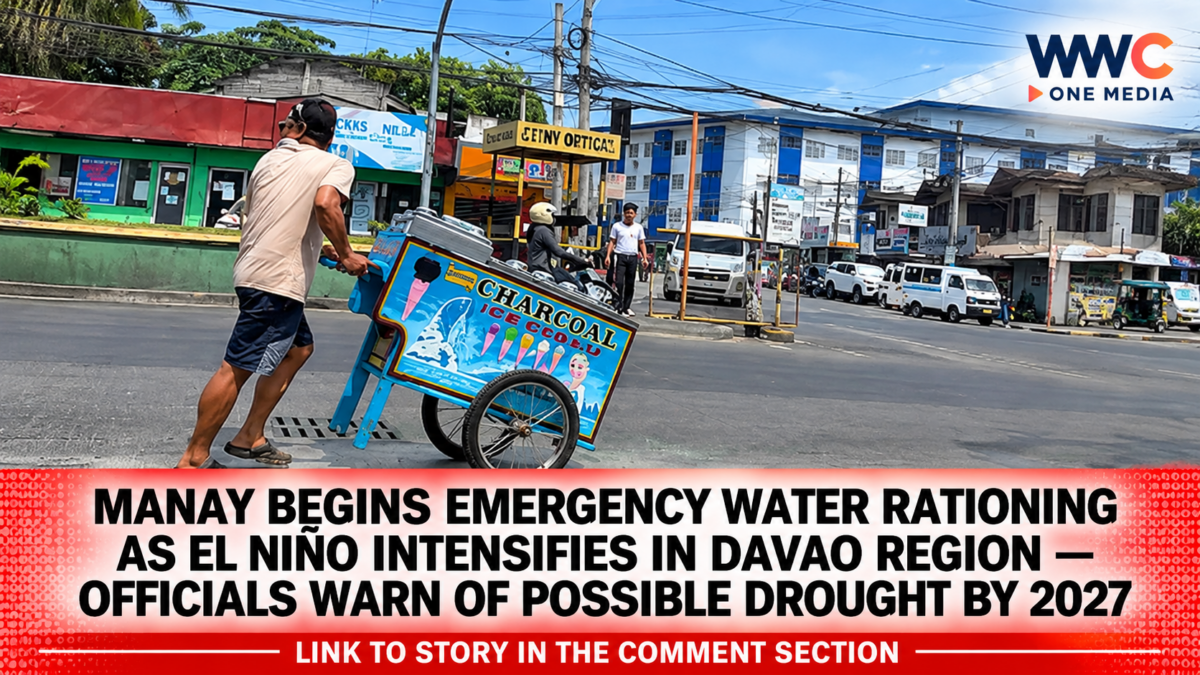
Residents of Manay, Davao Oriental, are facing an increasingly difficult water situation as the effects of El Niño spread across parts of Davao Region, forcing the local government to distribute water through fire trucks while preparing alternative sources in case existing supplies become unusable.
The Office of Civil Defense (OCD) Region XI confirmed the emergency response on November 4, 2026, saying only selected communities had been severely affected so far. In Manay, residents have been placing pails, drums and other containers outside their homes to receive water delivered by municipal fire trucks.
OCD-Davao Regional Director Ednar Dayanghirang said the town’s river sources have become difficult to use because even light rainfall in the mountains can turn the water brown and muddy.
The situation is a warning of how prolonged dry conditions can disrupt basic services even before an entire province experiences a formal drought declaration. SunStar Publishing Inc.+1
Fire Trucks Deliver Water as Manay River Becomes Difficult to Use
Manay’s emergency response has relied on municipal fire trucks to distribute water to households. During the November 4 briefing, Dayanghirang said another distribution was scheduled in Barangay Zaragoza, following an earlier delivery approximately two weeks before.
Residents were asked to leave containers outside their homes so the trucks could deliver available water.
The problem is not simply that river levels are falling. According to the OCD official, even light rain in the mountains can turn the river water brown, making it difficult to use as a household water source.
If stored supplies become insufficient, authorities have outlined additional emergency measures:
- The Bureau of Fire Protection could draw water from rivers and distribute it to affected communities.
- Municipal governments could deploy dump trucks fitted with water tanks and pumps.
- Local governments are exploring filtration equipment, including portable backpack units that can treat available water.
- Desalination machines are also being considered, particularly for coastal communities with access to seawater.
Mati City’s disaster management officer was expected to recommend that the city consider purchasing a desalination machine.
These are contingency measures under consideration, not confirmation that all the equipment has already been purchased or deployed. SunStar Publishing Inc.+1
Davao Oriental Warns of Possible Drought by March 2027
The outlook for Davao Oriental adds to concerns about the coming months.
The provincial government’s El Niño action plan projects below-normal rainfall from November 2026 through January 2027, with rainfall potentially declining further in February and March.
If those conditions persist, parts of the province could face drought by the end of March.
PAGASA’s broader national assessment is also concerning. In its November 4 advisory, the weather bureau confirmed that a very strong El Niño was present in the tropical Pacific and could persist through the first half of 2027, potentially reaching its peak near the end of 2026.
For November, PAGASA expects below-normal to way-below-normal rainfall over most parts of the Philippines. It also warned that several provinces could experience meteorological drought or dry-spell conditions.
El Niño does not mean that every location will remain completely dry. Tropical cyclones and other rain-bearing weather systems can still bring heavy rainfall, even while the broader climate pattern increases the risk of prolonged rainfall shortages. Pagasa+2
Davao City Has Water for Now, but Residents Are Being Asked to Prepare
While Manay is already distributing water through fire trucks, Davao City is not currently experiencing the same level of supply disruption.
Dayanghirang said the Davao City Water District (DCWD) had informed the OCD that the utility was using only about half of its capacity.
However, DCWD spokesperson Jovana Cresta “JC” Duhaylungsod warned residents not to assume that supply conditions will remain normal as El Niño intensifies.
Speaking at the Habi at Kape media forum at Ayala Malls Abreeza on November 4, she said the water district expected to operate under extraordinary conditions toward the end of 2026 and during the first quarter of 2027.
DCWD said it would make every effort to deliver water within a 24-hour period, using measures such as inline boosters to help maintain distribution.
That statement is a service commitment under difficult operating conditions, not a guarantee that every household will experience uninterrupted water pressure throughout the day.
Duhaylungsod urged customers to conserve water, prioritize essential household needs and keep emergency supplies in clean, covered containers. SunStar Publishing Inc.+1
Davao Region’s Farmers Have Already Suffered ₱584 Million in El Niño Damage
Water shortages are also affecting the region’s agricultural sector.
The Department of Agriculture Region XI reported that El Niño-related agricultural damage had reached approximately ₱584 million, affecting 6,205 farmers, based on figures reported in early November.
The Philippine Information Agency separately reported that moisture stress had affected 4,447 farmers and 4,790 hectares of farmland, with estimated losses of ₱444 million. These figures describe a specific category of reported agricultural impact and should not be added to the overall damage estimate without checking for overlap.
Areas under closer monitoring include Davao del Sur, Davao del Norte, Davao de Oro and Davao City. Matanao and Bansalan in Davao del Sur were identified among the communities reporting serious water shortages affecting farms.
Bananas and other high-value fruit crops have also experienced damage, while rain-dependent rice fields and farms without reliable irrigation remain vulnerable.
The Department of Agriculture is intensifying field monitoring and asking farmers to report damage early to their municipal agriculture offices so that agricultural technicians can inspect and validate the losses. Philippine Information Agency+1
WWC ONE MEDIA has also reported on the ₱584-million agricultural damage in Davao Region, where rice farmers have suffered the biggest losses.
Farmers Are Being Urged to Report Damage Before Crops Are Completely Lost
The agricultural response depends partly on how quickly affected farmers report problems.
DA-Davao has urged farmers to contact their municipal agriculture offices as soon as they notice moisture stress or crop damage. Agricultural technicians can then inspect the affected farms, document the condition of the crops and forward reports for validation.
Farmers with crop insurance should also coordinate with the Philippine Crop Insurance Corporation (PCIC) to understand the requirements for filing claims.
During the November 4 briefing, Dayanghirang raised concerns about the requirement for farmers to register for crop insurance every cropping season. He argued that farmers who have already registered should not face unnecessary barriers when their crops need to be validated.
This was a concern raised by the OCD regional director, not an announcement that PCIC had changed its registration rules.
WWC ONE MEDIA previously explained why Davao farmers are being told to report El Niño crop damage immediately, including the importance of allowing inspections before damaged crops are cleared or replaced.
DOST Water Treatment Technology Could Help Vulnerable Communities
Local governments are also exploring whether water treatment and desalination technology can provide additional protection.
During the Regional Science, Technology and Innovation Week in Davao City on October 15, Department of Science and Technology Secretary Renato Solidum Jr. said the department had deployed 22 mobile, solar-powered water treatment systems nationwide and established 13 desalination plants.
According to the report cited by SunStar, DOST could share these technologies with local governments capable of procuring the equipment.
Portable treatment systems could be particularly useful in communities where water is available but requires treatment before it can be safely consumed.
Desalination could provide another option for coastal areas where freshwater sources are limited, although operating costs, maintenance, energy requirements and water quality standards would need to be considered.
These technologies could complement emergency water deliveries, but they are not a substitute for protecting rivers, maintaining water infrastructure and managing available supplies. SunStar Publishing Inc.
No State of Calamity Has Been Declared in Davao Region
Despite the reported water shortages and agricultural damage, no local government in Davao Region had declared a state of calamity as of the November 4 briefing.
Dayanghirang emphasized that the decision rests with local government officials, particularly mayors who have access to ground-level information about affected communities.
The absence of a declaration does not mean there are no El Niño impacts. It means local governments have not determined that the conditions in their respective jurisdictions currently warrant such a declaration.
The same principle applies to decisions involving class suspensions and other localized emergency measures. The effects of El Niño vary between communities, so authorities are expected to base their decisions on actual local conditions rather than apply one blanket response across the region. SunStar Publishing Inc.+1
What Davao Residents Can Do to Prepare for Water Shortages
Authorities are urging households to prepare before water availability becomes more difficult.
Practical measures include:
- Prepare clean storage containers. Keep covered drums, pails or tanks ready for emergency water supplies.
- Prioritize essential uses. Reduce unnecessary water consumption and avoid wasting water during washing, cleaning and bathing.
- Collect rainwater where appropriate. Households in areas still receiving rainfall can use clean containers positioned beneath gutters to collect water for suitable non-drinking purposes.
- Protect stored water. Keep containers covered and clean to reduce contamination.
- Monitor local advisories. Follow announcements from municipal governments, barangays and water utilities regarding rationing or service changes.
For more practical conservation advice, read WWC ONE MEDIA’s guide to everyday bathroom habits that can help save water during El Niño.
The need for preparation is not limited to Davao. PAGASA’s outlook points to widespread rainfall shortages, and other cities are also strengthening their water contingency plans. WWC ONE MEDIA previously examined Cebu City’s preparations for water shortages and agricultural losses as El Niño intensifies.
The Bigger Threat Is Whether Davao Can Protect Its Water Supply Through 2027
Manay’s emergency water distribution is an early warning of the pressure that prolonged dry conditions can place on communities.
The situation also shows why water security cannot be treated as a problem affecting only households. Agriculture, public health, local businesses and essential services all depend on reliable access to safe water.
Davao City may still have sufficient supply at present, but DCWD is already preparing for extraordinary operating conditions. Meanwhile, Davao Oriental is planning for worsening rainfall shortages, and farmers across the region are dealing with hundreds of millions of pesos in reported agricultural damage.
PAGASA’s warning that very strong El Niño conditions could persist into the first half of 2027 makes early preparation even more important.
For Manay, the immediate priority is ensuring residents receive enough safe water. For the rest of Davao Region, the challenge is preventing today’s localized shortages from becoming a much wider crisis.
The critical question is whether emergency deliveries, water conservation, treatment technology and agricultural support will be enough to protect communities before the driest months arrive.