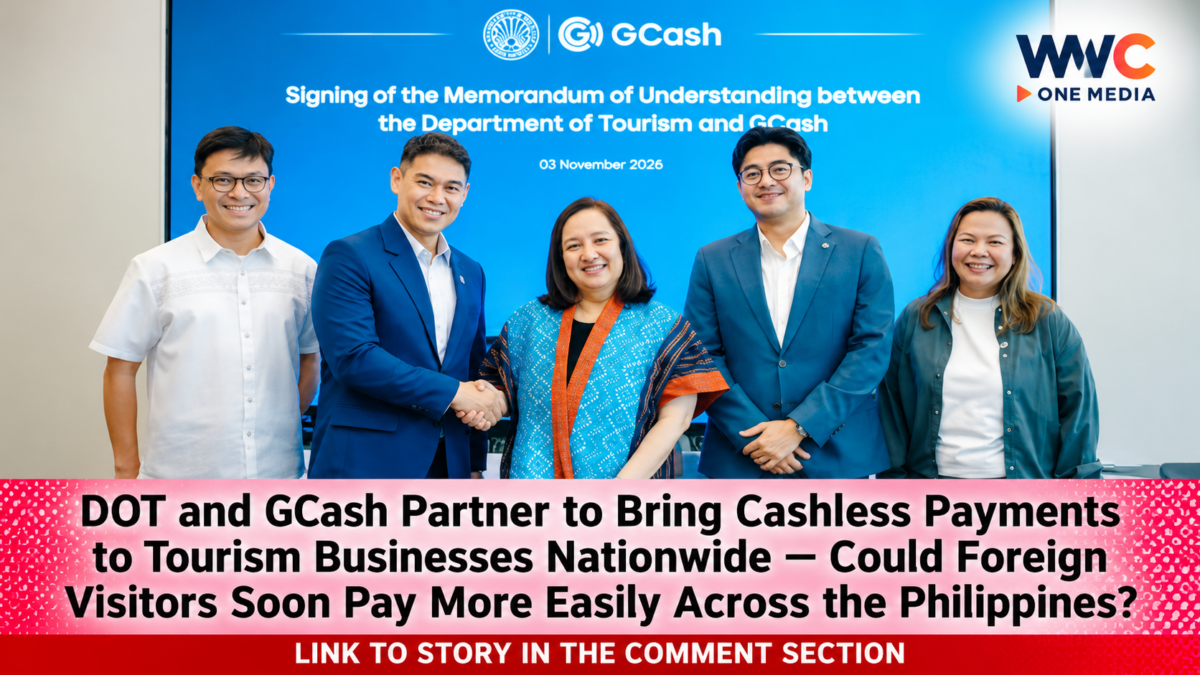
Filipino tourism businesses could soon find it easier to accept payments from both local and international travelers as the Department of Tourism (DOT) partners with GCash to accelerate cashless transactions among accredited micro, small and medium enterprises (MSMEs).
The agreement aims to help small tourism operators, including homestay owners, market vendors, local artisans and other accredited businesses, adopt digital payment systems without the complicated requirements often associated with traditional banking.
Signed on November 3, 2026, the memorandum of understanding (MOU) between the DOT and GCash’s mobile wallet operator, G-Xchange Inc. (GXI), establishes a framework for merchant onboarding, digital payment adoption, promotional campaigns and financial literacy training.
The partnership is nationwide, meaning eligible tourism-accredited businesses in Davao and other Philippine destinations may benefit from the initiative.
Tourism Secretary Maria Bernardita Angara-Mathay said the government wants local tourism enterprises to be ready for visitors who increasingly expect to pay digitally.
The agreement comes as the Philippines seeks to strengthen its tourism industry while ensuring that smaller businesses can participate in the economic opportunities generated by domestic and international travel. SunStar Publishing Inc.+2
What the DOT-GCash Partnership Will Provide to Tourism MSMEs
Under the agreement, GCash will help participating tourism businesses access digital payment facilities through its GCash for Business platform.
The available payment solutions include:
- GCash SoundPay: A payment acceptance solution that uses sound-based technology to confirm transactions.
- GCash PocketPay: A payment tool designed to help merchants accept digital transactions.
- GCash SoundPay Plus: An additional merchant payment solution included in the partnership.
- GCash EasyPOS: A point-of-sale solution designed to support business payment processing.
These tools are intended to give smaller tourism enterprises more options for accepting electronic payments from customers.
GCash said its simplified registration process requires a verified GCash account to get started, potentially making digital payment facilities more accessible to small merchants that do not have the same resources as larger establishments.
Participating businesses will also receive customized digital payment toolkits, merchant incentives and promotional support intended to encourage cashless transactions in key tourism destinations.
The partnership is not limited to providing payment technology. GCash will also conduct financial literacy training to help participating enterprises understand digital transactions and manage their finances more effectively. SunStar Publishing Inc.+2
Foreign Tourists Could Benefit From More Flexible Payment Options
One of the most important features of the agreement is its focus on international visitors.
Travelers arriving in the Philippines may not always have Philippine pesos immediately available. In some destinations, particularly remote communities, access to banks, ATMs and currency exchange facilities may also be limited.
The partnership aims to help participating merchants accept a wider range of payment methods, including supported foreign-issued cards.
This could make transactions more convenient for international visitors who prefer using digital or card-based payment options rather than carrying large amounts of cash.
For example, a foreign tourist staying at an accredited homestay or purchasing locally made products could have more ways to complete a payment, depending on the merchant’s available facilities and the payment method supported.
However, the agreement does not mean every GCash merchant will automatically accept every foreign bank card. Acceptance will depend on the specific payment solution, supported card networks and merchant arrangements.
The broader objective is to reduce payment barriers that could prevent small tourism businesses from capturing visitor spending. BMPlus+2
DOT Will Help Identify and Onboard Accredited Tourism Businesses
The Department of Tourism will play an important role in identifying businesses that may participate in the initiative.
Under the MOU, the DOT will:
- Share lists of accredited tourism enterprises for merchant outreach and verification, subject to data privacy laws.
- Coordinate with regional tourism offices to encourage eligible businesses to participate.
- Provide branding guidelines and digital marketing assets for joint campaigns.
- Share relevant tourist arrival data.
- Invite GCash to tourism events and trade activities where businesses can be introduced to the available payment solutions.
The two organizations will also develop co-branded campaigns supporting the DOT’s tourism promotions, including its Love the Philippines and Discover More to Love initiatives.
GCash, meanwhile, will provide campaign performance information and consumer trend insights that could help the tourism department understand how digital payment adoption is developing across participating destinations.
The arrangement creates a connection between tourism promotion and financial technology: the DOT helps identify and reach tourism businesses, while GCash provides tools that can help them receive payments from visitors. SunStar Publishing Inc.+1
Local Artisans and Small Tourism Operators Could Gain More Visibility
The partnership could have an important impact on businesses that operate outside major hotels, shopping centers and established tourism establishments.
Homestay operators, market vendors, souvenir sellers and local artisans often play a major role in shaping a visitor’s experience.
However, smaller businesses may not always have access to the same payment infrastructure, promotional resources or financial services available to larger companies.
By helping these enterprises accept digital payments, the DOT and GCash hope to make it easier for tourists to purchase local products and services.
The agreement also includes cooperation on tourism product development projects that support local artisans and creative enterprises among accredited MSMEs.
For communities that depend on tourism, the potential benefit goes beyond convenience. Easier payment acceptance could help local businesses capture more visitor spending and improve their ability to compete in an increasingly digital marketplace.
Still, access to payment technology alone will not guarantee higher sales. Businesses will also need reliable connectivity, customer awareness, appropriate pricing and consistent service quality.
Philippine Tourism Generated ₱2.27 Trillion in 2025
The partnership comes as tourism remains one of the country’s major economic contributors.
According to Philippine Statistics Authority figures cited by the DOT, tourism generated more than ₱2.27 trillion in Tourism Direct Gross Value Added in 2025, equivalent to approximately 8.1% of the Philippine economy.
The industry also supported around 7.7 million jobs nationwide.
These figures help explain why the government is placing greater emphasis on improving the competitiveness of tourism-related MSMEs.
In September 2026, the Philippine Information Agency reported that Tourism Secretary Angara-Mathay was shifting the department’s priorities toward long-term investment, stronger livelihoods and more inclusive industry development.
The DOT identified limited market visibility, difficulties accepting cashless payments and gaps in digital and financial literacy as barriers that prevent some small tourism enterprises from fully participating in the digital economy.
The GCash agreement directly addresses several of those challenges. Philippine Information Agency+1
Digital Payments Are Already Transforming Philippine Businesses
The DOT-GCash partnership also reflects a wider change in how Filipinos pay for goods and services.
Digital payments accounted for approximately 64.7% of Philippine retail payment transactions by volume in 2025, up from approximately 57.4% in 2024, according to the Bangko Sentral ng Pilipinas.
That means electronic payments already represent the majority of measured retail transactions by volume.
However, this figure does not mean that 64.7% of all Philippine businesses accept digital payments or that the same proportion of total retail spending by value is conducted electronically.
The distinction matters because payment adoption among consumers does not automatically translate into universal merchant readiness.
WWC ONE MEDIA previously examined this transition in its report, DTI and Mastercard Join Forces to Help Filipino Small Businesses Go Digital.
That initiative, like the DOT-GCash agreement, highlights the importance of helping smaller businesses adopt digital tools, improve payment security and participate in the country’s expanding digital economy.
Another related development is GCash’s introduction of GSukli, which converts eligible cash change from physical purchases into digital wallet balances.
These developments show how digital payments are increasingly being integrated into everyday transactions, from retail shopping to tourism services.
GCash and Government Agencies Are Expanding Digital Financial Services
The latest tourism partnership is also part of a wider pattern of cooperation between GCash and Philippine government agencies.
In October 2026, WWC ONE MEDIA reported that the Department of Social Welfare and Development had tapped GCash to support digital UPLIFT assistance payments, allowing eligible beneficiaries to receive succeeding ₱2,000 payouts through their mobile wallets.
The initiative, covered in DSWD Taps GCash for Digital UPLIFT Aid, demonstrates how mobile wallets can support government services beyond ordinary retail transactions.
The tourism agreement has a different purpose: instead of distributing government assistance, it aims to equip private tourism enterprises with payment tools that can help them serve customers and capture more visitor spending.
The two initiatives nevertheless reflect the growing role of digital financial platforms in connecting Filipinos, businesses and public services.
Davao Tourism Businesses Could Be Among the Beneficiaries
Although the agreement covers accredited tourism MSMEs nationwide, Davao’s growing visitor economy makes the initiative particularly relevant to local businesses.
Davao City recorded more than 1.63 million tourist arrivals from January to September 2026, an increase of approximately 161,901 visitors compared with the same period in 2025.
The city is targeting 2.5 million arrivals for the full year, although tourism officials have also cited a more conservative projection of 2.2 million to 2.4 million.
More visitors create potential opportunities for hotels, restaurants, tour operators, transport providers, souvenir shops and other tourism-related enterprises.
For small businesses, accepting convenient payment methods could help reduce the risk of losing a sale simply because a customer does not have enough cash.
WWC ONE MEDIA previously reported on Davao City’s 1.63 million tourist arrivals and its 2.5 million target.
The publication also examined Japan’s interest in strengthening tourism and investment cooperation with Mindanao, highlighting the region’s potential to attract more international visitors and business opportunities.
If more tourism enterprises become digitally equipped, the benefits could extend beyond major establishments to smaller operators serving visitors throughout Davao and other Mindanao destinations.
What Tourism Businesses Should Know Before Joining
The agreement establishes a framework for cooperation, but it does not mean every DOT-accredited business has already been automatically enrolled.
Eligible enterprises will need to go through the relevant merchant onboarding process with GCash.
Businesses interested in participating should:
- Confirm that their tourism establishment has the appropriate DOT accreditation.
- Maintain a verified GCash account and check the requirements for GCash for Business.
- Follow official announcements and instructions from the DOT and GCash.
- Review the payment solutions available for their type of business.
- Attend financial literacy or merchant orientation activities when offered.
Merchants should also review applicable transaction fees, settlement arrangements, supported payment methods and other commercial terms before adopting a payment solution.
The MOU does not establish that every payment service will be free of charge or that all participating merchants will receive identical incentives.
Businesses should obtain the specific terms directly from GCash before making decisions about their payment operations.
Can Cashless Tourism Payments Help More Money Stay in Local Communities?
The DOT-GCash partnership represents a significant step toward making Philippine tourism more accessible to digitally equipped businesses.
By combining tourism accreditation, merchant onboarding, payment technology, financial literacy and promotional support, the initiative aims to help smaller enterprises benefit from the spending of both Filipino and foreign travelers.
The opportunity is considerable. Tourism contributed more than ₱2.27 trillion to the Philippine economy in 2025 and supported millions of jobs.
But the real measure of success will be whether the smallest tourism businesses can actually use the new tools, attract more customers and improve their earnings.
The next challenge is implementation: getting eligible merchants onboarded, ensuring reliable payment services and making sure international visitors can use supported payment methods without unnecessary complications.
If the partnership delivers on those goals, a homestay in Davao, a market stall in a provincial destination or a local artisan selling handmade products could become better connected to the country’s growing tourism economy.