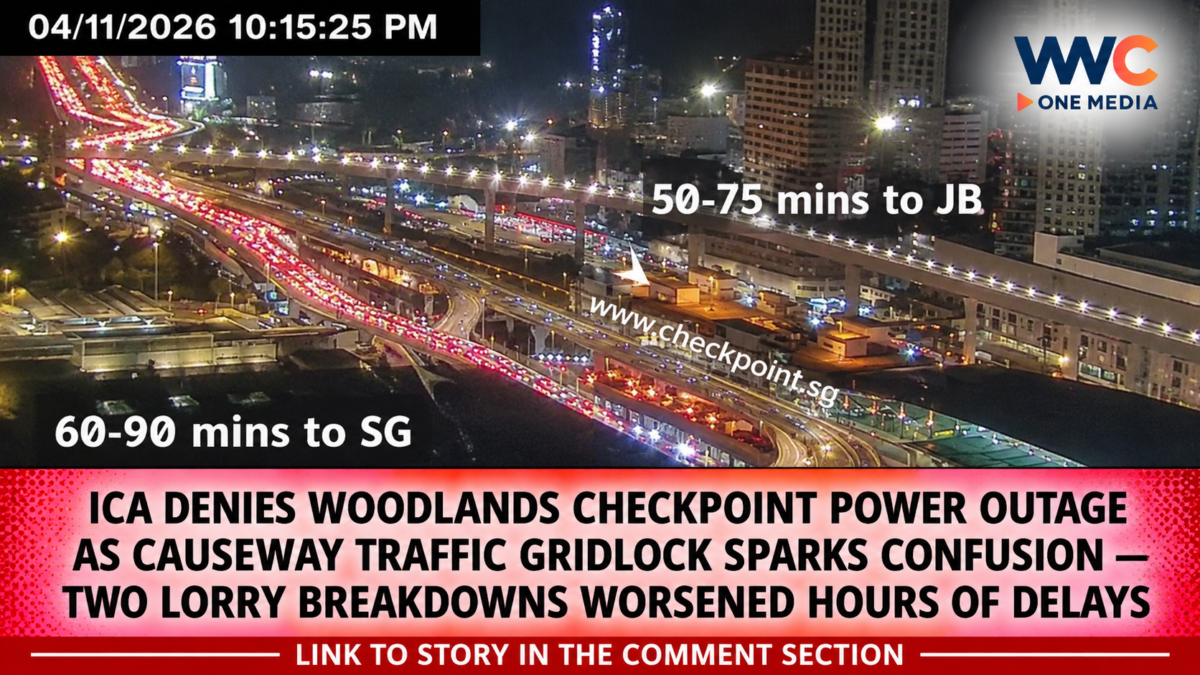
SINGAPORE — Singapore’s Immigration and Checkpoints Authority (ICA) has rejected reports that a power outage at Woodlands Checkpoint caused the massive traffic congestion along the Singapore-Malaysia Causeway on November 4, clarifying that the disruption was instead linked to planned electrical maintenance, a temporary build-up of cargo traffic and two lorry breakdowns on the Malaysian side.
The clarification came on November 5 after Malaysian newspaper The Star reported that a major power outage at Woodlands Checkpoint had triggered a heavy traffic jam across several roads leading to Johor Bahru’s Bangunan Sultan Iskandar (BSI) Customs, Immigration and Quarantine Complex.
The report described the incident as a “massive power outage” that began around noon and caused long delays for motorists travelling between Singapore and Malaysia.
However, ICA said no power outage occurred at Woodlands Checkpoint on November 4.
Instead, planned electrical maintenance was carried out at the Old Woodlands Checkpoint, temporarily affecting the clearance of arriving lorries at that facility. The situation was further complicated later in the afternoon when two lorries broke down on the Malaysian side of the Causeway, blocking one of the three lanes leading towards Singapore.
The breakdowns, combined with heavier evening traffic, caused queues to stretch back into Malaysia and disrupted travel towards Woodlands Checkpoint for several hours.
The clarification is significant for thousands of commuters who rely on the Causeway daily, particularly Singapore-based workers travelling to Johor Bahru and Malaysian residents crossing the border for employment, shopping and other activities.
ICA Says No Power Outage Occurred at Woodlands Checkpoint
In response to media queries, ICA directly rejected the claim that a power failure had disrupted Woodlands Checkpoint operations.
The authority explained that electrical maintenance works had been scheduled at the Old Woodlands Checkpoint on Wednesday, November 4, from 10am to 2pm.
During the maintenance period, the Old Woodlands Checkpoint was temporarily unavailable for the clearance of arriving lorries.
However, ICA clarified that lorry clearance continued at Woodlands Checkpoint, meaning the entire checkpoint operation was not shut down.
The temporary limitation at the Old Woodlands facility nevertheless contributed to a build-up of Singapore-bound cargo traffic along the Causeway.
Operations at the Old Woodlands Checkpoint resumed at around 4pm.
This distinction is important because the initial reports suggested that a widespread power failure had affected the checkpoint. ICA’s account instead described scheduled maintenance affecting a specific clearance facility, followed by separate traffic incidents on the Malaysian side.
Two Lorry Breakdowns Turned the Causeway Into a Traffic Bottleneck
Although the maintenance works contributed to an earlier build-up of cargo traffic, ICA said two subsequent vehicle breakdowns played a major role in prolonging the congestion.
The first lorry broke down at approximately 4.30pm on the Malaysian side of the Causeway while travelling towards Singapore.
A second lorry broke down at around 6.30pm.
Both vehicles blocked one of the three arrival lanes, restricting the movement of traffic approaching Woodlands Checkpoint.
The obstruction created a bottleneck at a particularly busy time of the day, when many commuters were travelling between Singapore and Johor Bahru.
ICA said the queues extended from the breakdown locations into Malaysia.
The first lorry was removed only at approximately 9.50pm on November 4, while the second was removed at around 12.22am on November 5.
This meant that the traffic disruption continued well into the night.
The extended removal time was a major factor in the prolonged congestion, as one of the three arrival lanes remained obstructed while motorists continued approaching the checkpoint.
Travel Times Reached Up to 90 Minutes During the Congestion
The impact was reflected in travel-time information reported during the evening.
According to Channel NewsAsia, data from Checkpoint.sg showed that at approximately 10.15pm on November 4, the journey from Johor Bahru to Singapore was estimated to take between 60 and 90 minutes.
Travel from Singapore towards Johor Bahru was estimated at between 50 and 75 minutes.
The figures illustrated the disruption experienced by travellers even after the usual evening peak had begun to ease.
The congestion was not limited to vehicles approaching Singapore. The traffic build-up also affected roads leading towards the Malaysian checkpoint, including major routes in Johor Bahru.
Malaysian authorities reportedly opened additional lanes and deployed more police personnel around BSI and major access roads to help manage the heavy traffic.
The measures were intended to ease the pressure around the checkpoint as commuters continued travelling between the two countries.
The Star’s Initial Report Was Later Challenged by Singapore Authorities
The incident attracted attention after The Star published its November 4 report under the headline “Power outage at Woodlands Checkpoint triggers massive Causeway gridlock”.
The report attributed the congestion to a power outage on the Singapore side and cited a Malaysian Home Ministry official who said the situation had been worsened by a lorry experiencing mechanical failure.
At the time of publication, the cause of the alleged power outage was described as unclear.
The following day, however, ICA provided a different account.
The authority said there had been no power outage at Woodlands Checkpoint and explained that the earlier traffic build-up was associated with planned electrical maintenance at the Old Woodlands Checkpoint.
It also identified the two lorry breakdowns as a major factor behind the subsequent queues.
The Star later published a follow-up report carrying ICA’s clarification.
The difference between the initial report and the subsequent official explanation highlights why early reports of major border disruptions need to be checked against information from the agencies responsible for checkpoint operations.
For travellers, the practical concern was the same: long queues and extended journey times. But the confirmed explanation matters when assessing what actually happened and which operational issues contributed to the delays.
Why the Woodlands-Johor Bahru Crossing Is So Vulnerable to Traffic Disruptions
The Woodlands Checkpoint and the Johor Bahru BSI complex form one of the busiest international land-border crossings in the region.
The Causeway serves commuters, private vehicles, buses, commercial transport and other cross-border traffic.
Because the crossing connects two major urban areas, even a temporary restriction can create a chain reaction.
When cargo vehicles build up on the approach to a checkpoint, traffic can slow down for other motorists. If a vehicle then breaks down and blocks an arrival lane, the available road capacity becomes even more restricted.
The November 4 incident demonstrated how several separate issues can combine to create a much larger traffic problem.
The planned maintenance affected the clearance of arriving lorries at the Old Woodlands Checkpoint. Cargo traffic accumulated during the temporary arrangement. Later, two lorry breakdowns blocked one of the three arrival lanes on the Malaysian side.
The evening rush added further pressure.
This sequence explains why the congestion lasted for hours, even though ICA said there had been no power outage.
ICA Used Social Media Advisories to Alert Travellers
ICA said it issued advisories on its Facebook page to inform travellers about the vehicle breakdowns and expected delays.
The authority also updated motorists when the affected lane reopened.
These updates were important because traffic conditions around the Causeway can change quickly, particularly when incidents occur close to the international boundary.
For people travelling between Singapore and Johor Bahru, official advisories can help distinguish between delays caused by immigration processing, road congestion, vehicle breakdowns or operational arrangements.
The November 4 incident also showed why motorists should not rely on an early report or a single traffic update when planning a cross-border journey.
Causeway Congestion Is Not a New Problem for Singapore and Malaysia
The November 4 disruption follows several other periods of heavy traffic at Woodlands Checkpoint.
In September 2026, motorists experienced significant congestion during Singapore’s school-holiday travel period, with traffic tailbacks from Malaysia affecting vehicles departing through Woodlands.
ICA had warned travellers to expect heavier traffic at both Woodlands and Tuas checkpoints during the holiday period.
WWC ONE MEDIA previously reported on the recurring congestion and the effect of cross-border traffic on motorists.
Causeway Jam Returns: Heavy Traffic Chokes Woodlands Checkpoint as Malaysia Tailback Hits Singapore
The report examined an earlier incident in which traffic tailbacks from Malaysia affected Singapore-bound and Malaysia-bound movements around Woodlands.
Another report highlighted the pressure on travellers during a separate period of heavy departure traffic.
Heavy Departure Traffic Hits Woodlands Checkpoint as Travellers Face Long Delays
That report discussed the impact of high traveller volumes, checkpoint congestion and the importance of monitoring traffic conditions before setting off.
These earlier incidents were separate from the November 4 maintenance and breakdown disruption. However, they show how quickly traffic conditions can deteriorate when cross-border demand increases or movement is restricted.
Singapore’s Land Checkpoints Handle Millions of Travellers
The scale of cross-border movement helps explain why disruptions at Woodlands can have a wide impact.
Singapore’s land checkpoints are used by large numbers of people travelling for work, education, family visits, tourism and business.
ICA has previously warned that heavy traffic can occur during weekends, school holidays and public-holiday periods.
The authority has also encouraged eligible travellers to use QR-code immigration clearance through the MyICA mobile application as part of Singapore’s New Clearance Concept.
However, faster immigration processing does not eliminate delays caused by road obstructions, vehicle breakdowns or traffic tailbacks from the opposite side of the border.
The November 4 incident is an example of how a road-related bottleneck can disrupt the journey even when the reported cause is not a failure of immigration systems.
What Travellers Should Know Before Crossing the Causeway
The November 4 incident has several practical implications for people travelling between Singapore and Malaysia.
First, traffic conditions on the Causeway can be affected by incidents on either side of the border. A queue approaching Woodlands may originate from a road obstruction or traffic build-up in Malaysia rather than from Singapore’s immigration counters.
Second, planned maintenance does not necessarily mean that an entire checkpoint has stopped operating. In this case, ICA said lorry clearance continued at Woodlands Checkpoint while the Old Woodlands facility was temporarily unavailable for arriving lorries.
Third, motorists should monitor official traffic advisories before beginning their journey, particularly during evening peak periods and busy travel seasons.
ICA’s updates, together with available traffic information, can help travellers understand where delays are occurring and whether affected lanes have reopened.
The Bigger Issue Behind the November 4 Traffic Gridlock
The November 4 incident was not caused by the power outage initially reported by Malaysian media.
According to ICA, the disruption developed through a combination of planned electrical maintenance, a temporary build-up of Singapore-bound cargo traffic, two lorry breakdowns and higher evening traffic volumes.
The distinction matters because the explanation points to several separate operational and road-traffic factors rather than a widespread electrical failure at Woodlands Checkpoint.
It also demonstrates how quickly a disruption at one point along the Causeway can affect thousands of travellers across two countries.
For commuters, the immediate concern was the hours spent waiting in traffic. For authorities, the incident underscores the importance of coordinating checkpoint operations, responding to vehicle breakdowns and communicating accurate information during major disruptions.
The queues eventually eased after the affected lorries were removed, but the incident has raised a wider question about the resilience of one of Southeast Asia’s busiest border crossings.
If a temporary maintenance arrangement and two vehicle breakdowns can create hours of congestion, how prepared are both sides of the border for the next major disruption?
Related WWC ONE MEDIA Reports
Causeway Jam Returns: Heavy Traffic Chokes Woodlands Checkpoint as Malaysia Tailback Hits Singapore
This earlier report examines how traffic tailbacks from Malaysia can affect movement at Woodlands Checkpoint, providing context for the cross-border congestion experienced on November 4.
Heavy Departure Traffic Hits Woodlands Checkpoint as Travellers Face Long Delays
This report looks at another period of heavy traffic at Woodlands and the challenges faced by travellers during peak cross-border movement.