
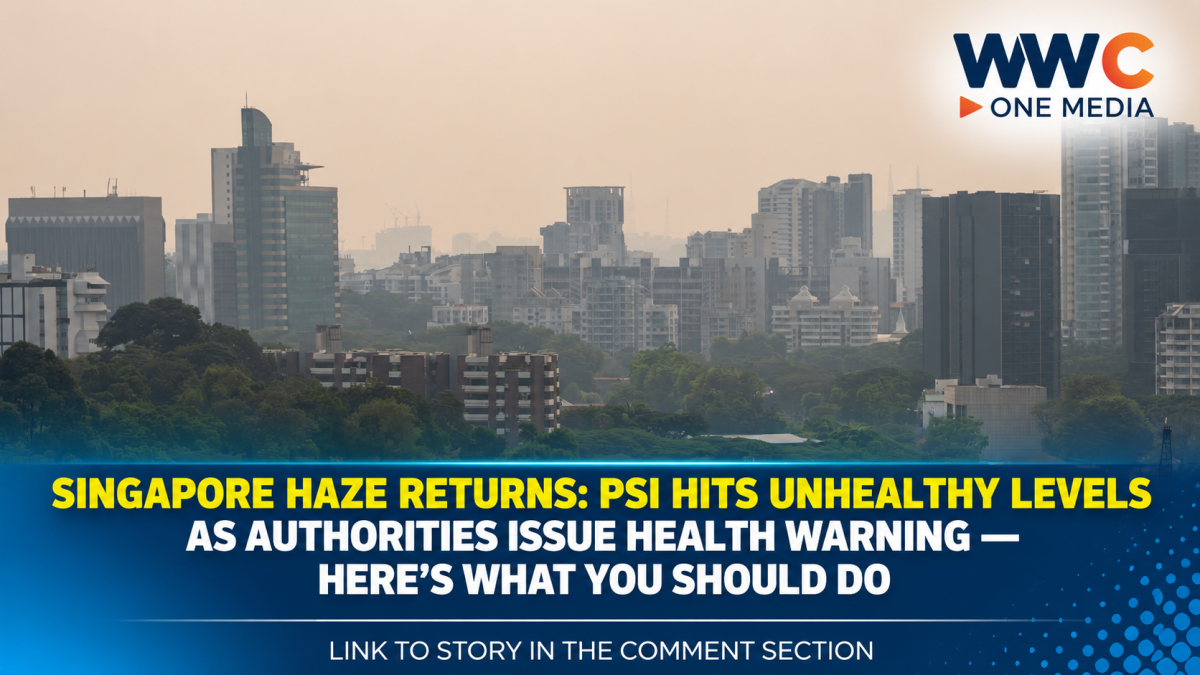
Singapore is experiencing its first haze episode to push the 24-hour Pollutant Standards Index into the “Unhealthy” range since October 2023, prompting authorities to activate measures to protect residents as regional fires continue to generate smoke.
The central region recorded a 24-hour PSI of 101 at 7am on Sept. 4, 2026, crossing into the unhealthy band. The reading subsequently rose to 105 at 10am, according to the National Environment Agency (NEA). Other regions remained in the moderate range at that time.
Why is Singapore hazy again?
The haze is linked to a broader regional fire and smoke situation.
Singapore’s Meteorological Service said dry conditions have persisted across parts of the southern ASEAN region, with an escalation in hotspot and smoke-haze activity reported in southern and central Sumatra and parts of Kalimantan since around Aug. 21.
With prevailing winds from the southeast or southwest, smoke from fires in the region can affect Singapore when conditions intensify.
NEA’s latest regional assessment also detected scattered to widespread hotspots in Kalimantan and southern and central Sumatra, alongside moderate to dense smoke plumes in parts of the region.
📊 What does a PSI of 101 actually mean?
Singapore’s PSI scale classifies:
| 24-hour PSI | Air quality |
|---|---|
| 0–50 | Good |
| 51–100 | Moderate |
| 101–200 | Unhealthy |
| 201–300 | Very Unhealthy |
| Above 300 | Hazardous |
The PSI is calculated using six pollutants, including PM2.5, PM10, ozone, sulphur dioxide, nitrogen dioxide and carbon monoxide. During transboundary haze, PM2.5 is the predominant pollutant of concern.
Importantly, the PSI is reported separately for Singapore’s five regions — North, South, East, West and Central. That means conditions can vary considerably depending on where you are.
Who should be most careful?
Authorities are particularly concerned about:
- Children
- Older adults
- Pregnant women
- People with chronic heart conditions
- People with chronic lung conditions
Haze can irritate the eyes, nose and throat even in otherwise healthy people, while exposure can aggravate existing heart and respiratory conditions.
Should you stop exercising outdoors?
Not necessarily — but the intensity and duration of outdoor activity matter.
At the current Unhealthy PSI level, MOH advises healthy people to reduce prolonged or strenuous outdoor physical exertion.
For elderly people, pregnant women and children, prolonged or strenuous outdoor exertion should be minimised. People with chronic heart or lung disease should avoid prolonged or strenuous outdoor physical activity.
So a short necessary trip outside is not the same as spending hours running, cycling or exercising outdoors.
Do you need an N95 mask?
This is one area where social-media advice can easily become misleading.
Singapore’s health authorities say N95 masks are not required for short exposure, such as commuting from home to school or work, or while indoors.
For a healthy person who needs to remain outdoors for several hours, an N95 may help reduce exposure when forecast air quality reaches the Hazardous range, above PSI 300.
For vulnerable people, an N95 may be considered if they must remain outdoors for several hours when the forecast reaches Very Unhealthy levels above PSI 200. Elderly people, pregnant women and people with severe heart or lung conditions who have difficulty breathing should consult their doctors about mask use.
The simplest advice: drink water and cut exposure
NEA recommends reducing outdoor activity and physical exertion when conditions deteriorate and drinking plenty of water to stay hydrated.
People with chronic heart or lung conditions should also make sure their prescribed medication is readily available. Anyone who feels unwell — particularly vulnerable individuals — should seek medical attention promptly.
What is Singapore doing about the haze?
The government’s Haze Task Force, involving 28 agencies, has activated preparedness measures.
Healthcare institutions are using measures including air purifiers, fans and portable air coolers where appropriate, while schools have haze-management plans and classrooms are equipped with air purifiers.
If the 24-hour PSI rises above 200, air-conditioned rooms at all community centres and selected Residents’ Committee/Residents’ Network centres will be placed on standby as places where members of the public can seek respite from the haze.
The authorities are also advising:
Motorists: Switch on headlights when visibility is reduced and drive carefully.
Schools: Monitor air quality and adjust outdoor and strenuous activities according to the health advisories.
Workplaces: Reduce prolonged or strenuous outdoor work and provide adequate hydration and rest measures when PSI reaches the unhealthy range.
Sports organisers: Monitor air quality and conduct risk assessments before deciding whether outdoor activities should proceed.
Daily haze advisories are now returning
Because the PSI has entered the unhealthy range, NEA will begin issuing daily haze advisories from the evening of Sept. 4.
The advisories will include a 24-hour PSI forecast, allowing residents and event organisers to plan activities for the following day.
This is significant because the current situation is not simply about today’s number.
The 24-hour PSI forecast is designed for planning longer activities, while the 1-hour PM2.5 reading is more useful for immediate decisions, such as whether to go for a run right now.
The bigger concern: dry weather could keep the risk elevated
Singapore’s Meteorological Service warned on Sept. 1 that dry conditions are expected to continue through the first half of September, with below-average rainfall forecast over most parts of the island.
At the same time, dry conditions in fire-prone parts of the region could keep hotspot and smoke-haze activity elevated.
Under prevailing southeast-to-southwest winds, Singapore could experience further hazy conditions if regional fires intensify.
That means residents should watch the trend rather than panic over a single PSI reading.
Air quality can change during the day as weather, wind direction and rainfall change.
What Singapore residents should do now
If PSI is 101–200:
- Reduce prolonged or strenuous outdoor exercise.
- Vulnerable groups should minimise prolonged or strenuous outdoor activity.
- Stay hydrated.
- Keep prescribed medication accessible if you have chronic heart or lung conditions.
- Check the PSI for your own region.
- Monitor NEA’s daily haze forecast.
- Seek medical attention if you develop significant breathing problems or feel unwell.
And remember: a PSI of 105 does not mean Singapore is experiencing hazardous air pollution. It is in the Unhealthy category, considerably below the Very Unhealthy and Hazardous bands.
That distinction matters.
THE BOTTOM LINE
Singapore’s haze has crossed an important threshold, with the central region entering the Unhealthy PSI range for the first time due to haze since Oct. 8, 2023.
The immediate advice isn’t to panic — it’s to reduce unnecessary exposure, cut back on strenuous outdoor activity, stay hydrated and pay attention to official air-quality forecasts.
But with dry weather expected to persist and regional hotspots remaining active, the situation could change quickly over the coming days.
WWC ONE MEDIA J.M.D

Leave a Reply