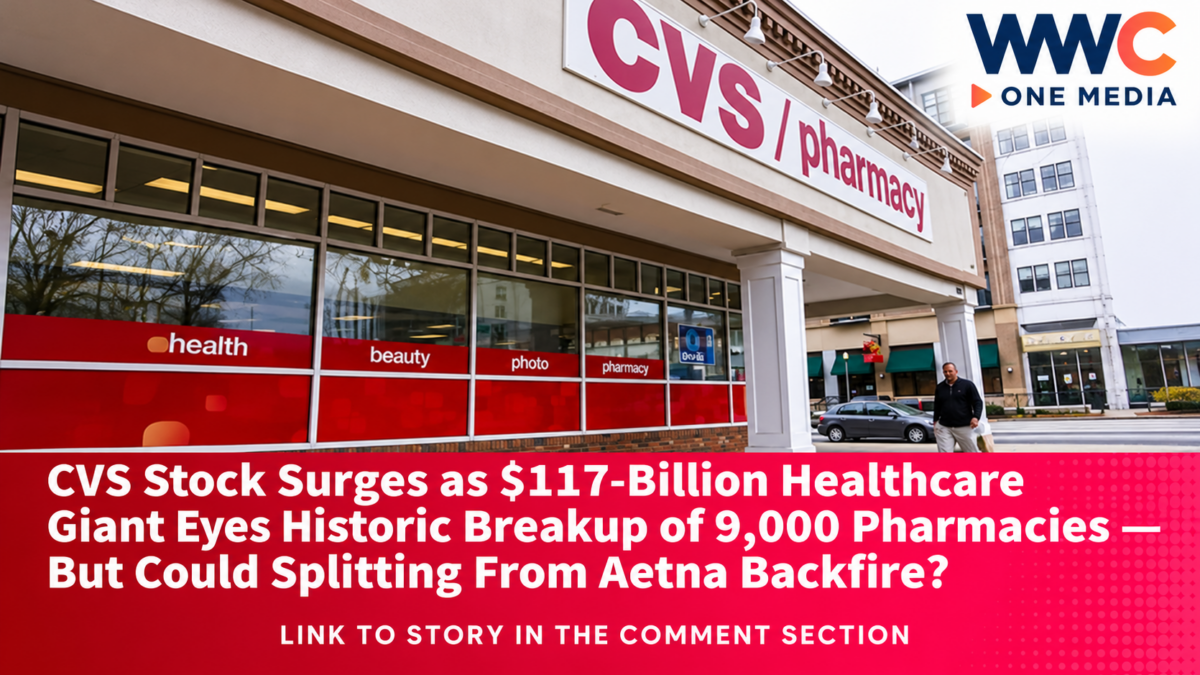
NEW YORK / RHODE ISLAND, United States — November 4, 2026 | WWC ONE MEDIA | Global Business, Healthcare & Financial Markets
America’s largest drugstore chain is preparing for what could become one of the most significant corporate restructurings in the healthcare industry, as CVS Health moves toward separating its nationwide pharmacy network from its insurance and pharmacy-benefit businesses.
The development sent CVS shares higher in after-hours trading on November 3, with Bloomberg reporting gains of as much as 3.7% following news of the potential breakup.
The proposed restructuring would dismantle part of a healthcare empire built through decades of acquisitions, including CVS’s roughly $78-billion takeover of insurance giant Aetna in 2018.
According to the Financial Times, CVS has been considering spinning off its retail pharmacy division into a separately listed company while retaining Aetna and pharmacy-benefit manager Caremark under another corporate entity.
Subsequent reporting by The Wall Street Journal indicated that CVS was moving toward a two-company structure, potentially targeting an early-2028 separation.
However, the precise timing, transaction structure and final corporate disclosures remain important matters for verification.
For investors, the potential split represents a dramatic reversal of the strategy that transformed CVS from a familiar neighborhood pharmacy into one of America’s most powerful healthcare conglomerates.
The proposed change comes as federal and state lawmakers intensify scrutiny of large companies that simultaneously control health insurance, prescription-drug benefits and pharmacies.
But the restructuring also raises difficult questions about competition, patient access, business profitability and the future of drug prices.
Could separating CVS’s 9,000 pharmacies from Aetna and Caremark unlock billions in shareholder value—or might dismantling the integrated business create new costs without delivering cheaper healthcare for Americans?
CVS Considers Breaking Up Its Healthcare Empire
CVS Health has grown into one of the largest healthcare organizations in the United States.
Its businesses span retail pharmacies, health insurance, pharmacy benefit management, medical clinics and home-based care.
The company reported record revenue of approximately $402.1 billion in 2025, an increase of 7.8% from the previous year.
Its scale reflects years of acquisitions designed to bring different aspects of healthcare under one corporate umbrella.
The latest restructuring proposal would reverse part of that strategy.
According to Bloomberg and the Financial Times, CVS’s retail pharmacy operations could become an independently traded company.
Aetna and Caremark would remain together within a separate organization.
Healthcare-services businesses such as Oak Street Health and Signify Health were also expected to remain associated with the insurance and pharmacy-benefit operations under the initially reported plan.
The move would create two businesses with very different financial characteristics.
One would focus primarily on pharmacies, prescription dispensing and consumer healthcare services.
The other would concentrate on insurance, pharmacy-benefit administration and related healthcare services.
The proposed separation may allow investors to assess the financial performance of each business more independently.
However, separating an integrated company can be expensive and complicated.
CVS would need to address technology systems, contracts, shared services, financing and relationships between its subsidiaries.
The $78-Billion Aetna Acquisition Comes Under Scrutiny
The potential breakup is particularly significant because of CVS’s acquisition of Aetna in 2018.
The transaction was valued at approximately $78 billion, including assumed debt, under commonly reported deal-value estimates.
The acquisition was intended to combine insurance coverage with pharmacy services and patient care.
The central argument was that integration would make healthcare more convenient and potentially more affordable.
Aetna customers could benefit from access to CVS pharmacies, healthcare services and prescription management.
The combined company could coordinate different parts of the patient experience.
But critics questioned whether such integration might weaken competition.
When one company owns a health insurer, a pharmacy-benefit manager and a pharmacy network, it may have financial incentives to favor affiliated businesses.
Supporters of the integrated model argue that coordination can reduce duplication and improve healthcare management.
The competing arguments have shaped the regulatory debate surrounding CVS.
A separation would represent a major strategic departure from the rationale used to support the Aetna acquisition.
However, a corporate breakup would not necessarily reverse every aspect of the acquisition.
If Aetna and Caremark remain together, CVS would continue operating a substantial integrated insurance and pharmacy-benefit business.
What Happens to Nearly 9,000 CVS Pharmacies?
The future of CVS’s retail stores is central to the proposed restructuring.
The company operates approximately 9,000 retail pharmacy locations across the United States.
These stores dispense prescriptions, provide vaccinations and sell consumer health products alongside other merchandise.
The network is one of the most recognizable parts of the company’s business.
According to the Financial Times, the retail pharmacy division is projected to generate roughly one-third of CVS’s approximately $417-billion forecast revenue for 2026.
That would make the proposed standalone pharmacy company a substantial business in its own right.
However, revenue and profitability are not interchangeable.
Retail pharmacies face expenses involving labor, store operations, inventory, distribution and reimbursements for prescription drugs.
The company has already closed hundreds of locations in recent years as it reassessed its store network.
Industry competition has also intensified.
Online pharmacies, delivery services and changing consumer shopping habits have placed pressure on traditional drugstores.
If the division becomes independent, investors will want to know whether it can maintain sufficient profitability without the financial and strategic support of the larger CVS organization.
Aetna and Caremark Could Remain Together
Under the proposed structure, Aetna and CVS Caremark would remain within the same corporate organization.
Aetna provides health insurance products and services to individuals, employers and government-sponsored healthcare programs.
Caremark operates as a pharmacy benefit manager, commonly known as a PBM.
PBMs negotiate and administer prescription-drug benefits for health plans and employers.
They play an important role in determining pharmacy networks, preferred medicines and reimbursement arrangements.
Caremark’s business includes managing prescription claims and negotiating with pharmaceutical manufacturers and pharmacies.
The proposed separation would remove direct ownership of CVS’s retail pharmacy chain from the same corporate structure as Caremark.
However, it would not eliminate the relationship between insurance and pharmacy-benefit management.
For investors, this matters because the proposed transaction is not a complete dismantling of CVS’s healthcare operations.
Instead, it would reorganize the group into businesses with different strategic priorities.
Whether the resulting structure satisfies regulators and lawmakers remains uncertain.
Why Pharmacy Benefit Managers Face Political Pressure
One of the biggest forces behind the restructuring debate is the growing scrutiny of PBMs.
Federal and state lawmakers have questioned whether the concentration of influence among major pharmacy-benefit companies contributes to high prescription-drug costs.
PBMs negotiate rebates and other financial arrangements with drug manufacturers.
They also determine which pharmacies participate in certain networks and how prescriptions are reimbursed.
Supporters argue that PBMs help negotiate discounts and manage drug spending.
Critics contend that complex pricing arrangements can reduce transparency and create conflicts of interest.
The debate has become increasingly bipartisan.
Lawmakers from both major political parties have introduced proposals addressing ownership relationships between PBMs and pharmacies.
Arkansas and Tennessee have also enacted measures aimed at restricting certain combinations of pharmacy and pharmacy-benefit businesses.
CVS and other companies have challenged aspects of those laws.
The legal outcomes and implementation schedules remain subject to ongoing proceedings.
A CVS restructuring could potentially reduce some ownership concerns.
But it would not automatically resolve every question about drug pricing or PBM contracting practices.
Could a Breakup Actually Lower Prescription Prices?
For patients, the most important question may be whether the corporate restructuring makes medicines more affordable.
There is no guarantee that it will.
Prescription-drug prices are influenced by several factors, including manufacturers’ prices, insurance coverage, negotiated discounts, pharmacy reimbursement and patient cost-sharing arrangements.
A pharmacy may operate independently and still face the same underlying drug-acquisition costs.
Likewise, a health insurer may continue using similar benefit structures after a corporate reorganization.
This is why changes in ownership do not automatically translate into lower out-of-pocket expenses.
WWC ONE MEDIA previously examined pharmaceutical pricing policy in Pfizer Deal Reveals Revenue-Sharing Provision in Trump Drug-Pricing Agreement.
That report described the Trump administration’s efforts to negotiate changes in prescription-drug pricing arrangements.
The Pfizer agreement and CVS’s proposed restructuring are separate developments.
However, both demonstrate the political pressure surrounding healthcare affordability.
For patients, the ultimate test will be whether reforms produce measurable reductions in prescription costs and improve access to appropriate treatment.
America’s Healthcare Costs Are Already Under Pressure
The CVS restructuring arrives during a period of substantial financial strain across the American healthcare system.
Patients, employers and insurers are dealing with rising spending on medical treatment, prescription drugs and insurance coverage.
WWC ONE MEDIA examined these concerns in America’s Healthcare Economy Is Booming — But Patients Are Paying the Price.
That analysis reported that total US healthcare spending reached approximately $5.3 trillion in 2024.
It also highlighted the rising cost of employer-sponsored health insurance and the financial burdens facing patients.
These pressures provide important context for CVS.
A company that combines insurance, pharmacies and medical services operates across several markets affected by healthcare inflation.
The financial challenges can appear differently in each division.
Insurers face rising medical claims.
Pharmacies face prescription reimbursement and operating-cost pressures.
Healthcare providers face staffing and treatment expenses.
A corporate breakup could make these challenges more transparent.
But it would not automatically eliminate them.
Aetna’s Recovery Has Helped CVS Regain Investor Confidence
CVS shares have recovered substantially since David Joyner became chief executive in October 2024.
The company’s previous difficulties included rising healthcare costs and weaker profitability within Aetna’s insurance operations.
Medical costs are particularly important for health insurers because they determine how much premium revenue must be spent paying claims.
If medical expenses rise more quickly than expected, profit margins can shrink.
CVS has made changes intended to improve Aetna’s performance, including adjustments to insurance products and cost management.
The company’s second-quarter 2026 results showed improvement in its healthcare-benefits division.
Revenue reached approximately $37.5 billion in that segment, while adjusted operating income increased substantially from the previous year.
The medical-benefit ratio improved to 87.4%, compared with 89.9% a year earlier.
A lower medical-benefit ratio generally means that a smaller share of applicable premium revenue is being spent on covered medical costs.
However, the measure should be interpreted alongside changes in membership, pricing and benefit design.
For CVS, the insurance turnaround has been one of the factors supporting renewed investor confidence.
UnitedHealth’s Recovery Shows the Wider Industry Challenge
CVS is not the only major healthcare company trying to improve profitability.
UnitedHealth Group has also faced pressure from rising medical expenses and changes to its insurance business.
WWC ONE MEDIA recently reported on the company’s recovery in UnitedHealth Raises 2026 Profit Forecast as Earnings Jump 61% — But Is Wall Street’s Troubled Insurance Giant Finally Making a Comeback?.
That report examined UnitedHealth’s higher earnings and efforts to improve financial performance.
The comparison is relevant because both companies operate across multiple segments of the US healthcare system.
UnitedHealth owns health insurance businesses and healthcare-services operations, including pharmacy-related activities through Optum.
CVS similarly developed an integrated model intended to coordinate insurance, drug benefits and healthcare delivery.
However, the companies have different business structures and customer relationships.
A separation at CVS would not necessarily mean UnitedHealth must adopt an equivalent strategy.
The wider lesson is that large healthcare conglomerates face increasing pressure to demonstrate that integration generates measurable value.
Drugmakers and Insurers Are Facing a Changing Pharmaceutical Market
Prescription-drug spending is also being influenced by the rapid growth of treatments for obesity, diabetes and other chronic conditions.
New medicines can provide substantial medical benefits for eligible patients.
But expensive therapies can increase spending for insurers and employers, depending on negotiated prices and coverage arrangements.
WWC ONE MEDIA previously examined the market in Eli Lilly Revenue Surges 39% to $24.4 Billion as Mounjaro and Zepbound Smash Records — But Why Did Its Earnings Forecast Fall?.
The report highlighted strong demand for diabetes and obesity medicines alongside questions about pricing and future profitability.
For CVS, the growing importance of specialty and chronic-disease medicines has implications across its insurance, pharmacy-benefit and retail businesses.
Aetna may be responsible for covering eligible treatments.
Caremark may administer pharmacy benefits.
CVS pharmacies may dispense medicines to patients.
The current corporate structure connects those activities.
A separation would require carefully designed commercial agreements to maintain continuity in services.
The Breakup Could Create Two Very Different Investment Stories
A major reason investors sometimes support corporate spin-offs is the possibility of assigning different valuations to separate businesses.
A diversified conglomerate can be difficult to analyze when its divisions have different growth rates, risks and operating costs.
An independent pharmacy company could be evaluated primarily on prescription volumes, operating margins, store productivity and consumer spending.
Aetna and Caremark could be assessed on insurance profitability, pharmacy-benefit contracts and healthcare-services growth.
Separating those businesses might make their financial performance clearer.
It could also encourage management teams to focus on distinct strategic priorities.
However, a breakup does not automatically create shareholder value.
The companies may lose purchasing advantages, operating efficiencies or shared customer relationships.
They may also incur new administrative, technology and financing expenses.
Investors therefore need to consider whether the advantages of separation outweigh the costs.
Could CVS Lose Valuable Business Synergies?
CVS originally pursued integration because management believed its different businesses could work together.
Aetna customers could receive coordinated care through affiliated services.
Caremark could manage prescription benefits across insurance and employer arrangements.
CVS pharmacies could help deliver medications and vaccinations within the broader healthcare network.
Separating the retail division could complicate some of those relationships.
Contracts would need to define how the businesses continue working together.
Data-sharing arrangements would also require appropriate privacy and regulatory safeguards.
The independent pharmacy company might have to negotiate service agreements that were previously handled within one corporate group.
Meanwhile, the insurance and pharmacy-benefit company could lose some direct control over retail distribution.
The potential costs are difficult to quantify without a detailed separation plan.
Analysts will therefore be watching for disclosures about transaction expenses, debt allocation, commercial agreements and management expectations.
Wall Street Sends CVS Shares Higher
Investors initially welcomed the breakup reports.
Bloomberg said CVS shares increased as much as 3.7% in after-hours trading on November 3.
Reuters reported a gain of approximately 1.2% at the time of its earlier dispatch.
Other financial coverage described an increase of around 2% during extended trading.
These percentages refer to different moments within the after-hours session.
They should not be interpreted as conflicting final closing prices.
The market reaction suggests that some investors believe a separation could unlock value or improve management focus.
However, short-term share-price gains do not establish that the restructuring will succeed.
Financial markets frequently respond positively to major corporate announcements before the operational and financial consequences become clear.
The full impact will depend on the eventual terms of the transaction and the performance of the resulting companies.
The Role of Activist Investors
The potential restructuring follows a period of pressure from investors seeking improvements at CVS.
In 2024, activist investment firm Glenview Capital became involved with the company as its financial performance weakened.
Glenview’s founder Larry Robbins joined CVS’s board during the period of strategic changes.
David Joyner replaced Karen Lynch as chief executive in October 2024.
Since then, CVS has worked to improve insurance profitability and strengthen its broader financial position.
Robbins subsequently left the board in August 2026 after Glenview began reducing its investment.
The latest breakup reports have renewed attention to the company’s strategic direction.
However, it would be inaccurate to state that Glenview alone caused the proposed separation.
Corporate decisions of this scale involve directors, executives, advisers and multiple business considerations.
Investor pressure may influence the process, but the ultimate justification must rest on the expected benefits to the company and its shareholders.
What the Financial Times, Bloomberg and Reuters Confirm
The Financial Times initially reported that CVS was considering separating its retail pharmacy business from Aetna and Caremark.
Bloomberg independently covered the report and documented the immediate positive share-price reaction.
Reuters confirmed the broad details and emphasized that the discussions were at an early stage when the initial reports emerged.
Subsequent Wall Street Journal coverage described a more developed two-company proposal, including a possible early-2028 separation.
The reports are consistent on the central issue: CVS is moving toward a significant reorganization of its healthcare businesses.
However, the initial Bloomberg article and the later reporting were published at different stages of the developing story.
A definitive corporate announcement, financial transaction documents and regulatory filings are needed to establish all final terms.
What Could Happen Next?
CVS scheduled its third-quarter earnings call for November 4 at 8 a.m. Eastern Time.
Investors were expected to examine both the company’s financial results and any formal restructuring disclosures.
Key issues include the ownership of retail and mail-order pharmacies, the treatment of MinuteClinic and specialty-drug operations, the allocation of corporate debt and the timeline for a possible separation.
Shareholders will also want to know whether they would receive shares in both companies and how the transaction would be structured for tax purposes.
Regulators may examine the implications for competition and healthcare markets.
The company would also need to preserve access to pharmacy services during any transition.
These issues could determine whether the restructuring delivers the benefits anticipated by investors.
The Bottom Line: A Historic Change, but Patients May Still Be Waiting
CVS Health’s potential breakup would mark a major turning point in American healthcare.
After years of expanding through acquisitions, the company is considering separating its vast pharmacy network from its insurance and pharmacy-benefit businesses.
The prospect has already generated a positive response from Wall Street.
But investors, regulators and patients will evaluate the outcome differently.
For shareholders, the focus is whether the resulting companies become more profitable and attract higher valuations.
For regulators, the concern is whether the reorganization reduces conflicts of interest and improves competition.
For patients, the most important questions involve access to pharmacies, insurance coverage and the cost of prescription medicines.
CVS may be preparing to reverse the strategy that transformed it into a $117-billion healthcare conglomerate. But breaking a company into two does not necessarily make healthcare more affordable or efficient.
As Wall Street welcomes the prospect of a historic corporate breakup, will CVS unlock billions in hidden value and strengthen its businesses—or could separating its 9,000 pharmacies from Aetna expose financial weaknesses that its integrated model helped conceal?