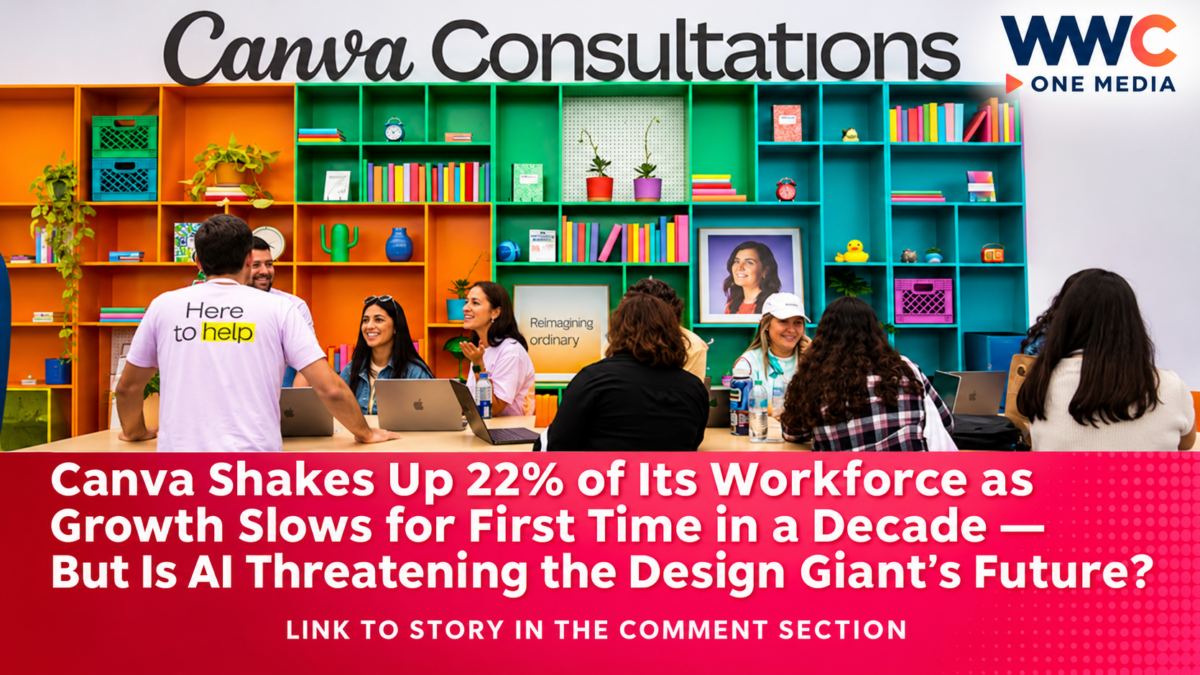
SYDNEY, AUSTRALIA — Canva, the Australian technology giant that transformed online graphic design into a global business used by hundreds of millions of people, has announced one of the most sweeping reorganizations in its 13-year history, affecting 1,271 employees—or approximately 22% of its worldwide workforce.
The dramatic restructuring comes as the company’s growth slows for the first time in a decade, while artificial intelligence is rapidly changing how businesses and individuals create designs, presentations, advertisements and other digital content.
According to Bloomberg’s November 3 report, Canva will eliminate some positions, change the responsibilities of others and ask certain employees to relocate to centralized offices.
However, the company has not disclosed the precise number of employees who will lose their jobs.
The distinction is important: 22% of Canva’s workforce is affected by the restructuring, but not all affected employees are confirmed layoffs.
Canva co-founder and chief executive Melanie Perkins described the announcement as the company’s most difficult organizational moment.
For a technology business widely regarded as one of Australia’s greatest startup success stories, the announcement raises an uncomfortable question.
If a design platform with hundreds of millions of users must radically restructure to remain competitive, what does that mean for the future of creative jobs in an increasingly AI-driven economy?
Canva’s 1,271-Employee Restructuring: What Exactly Is Happening?
Canva’s sweeping changes affect approximately one in every five employees.
In an internal message published on the company’s official website, Perkins explained that the organization needs a fundamentally different operating structure to compete during the next phase of technological transformation.
The restructuring includes three major employment outcomes:
1. Job losses. Some employees will leave the organization permanently as Canva eliminates positions and consolidates responsibilities.
2. Changes in responsibilities. Other workers will remain employed but may be assigned different duties, teams or organizational structures.
3. Relocation requests. Certain employees will be asked to move to centralized hubs as Canva brings more teams together geographically.
The company has not provided a complete breakdown of how many employees fall into each category.
This means claims that Canva has already laid off exactly 1,271 people would overstate the information currently available.
The changes represent an effort to reduce organizational complexity and restore the faster decision-making processes that characterized Canva’s earlier years.
Canva’s Growth Slows for the First Time in 10 Years
The announcement follows a significant change in Canva’s financial outlook.
For years, the company expanded rapidly as businesses, students, marketers and content creators adopted its browser-based design tools.
Its accessible templates and simplified editing features helped bring professional-looking digital content within reach of users who had little formal design training.
That success helped Canva become one of Australia’s most valuable private technology companies.
But its growth trajectory has weakened.
Business Insider reported that Canva reduced its expected 2026 revenue growth rate from 30% to 20% in August.
Although 20% growth remains substantial for a mature software business, the revision indicates that management’s earlier expectations were too optimistic.
Perkins also acknowledged that Canva’s growth had slowed for the first time in a decade.
Slower growth creates difficult financial decisions.
A company that expanded its workforce and operating structure during years of rapid revenue increases may need to reconsider its costs, organizational responsibilities and future staffing requirements when growth moderates.
However, slowing revenue growth does not automatically mean Canva is operating at a loss.
The Australian reported that the company remained profitable despite the slowdown.
The restructuring therefore appears to be aimed at repositioning the business for future competition rather than responding to a confirmed financial collapse.
Is Artificial Intelligence Behind Canva’s Workforce Shake-Up?
One of the biggest questions surrounding Canva’s restructuring concerns the growing influence of artificial intelligence.
The company did not explicitly identify AI as the direct cause of the layoffs in Perkins’ announcement.
Instead, management referred to new technology transforming creative work, evolving customer expectations and the need for different organizational capabilities.
Nevertheless, industry observers have highlighted the growing competitive pressure from generative AI.
Tools capable of producing images, presentations, advertisements and written content from simple instructions increasingly overlap with services offered by traditional design software companies.
Canva itself has invested heavily in AI-powered products as it attempts to remain competitive.
Its challenge is no longer simply making graphic design easier.
It must also prove why customers should continue paying for its platform when increasingly capable AI tools can perform parts of the creative process automatically.
That shift could affect the types of skills technology companies need.
Software engineering, AI development, product integration, data infrastructure and specialized design expertise may become more strategically important.
At the same time, some repetitive administrative, operational and production tasks could be consolidated or automated.
But it would be inaccurate to conclude that AI has already replaced all the workers affected by Canva’s restructuring.
The company’s announcement does not establish that claim.
The broader employment debate was previously examined by WWC ONE MEDIA in Silicon Valley Warns AI Could Wipe Out Millions of Jobs — But Economists Say the Real Threat May Be Hiding in Entry-Level Hiring.
That report explored how AI can affect employment through reduced hiring, changed responsibilities and automation without necessarily producing immediate mass unemployment.
Canva’s restructuring offers another example of why the distinction between jobs eliminated and jobs transformed matters.
Canva Merges Major Departments to Reduce Management Layers
The restructuring extends beyond workforce reductions.
Canva plans to combine its Product, Growth and Platform organizations into a single product structure.
Previously, separate teams managed different elements of product development, user growth and technical infrastructure.
As businesses expand, these divisions can become increasingly specialized.
While specialization can improve expertise, it can also slow decisions when projects require approval or coordination across several departments.
Perkins identified these coordination challenges as one reason for the overhaul.
By bringing major functions together, Canva hopes to reduce duplicated responsibilities, simplify leadership structures and allow teams to make decisions more quickly.
The company is also reducing excessive specialization and consolidating overlapping duties.
The goal is to create smaller, more empowered teams capable of developing and improving products without navigating unnecessary organizational barriers.
This approach reflects a broader trend among major technology companies seeking to reduce management complexity while increasing productivity.
For comparison, WWC ONE MEDIA previously reported on another restructuring involving thousands of employees in Uber Is Cutting 3,300 Jobs Even as Business Booms — But the Real Shake-Up Is About What Comes After Human Drivers.
Although Uber and Canva operate in different industries, both cases demonstrate how companies can reorganize their workforces while continuing to pursue long-term growth.
The crucial difference is that Canva has not disclosed an exact layoff total.
Sydney Becomes Canva’s Main Product Development Hub
Canva’s restructuring will also reshape where employees work.
Sydney will become the primary base for more product teams and other roles requiring close coordination.
Some employees may be asked to relocate to centralized locations.
Management argues that bringing teams together more frequently can improve communication, strengthen collaboration and accelerate innovation.
The company currently operates across 37 countries, reflecting its expansion into a global technology platform.
That international structure gives Canva access to talent across different markets.
However, Perkins acknowledged that geographical separation can create challenges when employees working on the same products need to collaborate closely.
Starting in January 2027, most employees under hybrid working arrangements will be expected to spend approximately two to three days each week in the office, depending on their teams.
The relocation requirements may prove challenging for employees with family commitments, housing obligations or personal circumstances that make moving difficult.
Canva said it intends to provide support to workers asked to relocate.
Still, the policy highlights another major shift in the technology industry as employers reconsider the balance between flexible remote work and centralized operations.
Six Months’ Salary and Additional Benefits for Departing Workers
Canva has outlined several measures to support employees who leave as part of the restructuring.
According to the company’s official announcement, departing workers will receive at least six months of salary, including applicable statutory entitlements, regardless of location.
Additional measures include continued healthcare coverage for 12 months in countries where Canva provides that benefit, career-transition resources and employee wellbeing assistance.
The company will also remove the standard one-year equity vesting requirement for eligible employees who joined during the preceding year.
Departing employees may keep their company-issued laptops.
Canva is also introducing a fund through which eligible former employees can apply for US$10,000 grants to establish businesses or pursue community initiatives.
These grants are not automatic cash payments to every departing employee.
They are available through an application process.
The support package reflects the company’s attempt to reduce the immediate financial and professional disruption caused by the restructuring.
However, severance payments cannot fully eliminate the uncertainty associated with losing employment, especially when hiring conditions across parts of the technology sector are becoming more competitive.
Australian Technology Companies Face a Wider Employment Reset
Canva is not the only major Australian technology business restructuring its workforce.
The Guardian reported that Atlassian, Block and WiseTech Global have also announced workforce reductions.
Atlassian previously eliminated approximately 1,600 positions as part of changes to its operating model.
The broader trend reflects growing pressure on software businesses to justify spending, improve productivity and adapt their products to rapidly developing AI capabilities.
However, not every company’s restructuring has the same cause.
Some businesses may be responding primarily to financial pressures.
Others may be consolidating acquisitions, simplifying management structures or redirecting investment toward AI development.
In Canva’s case, management has pointed to slower growth, organizational complexity and technological change.
The combination suggests that established software companies are entering a period in which previous assumptions about staffing and organizational expansion are being reassessed.
What Canva’s Restructuring Means for Filipino Designers and Digital Workers
Although Canva is headquartered in Australia, its products are widely used by Filipino freelancers, graphic designers, entrepreneurs, students, marketing agencies and social media professionals.
Its restructuring therefore carries wider implications for the Philippine creative and digital-services economy.
The immediate announcement does not establish that Canva users in the Philippines will lose access to existing services or that Filipino freelancers are directly included in the company’s layoffs.
However, the broader technological shift affecting Canva is relevant to the Philippines.
AI-powered design and content-generation systems can help businesses produce marketing materials more quickly.
They may also reduce demand for some routine design assignments, particularly when customers are satisfied with automatically generated templates and basic promotional content.
For creative professionals, the challenge will increasingly involve providing services that extend beyond simple image production.
These may include creative strategy, brand development, original concepts, visual storytelling, campaign management and complex client collaboration.
The changing nature of digital employment is already being discussed across Philippine industries.
WWC ONE MEDIA previously examined how artificial intelligence is affecting corporate productivity in PLDT’s AI Agents Are Saving Tens of Thousands of Work Hours — But the Bigger Question Is What Happens to the Human Workforce.
The report highlighted how automation can reduce repetitive work while raising questions about hiring, retraining and long-term career opportunities.
For the Philippine outsourcing industry, the shift is also creating demand for more technically skilled workers.
WWC ONE MEDIA examined this transition in Philippine IT-BPM Revenue Seen Nearing $45 Billion in 2027 Despite AI Disruption.
The lesson for Filipino creative workers is that learning to use AI effectively may become increasingly important, but strong judgment, original thinking and client relationships will remain valuable.
AI Is Creating New Jobs Even as Traditional Roles Change
The rapid expansion of AI is not producing a single, uniform employment outcome.
While some businesses are eliminating or redesigning roles, others are recruiting workers with specialized AI expertise.
Technology firms, financial institutions and enterprise software companies increasingly require employees capable of developing, integrating and managing intelligent systems.
Demand is growing for AI engineers, machine-learning specialists, cybersecurity professionals and workers who can combine technical expertise with industry knowledge.
WWC ONE MEDIA previously reported on this trend in Wall Street AI Hiring Surges as Banks Race for Agent Orchestration Skills.
That report examined how financial institutions are recruiting workers to manage increasingly sophisticated automated workflows.
The contrasting developments illustrate an important point.
Artificial intelligence can reduce demand for certain tasks while increasing demand for others.
The challenge for employees and policymakers is ensuring that workers can acquire the skills needed for changing industries.
Canva’s announcement does not prove that creative professions are disappearing.
It does, however, demonstrate that even successful technology companies are reassessing how work should be organized.
Could Canva’s Restructuring Affect Its Future IPO?
Canva has long been discussed as a potential candidate for a major public listing.
The privately held company has attracted substantial investor interest because of its global user base and rapid expansion.
However, its slower growth and organizational restructuring may influence how investors assess its future valuation.
Prospective investors typically evaluate revenue growth, profitability, customer retention, competitive positioning and the sustainability of a company’s business model.
A restructuring can improve operating efficiency if it successfully reduces unnecessary costs and accelerates product development.
But workforce upheaval can also create execution risks.
The departure of experienced employees may disrupt important projects, while reorganized teams require time to establish effective working relationships.
For Canva, a successful transition could strengthen its position ahead of any eventual public listing.
An unsuccessful transition could intensify questions about its ability to compete in an increasingly AI-driven software market.
No finalized IPO date should be treated as confirmed solely because analysts or media outlets have discussed a possible listing.
What Happens Next? Canva Faces Three Major Tests
Canva’s future will depend on whether the company can turn its restructuring into measurable business improvements.
The first test is restoring stronger growth. Investors and industry observers will watch whether Canva can stabilize its revenue outlook and continue attracting paying customers.
The second test is AI competition. The company must demonstrate that its expanding AI capabilities make its platform more valuable rather than allowing competing tools to erode customer demand.
The third test is organizational execution. Merging departments, relocating employees and reducing management layers may improve efficiency, but the changes could also disrupt development if handled poorly.
Canva has scheduled a company-wide meeting for November 10 to discuss the changes and its future direction.
The company’s ability to retain essential talent, maintain product quality and rebuild employee confidence will be important factors in the transition.
The Bigger Picture: Is Canva Entering a New Era—or Facing a Much Bigger Threat?
Canva’s restructuring marks a critical turning point for one of the most recognizable companies in the global digital-design industry.
The platform that made creative tools accessible to hundreds of millions of users must now adapt to an environment in which artificial intelligence is transforming both customer expectations and the economics of software development.
The company’s growth has slowed for the first time in a decade.
More than one-fifth of its workforce faces changes.
Management is consolidating departments, bringing employees closer together and attempting to restore the organizational agility that helped build the business.
Yet none of these developments guarantees that Canva is entering a long-term decline.
The restructuring could strengthen its competitiveness if it leads to faster innovation, more efficient operations and better products.
But it could also expose deeper challenges if AI competitors continue to disrupt the software market and revenue growth fails to recover.
For workers, creators and technology investors, the consequences could extend far beyond Canva.
As 1,271 employees face layoffs, relocation or changing responsibilities—and artificial intelligence transforms the creative economy—is Canva preparing for its next decade of growth, or has the company just revealed the first signs of a much bigger disruption threatening the future of digital-design jobs?