OTTAWA, Canada / WASHINGTON, United States — November 4, 2026 | WWC ONE MEDIA | Global Business, International Trade & Politics
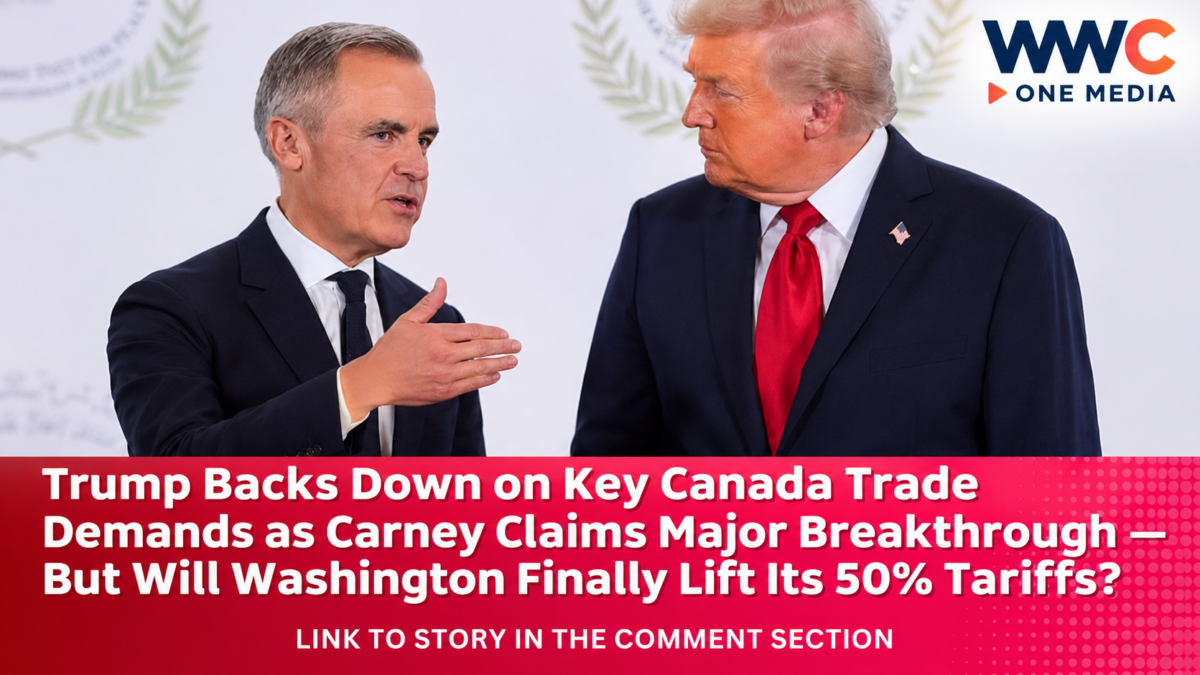
The bitter trade war between the United States and Canada may finally be approaching a breakthrough after Canadian Prime Minister Mark Carney revealed that Washington has softened several demands that previously caused negotiations to collapse.
In a significant change of tone, Carney said the Trump administration is now “asking less and offering more” as the two countries work toward a possible agreement covering tariffs, manufacturing and the future of their economic relationship.
The comments, reported by Bloomberg on November 3 and independently confirmed by Reuters and The Wall Street Journal, suggest that months of diplomatic confrontation may be giving way to renewed negotiations.
Most importantly, Carney indicated that the United States had backed away from an earlier proposal that would have restricted Canada’s ability to negotiate independent trade agreements with other countries.
That demand had become one of Ottawa’s major objections during the unsuccessful August negotiations.
President Donald Trump has also expressed optimism, suggesting that the two governments are approaching an agreement that could benefit American farmers and businesses.
But neither government has announced a completed trade pact.
US tariffs affecting Canadian steel, aluminum, automobiles and other products remain a critical obstacle, while disagreements over national sovereignty and economic protections have not been entirely resolved.
The biggest question now is whether Washington’s apparent concessions will lead to meaningful tariff relief—or whether another dispute over the fine print could destroy the deal just as the two countries move closer to an agreement.
Carney Says Washington Has Changed Its Position
Speaking to Canadian reporters in St. John’s, Antigua and Barbuda, on November 3, Carney described recent negotiations as more constructive than the discussions that broke down in August.
He indicated that some of Canada’s most important objections were no longer being pressed in the same way.
These involved Canada’s sovereignty, its ability to protect its language and culture, and its freedom to establish commercial relationships with countries outside North America.
One particularly contentious earlier proposal would have given the United States a form of final approval over trade deals Canada might negotiate with other countries.
For Ottawa, that would have represented an unacceptable restriction on Canadian economic independence.
Carney said Washington had withdrawn or relaxed that demand.
Reuters independently confirmed his account of the shift in the US negotiating position.
However, the prime minister did not provide a complete list of concessions or disclose a finalized draft agreement.
That distinction matters.
A willingness to reconsider negotiating demands does not automatically translate into an enforceable commitment.
The remaining details will determine whether the apparent breakthrough can become a durable agreement.
Why the August Trade Deal Collapsed
The latest optimism comes after a particularly damaging breakdown in negotiations on August 21.
Officials from both countries had been working toward an arrangement intended to ease tariffs affecting important manufacturing industries.
The discussions included potential reductions in duties on Canadian steel, aluminum, vehicles and other goods.
But the negotiations failed after Canadian officials objected to the detailed provisions proposed by Washington.
Carney argued that the agreement threatened Canada’s ability to maintain independent trade policies and protect domestic industries.
There were also disagreements over French-language protections, digital services and the treatment of Canadian-made vehicles.
Washington disputed Canada’s interpretation of several proposals.
The Trump administration argued that Ottawa had rejected an unusually favorable offer.
The dispute quickly escalated into new tariffs and retaliatory measures.
WWC ONE MEDIA previously examined the breakdown in Carney Tells Trump to Get Serious Before Canada Restarts Trade Talks — But the Biggest Fight Is Still Ahead.
That report highlighted the risks facing integrated North American industries and Canada’s refusal to sacrifice key economic protections.
The current negotiations represent an opportunity to reverse that deterioration.
But officials must overcome the same underlying disagreements that caused the earlier failure.
A 50% Tariff Battle Has Put Canadian Industry Under Pressure
The August breakdown triggered a new wave of trade restrictions.
The United States imposed tariffs of 50% on approximately US$20 billion worth of Canadian goods, according to Reuters and Associated Press reporting.
Canada subsequently announced retaliatory measures targeting American products.
The tariff dispute has affected an array of industries, including steel, aluminum, agricultural products, consumer goods and manufacturing.
However, not every Canadian export faces the same tariff.
Applicable rates depend on product classifications, eligibility under the Canada–United States–Mexico Agreement and the particular US trade measure involved.
Some products remain eligible for preferential treatment under existing trade rules.
Others face additional sector-specific duties.
The distinction is important because the current dispute involves multiple overlapping tariff authorities rather than one universal 50% tax on all Canadian goods.
For affected businesses, the uncertainty has made long-term planning more difficult.
Companies must consider whether higher import costs will reduce profits, force price increases or make production in another location more attractive.
Canada’s Auto Industry Faces a Particularly Dangerous Threat
Among the most sensitive issues are tariffs on Canadian-made automobiles.
Trump previously threatened to raise tariffs on Canadian vehicle imports from 25% to 50%, with the proposed increase potentially taking effect on January 1, 2027.
The threat has raised concerns among automakers operating factories in Canada.
Companies such as Toyota and Honda rely on integrated production networks in which vehicles, engines and components move between Canada, the United States and Mexico.
WWC ONE MEDIA examined the risks in Toyota, Honda Face Fresh Tariff Shock as Trump Targets Canadian Auto Imports.
The report described how tariffs could threaten Canadian manufacturing operations and raise costs across North American supply chains.
For automobile manufacturers, the consequences extend beyond the final selling price of a vehicle.
A tariff may influence decisions about where new factories are built, whether existing facilities receive investment and how companies allocate production.
However, the proposed increase to 50% on Canadian-made automobiles should not be presented as an already implemented rate on every vehicle.
The ultimate policy could change if negotiations produce an agreement.
For Canada, securing predictable automotive trade rules remains a central priority.
Trump Says a Deal Could Be Close
The latest negotiations gained momentum after a conversation between Trump and Carney on November 1.
Trump subsequently told reporters that the countries were approaching an arrangement that could benefit their economies.
He suggested the prospective deal would be especially favorable to American farmers.
Carney also acknowledged progress but emphasized that negotiators would need additional time to resolve outstanding issues.
Both leaders offered their most optimistic assessments since the August breakdown.
The contrast with earlier exchanges is striking.
During the previous months, relations had deteriorated amid tariff threats, public criticism and disagreements over Canadian sovereignty.
Now, both governments appear willing to explore terms that could restore some stability.
However, a positive statement by a political leader is not equivalent to a completed trade agreement.
No comprehensive schedule of tariff reductions has been released.
Neither government has publicly confirmed the final treatment of automobiles, steel, aluminum, agriculture or cultural protections.
For businesses, uncertainty therefore remains.
America’s Midterm Elections Add Political Pressure
The renewed negotiations coincided with the November 3 US midterm elections.
Trade tensions with Canada have become politically sensitive in states with extensive cross-border manufacturing and agricultural connections.
Michigan is particularly exposed because its automotive industry depends on Canadian plants and suppliers.
Other northern states also maintain substantial commercial ties with Canadian businesses.
Politicians in these regions face pressure from companies and workers concerned about tariffs and uncertainty.
The timing has encouraged speculation that Washington may have additional political reasons to pursue a deal.
However, no verified evidence establishes that the Trump administration softened its demands solely because of the election.
US officials have their own stated concerns involving manufacturing, agriculture and market access.
The negotiation may be influenced by several factors at once.
For Canada, the longer-term economic relationship is more important than a single American election cycle.
Carney has said Ottawa should not accept an unfavorable deal merely to meet a political deadline.
The Great Lakes Economy Has Billions at Stake
Few regions demonstrate the consequences of US–Canada trade tensions more clearly than the Great Lakes.
For generations, manufacturers and transportation companies have relied on cross-border commerce involving steel, automobiles, agricultural products and industrial materials.
Ports, railways, trucking networks and factories are organized around that trade.
WWC ONE MEDIA previously reported on these connections in The Great Lakes Built a $376 Billion Trade Lifeline — Trump’s Tariffs Are Now Putting It Under Pressure.
The report described how tariff escalation could increase business costs and discourage investment in infrastructure designed to serve the integrated North American economy.
The danger is not limited to immediate tariff payments.
Companies may reconsider future investments if they believe trade policies could change unpredictably.
Manufacturers planning new factories often make decisions based on expected conditions over many years.
Repeated tariff threats can complicate those calculations.
A durable Canada–US agreement could therefore provide benefits beyond a short-term reduction in import duties.
It could help restore confidence in the commercial arrangements supporting manufacturing and logistics.
Canada’s Sovereignty Is Still a Critical Negotiating Issue
One of Ottawa’s strongest objections to the earlier US proposal concerned Canada’s freedom to establish its own international trade relationships.
Canadian officials argued that the proposed terms could have limited the country’s ability to negotiate agreements with third countries.
The concern extended beyond any single potential trading partner.
Canada wants to preserve its authority to develop relationships with Europe, Asia and other markets.
Carney has emphasized that trade diversification is essential to reducing the country’s vulnerability to changes in US policy.
The withdrawal of Washington’s reported demand concerning third-country trade agreements is therefore an important development.
However, Canada must still examine the precise wording of any final arrangement.
Rules concerning investment, national security, supply chains and regulatory cooperation can influence a country’s economic flexibility even when they do not explicitly prohibit outside agreements.
For Ottawa, the challenge is obtaining meaningful tariff relief without surrendering the independence it considers fundamental.
Canada Is Strengthening Its European Partnerships
The negotiations are unfolding as Canada pursues closer economic and strategic cooperation with Europe.
Carney recently participated in discussions with European leaders aimed at expanding investment, technology cooperation and trade opportunities.
WWC ONE MEDIA examined the initiative in Canada and EU Push Historic New Alliance as Carney and Macron Challenge US Dominance — But Could Europe’s Internal Divisions Derail the Deal?.
The report explored Canada’s interest in developing stronger ties with European Union members while reducing excessive reliance on the American market.
The initiative builds on the Canada–EU Comprehensive Economic and Trade Agreement, which has already reduced many barriers between the two economies.
However, closer Canadian-European integration remains a complex process.
Differences in regulations, investment priorities and political interests must still be addressed.
Canada cannot quickly replace its extensive US trading relationship.
North American supply chains reflect decades of investment and geographic proximity.
European diversification is better understood as an effort to create additional options rather than abandon the United States.
The latest shift in Washington’s negotiating position could allow Canada to pursue both objectives more effectively.
Import Restrictions Make the Trade Dispute More Complicated
The US–Canada dispute has expanded beyond conventional import tariffs.
In September, Washington announced restrictions affecting selected Canadian products, including certain alcoholic beverages, dairy-related items and motorcycles.
WWC ONE MEDIA examined the measures in Trump Is Banning Canadian Goods From the US — But the Next Target Could Hit Both Economies Much Harder.
The report detailed the distinction between products subjected to tariffs and those covered by outright import restrictions.
That distinction matters in the present negotiations.
Reducing an import duty does not automatically eliminate a separate prohibition.
A comprehensive settlement may require both governments to address multiple kinds of trade measures.
Businesses will need to examine the precise coverage, implementation dates and exceptions of any eventual agreement.
A political announcement describing a breakthrough may not resolve every practical restriction.
The full legal text will be critical.
What About the Canada–US–Mexico Trade Agreement?
The wider trade relationship is governed in part by the Canada–United States–Mexico Agreement, known as CUSMA in Canada and USMCA in the United States.
The agreement replaced the North American Free Trade Agreement in July 2020.
It provides rules governing substantial portions of trade among the three countries.
However, the existence of USMCA has not prevented the Trump administration from imposing additional tariffs using other legal authorities.
The agreement’s review process has also created uncertainty about its long-term future.
Canada wants a stable framework that allows businesses to make investments with confidence.
The United States is pursuing changes it believes will strengthen American manufacturing and address perceived imbalances.
Mexico has separate interests involving its automotive industry, manufacturing supply chains and investment.
The bilateral negotiations between Trump and Carney may influence the broader trade environment.
But they are not automatically equivalent to a completed trilateral revision of USMCA.
Any agreement involving the three countries would need to follow its own procedures.
What Canadian Businesses Need From a Final Agreement
For exporters and manufacturers, the most valuable outcome may be greater predictability.
Companies need to know what tariffs will apply when goods cross the border.
They also need confidence that agreed rates will not change unexpectedly.
Carney previously criticized proposed terms that, in Ottawa’s view, did not provide sufficient protection against future tariff increases.
That concern remains relevant.
Even if the United States offers lower rates in the latest negotiations, Canada may seek guarantees concerning how long those rates will apply and under what conditions they can be changed.
Businesses may also require clarity over customs procedures, product eligibility and sector-specific exceptions.
For an automobile manufacturer, a promised tariff reduction may have limited value if it can be reversed without adequate notice.
For steel producers, the treatment of import quotas could be as important as the nominal tariff rate.
The quality of a final agreement will therefore depend on its enforceable provisions, not simply the political language used to announce it.
The Disagreement Over Who Needs Whom
Trump has repeatedly criticized the US trading relationship with Canada, arguing that American industries should become less dependent on imports.
Carney has responded that the two economies benefit from substantial cross-border integration.
Both governments are attempting to improve their negotiating positions.
The US economy is considerably larger, giving Washington substantial leverage.
But American businesses also depend on Canadian energy, raw materials, agricultural inputs and manufacturing capacity.
Canada, meanwhile, faces significant exposure because the United States remains its dominant export market.
This asymmetry explains why Ottawa is trying to diversify its trading relationships.
Yet diversification takes time.
Companies cannot easily replace established customers, logistics networks and manufacturing infrastructure.
That makes a workable agreement attractive to both sides, even when their political positions differ.
What Other News Outlets Confirm
Bloomberg reported on November 3 that Carney believed the United States had reduced its demands and improved its offers in the latest negotiations.
Reuters independently confirmed that Washington had withdrawn some earlier conditions, including the proposed restriction on Canada’s ability to negotiate trade deals with other countries.
The Wall Street Journal reported that the negotiations had made progress while significant differences remained.
Associated Press described the November 1 conversation between Trump and Carney, including the president’s optimism and Canada’s insistence on protecting its sovereignty.
Global News Canada also covered Carney’s November 3 remarks, confirming that more intensive negotiations were underway.
These sources consistently establish that the negotiating atmosphere has improved.
However, they do not establish that the two countries have completed a final agreement or agreed on the precise removal of existing tariffs.
What Happens Next?
The immediate priority is turning political progress into a negotiated document.
Officials must determine which tariffs will be reduced, which restrictions will remain and how any changes will be implemented.
The automotive sector is likely to remain especially important because of the potential consequences for factories and employment.
Steel and aluminum producers are also seeking clarity.
Agricultural trade and regulatory issues may require further discussion.
Canada will continue insisting that any agreement preserve its cultural protections and freedom to negotiate independently with other countries.
Washington, meanwhile, will seek provisions it can present as favorable to American workers, farmers and industries.
The process could advance in the coming weeks.
But there is no confirmed signing date or complete timetable for implementation.
The Bottom Line: A Breakthrough, but Not Yet a Trade Deal
Carney’s latest remarks represent a meaningful change in the Canada–US trade dispute.
After months of confrontation, Washington appears to have relaxed several demands that Ottawa considered unacceptable.
Trump has also expressed optimism about reaching a mutually beneficial agreement.
The developments have improved the prospects for negotiations.
But the hardest part may still lie ahead.
Businesses need tariff relief, legal certainty and predictable trading conditions.
Canada wants to protect its sovereignty and major industries.
The United States wants concessions that it believes will strengthen American economic interests.
The latest diplomatic thaw suggests that both sides may finally see a path toward compromise. Yet until a final agreement is signed and implemented, the costly trade restrictions remain a threat to companies and workers on both sides of the border.
Will Trump’s softened demands deliver the tariff breakthrough Carney has been seeking—or could another last-minute disagreement over automobiles, sovereignty and the fine print push North America’s two largest neighbors back into a damaging trade war?