MANILA, Philippines — November 4, 2026 | WWC ONE MEDIA | Philippine News, Government Accountability & Energy
Thousands of boxes containing government records were reportedly disposed of by a private warehouse contractor hired by the Power Sector Assets and Liabilities Management Corporation (PSALM), triggering serious questions about document security, contractor accountability and the management of public records.
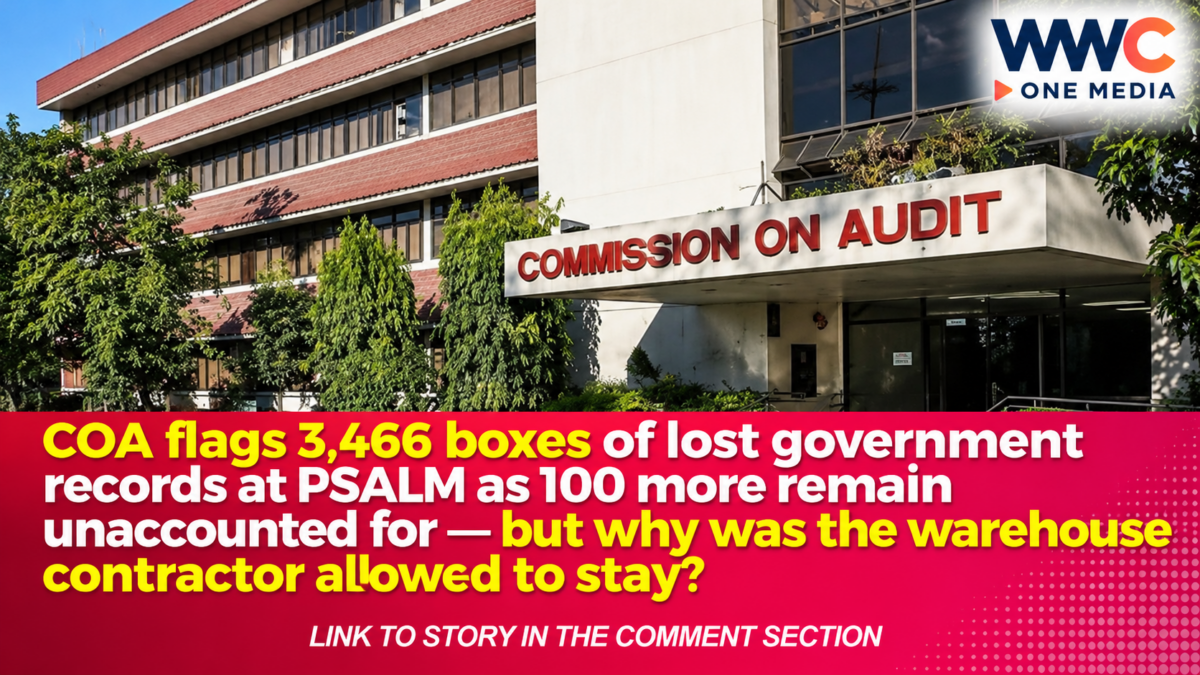
A November 4 investigation by Bilyonaryo, citing findings of the Commission on Audit (COA), revealed that 3,466 boxes of government documents were accidentally disposed of while under the custody of an outsourced warehouse service provider.
The number represented approximately 44% of the 7,954 boxes reportedly stored at the facility.
But the controversy did not end with the destruction of thousands of records.
Auditors also identified a discrepancy involving another 100 boxes that appeared in one inventory but were not accounted for in the contractor’s incident report.
Despite the reported loss, PSALM did not immediately terminate its contract with the warehouse provider, partly because it lacked an alternative storage facility for the remaining government records.
The situation has placed renewed scrutiny on PSALM, led by President and Chief Executive Officer Dennis Edward Dela Serna, whose government corporation oversees significant public power-sector assets and financial liabilities.
The central question is no longer simply how thousands of government records were disposed of—but whether the oversight failures that allowed the incident to happen will result in meaningful accountability.
How 3,466 Boxes of Government Records Were Reportedly Lost
According to Bilyonaryo’s account of the COA findings, PSALM had entrusted 7,954 boxes of government documents to an external warehouse contractor.
Of those, 3,466 boxes were reportedly disposed of through an incident attributed to negligence and a system failure.
The contractor formally notified PSALM about the incident on December 2, 2024.
The incident reportedly occurred in the context of records held at a warehouse identified in the audit through references to RMS personnel and facilities.
However, the published report does not establish the complete contents of every discarded box.
It also does not specify the monetary value of any individual record or establish that the documents contained evidence of financial wrongdoing.
Those distinctions matter.
Government records may include contracts, administrative papers, correspondence, accounting documents or other materials requiring different retention periods.
Losing or destroying records can interfere with audit verification, legal proceedings and institutional accountability.
But the seriousness of the incident must be assessed using the records’ actual contents, legal retention requirements and the circumstances of their disposal.
Another 100 Boxes Raise Questions About Inventory Accuracy
Perhaps one of the most troubling findings involved inconsistent inventory figures.
The contractor’s October 2024 inventory reportedly listed 3,566 boxes as disposed of.
However, its formal incident report referred to only 3,466 boxes.
That created a discrepancy of 100 boxes.
The available reporting does not establish whether those additional boxes were destroyed, misplaced, miscounted or incorrectly classified.
Consequently, they should be described as unaccounted for in the reported inventory comparison—not automatically as another 100 boxes proven to have been destroyed.
Nevertheless, the inconsistency raises an important question about the reliability of the contractor’s recordkeeping procedures.
A properly managed records facility should maintain a traceable inventory identifying what was received, where it was stored, when it was accessed and whether any authorized disposal took place.
If the inventories cannot be reconciled, it becomes more difficult to determine the precise scope of the loss.
For auditors, the problem extends beyond the number of boxes.
It concerns whether the government corporation possessed adequate systems to monitor documents placed under private custody.
COA Reportedly Finds Weak Monitoring and Contractual Safeguards
Bilyonaryo reported that COA identified deficiencies in PSALM’s oversight arrangements.
According to the investigation, PSALM had not conducted periodic inventories of the documents held by its warehouse contractor.
The storage agreement also reportedly lacked specific penalties addressing negligence-related incidents.
These deficiencies could weaken the government’s ability to detect missing records promptly and enforce accountability after an incident.
A warehouse agreement may transfer day-to-day physical custody of documents to a private provider.
However, outsourcing storage does not automatically transfer away the government’s legal responsibilities for public records.
The principle is straightforward.
A government agency must still exercise appropriate supervision over contractors handling official documents.
That includes establishing inventory procedures, safeguarding records, maintaining access controls and ensuring compliance with retention and disposal requirements.
The reported findings raise questions about whether PSALM’s monitoring systems were sufficiently robust before the disposal occurred.
Why the National Archives Matters
The controversy also raises questions about compliance with the Philippine government’s records-disposal framework.
The National Archives of the Philippines regulates the retention, preservation and authorized disposal of public records.
Government rules generally require agencies to follow approved records disposition schedules and obtain appropriate authority before destroying official documents.
The rules also prohibit disposal of certain records that remain subject to audit or unresolved legal proceedings.
In its report, Bilyonaryo said COA found no evidence establishing that the National Archives had explicitly authorized PSALM to transfer custodianship and management of the government records to a private entity.
That is a question about authorization for outsourced custody.
It should be distinguished from the separate question of whether the specific destroyed records had received lawful disposal approval.
Both require examination of the underlying documentation.
The reported absence of evidence of permission does not, by itself, establish that every relevant authorization was never issued.
However, the audit concern underscores the need for agencies to maintain clear documentary proof of compliance.
Why PSALM Did Not Immediately Terminate the Contractor
One of the most controversial aspects of the incident concerns what happened after the loss was reported.
According to Bilyonaryo, PSALM’s records management team considered measures including a notice to explain, contract termination and possible blacklisting of the warehouse provider.
Yet the agency did not immediately end the arrangement.
The reason was an operational problem: PSALM reportedly had no alternative warehouse ready to receive the remaining documents.
Removing the contractor without another secure facility could have exposed the surviving records to further loss, misplacement or unauthorized access.
The agency therefore faced a difficult decision.
Continuing to use the existing provider carried obvious accountability concerns.
But terminating the agreement without a replacement could have created additional records-security risks.
According to the published investigation, the records management team recommended retaining the provider temporarily while identifying another storage arrangement.
This does not establish that continued use of the contractor was necessarily the best available decision.
It does, however, explain the operational reasoning reported behind the delay.
The incident illustrates why government agencies need contingency plans before outsourcing custody of critical documents.
Contractor Reportedly Allowed to Join Two More Bidding Exercises
The audit findings described another development that raises concerns about procurement oversight.
Bilyonaryo reported that the same warehouse provider was permitted to participate in two subsequent bidding exercises for PSALM’s 2025 document storage and management services.
That occurred despite the reported disposal incident.
The development raises questions about the agency’s handling of contractor performance and eligibility.
However, participation in a bidding process is not equivalent to receiving a contract award.
Nor does an audit recommendation automatically establish the legal grounds necessary for blacklisting.
Any sanctions must follow the applicable procurement rules, contract provisions and procedural safeguards.
The relevant questions are whether the contractor’s performance was properly evaluated, whether violations were established under the agreement and whether appropriate administrative remedies were pursued.
PSALM Eventually Moves Remaining Records to Manila
The warehouse arrangement eventually expired on November 1, 2025.
According to Bilyonaryo, PSALM transferred its remaining records to an agency-controlled storage facility in Port Area, Manila.
The transfer was completed on November 14, 2025.
However, COA reportedly found that PSALM had not provided its audit team with prior written notice of the relocation.
That omission introduced another documentation concern.
When large volumes of government records are transferred, formal inventories and turnover documentation can help establish continuity of custody.
These safeguards make it easier to determine whether records received at the new location match those released from the previous facility.
The published report does not establish that the November transfer itself caused additional records to disappear.
But the absence of prior notification reportedly complicated audit oversight of the process.
Why This Controversy Matters Beyond PSALM
PSALM is not an ordinary government office.
The corporation was created under Republic Act No. 9136, the Electric Power Industry Reform Act of 2001, to manage the assets and liabilities associated with the restructuring of the Philippine electricity industry.
Its responsibilities include inherited National Power Corporation assets, obligations and related contractual arrangements.
These functions make accurate records management especially important.
Historical financial and administrative documents can be essential for establishing contractual rights, tracking outstanding obligations and supporting government audits.
But the potential significance of the missing records should not be exaggerated.
There is currently no verified public breakdown showing that the destroyed boxes contained particular financial contracts, evidence of corruption or documents associated with specific power transactions.
The appropriate response is to determine what the boxes contained, whether recoverable copies exist and what legal or operational consequences resulted from their disposal.
Other COA Findings Show Why Documentation Is Critical
The PSALM controversy reflects a broader issue repeatedly identified in Philippine public-sector audits: incomplete records can make it harder to verify whether government resources were properly managed.
In an earlier report, WWC ONE MEDIA examined COA’s documentation findings involving the Office of the Vice President’s ₱168-million relief operations.
That separate audit concerned inconsistencies in mission orders, beneficiary records and supporting documents.
Although the circumstances differ substantially from PSALM’s warehouse incident, both cases demonstrate why public agencies must maintain complete and traceable documentation.
Missing records do not automatically prove corruption.
They do, however, complicate the ability of auditors to verify transactions and determine whether government procedures were followed.
Public Accountability Depends on a Reliable Audit Trail
The value of documentary records also extends to government budgeting and procurement.
WWC ONE MEDIA previously reported on calls for a complete audit trail in Congress’ proposed ₱7.2-trillion national budget.
The budget transparency proposal sought records identifying amendments, insertions and changes to public spending plans.
Although that debate concerns a different branch of government, the underlying principle is comparable.
Public accountability becomes more difficult when officials cannot establish the history of government decisions and transactions.
A complete audit trail allows investigators, auditors and the public to examine how decisions were made and who was responsible for approving them.
For PSALM, reconstructing the lost records and identifying the documents involved would be important steps toward determining the actual consequences of the disposal incident.
Contractor Oversight Is Becoming a Wider Government Concern
The warehouse controversy also highlights the importance of monitoring private contractors handling public-sector responsibilities.
WWC ONE MEDIA recently reported on Cebu Normal University’s ₱947-million Smart Hub project and the contractor’s response to COA findings.
That separate case concerned questions involving project implementation, payments, documentation and equipment accountability.
The situations are not directly connected.
But both demonstrate why government contracts require effective oversight beyond the initial procurement process.
Awarding a contract is only one stage of public administration.
Agencies must also monitor service delivery, document compliance, investigate performance deficiencies and enforce lawful remedies when necessary.
Similarly, WWC ONE MEDIA covered the Ombudsman’s investigation into approximately ₱1.55 billion in DICT contracts, another distinct controversy involving questions about procurement relationships and public accountability.
None of these other cases establishes misconduct at PSALM.
They provide context for why government procurement and contract management continue to attract public scrutiny.
Could the Incident Affect Future Investigations?
The loss of official records can have consequences beyond administrative inconvenience.
If particular documents were needed for audits, legal disputes or the verification of government transactions, their destruction could make those processes more difficult.
However, whether the PSALM incident actually affected any such proceeding remains unverified.
The published report does not identify specific investigations that failed because of the missing boxes.
It also does not establish whether digital copies, duplicates or records held by other agencies could help reconstruct the lost information.
The next important step would be a detailed accounting of the destroyed documents.
That process should distinguish between records permanently lost, records recoverable from other sources and records whose retention periods may already have expired.
Only then can the full administrative and financial consequences be properly assessed.
What COA Reportedly Recommended
According to Bilyonaryo, COA recommended action against the warehouse contractor and an investigation into PSALM personnel responsible for inventory and contract monitoring.
The report also said PSALM management agreed to impose appropriate sanctions and inform the National Archives about the disposal incident.
However, agreement to pursue sanctions is not the same as confirmation that penalties have already been imposed.
The available reporting does not establish that particular PSALM officials have been found administratively or criminally liable.
Nor does it document a final legal determination against the warehouse provider.
Any investigation must identify the relevant contractual duties, applicable government rules, actions of responsible personnel and evidence of negligence or other violations.
Individual accountability should be determined through the proper administrative or judicial procedures.
Five Questions PSALM Still Needs to Answer
For the public, several issues remain unresolved.
First: What documents were actually contained in the 3,466 boxes reportedly destroyed?
Second: What explains the 100-box discrepancy between the contractor’s inventory and incident report?
Third: Were authorized electronic or physical duplicates available to reconstruct the missing records?
Fourth: What penalties, if any, have been formally imposed on the warehouse contractor, and what disciplinary action has been taken regarding PSALM personnel?
Fifth: What new inventory, security and monitoring measures have been established to prevent a similar incident?
Clear answers would help determine whether the agency has addressed the weaknesses identified in the reported audit findings.
They would also allow the public to distinguish between an administrative records-management failure and any more serious consequences that further investigation might uncover.
The Bottom Line: Who Takes Responsibility for the Lost Records?
The reported disposal of 3,466 boxes of PSALM records is a significant government accountability issue.
It raises questions about outsourced storage, internal monitoring, inventory controls and the procedures used to protect official documents.
The additional 100-box discrepancy makes a detailed reconstruction of the warehouse inventory especially important.
PSALM’s decision to retain the contractor temporarily also demonstrates the risks agencies face when they depend on a single provider without an immediate contingency arrangement.
For CEO Dennis Edward Dela Serna and PSALM management, the challenge is to establish what went wrong, determine the actual consequences and demonstrate that effective safeguards have been implemented.
The case should not be treated as proof of corruption or personal wrongdoing without supporting evidence.
But the reported audit deficiencies warrant serious scrutiny because the records belong to a public institution entrusted with important energy-sector obligations.
PSALM was created to manage some of the Philippine government’s most consequential power-sector assets and liabilities. Yet thousands of its own records were reportedly destroyed while under outsourced custody.
As COA pushes for accountability, will PSALM identify who was responsible, recover what information it can and enforce meaningful safeguards—or will the disappearance of thousands of government records become another unresolved chapter in Philippine public-sector oversight?