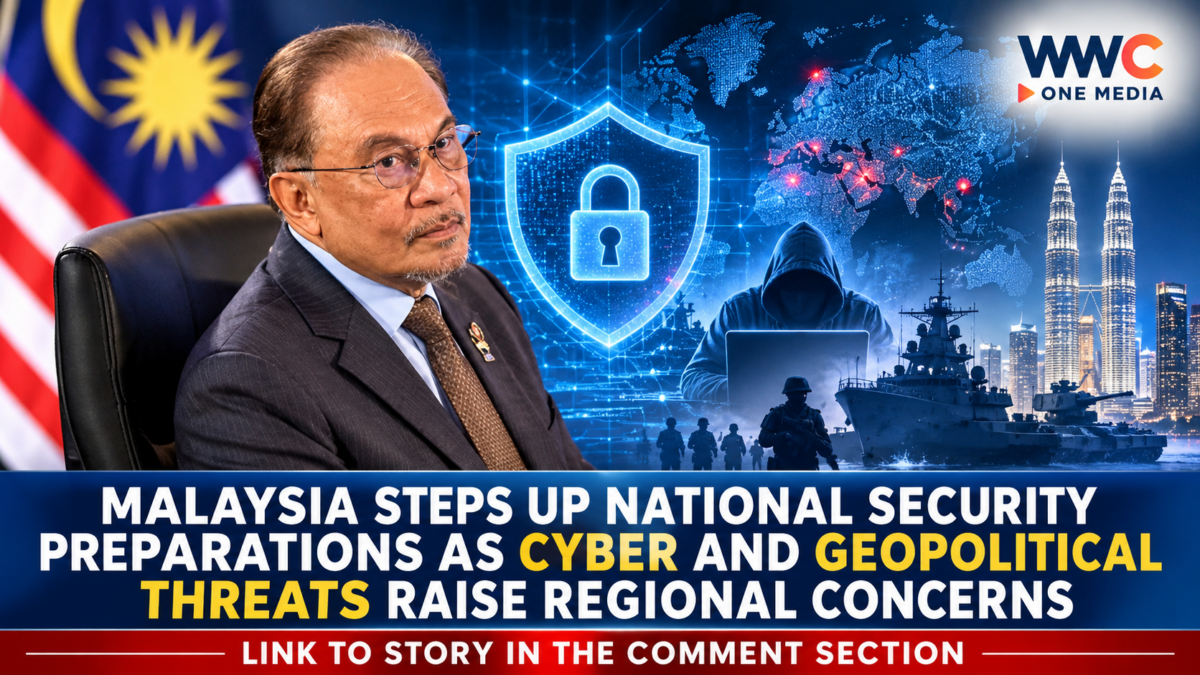
KUALA LUMPUR, November 3, 2026 — Malaysia is preparing to strengthen its national security coordination as Prime Minister Anwar Ibrahim warns that cyberattacks, geopolitical tensions and emerging threats to critical infrastructure could have consequences far beyond the countries where they originate.
Anwar announced that senior government officials and financial authorities would convene separate meetings to assess the country’s preparedness, following a special session of the National Security Council (NSC) on November 2.
The Chief Secretary to the Government is expected to coordinate discussions with government departments, while Bank Negara Malaysia’s governor will separately meet representatives of financial institutions.
The announcement reflects growing concern in Putrajaya that international instability can affect Malaysia’s public services, economic stability and national interests, even without a direct military confrontation.
Speaking in Parliament on November 3, Anwar said developments in Europe, the Middle East, Yemen and the Red Sea demonstrated how events abroad could create risks for Malaysia. <Cite refs={[“turn699807news17″,”turn699807search0″,”turn699807search2”]} />
Malaysia Reviews Its Readiness After Cyber Disruptions Overseas
Anwar’s announcement followed reports of cyber incidents affecting government and public-sector digital infrastructure in several countries.
In Parliament, he referred to disruptions involving Belgium’s national tax portal, a breach affecting Denmark’s central population registry and problems involving the United States Federal Election Commission’s filing system.
He also cited a reported cyber intrusion in Japan involving the personal records of more than 100,000 police personnel.
The incidents illustrate why cybersecurity has become a national security issue rather than a concern limited to technology companies.
Government databases, financial networks and public-service platforms increasingly depend on interconnected digital systems. Disruptions affecting one institution can therefore create consequences for citizens, businesses and other organisations that rely on its services.
Malaysia’s government is seeking to ensure that its existing security mechanisms can respond to different types of disruptions, including those that cross institutional and national boundaries.
Reuters reported that the planned meetings would allow government departments and financial institutions to assess risks and improve preparedness. <Cite refs={[“turn699807news17″,”turn699807search3”]} />
National Security Council Examines Hybrid and Geopolitical Risks
The special NSC meeting on November 2 considered the country’s existing security arrangements, coordination between government agencies and the readiness of security forces.
Anwar also identified wider geopolitical developments that could affect Malaysia, including tensions in the Middle East and developments involving Yemen and the Red Sea.
These concerns are part of a broader security environment in which countries must consider more than conventional military threats.
Hybrid threats can involve combinations of cyber disruption, intelligence activity, disinformation, economic pressure and interference with critical infrastructure. Their effects may be felt across government, finance, transportation and essential services.
Malaysia’s national security preparations therefore involve multiple agencies rather than relying on a single department.
The government has emphasised closer coordination, information-sharing and clearer responsibilities to ensure that agencies can respond without unnecessary delays or overlapping duties.
In a separate statement reported by Bernama, Anwar outlined five areas for strengthening national preparedness: inter-agency coordination, regular preparedness exercises, protection of strategic infrastructure, public education and stronger capabilities among security and crisis-management agencies. <Cite refs={[“turn699807search2”]} />
Anwar Warns That Regional Security Risks Cannot Be Treated as Distant
The prime minister also raised concerns about foreign intelligence activities in neighbouring countries.
According to reports of his parliamentary remarks, Anwar said Malaysian intelligence agencies had identified potential security concerns connected to foreign intelligence operations in the region, including activities he attributed to Israeli intelligence organisations.
He also referred to alleged Israeli settlements in Phuket and southern Thailand, which he said Malaysian intelligence agencies viewed as potential threats.
These were statements attributed to the prime minister and should be understood as the government’s security assessment. The public reports did not provide independent evidence or detailed intelligence findings to establish the full nature of the alleged activities.
Anwar’s wider argument was that Malaysia could not assume developments outside its borders would remain external problems.
He pointed to international cyber incidents and geopolitical tensions as examples of how events elsewhere could affect national interests.
The remarks underline the importance of regional intelligence cooperation, particularly when governments are assessing potential threats that may involve more than one country. <Cite refs={[“turn699807search1″,”turn699807search3”]} />
Financial Institutions and Critical Infrastructure Are Part of the Response
One of the most significant parts of the announcement is the involvement of Bank Negara Malaysia and the country’s financial institutions.
Banks and other financial organisations depend on secure digital systems to process payments, maintain customer records and support transactions across the economy.
A serious disruption could affect more than individual institutions. It could also undermine public confidence and interrupt services relied upon by households and businesses.
The planned meeting involving the central bank and financial institutions is intended to assess potential risks and strengthen readiness.
The government has also identified several strategic sectors requiring continued protection, including:
- Energy: Maintaining reliable supplies and protecting essential energy infrastructure.
- Transportation: Preserving the operation of important transport networks and services.
- Finance: Strengthening the resilience of financial institutions and their supporting systems.
- Food supplies: Ensuring that international disruptions do not unnecessarily affect domestic availability.
- Telecommunications: Protecting the digital connections that support government, business and public communication.
The importance of these sectors is closely connected. A disruption to telecommunications, for example, could affect financial transactions and the delivery of other essential services.
Malaysia’s preparations therefore need to consider how problems in one area could spread to others. <Cite refs={[“turn699807search1″,”turn699807search2″,”turn699807search4”]} />
Malaysia’s Growing Digital Economy Creates New Security Responsibilities
Malaysia’s ambition to become a more important regional digital and artificial intelligence hub adds another dimension to the issue.
The country has attracted significant interest from technology companies and data-centre operators, particularly in Johor, where large-scale infrastructure projects are being developed to support cloud computing and AI-related demand.
That growth brings investment, employment opportunities and new economic activity. It also increases the importance of protecting the infrastructure that supports digital services.
Data centres, cloud platforms and telecommunications networks are increasingly connected to essential economic functions. Their disruption could affect businesses and public services well beyond the immediate location of a facility.
This challenge is not unique to Malaysia. Across Southeast Asia, governments are working to balance digital investment with stronger cybersecurity and operational resilience.
Singapore, for example, has proposed a regulatory framework for major data centres and cloud providers through its Digital Infrastructure Bill. WWC One Media examined the proposal in Singapore’s Digital Infrastructure Bill Sets New Rules for Data Centres and Cloud Providers.
Malaysia’s preparations come against the same regional backdrop: as digital infrastructure becomes more economically important, its protection becomes a larger national responsibility.
The growing scale of regional data-centre investment also raises questions about infrastructure security and resilience. WWC One Media previously explored the financial and operational pressures behind the sector in Singapore’s PDG Seeks $1.2 Billion for Malaysia AI Data Center — But Asia’s Growing Debt Boom Faces a Bigger Test.
Government Wants Stronger Coordination Across Agencies
Anwar has stressed that national preparedness cannot depend on isolated decisions by individual departments.
The government is emphasising a whole-of-government and whole-of-society approach, bringing together ministries, security agencies, private-sector organisations and the public.
The five priorities outlined by the prime minister include:
- Better coordination and information-sharing: Strengthening cooperation among ministries, agencies and security organisations.
- Regular exercises and simulations: Improving readiness through training and practical preparedness activities.
- Protection of strategic infrastructure: Strengthening safeguards for essential sectors such as energy, telecommunications, transport, finance and food.
- Public preparedness: Improving public awareness, education and household readiness for emergencies.
- Stronger institutional capabilities: Developing expertise, training, equipment and appropriate technology for security and crisis-management agencies.
The approach recognises that government preparedness is only one part of national resilience. Businesses operate important infrastructure, while communities and households also need to understand how to respond when essential services are disrupted.
Malaysia’s authorities have also discussed strengthening the capabilities of frontline agencies, including the Royal Malaysia Police and Malaysian Armed Forces. <Cite refs={[“turn699807search2″,”turn699807search3”]} />
Why Malaysia’s Security Preparations Matter to Southeast Asia
Malaysia’s announcement carries significance beyond its own borders.
The country is deeply connected to regional trade, energy networks, financial services and digital infrastructure. Its position along important shipping routes also means that disruptions in nearby waters and international trade corridors can have wider economic consequences.
Developments in the Red Sea, for instance, have drawn attention to the vulnerability of international shipping routes and supply chains. Any prolonged disruption can affect transport costs, delivery schedules and the movement of goods.
For Southeast Asian economies that rely heavily on international trade, preparedness requires more than strengthening domestic security agencies. Governments also need to coordinate with regional partners and maintain the continuity of essential services.
Malaysia’s approach will therefore be relevant to neighbouring countries that face similar challenges as their economies become more connected and dependent on digital infrastructure.
Singapore’s emphasis on community preparedness provides another regional example. WWC One Media previously reported on this approach in PM Wong Says Community Resilience Is Key to Singapore’s National Security.
Although the security priorities of the two countries are not identical, both governments have highlighted the importance of involving institutions and the wider public in national preparedness.
What Happens Next?
The meetings involving government departments and financial institutions are intended to translate the government’s security assessment into stronger coordination and practical preparedness.
Anwar has also indicated that the National Security Council would provide a special briefing for lawmakers, allowing members of Parliament to receive additional information about the threats being assessed.
Some details may remain confidential because of the sensitive nature of intelligence and national security matters.
For now, the government has not publicly identified a specific imminent attack against Malaysia or provided a detailed account of every threat being investigated.
That distinction matters. Preparing for possible risks does not mean that a particular incident is certain to happen. It means authorities are reviewing their ability to respond if conditions deteriorate.
Malaysia’s challenge will be to turn the meetings and policy commitments into measurable improvements: stronger institutional coordination, more resilient infrastructure, better emergency planning and public confidence.
As cyber risks and geopolitical tensions increasingly overlap, the country’s security will depend not only on its ability to detect threats but also on how effectively its institutions can continue operating when disruptions occur.
Can Malaysia turn its latest security warnings into a stronger national resilience system—and will the rest of Southeast Asia be prepared for the same combination of cyber and geopolitical risks?