MANILA, Philippines — Wellness is often treated as another item on an already crowded to-do list: exercise more, eat better, sleep longer and find time to relax. But making those habits part of everyday life can be more difficult than simply knowing what is good for us.
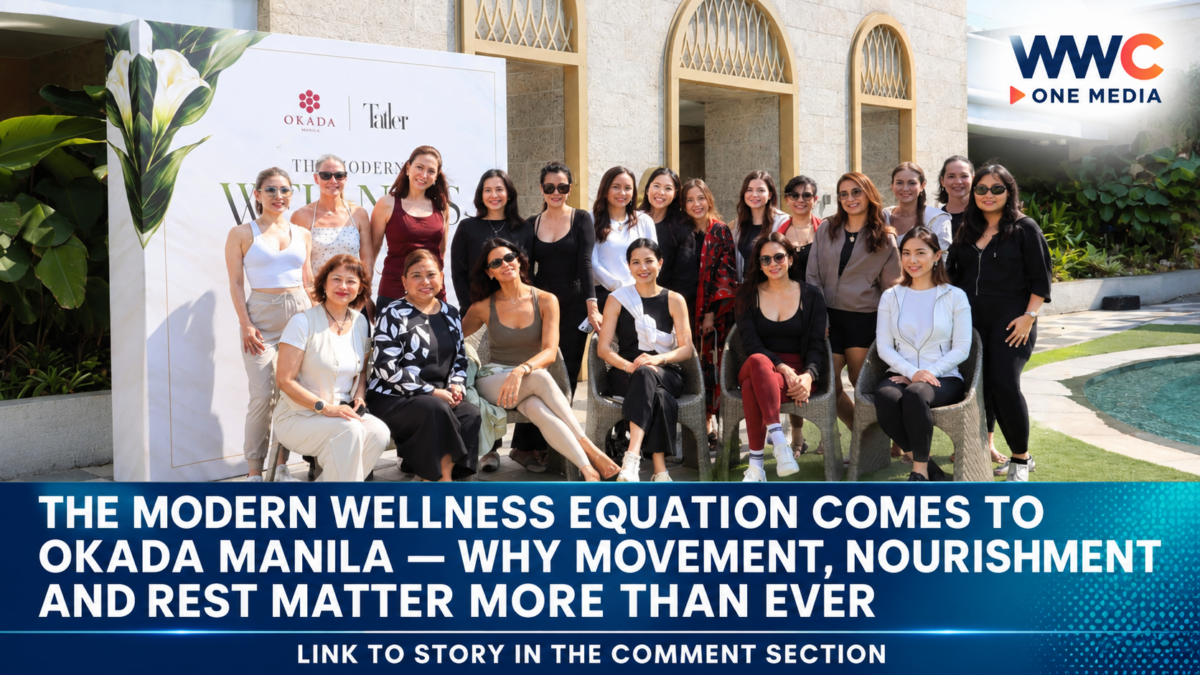
That was the idea behind The Modern Wellness Equation, a wellness retreat hosted by Tatler Philippines and Okada Manila on October 21, 2026. Bringing together movement, nourishment, rest and conversation, the gathering invited participants to consider a more balanced approach to looking after themselves.
Held under Tatler’s Limitless platform, the event was its first wellness retreat and brought guests together for a programme that moved from restorative yoga and sound bathing to lunch, a panel discussion and individual spa treatments.
Rather than centring the day on an intensive fitness programme, the retreat presented wellbeing as a combination of experiences—some active, others deliberately quiet.
Its central message was straightforward: taking care of oneself is not necessarily about doing more. Sometimes, it means making room to pause.
A Wellness Retreat Designed Around Balance
The morning began at Okada Manila’s Chairman’s Lounge, where guests were welcomed by views of Manila Bay and yoga mats prepared for the first activity.
The setting was an intentional part of the experience. With the water stretching towards the horizon, the room offered a contrast to the busy schedules and screen-filled routines that often shape modern working life.
Guests arrived to a light breakfast featuring wholewheat tuna sandwiches, muesli cups, fresh fruit, juices and infused water. After an opportunity to catch up, the gathering shifted from conversation to movement.
Tricia Centenera hosted the programme, introducing Okada Manila executives Reddy Leong, vice president for corporate marketing and communications, and David Baldwin, executive vice president for hotel operations.
Baldwin described wellness as an important part of the property’s guest experience, highlighting the resort’s intention to bring opportunities for rest and restoration into its hospitality offering.
The retreat was therefore more than a single exercise session. It was structured as a sequence of experiences intended to address different aspects of personal wellbeing.
Restorative Yoga Made Movement More Accessible
The first major activity was a restorative yoga session led by Alleina Mendoza of Vida Yoga.
After a warm-up, participants moved through standing poses and a slower sequence of movements. The emphasis was on allowing each person to work within their own range rather than treating the session as a competition or performance.
That distinction is important in a wellness conversation increasingly populated by demanding workout routines and ambitious fitness targets.
Movement does not always have to be measured by intensity. For some people, a gentler practice can provide an approachable way to build a regular routine, improve familiarity with movement and create time away from everyday distractions.
The session also reflected a broader shift in boutique wellness, where the experience surrounding a class can be as important as the exercise itself.
In Manila, studios such as Hot House have helped introduce lifestyle-oriented fitness concepts that combine movement with community and carefully designed spaces. WWC One Media explored this development in Is Hot House Manila’s New Cool-Girl Fitness Studio? Inside the Family Form Studio Taking Over Makati.
The approaches are different, but both point towards a growing interest in making movement a more intentional part of everyday life.
Joey Mead King Leads a Sound Bathing Session
After yoga, guests returned for a sound bathing session led by Joey Mead King.
The activity offered a different kind of experience from the morning’s movement. Participants settled onto their mats, closed their eyes and listened as Mead King played a singing bowl.
The intention was to give guests time to become still and focus on the sounds around them.
For people accustomed to filling every moment with work, messages or other responsibilities, doing very little can feel unfamiliar. The Tatler account described the initial difficulty of remaining still and resisting the impulse to follow every passing thought.
That observation became one of the retreat’s more relatable moments.
Rest is often discussed as though it happens automatically whenever a person stops working. In practice, setting aside time without an immediate task can require deliberate effort, particularly when daily routines encourage constant activity.
Sound bathing is commonly presented as a relaxation experience, but it should not be confused with a substitute for medical or mental health care. The value of the session in this setting was its invitation to pause, listen and experience a quieter part of the day.
Nourishment Was Part of the Experience, Too
The retreat also treated food as part of the wider wellness conversation.
Following the morning activities, guests gathered for lunch prepared by Okada Manila. The spread included beetroot carpaccio with citrus, burrata with roasted tomatoes, miso-marinated salmon and coconut panna cotta.
Fresh salads and other refreshments complemented the meal.
Beyond the menu itself, lunch provided an opportunity for participants to reconnect and continue conversations that had begun earlier in the day.
This social element is worth noting. Wellness is frequently presented as an individual pursuit, but shared meals and supportive relationships can also contribute to a person’s sense of connection and belonging.
The retreat’s programme therefore linked nourishment with more than the food on the table. It also created space for conversation and community.
The Tatler House Dialogues Put Self-Care Into Perspective
The afternoon moved to The Retreat Spa, where guests heard from Vikki Aquino, Okada Manila’s executive director of wellness and leisure.
Tricia Centenera then moderated the Tatler House Dialogues, featuring Electric Studio co-founder and chief executive officer Kris Sy and Vida Yoga owner Amanda Griffin Jacob.
The discussion focused on a familiar challenge: making personal wellbeing a priority while managing work, family and other responsibilities.
Sy spoke about how fitness began as something she turned to for personal fulfilment before becoming part of her professional life.
Jacob, meanwhile, highlighted the tendency for women to place the needs of others ahead of their own. One practical suggestion was to schedule exercise with the same consideration given to a business meeting.
The conversation also acknowledged that commitment does not always mean feeling motivated. Sy emphasised the importance of finding an activity a person genuinely enjoys, while Jacob recognised that even enjoyable routines can sometimes require an extra effort to maintain.
The underlying point was not that everyone should follow the same fitness programme. It was that sustainable habits are more likely to become part of daily life when they are realistic and personally meaningful.
The discussion also connects with a wider conversation about wellbeing beyond appearance. In October, WWC One Media covered a Tatler roundtable in Women Leaders Redefine Beauty, Wellness and Ageing Beyond Appearance, where participants discussed health, personal choice, boundaries and the changing meaning of ageing.
Both conversations challenge the idea that wellness can be reduced to one physical ideal or a single routine.
Okada Manila Extends Wellness Beyond the Retreat
The event concluded with individual treatments at The Retreat Spa and The Sole Retreat, giving guests an opportunity to finish the programme with time dedicated to personal care.
These facilities are part of Okada Manila’s broader wellness offering.
According to the resort, The Retreat Spa spans approximately 3,000 square metres and includes treatment suites, relaxation areas, an outdoor pool, fitness facilities and aqua therapy amenities. The property also offers The Sole Retreat, a separate foot spa and reflexology centre with additional body-care services.
The resort’s facilities position wellness as part of a larger hospitality experience rather than an activity limited to a gym or treatment room.
However, it is useful to distinguish the retreat’s one-day programme from the resort’s full range of services. The yoga and sound bathing sessions were activities organised for the October 21 gathering; they should not automatically be understood as permanent daily guest offerings.
For visitors interested in the facilities, Okada Manila’s official website provides information about The Retreat Spa and The Sole Retreat.
The Business of Making Wellness Part of Hospitality
The retreat also reflects a wider development in the hospitality industry: wellness is increasingly being incorporated into the overall guest experience.
Hotels and integrated resorts have traditionally competed through accommodation, dining, entertainment and service. Wellness facilities add another dimension, appealing to travellers who want opportunities to maintain familiar routines or make time for relaxation while away from home.
Okada Manila has previously promoted wellness through its Move in Balance campaign, which brought together dining, leisure, spa and lifestyle experiences.
The Modern Wellness Equation fits into that broader positioning. Its combination of movement, food, discussion and treatments presents wellness as a connected experience rather than a single service.
For the hospitality sector, this creates opportunities to develop more specialised experiences and encourage guests to spend time across different parts of a property.
But there is also a practical question: how can premium wellness experiences become more than occasional indulgences?
A retreat can introduce people to activities and encourage them to reflect on their routines. Lasting benefits, however, depend on what participants can realistically continue after the event ends.
The Real Equation Is Finding a Routine That Lasts
The Modern Wellness Equation brought together several familiar elements of self-care: movement, nourishment, quiet reflection, conversation and personal treatments.
Its most interesting contribution was the way these activities were arranged. Rather than treating wellness as a demanding programme built around constant improvement, the retreat offered a day in which different forms of care could coexist.
That does not mean a single retreat can resolve the pressures of modern life. Nor does one event establish the effectiveness of every wellness practice it features.
What it can do is create an opportunity to reconsider priorities.
For some, that may mean finding a form of movement they enjoy. For others, it may involve protecting time for meals, reconnecting with friends or allowing space for rest without feeling that every hour must be productive.
Ultimately, the equation is personal. The most useful routine is not necessarily the most elaborate or expensive one, but one that can be maintained alongside the realities of everyday life.
As wellness becomes an increasingly visible part of travel, hospitality and urban culture, the question is no longer simply where people can go to unwind. It is whether the experiences they discover can help them build more balanced lives after they return home.
Can modern wellness move beyond a luxury retreat and become a realistic everyday habit—or will the idea of finding balance remain something people only make time for on special occasions?