
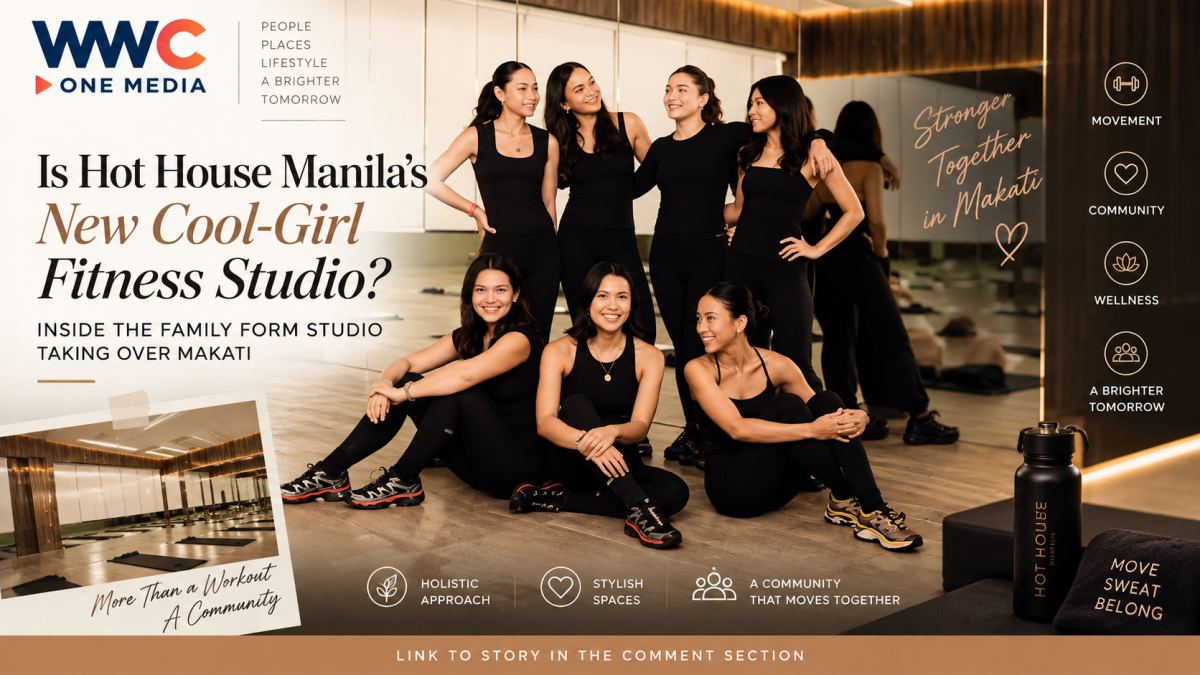
MANILA — A New Fitness Studio Is Getting People Talking
There is a certain type of fitness studio that becomes more than a place to exercise. It becomes a routine, a social space and, eventually, part of a city’s lifestyle conversation.
Hot House in Makati appears to be entering that territory.
Opened in May 2026, Hot House is the first dedicated Family Form studio in Manila and the Philippines, bringing the Hong Kong-developed fitness method into its own purpose-built space. The studio has quickly attracted attention from Manila’s wellness and lifestyle crowd, prompting Tatler Asia to ask whether it has become the city’s newest “cool girl” studio.
But the studio’s founders insist that looking cool isn’t really the point.
The philosophy is more about consistency, movement, community and making fitness feel like a daily ritual.
What Exactly Is Family Form?
At the center of Hot House is Family Form, a full-body conditioning method that combines elements associated with yoga, ballet, gymnastics and strength training.
The signature class lasts 55 minutes and takes place on mats inside an infrared-heated room. Optional hand and ankle weights can add another strength challenge.
The method was developed by Lindsay Jang and Helen Kim at The Upper House in Hong Kong, with Jang bringing a yoga background and Kim drawing on experience in gymnastics, dance and other sports.
The result is neither a conventional yoga class nor a traditional strength workout.
Instead, participants move through a choreographed sequence designed to challenge the entire body while requiring concentration and control.
Why Hot House Feels Different
Hot House’s appeal isn’t limited to what happens during the workout.
The founders have deliberately designed the studio as a broader lifestyle environment, describing it as a place where movement, nourishment and community can become part of everyday routines.
The interior follows that philosophy.
Rather than adopting the stark, highly technical look often associated with fitness studios, Hot House uses warm, grounding design elements intended to make the space feel more like a hospitality destination.
Managing director Gabbie Rodriguez told Tatler Asia that the studio was conceived as a hospitality business that happens to have classes in it.
That distinction may help explain why the studio has generated attention beyond people specifically searching for a new workout.
Three Ways to Move at Hot House
Hot House currently offers three main classes:
FAMILY FORM
The signature 55-minute infrared-heated, mat-based full-body sculpting class is the studio’s centerpiece.
It combines controlled movement with choreography and optional weights for people looking for an additional challenge.
FOUNDATION
Foundation is designed as a more accessible entry point, with a slower pace and greater emphasis on technique, form and fundamental movements.
Hot House says beginners are welcome, making the class a starting point for people unfamiliar with the Family Form method.
RECOVER
Recover takes the intensity down.
The 60-minute heated mobility class focuses on slower movement, stretching and mobility rather than pushing through another high-intensity workout.
Together, the three formats give Hot House a structure that goes beyond the idea of simply attending a hard workout every day.
The Secret May Be Repetition
One of Hot House’s more unusual approaches is its class programming.
Rather than changing the entire sequence every day, the studio keeps the same sequence throughout the week, with new choreography introduced on Wednesdays.
That means participants have several opportunities to repeat the same movements, understand the sequence and notice how their performance changes during the week.
It is a different philosophy from constantly introducing new exercises.
Instead of chasing novelty, Hot House emphasizes practice and consistency.
That approach also makes the experience less intimidating for newcomers who need time to learn the choreography.
From Pop-Ups to a Dedicated Studio
The story of Hot House began before the physical studio itself.
Rodriguez and creative director Ysabela Narvasa encountered Family Form through pop-ups in Manila and eventually became instructors themselves.
The method initially operated within a multi-concept studio, where it developed a regular following. As demand grew, however, there was not enough space to accommodate the number of classes clients wanted.
That created the opening for a dedicated Family Form home.
Hot House was born from that demand.
More Than a Workout Trend
The rise of Hot House comes as heated fitness becomes increasingly visible across Metro Manila.
Metro.Style recently included Hot House among a group of Manila workout studios bringing heated classes into the city’s growing boutique fitness scene.
But Hot House’s positioning goes beyond heat.
Its founders are building a community around the idea of fitness as a daily ritual, rather than an occasional activity. The studio also has a “Neighborhood” concept featuring partner brands and lifestyle offerings that extend the experience beyond the workout itself.
That combination—exercise, design, wellness and community—is likely a major reason it has attracted lifestyle-media attention so quickly.
Is It Really the “Cool Girl” Studio?
That’s ultimately subjective.
What can be observed is that Hot House has many of the ingredients associated with Manila’s modern boutique-fitness culture: a distinctive workout format, carefully considered interiors, a strong community component and a lifestyle-oriented identity.
But the studio’s own message is notably less about exclusivity or appearance and more about showing up consistently and building a sustainable routine.
And perhaps that is what makes the concept interesting.
Hot House isn’t necessarily selling the idea that fitness has to look effortless.
It is selling the idea that fitness can become part of how you live.
As boutique wellness continues to expand in Manila, Hot House may be less interesting as another fashionable workout destination than as a sign of where the city’s fitness culture is heading next: less gym, more ritual; less intimidation, more community; and increasingly, a workout experience designed to fit into an entire lifestyle.


Leave a Reply