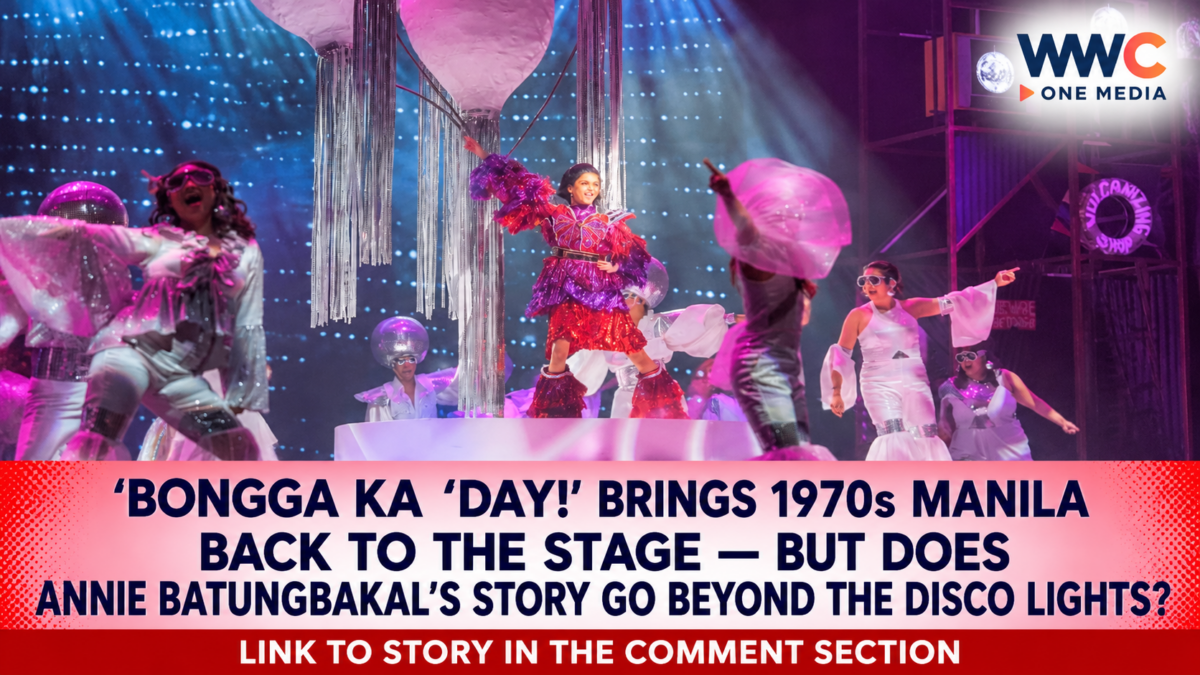
MANILA, Philippines — The glittering world of 1970s Manila returned to the theatre through Bongga Ka ’Day!: The Annie Batungbakal Musical, a stage production built around the music of Filipino band Hotdog. Featuring Atasha Muhlach in the titular role, the musical brought together familiar Manila Sound hits, colourful fashion, elaborate choreography and a story about a young woman determined to pursue her ambitions.
But beyond its nostalgic appeal, the production also raised questions about the story it wanted to tell. In its review, Tatler Philippines praised the show’s visual spectacle and performers while examining whether Annie’s journey sufficiently explored the challenges of ambition, class and belonging.
The musical completed its theatrical run on October 31, 2026, at the Newport Performing Arts Theater in Pasay City. Its closing leaves audiences with more than memories of a disco-inspired production: it also invites a closer look at how a familiar Filipino song was transformed into a contemporary stage story.
A Familiar Hotdog Song Becomes a Musical Story
At the centre of the production is Annie Batungbakal, a fictional character inspired by Hotdog’s 1979 hit of the same name.
The song captures the contrast between an ordinary working day and the excitement of Manila’s nightlife. The musical expands that premise into a story about a young woman who works as a sales assistant at House of Pasion but dreams of becoming a fashion designer.
Annie also wants to enter Coco Banana, the fashionable Malate nightclub associated with Manila’s disco culture. For her, the venue represents more than a place to dance. It is a world of glamour, social connections and opportunities that appear far removed from her everyday circumstances.
The production uses Hotdog’s music to connect Annie’s personal ambitions with a recognisable period in Philippine popular culture.
Songs associated with the Manila Sound help establish the setting while giving the audience familiar musical moments throughout the story.
Atasha Muhlach Takes on the Role of Annie
Atasha Muhlach leads the production as Annie Batungbakal, taking on a role that requires singing, dancing and acting in front of a live audience.
She is joined by Sam Concepcion as Romer, KD Estrada as Burn and Gerhard Krysstopher as Toots. Veteran performers Jackie Lou Blanco and other members of the cast help bring the world of House of Pasion and Coco Banana to life.
John Lapus plays Tarurit, the nightclub gatekeeper whose sharp humour and larger-than-life personality become part of the production’s comic appeal.
The casting also drew public attention before the show opened. Atasha’s transition into a major musical-theatre role prompted online discussion about her experience and suitability for the demanding part.
WWC ONE MEDIA previously examined that debate in Atasha Muhlach Faced Online Criticism Before Her Musical Debut—Then John Lapus Revealed What Happened on Opening Night, which covered the criticism surrounding her casting, the audition controversy and Lapus’s public support following the opening-night performance.
The discussion illustrates the expectations placed on performers entering major productions, particularly when they come from well-known entertainment families. However, casting debates and assessments of an individual performance remain separate questions.
The World of House of Pasion and Coco Banana
The musical moves between two contrasting settings.
House of Pasion represents the fashion industry and the working environment Annie hopes to move beyond. Coco Banana, meanwhile, offers a glamorous nightlife scene where appearance, connections and social acceptance influence who gets through the door.
That contrast gives the story its central tension.
Annie wants to become a designer rather than remain a sales assistant, but her ambition is complicated by the expectations of people around her. Her clothes become part of her effort to gain acceptance in a world that initially seems inaccessible.
Tatler’s review focuses on this distinction, questioning whether the production examines Annie’s actual creative ability as closely as it examines her appearance and access to fashionable spaces.
The review also points to the different ways characters assess her: the boutique’s established figures judge her ambition, while the nightclub’s gatekeeping culture places importance on how she looks and presents herself.
This creates an interesting premise about social mobility, but the review argues that the musical does not fully develop every question raised by Annie’s journey.
A Supporting Relationship That Could Have Gone Further
One of the more interesting relationships in the story is between Annie and Aurora Pasion, the influential fashion designer connected to House of Pasion.
Aurora, portrayed by Jackie Lou Blanco in the reviewed performance, represents an established figure in the fashion world. Annie, by contrast, is still trying to prove that her ambitions deserve recognition.
Their eventual business partnership offers the possibility of a story about two women from different positions working together. One has influence and an established name; the other has creative aspirations and the desire to build something of her own.
Tatler’s review identifies this relationship as one of the production’s more compelling ideas, while questioning whether the story gives their partnership enough development before the conclusion.
The relationship could have provided a stronger examination of mentorship, opportunity and the challenges women face when trying to establish themselves professionally.
The Performances Bring Energy to the Production
Despite its questions about the story, Tatler highlights several performers who help sustain the musical’s energy.
Muhlach delivers the choreography and stage movements required of Annie, while the review notes her progress in speaking Tagalog on stage. It also observes moments when her singing does not always keep pace with the lyrics.
Blanco brings a commanding presence to Aurora, while Lapus uses carefully timed humour to make Tarurit a memorable character.
Estrada’s portrayal of Burn also receives attention for its comparatively restrained approach, allowing the character’s feelings to emerge through his movements and mannerisms.
These performances contribute to the production’s lively atmosphere, particularly during scenes that bring together the ensemble and the musical’s disco-inspired elements.
Costumes, Sets and Choreography Recreate the Disco Era
The production’s visual design is among its strongest attractions.
The House of Pasion set opens up like a dollhouse, allowing the audience to see different spaces within the fashion establishment. It then transforms to reveal Coco Banana, complete with its grand staircase and nightclub atmosphere.
Lighting, projections and choreography help create the impression of a bustling 1970s Manila nightlife scene.
The costumes are especially important to the show’s visual identity. Sequins, colourful outfits, kaftans and period-inspired fashion help communicate the characters’ ambitions and social worlds.
The musical arrangements and ensemble choreography add movement to the production, while the disco sequences provide some of its most memorable theatrical moments.
Tatler’s review particularly singles out the Coco Banana sequence, where the mirror ball, dancers and staircase combine to create the spectacle audiences might expect from a musical celebrating Manila’s disco culture.
The Bigger Questions Behind the Nostalgia
The production’s setting also creates opportunities to explore the historical and social context of late-1970s Manila.
Coco Banana, which opened in 1977, became associated with the city’s nightlife and a diverse social scene that included artists, celebrities, socialites and members of the LGBTQ+ community.
Its reputation as a glamorous venue also makes it a useful setting for a story about acceptance and exclusion.
However, the review raises a question about how deeply the musical investigates the social realities behind its nostalgic setting. The glittering nightclub world is visually prominent, but the experiences of people who remain outside its doors could have received more attention.
The distinction matters because Annie’s story is not simply about getting into a nightclub. It is also about a working woman seeking recognition and a chance to shape her own future.
A stronger exploration of those issues might have made the character’s transformation more convincing and given the musical greater emotional depth.
A Spectacle That Leaves Some Questions Unanswered
By the finale, Annie appears to have achieved several of her goals: she gains access to Coco Banana, moves closer to her fashion ambitions and finds opportunities through important relationships.
Yet Tatler’s review questions whether the story adequately explores the compromises and consequences behind that success.
It also points to Toots, Annie’s loyal friend, whose hurt becomes visible when Annie reaches the nightclub and appears to leave him behind. That moment briefly introduces the personal cost of her ambition, but the review suggests the story does not pursue the issue far enough.
The result is a production whose spectacle sometimes moves faster than its character development.
Its music, costumes, choreography and stage design provide an entertaining celebration of Manila’s disco era. Its central character, however, could have benefited from a more detailed examination of what it means to pursue success without losing sight of the people and experiences that shaped you.
What ‘Bongga Ka ’Day!’ Leaves Behind
Although its theatrical run has ended, Bongga Ka ’Day!: The Annie Batungbakal Musical offered a new generation an opportunity to encounter the music and nightlife culture associated with 1970s Manila.
Its use of Hotdog’s songs demonstrates how familiar Filipino music can become the foundation for a new theatrical experience. It also shows the continuing appeal of stories rooted in local popular culture.
The production’s lasting conversation may not be limited to whether its songs were familiar or its disco scenes were spectacular. It also concerns how Filipino musicals can use nostalgia to tell more layered stories about ambition, identity, class and belonging.
Annie Batungbakal may have found her way into Coco Banana, but the questions surrounding her journey remain worth discussing.
When Filipino musicals revisit the country’s most memorable cultural eras, should nostalgia and spectacle be enough—or should audiences also expect stories that challenge the social realities behind the glitter?