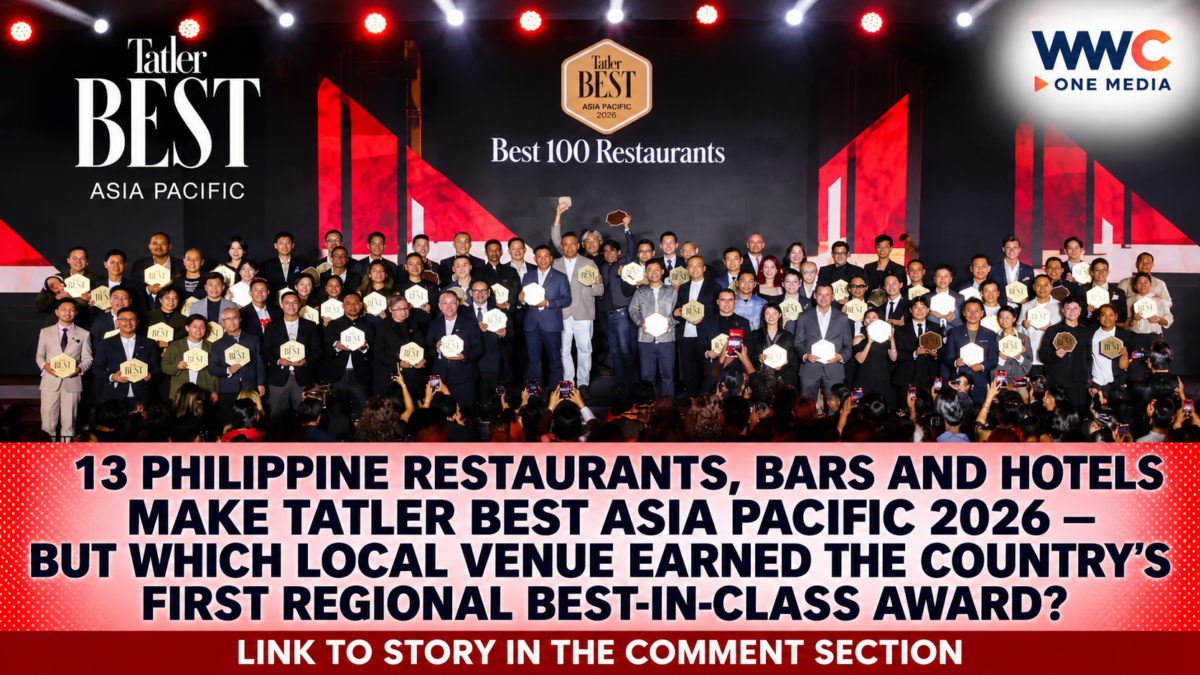
SHANGHAI, CHINA — Philippine restaurants, bars and hotels have secured 13 places in the Tatler Best Asia Pacific 2026 selections, giving the country’s hospitality industry another major opportunity to showcase its culinary talent and tourism destinations to an international audience.
The recognition covers seven restaurants, three bars and three hotels, bringing together established dining destinations, contemporary Filipino culinary concepts, creative hospitality businesses and luxury resorts.
But one achievement stands out.
Makati-based Celera received the Philippines’ first Asia Pacific Best-in-Class award, winning the distinction of Tatler Best New Restaurant Asia Pacific 2026.
The awards ceremony took place on October 22 at Yan Gardens in Shanghai, China, as part of a five-day programme bringing together chefs, bartenders, hotel representatives and hospitality professionals from across the region.
For the Philippines, the results represent more than a collection of individual awards. They highlight the growing regional visibility of Filipino cuisine, local hospitality concepts and destinations that combine international standards with distinctly Philippine influences.
The 13 establishments were recognised across Tatler’s Best 100 Restaurants, Best 100 Bars and Best 100 Hotels selections.
The Philippines Secures 13 Places Across Three Hospitality Categories
Tatler Best Asia Pacific 2026 recognised 300 establishments through three regional selections: the Best 100 Restaurants, Best 100 Bars and Best 100 Hotels.
The Philippines secured 13 places across these categories.
The seven restaurant selections highlight different interpretations of contemporary dining, including Filipino heritage, regional ingredients and international culinary techniques. The three bars represent Manila’s developing hospitality and cocktail scene, while the hotel selections include two Palawan island destinations and a major luxury property in Metro Manila.
The 13 Philippine establishments are:
Restaurants
- Blackbird at the Nielson Tower
- Celera
- Gallery by Chele
- Hapag
- Helm by Josh Boutwood
- Inatô
- Toyo Eatery
Bars
- Big Fuzz
- Problem Child
- The Spirits Library
Hotels
- Amanpulo
- Pangulasian Island Resort
- Shangri-La The Fort, Manila
The selection reflects the breadth of Philippine hospitality, from intimate tasting experiences and contemporary Filipino cooking to urban dining destinations and private island resorts.
It is important to distinguish inclusion in a Best 100 selection from receiving an individual Best-in-Class award. These are separate forms of recognition, and the 13 establishments should not be interpreted as being ranked in a particular order against one another.
Celera Makes History With the Philippines’ First Asia Pacific Best-in-Class Award
The most significant individual achievement for the Philippines came from Celera, which received the 2026 Best New Restaurant Asia Pacific award.
Located in Makati, Celera is led by chefs Nicco Santos and Quenee Vilar.
The restaurant combines Southeast Asian flavours with French and Asian culinary techniques, creating a contemporary dining identity that draws from different regional influences.
Its recognition is particularly notable because it marks the Philippines’ first Asia Pacific Best-in-Class win.
Celera’s award also distinguishes it from the other Philippine restaurants included in the regional Best 100 selection. It received both recognition as a restaurant on the regional list and a separate award for its achievement as a new restaurant.
The milestone provides wider visibility for the restaurant’s culinary team and reinforces the growing interest in Southeast Asian dining concepts that combine local identity with international techniques.
For the Philippine restaurant industry, Celera’s achievement is another example of local culinary talent receiving recognition beyond the domestic market.
Seven Philippine Restaurants Recognised Across Asia Pacific
The restaurant selection brings together different approaches to contemporary dining, from international classics and experimental tasting menus to Filipino ingredients and regional culinary traditions.
The growing international attention on Philippine restaurants can also be seen in other recent developments. In Cebu Restaurants Earn Michelin Guide 2027 Recognition as 20 Establishments Make the List — See the Complete Lineup, WWC ONE MEDIA examined how 20 Cebu establishments earned places in the 2027 Michelin Guide Philippines selection. Together, these developments show how different parts of the country’s dining industry are gaining wider recognition.
Blackbird at the Nielson Tower
Blackbird occupies the restored former terminal of Manila’s pre-war airport, the Nielson Tower.
The restaurant combines classic international dishes with contemporary Asian cooking.
Chefs Colin Mackay and Kerwin Go lead its culinary direction, while the historic Art Deco setting gives the establishment a distinctive place within Makati’s dining landscape.
Its inclusion in Tatler’s selection recognises a restaurant that combines its architectural heritage with refined à la carte dining and established hospitality.
Celera
Celera is one of the most prominent Philippine establishments in this year’s selection.
The Makati restaurant’s chefs, Nicco Santos and Quenee Vilar, bring together Southeast Asian flavours with French and Asian techniques.
Its Best New Restaurant Asia Pacific award makes it the Philippines’ historic Best-in-Class winner for 2026.
The distinction also places attention on the restaurant’s approach to cuisine that draws from several culinary traditions rather than relying on a single established style.
Gallery by Chele
Gallery by Chele, led by chefs Chele González and Carlos Villaflor, has developed its identity around research into Philippine ingredients and culinary traditions.
Its tasting menus explore products such as cacao, coconut and heirloom rice.
The restaurant works with farmers and producers to understand local ingredients before developing contemporary dishes through experimentation.
This emphasis on research and local sourcing makes Gallery by Chele an example of how Philippine agricultural products and culinary heritage can become the foundation for modern gastronomy.
Hapag
Hapag approaches Filipino cuisine through research into regional traditions, indigenous craftsmanship and local cooking practices.
Chefs John Kevin Navoa and Kamille Cate develop progressive menus that connect individual dishes with the country’s diverse culinary heritage.
Rather than treating Filipino food as a single style, the restaurant explores the different ingredients, techniques and stories that shape regional cuisines.
Its inclusion gives further regional visibility to contemporary Filipino dining.
Helm by Josh Boutwood
Helm by Josh Boutwood is known for its minimalist dining room and changing thematic tasting menus.
Chef Josh Boutwood develops menus inspired by different subjects, including global street food and cinematic concepts.
The restaurant combines technical precision with imaginative presentation, creating a dining experience that changes according to its culinary themes.
Its inclusion reinforces Boutwood’s standing within the Philippine fine-dining scene.
Inatô
Inatô takes its name from a Binisaya expression meaning “our way.”
Chef Grenwin Mendoza uses the restaurant as a platform for a personal interpretation of Filipino culinary heritage.
Its intimate counter-style arrangement brings the kitchen and dining room closer together, allowing guests to experience the team’s cooking and hospitality directly.
Traditional techniques meet seasonal ingredients from local and international sources, resulting in contemporary Filipino cooking that reinterprets familiar flavours while retaining their cultural connections.
Toyo Eatery
Toyo Eatery, led by chef-patron Jordy Navarra and head chef Patch Marce, continues to explore Filipino cuisine through everyday ingredients and local traditions.
The restaurant is celebrating its tenth year in 2026.
Its approach involves rediscovering familiar Filipino food products and techniques, demonstrating how everyday ingredients can be transformed through careful preparation and contemporary presentation.
Toyo has also introduced Filipino culinary perspectives to international audiences through collaborations and industry appearances.
Its continued inclusion in the regional selection reflects its established position in the country’s modern dining scene.
Three Philippine Bars Bring Local Hospitality Concepts to the Regional Stage
The Philippines’ recognition extends beyond restaurants.
Big Fuzz, Problem Child and The Spirits Library were included in Tatler Best 100 Bars Asia Pacific 2026.
Each establishment has developed a different identity, demonstrating the variety of concepts emerging within the country’s hospitality industry.
Big Fuzz
Located in Makati’s Little Tokyo, Big Fuzz is known for its relaxed atmosphere, eclectic interiors and vinyl records.
Co-owner and head bartender Kyle Quismundo leads the bar’s approach to reinterpreting classic drinks through pop-culture influences and contemporary techniques.
Its concept centres on creating a neighbourhood gathering place rather than an overly formal hospitality experience.
Tatler also identified Eli Paraiso as the recipient of its Philippine Bar of the Year 2026 recognition.
Problem Child
Problem Child has developed a distinctive concept built around frequent reinvention.
Its beverage leads, Kevin Corales and Patrick Leyble Jr, founded the bar with Wendy Esteban.
The team changes the bar’s concept every three months, including its menu and staff uniforms, with each cycle organised around a particular colour.
Its House Problem programme reflects this creative approach, combining culinary influences with experimentation and a constantly changing identity.
The concept gives Problem Child a distinctive position within Makati’s hospitality scene.
The Spirits Library
The Spirits Library takes a different approach, placing historical references, rare bottles and vintage collections at the centre of its identity.
Founded by Lee Watson, the bar brings together vintage glassware, historical bar books and antiques.
Watson and senior general manager Edward Reyes draw inspiration from Charles Baker’s 1939 travelogue, The Gentleman’s Companion.
Its concept connects the history of hospitality with a contemporary approach to the guest experience.
Together, the three selections demonstrate that Philippine recognition is not limited to restaurants. Local hospitality professionals are also gaining visibility through distinct bar concepts and creative service experiences.
Three Philippine Hotels Recognised for Luxury and Hospitality
The hotel category brings together three properties with different settings and guest experiences.
Two are island destinations in Palawan, while the third is a major luxury hotel in Bonifacio Global City.
Amanpulo
Amanpulo is a private island resort in Palawan known for its secluded setting and luxury accommodation.
Accessible only by private plane, the property offers casitas and villas designed by architect Francisco “Bobby” Mañosa, drawing inspiration from the traditional Filipino bahay kubo.
The resort also highlights experiences connected to its natural surroundings, including marine activities, turtle-related conservation experiences and private beachfront dining.
Its inclusion recognises the appeal of private island hospitality in the Philippines.
Pangulasian Island Resort
Located in El Nido within Palawan’s Bacuit Bay, Pangulasian Island Resort is known as the “Island of the Sun.”
The property operates 42 villas and is managed under Ayala Land Hospitality.
Its approach combines island luxury with environmental initiatives, including renewable energy efforts, coral monitoring and mangrove activities.
The resort’s inclusion places attention on a form of Philippine hospitality that connects tourism with the protection of its natural environment.
Shangri-La The Fort, Manila
In contrast to the private island properties, Shangri-La The Fort is located in the centre of Bonifacio Global City.
The hotel combines accommodation, restaurants, bars, event spaces and sports facilities in one major urban property.
Its food and beverage operations include eight restaurants and two bars, including The Back Room.
The culinary team is led by chef Joris Rycken, while the hotel also offers extensive event facilities and Kerry Sports Manila.
Its selection reflects the importance of urban luxury hotels as destinations for dining, business events and travel in Metro Manila.
How Tatler Selects Its Best 100 Establishments
The Tatler Best Asia Pacific selection is based on a jury process involving more than 900 jurors from around the world.
According to Tatler Group, jurors are selected from the Tatler community based on their interest in travel, gastronomy and adventure.
Tatler editors and trusted reviewers also contribute to the selection process.
The voting process is overseen by jury co-chairs Sean Fitzpatrick, Tatler Asia’s chief experience officer, and Andy Cheng, its head of dining.
The resulting lists recognise establishments across three main categories: restaurants, bars and hotels.
Separate Best-in-Class awards highlight particular achievements within the hospitality industry.
This distinction matters because the Best 100 selections and Best-in-Class awards are not identical.
A venue can be included in a regional Best 100 list while also receiving a separate award for a specific achievement, as happened with Celera.
Tatler Best Asia Pacific Expands Beyond Restaurants, Bars and Hotels
The 2026 edition also introduced new award categories.
For the first time, Tatler Best included cruise awards, recognising cruise experiences and operators through four distinctions.
These included Cruise of the Year, Best Boutique Cruise Line, Best Family Friendly Cruise Line and Best Private Yacht Charter.
Two additional hotel distinctions were also introduced for wellness and family travel.
The expansion reflects the organisation’s broader approach to hospitality, recognising that travel experiences extend beyond accommodation and dining.
The 2026 programme included five days of activities in Shanghai from October 20 to 24.
Alongside the October 22 awards ceremony, the programme featured Tatler Best Talks, a series of private discussions involving hospitality leaders, and 28 dining and hospitality collaborations under the Tatler Best Takeover Series.
The event brought together chefs, bartenders and hospitality professionals for a wider exchange of ideas and experiences.
Philippine Restaurants Are Building a More Collaborative Dining Scene
The Tatler recognition comes as Philippine restaurants and hospitality professionals increasingly participate in collaborations, special dining events and regional culinary exchanges.
These activities give chefs and restaurant teams opportunities to work beyond their usual menus and introduce different culinary perspectives to diners.
WWC ONE MEDIA previously explored this development in Off Menu PH 2026: Meet the Restaurant Teams Bringing Manila’s Best Kitchens Together, which examined how local restaurant and bar teams collaborated through limited dining experiences.
The development is relevant to the Tatler results because regional recognition does not happen in isolation. The wider hospitality environment also depends on professional exchanges, new concepts and opportunities for chefs and teams to develop their work.
For the Philippine industry, these collaborations can help strengthen relationships between establishments while introducing diners to different approaches to food and service.
What the Recognition Could Mean for Philippine Tourism and Hospitality
The recognition of 13 Philippine establishments gives the country another opportunity to present its hospitality industry to international audiences.
For restaurants, regional visibility can introduce Filipino ingredients, culinary traditions and contemporary cooking styles to diners who may not yet be familiar with the country’s food scene.
For bars, recognition can highlight the creativity of local hospitality professionals and the development of distinctive service concepts.
For hotels, inclusion can strengthen the visibility of Philippine destinations, particularly Palawan, as well as Metro Manila’s luxury hospitality market.
The wider growth of international restaurant recognition in the country can also be seen in individual establishments receiving attention from different guides. For example, Nilo Divina’s Aurora Earns Michelin Recognition for Second Straight Year — But Could a Star Be Its Next Big Milestone? explored how a Makati restaurant retained its Michelin Selected distinction for a second consecutive year. Although Michelin and Tatler operate separate recognition programmes, both developments highlight the growing visibility of Philippine dining destinations.
However, awards should not automatically be treated as proof of increased tourist arrivals, higher revenue or new investment.
Those outcomes require separate economic and tourism data.
What the Tatler selection establishes is that these 13 establishments have been recognised within a regional hospitality programme involving a broad international jury.
The result also provides a platform for Philippine businesses to reach a wider audience and compete for attention alongside established hospitality names across Asia Pacific.
A Stronger Regional Profile for Filipino Hospitality
The Tatler Best Asia Pacific 2026 results bring together several parts of the Philippine hospitality industry.
The seven restaurants show how Filipino chefs are interpreting local ingredients and traditions through contemporary dining.
The three bars demonstrate the variety of hospitality concepts emerging in the country.
The three hotels highlight the Philippines’ appeal as both an urban luxury destination and an island tourism market.
Celera’s Best New Restaurant Asia Pacific award adds another milestone, giving the country its first Asia Pacific Best-in-Class distinction.
The recognition does not mean the work is finished. Restaurants must maintain consistency, hospitality businesses must continue developing their concepts, and hotels must sustain the service standards expected by international travellers.
But the results provide another indication of how Philippine hospitality is gaining regional visibility.
With 13 establishments recognised across the Tatler Best Asia Pacific 2026 selections, could the Philippines build on this momentum and secure even more regional honours in the next edition?