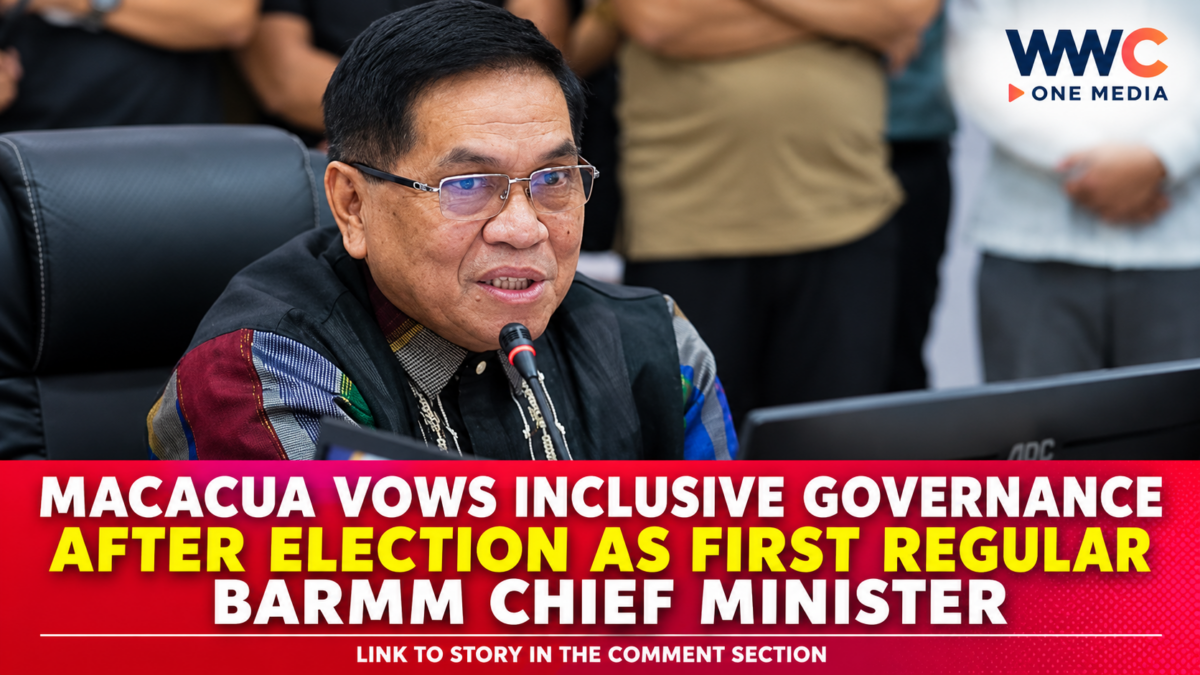
COTABATO CITY, Philippines — Newly elected Bangsamoro Chief Minister Abdulraof “Sammy Gambar” Macacua has pledged to lead an inclusive regional government, promising to serve all Bangsamoro constituents and work with lawmakers regardless of their political affiliations.
Macacua made the commitment following his election as the first chief minister of the first regular Bangsamoro Parliament during its inaugural session on October 30, 2026.
In a statement issued after the proceedings, he said his responsibility extends beyond the lawmakers who supported his election to include those who backed other candidates and every citizen in the Bangsamoro Autonomous Region in Muslim Mindanao (BARMM).
He emphasized that the new parliamentary leadership must focus on the shared aspirations of the Bangsamoro people, particularly peace, justice, and development.
Macacua calls for cooperation across political lines
Macacua described the inaugural session as more than a process of selecting regional leaders. He said it demonstrated the ability of Bangsamoro institutions to function following years of struggle, peace negotiations, and efforts toward self-governance.
He also recognized the cooperation of the Bangsamoro Federalist Party (BFP), the United Bangsamoro Justice Party (UBJP), and other political groups during the leadership transition.
According to Macacua, political differences should not prevent elected representatives from working together on the region’s priorities.
He thanked President Ferdinand Marcos Jr. for attending the historic proceedings and supporting the Bangsamoro peace process.
He also acknowledged the Armed Forces of the Philippines, Philippine National Police, peace mechanisms, government agencies, international development partners, civil society organizations, and other stakeholders who contributed to the peaceful conduct of the transition.
Macacua wins 51 votes in historic parliamentary election
Macacua secured 51 votes against 27 for former interim Chief Minister Ahod “Al Haj Murad” Ebrahim. One member abstained during the October 30 voting in Cotabato City.
Seventy-nine of the Parliament’s 80 members attended the inaugural proceedings.
The election marked the transition from the interim Bangsamoro administration to a regular parliamentary government following the region’s first parliamentary elections on September 14, 2026.
Under Republic Act No. 11054, or the Bangsamoro Organic Law, the chief minister is elected by a majority of all 80 members of Parliament, requiring at least 41 votes.
Unlike the previous gubernatorial system under the former Autonomous Region in Muslim Mindanao, the parliamentary arrangement allows members of the regional legislature to elect the head of government from among themselves.
New Parliament begins a five-year term
The first regular Bangsamoro Parliament consists of 80 members: 40 regional parliamentary political party representatives, 32 district representatives, and eight sectoral representatives.
The Bangsamoro Federalist Party secured 31 seats, while the United Bangsamoro Justice Party obtained 30. The BARMM Grand Coalition won eight seats, and Serbisyong Inklusibo Alyansang Progresibo secured six.
Amer Zaakaria Rakim was also elected Speaker of the first regular Parliament, receiving 51 votes. He defeated former interim Speaker Mohammad Yacob, who received 27 votes.
The Parliament is expected to serve a five-year term ending June 30, 2031.
Inclusive leadership and the Bangsamoro peace process
In a separate inaugural address reported by the Philippine Information Agency, Macacua also pledged to continue the moral governance agenda championed by Ebrahim.
He committed to open dialogue, constructive criticism, and cooperation across political and institutional lines.
As chief minister, Macacua will lead the Bangsamoro government, appoint heads of ministries and agencies, and present the administration’s agenda for Parliament’s approval.
The new leadership now faces the task of translating its commitments into government programs and policies while maintaining cooperation among political groups and institutions.
For BARMM, the start of the first regular parliamentary government represents another stage in its transition toward self-governance. Its progress will depend on how the new administration and Parliament work together to address the region’s priorities for peace, justice, and development.