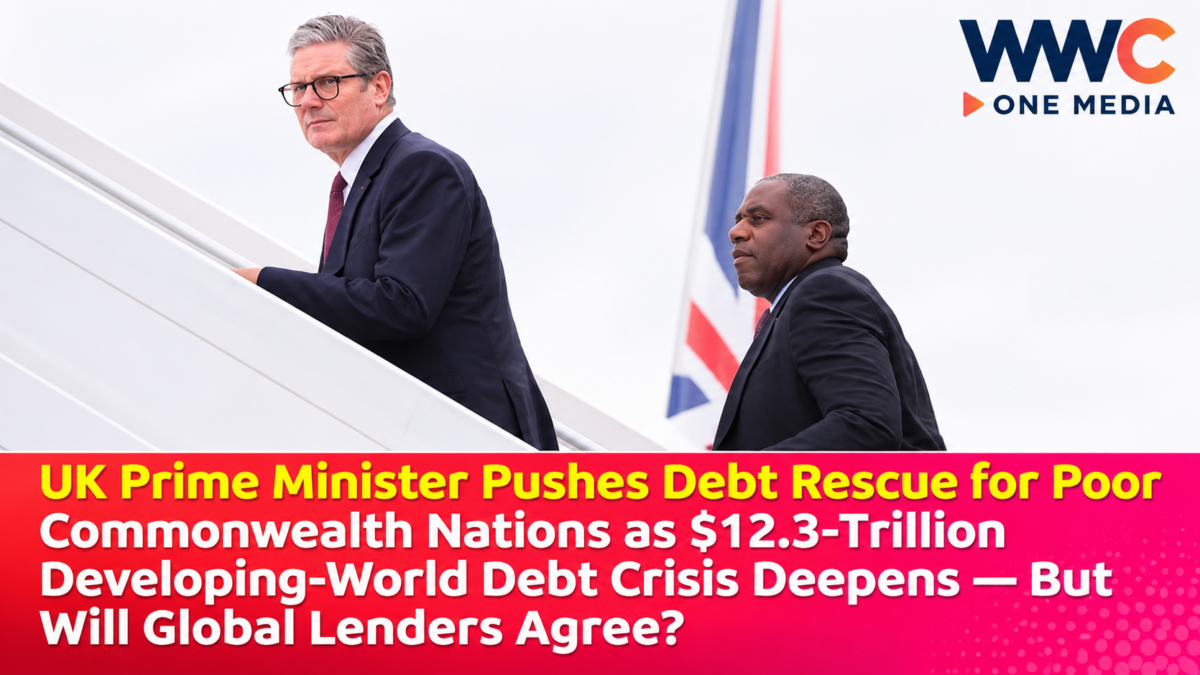
ST. JOHN’S, Antigua and Barbuda / LONDON — November 3, 2026. Britain is preparing a major push to reform international debt arrangements for some of the world’s poorest Commonwealth countries, as UK Prime Minister Andy Burnham warns that crushing repayment obligations are depriving vulnerable economies of money needed for healthcare, infrastructure and economic development.
The proposal, highlighted in Bloomberg’s November 2 report, comes as leaders from 56 Commonwealth nations gather in Antigua and Barbuda for a summit overshadowed by mounting debt problems, geopolitical uncertainty and renewed demands for Britain to address its historical role in the transatlantic slave trade.
According to Reuters and the Financial Times, Burnham wants international lenders to offer more favorable repayment terms to countries struggling under heavy debt burdens.
The initiative would seek longer repayment periods, better borrowing rates and greater cooperation involving wealthy governments, private creditors and international financial institutions.
Former British Prime Minister Gordon Brown is expected to help advance the proposal.
But the plan is already generating controversy.
While Britain is expressing openness to a formal apology for its role in slavery, Burnham has ruled out direct financial reparations, a position challenged by Caribbean leaders who argue that historical injustice requires meaningful economic repair.
The stakes extend far beyond the Commonwealth.
A July 2026 United Nations report found that developing countries’ external debt reached US$12.3 trillion in 2025, illustrating the enormous pressure facing governments struggling to finance public services while meeting international repayment obligations.
The central question is whether Britain’s debt-reform initiative can unlock meaningful financial relief — or whether disagreements among creditors, governments and former colonial powers will prevent the world’s poorest nations from escaping their mounting debt burdens.
Burnham Calls for a Reset of the Global Debt System
Burnham is expected to use the Commonwealth Heads of Government Meeting to argue that the international debt system is failing some of the countries most vulnerable to economic shocks.
The proposed changes would focus on improving repayment conditions for struggling economies.
Rather than requiring countries to repay expensive loans under existing schedules, creditors could negotiate longer maturities, lower interest rates or other arrangements intended to reduce near-term financial pressure.
Such measures are generally described as debt restructuring.
The objective is to prevent debt repayments from consuming so much government revenue that essential public investment becomes increasingly difficult.
Reuters reported that Burnham believes debt reform must involve institutions and creditors beyond the Group of Seven major advanced economies.
Private-sector participation will also be necessary.
That distinction is important because many developing countries owe money to a combination of governments, development banks, commercial lenders and bondholders.
Britain cannot unilaterally rewrite all those financial agreements.
The initiative will require broader international cooperation if it is to deliver substantial relief.
Why Poor Commonwealth Nations Are Struggling With Debt
The Commonwealth includes countries with vastly different levels of economic development.
Members range from advanced economies such as Britain, Canada, Australia and Singapore to smaller island states and low-income countries facing persistent fiscal constraints.
Many poorer members must finance essential services while managing debt accumulated over years of economic shocks.
These pressures can result from expensive borrowing, exchange-rate changes, commodity-price volatility, natural disasters and limited access to affordable international financing.
Burnham has argued that roughly half of developing countries experiencing debt distress belong to the Commonwealth.
That figure, reported by Reuters and the Financial Times, highlights the organization’s exposure to global financial instability.
The British prime minister has also stated that debt servicing costs for the poorest Commonwealth economies are at their highest in more than 25 years.
He further claimed that more than 40% of those countries spend more on interest payments than on healthcare.
Those specific claims require caution because their underlying country-level calculations were not independently established in the sources reviewed.
Nevertheless, broader data from the United Nations and International Monetary Fund confirm serious debt-service pressures across developing economies.
UN Warns Developing-Country Debt Has Reached $12.3 Trillion
The scale of the problem is documented in the United Nations Conference on Trade and Development’s 2026 report on external debt sustainability.
According to UNCTAD, developing countries’ external debt reached $12.3 trillion in 2025.
Total external debt-service payments amounted to approximately $1.6 trillion.
Although overall debt-service payments declined from earlier peaks, interest costs on long-term external debt increased by almost 14% during 2025.
The report also found that least-developed countries spent an average of 18.2% of export earnings on external debt service.
For public and publicly guaranteed external debt, servicing obligations consumed an average of 17.6% of government revenue among least-developed countries.
These statistics demonstrate why high borrowing costs can restrict development spending.
Money allocated to debt payments cannot simultaneously finance schools, hospitals, roads or other government priorities.
The figures cover developing and least-developed countries globally, not exclusively Commonwealth members.
But they provide strong evidence that the debt pressures motivating Burnham’s proposal are part of a much wider international problem.
WWC ONE MEDIA previously explored these risks in IMF Chief Warns Energy Shock, Rising Debt and AI Boom Threaten Global Growth.
The report examined how mounting public obligations and limited fiscal resources are leaving governments more vulnerable to future economic shocks.
Gordon Brown Could Help Lead a New Debt-Relief Initiative
Former British Prime Minister Gordon Brown is expected to play a significant role in advancing the proposed reforms.
Brown has decades of experience in international economic policymaking.
He served as UK chancellor of the exchequer from 1997 to 2007 before becoming prime minister.
During his years in government, Britain participated in international efforts to improve debt relief for poor countries.
The broader debt-relief movement included initiatives involving the International Monetary Fund and World Bank, as well as debt cancellation efforts supported by wealthy creditor countries.
Those programs demonstrated that international cooperation could reduce debt burdens in some circumstances.
However, today’s debt landscape is more complicated.
Governments increasingly owe money to diverse creditors, including private bondholders and nontraditional bilateral lenders.
Each creditor may have different priorities, legal rights and financial expectations.
A successful restructuring program would need to reconcile those competing interests.
Brown’s participation could strengthen the diplomatic effort, but his involvement does not guarantee creditor approval or debt cancellation.
Debt Restructuring Is Not the Same as Debt Cancellation
One of the most important distinctions in the proposed initiative concerns what kind of financial relief is being offered.
Debt restructuring changes the terms of an existing obligation.
For example, creditors may extend the repayment period or reduce the interest rate.
That can improve a country’s immediate cash flow without necessarily reducing the total principal owed.
Debt cancellation, by contrast, involves forgiving part or all of an obligation.
A country receiving a longer repayment period might experience short-term relief while continuing to owe substantial sums.
The eventual financial benefit depends on the complete agreement.
Some restructurings can also include reductions in principal, but such concessions require negotiation.
Burnham’s proposal is therefore best described as an initiative to pursue more favorable debt arrangements.
It is not a confirmed promise that Britain’s government will cancel all debts owed by poor Commonwealth countries.
Nor has a complete list of participating creditor governments or eligible countries been finalized in the reviewed reporting.
Commonwealth Summit Becomes a Test of Britain’s Global Influence
The debt initiative comes during a four-day Commonwealth summit in Antigua and Barbuda.
The organization includes 56 independent member countries and represents approximately 2.7 billion people.
Leaders are discussing economic development, international trade, climate resilience, technology and security.
Burnham wants to strengthen the Commonwealth’s role as an international platform for cooperation.
The British government is proposing new working groups focused on expanding trade in critical minerals and reducing commercial barriers.
It is also announcing £40 million for Caribbean infrastructure over three years.
These initiatives reflect efforts to encourage investment and strengthen economic relationships.
However, proposed working groups are not the same as completed trade agreements.
Likewise, the £40-million infrastructure commitment should not be confused with the value of a future debt-restructuring program.
The financial scope of the proposed debt initiative remains to be determined.
Slavery Reparations Threaten to Overshadow the Debt Proposal
The summit is also confronting one of the most sensitive issues in Britain’s relationship with Caribbean nations.
For years, Caribbean governments and advocacy organizations have sought reparatory justice for the transatlantic slave trade.
Their demands include formal apologies, education and healthcare investment, development assistance, debt cancellation and other measures intended to address the continuing consequences of slavery and colonial exploitation.
Burnham has said Britain should confront its historical role honestly.
He has expressed openness to discussions that could lead to a formal state apology.
However, he has rejected direct financial reparations.
The prime minister argues that people living today should not automatically bear personal financial liability for historical wrongs committed by earlier generations.
Caribbean leaders and reparations campaigners dispute that reasoning.
They argue that reparatory justice concerns institutional responsibility and continuing structural consequences, rather than merely assigning personal blame to individuals.
The Caribbean Community, or CARICOM, has emphasized that an apology without meaningful repair is insufficient.
Debt reform could become part of a wider conversation about development and historical justice.
But Caribbean governments have made clear that debt restructuring alone does not necessarily satisfy their demands for reparations.
Can Debt Relief Replace Financial Reparations?
The relationship between debt restructuring and reparations raises a difficult political and economic question.
From Britain’s perspective, improving financing conditions for vulnerable nations could deliver practical development benefits.
Lower borrowing costs could free government resources for public services and infrastructure.
From the perspective of reparations advocates, however, such assistance may not adequately recognize the historical foundations of existing inequalities.
A debt-restructuring arrangement typically addresses a current financial obligation.
Reparatory justice seeks acknowledgment and remedies for historical harm.
The two objectives can overlap but are not identical.
Some Caribbean governments support debt relief while continuing to demand a formal apology and broader reparatory measures.
The future of the debate will depend on negotiations among governments, civil society groups and international institutions.
The summit could open new channels for cooperation, but there is no verified agreement resolving the disagreement.
Climate Disasters Are Making Sovereign Debt More Dangerous
Another challenge confronting Commonwealth countries is exposure to natural disasters.
Many small island developing states face hurricanes, flooding, sea-level rise and other environmental hazards.
Disasters can destroy infrastructure, weaken tourism revenue and increase government spending requirements.
They can also force governments to borrow additional money when their financial resources are already stretched.
That combination creates a difficult cycle.
A country borrows to rebuild damaged infrastructure, then faces higher repayments while remaining exposed to future disasters.
The IMF’s April 2026 Fiscal Monitor noted that extreme weather shocks can impose substantial fiscal costs on vulnerable economies.
For small island countries, disaster preparedness and affordable financing are therefore closely connected.
Debt arrangements that account for exceptional shocks could potentially reduce the pressure on public budgets.
Some countries have already explored debt instruments containing disaster-related repayment provisions.
However, the details of any new Commonwealth-wide approach remain uncertain.
The IMF and World Bank Are Already Reviewing Debt Rules
Burnham’s proposal comes as major international financial institutions examine how debt risks should be assessed.
In September 2026, the International Monetary Fund and World Bank endorsed changes to their joint debt sustainability framework for low-income countries.
The revisions were designed to improve assessments of domestic debt, long-term development challenges and economic vulnerability.
They also placed greater emphasis on risks associated with climate change.
These changes concern the analytical framework used to assess debt sustainability.
They do not automatically cancel outstanding government loans.
Nevertheless, they demonstrate growing recognition that conventional debt assessments must reflect the increasingly complex financial conditions facing developing countries.
International cooperation could become especially important where countries have obligations to multiple creditors.
But agreement on technical assessment methods does not guarantee agreement on restructuring terms.
Private creditors, bilateral lenders and multilateral institutions may still differ over how losses and repayment concessions should be shared.
Developing Countries Are Demanding a Fairer Financial System
The call for reform is not coming from Britain alone.
Developing-country governments and civil society groups have increasingly criticized aspects of the international financial system.
During the IMF and World Bank annual meetings in Bangkok in October, campaigners called for debt relief and stronger economic protections for vulnerable communities.
WWC ONE MEDIA covered the demonstrations in Bangkok Erupts in Protest as IMF and World Bank Leaders Gather, But Demonstrators Have a Bigger Message for the World.
The demonstrations reflected concerns about debt servicing, inequality and the social consequences of international financial policies.
Activists argued that governments should have sufficient resources to invest in public services and economic resilience.
These arguments have become more urgent as higher borrowing costs reduce the financial flexibility of many countries.
Burnham’s initiative could help bring some of those concerns into negotiations among governments and financial institutions.
However, the eventual impact will depend on whether the proposal produces enforceable commitments rather than another round of political declarations.
Africa’s Financing Strategy Shows Why Creditors Matter
African countries and development institutions have been exploring additional funding sources as international borrowing conditions remain difficult.
One example is the African Export-Import Bank’s proposed $1-billion syndicated loan involving US dollars and offshore Chinese yuan.
WWC ONE MEDIA examined the transaction in Afreximbank Eyes $1-Billion Loan With Chinese Yuan Financing as Africa Diversifies From the Dollar — But Could a New Currency Risk Emerge?.
The proposed facility demonstrates how institutions are considering different currencies and lenders to improve financing flexibility.
However, Afreximbank is a trade-finance institution, and its proposed borrowing is not itself a sovereign debt-relief agreement.
It is a separate example of the broader effort to manage financing costs.
For countries negotiating debt restructuring, creditor diversity can create opportunities but also complicate coordination.
A government may owe money to international bondholders, foreign governments and development institutions simultaneously.
Restructuring one obligation may not resolve its overall financial difficulties.
That is why Burnham’s call for broader creditor participation could be consequential.
Asia Also Faces Difficult Development-Financing Decisions
Although the proposal focuses on Commonwealth countries, the broader debt debate has implications for developing economies across Asia.
Bangladesh, a Commonwealth member, faces a range of financial and development challenges involving international trade, energy costs and economic resilience.
In October 2026, the United Nations approved a three-year extension for Bangladesh and Nepal before their planned graduation from the Least Developed Countries category.
WWC ONE MEDIA examined the decision in UN Gives Bangladesh and Nepal Three More Years Before Losing LDC Benefits — But Can Their Economies Survive the 2029 Deadline?.
Bangladesh belongs to the Commonwealth, while Nepal does not.
The UN classification decision is separate from Burnham’s proposed debt-restructuring program.
Nevertheless, it illustrates how external shocks and limited financial resources can complicate development planning.
Governments must manage debt, investment, industrial competitiveness and international support while preparing for future economic challenges.
For Bangladesh and other vulnerable Commonwealth economies, improved international financing conditions could provide additional policy flexibility.
But eligibility for any new debt initiative remains unconfirmed.
What This Means for the Philippines
The Philippines is not a Commonwealth member and is not directly included in the proposed Commonwealth initiative.
However, the broader discussion matters to Philippine policymakers and financial institutions.
The Philippines also faces the challenge of balancing public borrowing with infrastructure investment, social spending and disaster preparedness.
International interest rates, foreign exchange movements and global investor confidence influence the cost of government financing.
A more effective international debt-restructuring framework could shape discussions about how developing countries access financing during periods of severe economic stress.
But a Commonwealth-specific initiative would not automatically change Philippine debt agreements.
The country’s borrowing obligations would remain governed by their existing terms unless separate negotiations or policy decisions occurred.
The wider lesson is that debt sustainability requires careful consideration of repayment capacity, borrowing costs and the long-term economic benefits of public investment.
What Must Happen Before the Proposal Becomes Reality?
The next stage will depend on whether Commonwealth leaders can turn the proposal into a coordinated international effort.
Major questions remain unresolved.
Which countries will qualify for assistance?
Will creditors offer lower interest rates, longer maturities or actual reductions in debt principal?
How will private lenders participate?
What role will the IMF and World Bank play?
Will the reforms apply to existing debt, future borrowing or both?
And how will countries demonstrate that any resulting financial relief supports essential development needs?
These questions cannot be answered simply by announcing the initiative.
Detailed negotiations and agreements will be required.
Investors will also examine whether restructuring terms affect expectations about future lending and repayment.
For borrowing countries, the most valuable outcome would be sustainable financial relief without permanently damaging their ability to access capital markets.
The Bigger Question: Can Britain Deliver a Fairer Debt Deal?
Burnham’s proposal arrives at a critical moment for international development finance.
Many vulnerable countries face rising interest costs, limited fiscal resources and repeated economic shocks.
The Commonwealth offers a platform through which advanced and developing economies can discuss coordinated solutions.
Former Prime Minister Gordon Brown’s involvement could provide additional experience in international debt negotiations.
And Britain’s proposed trade and infrastructure initiatives may help strengthen cooperation among member states.
But significant obstacles remain.
International creditors may disagree about who should bear financial losses.
Debt restructuring could take years.
Caribbean leaders continue pressing for reparatory justice.
And some governments may question whether the proposed reforms go far enough to address long-standing economic disadvantages.
The summit offers an opportunity for Britain to demonstrate leadership.
Yet the ultimate measure of success will not be the strength of speeches or the number of initiatives announced.
It will be whether financially vulnerable countries actually receive better borrowing terms and greater resources for their people.
With developing-country external debt reaching $12.3 trillion and Britain promising to push for relief across the Commonwealth, can Andy Burnham and Gordon Brown persuade global lenders to deliver meaningful reforms — or will another ambitious international debt initiative collapse under political disagreements and creditor resistance?