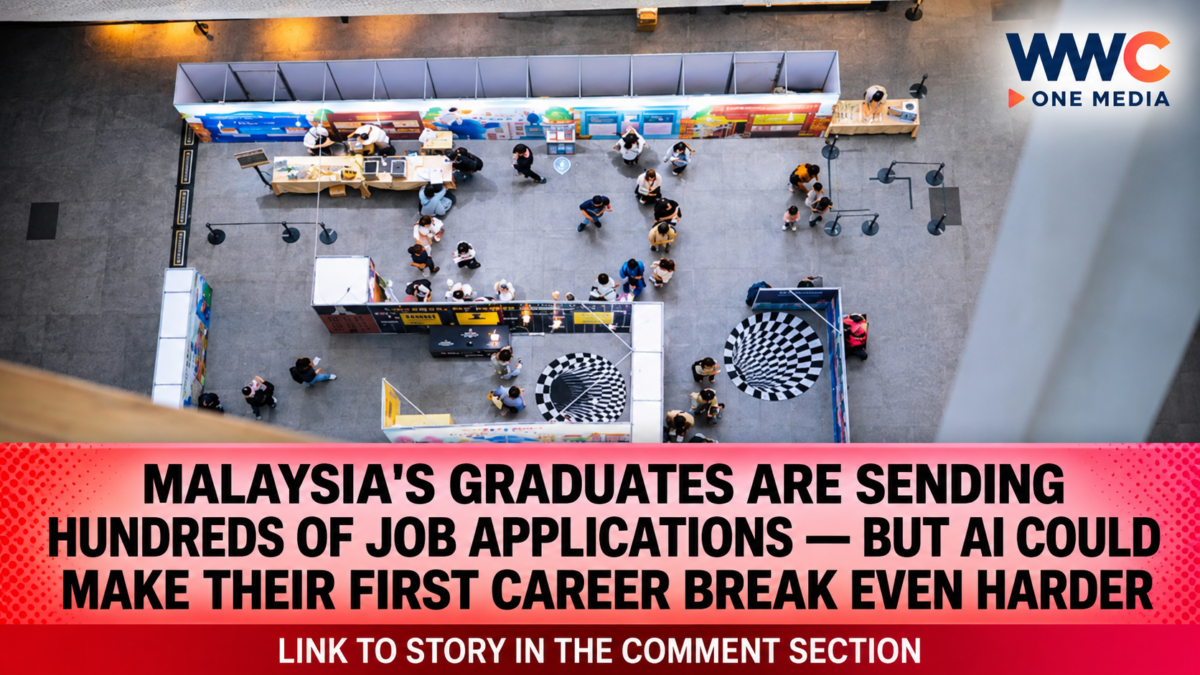
KUALA LUMPUR, November 3, 2026 — A university degree was once seen as an important first step towards a professional career. But for some Malaysian graduates entering today’s job market, getting that first opportunity is becoming an increasingly difficult challenge.
Some are submitting more than 100 applications without securing a suitable position. Others are sending hundreds of applications while struggling to find employers willing to offer the salary and professional opportunities they need.
And now artificial intelligence (AI) is adding another complication: the routine assignments that once helped junior employees gain workplace experience are increasingly being performed or assisted by automated tools.
The result is a difficult employment dilemma.
Companies want applicants who can demonstrate practical experience, but fresh graduates need their first jobs to acquire that experience.
The concern is no longer simply whether graduates can find work. It is whether the traditional entry-level career pathway is changing faster than young workers, employers and education systems can adapt.
More than 100 applications — but no suitable job
The problem is illustrated by the experiences of two Malaysian graduates featured in reporting by the South China Morning Post (SCMP).
Andy Iskandar Baharudin, a 23-year-old finance graduate from a public university, reportedly applied to more than 100 companies after completing an internship in July.
Despite his efforts, he was still struggling to secure employment.
His question captures the frustration facing inexperienced applicants: how can graduates gain professional experience when they cannot get an opportunity to start working?
Marketing graduate Nafeesa Azman, 24, described an equally difficult experience.
She reportedly submitted between 200 and 300 applications after completing an internship approximately two months earlier.
Nafeesa said she was looking for a permanent position that would make use of her education and provide a salary of at least RM3,000 a month. However, she found that many offers fell below her expectations.
She also expressed concern that AI tools were reducing opportunities in copywriting and visual-content work, while changing what employers were prepared to pay.
These are individual accounts, not a nationwide survey of graduate experiences. But they highlight the gap between the expectations of young jobseekers and the opportunities available to them.
Malaysia’s unemployment rate looks healthy — but young people face a different reality
Malaysia’s national unemployment rate stood at 2.9% in August 2026, according to the Department of Statistics Malaysia (DOSM).
The number of unemployed people declined to approximately 511,600, while total employment increased to around 16.87 million.
On the surface, these figures suggest a relatively resilient labour market.
However, the picture changes when younger workers are examined separately.
DOSM reported that unemployment among people aged 15 to 24 reached 10.1% in August, equivalent to approximately 291,300 young people.
This is considerably higher than the national unemployment rate.
The figures demonstrate why a relatively low overall unemployment rate does not necessarily mean that graduates are finding suitable professional opportunities.
Young people entering the labour market often face additional barriers, including limited experience, competition for vacancies, skills mismatches and employers’ expectations about immediate workplace readiness.
Source: Department of Statistics Malaysia, August 2026 Labour Force Statistics.
The graduate underemployment problem is even bigger
Unemployment is only part of Malaysia’s employment challenge.
Another concern is graduate underemployment, which occurs when people with tertiary qualifications work in positions below their education or skills level.
DOSM’s Graduate Statistics 2024 report recorded approximately 1.6 million graduates in skills-related underemployment, representing a rate of 32.2% among employed graduates.
The rate was marginally lower than the 32.4% recorded in 2023, but the number of underemployed graduates increased from approximately 1.54 million to 1.6 million.
More recently, Deputy Human Resources Minister Khairul Firdaus Akbar Khan told Parliament that the government was targeting a reduction in skills-related graduate underemployment to 30% by 2030.
The government has acknowledged that matching graduates with appropriate jobs takes time, particularly as technology and industry requirements change.
The figures reveal a problem that goes beyond graduates who cannot find employment: some are working, but their jobs do not fully use the qualifications and skills they spent years developing.
Sources: DOSM Graduate Statistics 2024; The Star, October 29, 2026.
AI is changing the first rung of the career ladder
For decades, entry-level employees learned through routine assignments.
A new finance employee might begin by compiling spreadsheets, preparing basic reports and organising financial information.
A junior marketing employee might write initial advertising drafts, prepare presentations and assist with research.
A newly recruited software developer might start by writing simpler programmes, testing applications and debugging basic code.
These responsibilities were not necessarily the most complex parts of the job, but they provided an important training ground.
They allowed inexperienced employees to understand professional standards, learn from senior colleagues and gradually take on more demanding responsibilities.
Generative AI can now assist with many of these activities.
It can produce initial drafts, summarise documents, organise information, generate code and help employees complete repetitive tasks more efficiently.
For businesses, that can improve productivity and reduce costs.
But it also raises a difficult question: if experienced employees can use AI to complete more routine work, will companies still recruit as many junior workers to perform those tasks?
The answer will vary between industries and employers. AI does not automatically eliminate an entire occupation simply because it can perform some of its tasks.
Nevertheless, the changing nature of entry-level work is becoming an important issue for graduate recruitment.
The ILO says nearly 80 million ASEAN workers are exposed to AI
The International Labour Organization (ILO) has warned that generative AI could affect employment across Southeast Asia.
Its July 2026 report, Generative AI and Labour Markets in ASEAN: Significant Exposure, Limited Disruption, Uneven Preparedness, estimated that approximately 80 million workers, or 22.9% of ASEAN employment, are in occupations with more than minimal potential exposure to generative AI.
Around 11.7 million workers, equivalent to 3.3% of the regional workforce, are in occupations classified within the highest exposure category.
However, an important distinction must be made: these figures measure potential exposure to AI, not confirmed job losses.
The ILO specifically said there was no evidence of large-scale AI-driven employment disruption across the region at the time of its report.
It also found that employment in highly exposed occupations had continued to grow.
The organisation’s warning is therefore not that millions of workers have already been replaced. Rather, it is that the region needs to prepare for significant changes in how work is performed.
The ILO recommends stronger skills development, responsible AI adoption, better digital capabilities and support for workers and businesses adapting to the technology.
Source: International Labour Organization, July 8, 2026.
Singapore is already trying to rebuild the entry-level pathway
Malaysia’s southern neighbour is confronting a similar concern.
Singapore Prime Minister Lawrence Wong previously warned that AI could weaken the traditional starting point of professional careers.
The concern is that if AI increasingly performs routine tasks, young professionals may find fewer opportunities to develop the practical experience needed for more senior positions.
Singapore is responding with a programme designed to connect education more closely with employment.
On October 19, 2026, the country’s Infocomm Media Development Authority announced an expansion of its Bridge2Tech initiatives, including approximately 3,000 one-year internships over three years for eligible tertiary students in information and digital technology fields.
The placements are intended to provide substantial workplace experience, exposure to real projects and opportunities to learn from experienced professionals.
Singapore is also increasing support for industry-recognised training in AI, cloud computing and cybersecurity.
The programme reflects an important shift in thinking: graduates cannot simply be expected to arrive at their first jobs with years of professional experience.
Employers and educational institutions must also help create opportunities through which that experience can be developed.
WWC One Media previously examined this development:
Employers are changing what they expect from graduates
The employment challenge is not simply about the number of available vacancies.
It is also about what companies expect applicants to contribute from their first day.
Some employers increasingly value candidates who can demonstrate practical skills, communicate effectively, solve problems and use digital tools in real working environments.
A degree remains important, but academic qualifications alone may not demonstrate how well someone can perform a particular job.
This is contributing to greater interest in skills-based recruitment, where employers evaluate practical capabilities alongside formal education.
However, there is a potential contradiction.
If companies demand experienced applicants for positions described as entry-level, graduates may struggle to obtain the very opportunities required to develop those capabilities.
The issue therefore requires action from both sides.
Graduates need opportunities to develop relevant skills, while employers need to recognise that inexperienced applicants cannot reasonably be expected to have years of professional experience.
The problem is not unique to Malaysia
Other economies are also debating how AI could change early-career employment.
WWC One Media previously reported on Singapore’s growing concerns about graduate recruitment and the relationship between job applications, workplace experience and employer expectations.
Fresh Graduates Keep Getting Rejected From Jobs — But What If the Problem Isn’t Them?
Another WWC One Media report examined research suggesting that AI’s effects on employment may be more complicated than predictions of immediate mass unemployment.
The distinction is important.
AI can change the number and type of tasks employees perform without immediately eliminating entire occupations.
But even when overall employment remains stable, a reduction in entry-level recruitment could make it harder for young people to enter certain professions.
That is a risk worth monitoring.
Could Malaysia learn from Singapore’s internship approach?
Singapore’s expanded internship programme offers one possible direction for Malaysia.
Longer industry placements can give students opportunities to work on actual projects, develop professional judgment and understand how their academic knowledge applies in a workplace.
Malaysia could also benefit from stronger cooperation between universities, technical institutions and employers.
Possible areas for improvement include:
- More structured internships linked to actual industry requirements.
- Graduate trainee programmes that provide supervised workplace experience.
- Stronger partnerships between universities and employers.
- Practical AI, digital and data skills integrated into different academic disciplines.
- Recruitment practices that recognise potential rather than requiring extensive experience for genuinely entry-level roles.
These approaches would not guarantee employment for every graduate, but they could help narrow the gap between education and workplace expectations.
WWC One Media has also covered a Philippine initiative focused on practical digital career preparation.
The wider lesson is that employability requires more than academic qualifications. Young people also need meaningful opportunities to demonstrate what they can do.
AI could create opportunities too — but preparation matters
It would be inaccurate to portray AI as purely a threat to employment.
The technology can help businesses develop new products, improve productivity and create demand for specialised skills.
The ILO’s research also points to the importance of preparing workers and institutions to benefit from these changes.
The challenge is ensuring that productivity gains do not come at the expense of opportunities for the next generation.
Companies may need to rethink how junior employees are trained, particularly when AI performs tasks that previously served as practical learning exercises.
Instead of removing the entry-level pathway, businesses could redesign it around supervised AI-assisted work, problem-solving, verification, communication and professional decision-making.
The goal should be to prepare graduates to work effectively alongside technology, not simply compete against it.
The biggest question: Who will train tomorrow’s experienced workers?
Malaysia’s graduate employment challenge is becoming more complicated.
The country has a relatively low overall unemployment rate, but youth unemployment remains significantly higher. Graduate underemployment continues to affect a substantial number of qualified workers, while AI is changing the responsibilities traditionally assigned to junior employees.
The experiences of Andy and Nafeesa show how frustrating the transition from education to employment can become.
But their stories also raise a question that businesses, universities and policymakers cannot ignore.
If employers continue demanding experience from fresh graduates while reducing opportunities to gain it, the next generation could find it increasingly difficult to enter professional careers.
AI may make experienced employees more productive today.
But tomorrow’s experienced workforce still has to come from somewhere.
And if the first rung of the career ladder disappears, Malaysia may eventually face a much bigger problem than graduates struggling to find their first jobs.
RELATED WWC ONE MEDIA STORIES
- Singapore Launches 3,000 Tech Internships as AI Takes Over Entry-Level Tasks
- Fresh Graduates Keep Getting Rejected From Jobs — But What If the Problem Isn’t Them?
- Silicon Valley Warns AI Could Wipe Out Millions of Jobs — But Economists Say the Real Threat May Be Hiding in Entry-Level Hiring
- 89% of Singapore Professionals Are Already Using AI at Work — But Only 67% Think It Will Help Their Careers
- Unilab Education and FutureProof Launch Digital Career Initiative for Filipino Students