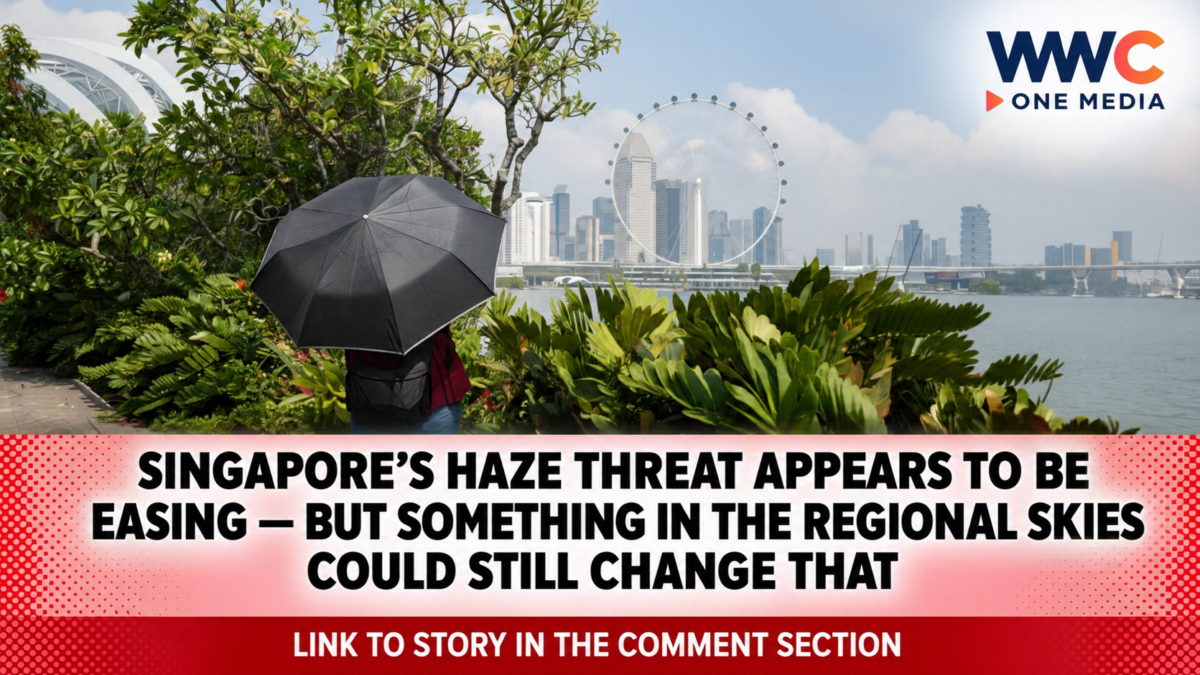
Rain over Singapore, Sumatra and Kalimantan is helping suppress the haze, with air quality remaining in the good-to-moderate range. But smoke plumes are still present in parts of Indonesia, meaning the regional haze threat has not completely disappeared.
SINGAPORE — Singapore appears to be getting a much-needed break from the haze after weeks of volatile air quality.
Showers across Singapore and surrounding areas are helping keep the regional haze situation suppressed, with the National Environment Agency (NEA) forecasting 24-hour PSI levels of 51 to 80 — the moderate range — for Nov. 3.
The improvement comes after Singapore endured a prolonged spell of poor air quality in October, when smoke from regional fires periodically pushed pollution levels into unhealthy and, at times, very unhealthy territory.
But officials are not declaring the haze threat over.
Rain is giving Singapore a temporary shield
In its Nov. 2 haze situation update, NEA said heavy showers had fallen over many parts of Singapore.
At 6pm, the 1-hour PM2.5 concentration was between 16 and 25 micrograms per cubic metre, remaining in the normal band.
The 24-hour PSI ranged from 63 to 81, putting readings around the moderate range.
CNA similarly reported that Singapore’s 1-hour PM2.5 readings remained within the normal band across all five regions, while 24-hour PSI readings were in the good-to-moderate range.
The combination of rain and changing atmospheric conditions is therefore providing some relief after a particularly difficult October.
But smoke is still visible over Indonesia
The improvement does not mean the fires in the region have disappeared.
NEA said moderate to dense smoke plumes were observed over some parts of Kalimantan and southern Sumatra.
That matters because winds can transport smoke across national borders when conditions are favourable.
For Nov. 3 through Thursday, prevailing winds are expected to blow mostly from the east or southeast.
However, showers are forecast over Sumatra, Kalimantan, Singapore and surrounding areas — conditions that NEA said could help keep the haze situation suppressed.
In other words, Singapore has a favourable combination of weather conditions at the moment, but the regional source of smoke remains active.
Singapore’s weather pattern is changing
The improvement comes as Singapore moves into the inter-monsoon period.
The Meteorological Service Singapore said the Southwest Monsoon has been weakening, with inter-monsoon conditions progressively setting in over Singapore and the surrounding region.
That means winds are becoming lighter and more variable, reducing the likelihood of smoke haze being transported towards Singapore.
At the same time, wetter conditions are expected to help further improve the haze situation.
This shift is important because October’s haze was closely linked to prevailing winds transporting smoke from fires in neighbouring regions.
The first half of November could be much wetter
Singapore’s weather outlook for the first half of November is providing another reason for cautious optimism.
Moderate to heavy thundery showers are expected over parts of the island on most days, with rainfall potentially extending into the evening on several days.
Total rainfall during the first half of November is forecast to be slightly above the long-term average over most parts of Singapore.
Temperatures, however, are still expected to remain high.
Daily maximum temperatures are forecast to reach around 33°C to 35°C on most days, with temperatures potentially exceeding 35°C on a few days.
So while rain may help clear the air, Singaporeans should not expect a dramatic end to the hot and humid weather.
October was a very different story
The latest improvement comes after a difficult second half of October.
According to MSS, smoke haze was transported towards Singapore as winds blew mainly from the southwest or southeast between Oct. 16 and 28.
During that period, air quality reached the unhealthy range for seven days and the very unhealthy range for three days.
Singapore also experienced several days of significant rainfall.
On Oct. 21, Tuas South recorded 81mm of rain, the highest daily total for the second half of October.
Despite those showers, temperatures remained high, with Woodlands recording a maximum temperature of 36.1°C on Oct. 23.
That combination of heat, dry periods and regional fires created challenging conditions for Singapore.
Singapore previously faced a prolonged haze episode
The 2026 haze season has been particularly notable because of the length and severity of several episodes.
The Straits Times reported in October that Singapore had experienced its longest stretch of poor air quality since 2015, with officials warning at one stage that PSI levels could potentially climb above 300 before weather conditions improved.
The situation subsequently improved as the inter-monsoon period approached.
The Straits Times later reported that the risk of transboundary haze affecting Singapore was expected to decline because of the onset of inter-monsoon conditions and wetter weather.
That means the latest improvement is not simply a one-day weather event. It is part of a broader seasonal change.
Still, officials are watching Indonesia closely
The regional picture remains important.
Indonesia has experienced significant fire activity this year, particularly in areas of Sumatra and Kalimantan.
The Straits Times reported in October that Indonesia was experiencing an unusually severe fire season, with prolonged heat and dryness contributing to the conditions. Indonesia subsequently welcomed offers from Singapore and Malaysia to assist with tackling the haze problem.
That regional cooperation matters because smoke does not stop at national borders.
Singapore’s air quality can change depending on the location of fires, wind direction, atmospheric conditions and rainfall.
A shift in any of those factors could therefore change the situation quickly.
What should Singapore residents watch?
NEA recommends using the 24-hour PSI forecast when planning outdoor activities, while the 1-hour PM2.5 readings provide more immediate information about current air quality.
That distinction is important.
The PSI forecast is useful for planning ahead, while short-term PM2.5 readings can change more quickly depending on local and regional conditions.
For now, the readings are reassuring compared with the worst periods in October.
But residents should continue checking official updates, particularly if regional smoke conditions worsen.
The bigger picture: the haze threat is suppressed, not erased
The latest numbers tell a relatively encouraging story.
PM2.5 concentrations are normal.
The 24-hour PSI remains around the good-to-moderate range.
Rain is forecast across Singapore and nearby parts of Indonesia.
And the transition into the inter-monsoon period should make it harder for smoke to be consistently transported towards Singapore.
But smoke plumes remain over parts of Kalimantan and southern Sumatra.
That means the underlying source of the haze has not completely disappeared.
For now, rain is buying Singapore some breathing room.
The question is whether that weather advantage lasts long enough to keep the regional smoke from returning.
And that is why the next few days could be crucial.