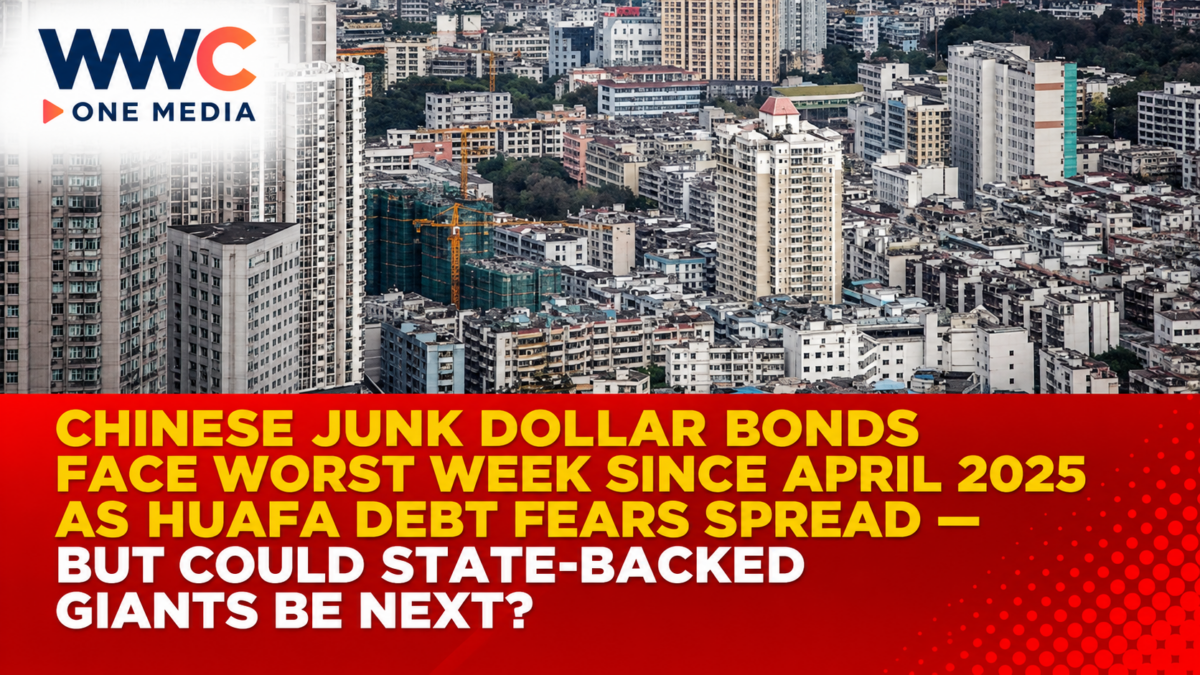
HONG KONG / BEIJING — October 30, 2026. China’s high-yield dollar bond market is heading for its worst weekly performance in more than a year as mounting financial pressure at government-controlled Zhuhai Huafa Group reignites fears that the country’s prolonged property debt crisis is spreading to borrowers once considered relatively secure.
According to Bloomberg market data, the average price of Chinese high-yield dollar bonds declined by approximately 1.9 cents on the dollar during the week through Thursday, marking the steepest weekly decline since April 2025.
Some bonds issued by state-backed property companies rebounded by approximately one cent during Friday morning trading, suggesting investors were selectively buying after the selloff.
But the partial recovery did little to remove the underlying concern.
Huafa, a major conglomerate controlled by the authorities in Zhuhai, Guangdong province, has reportedly missed payments on two trust-financing products and requested extensions on loans from at least three banks.
The company carried approximately 413 billion yuan, or $61.9 billion, in interest-bearing liabilities as of March 2026.
The latest market reaction is therefore about more than one troubled borrower.
Investors are questioning whether China’s locally owned corporate giants can still rely on government support when refinancing becomes difficult.
China’s junk dollar bonds suffer their worst week in over a year
Chinese high-yield dollar bonds are debt securities issued in US dollars by borrowers considered to have elevated credit risk.
Because these bonds carry greater default and repayment uncertainty than investment-grade securities, investors generally demand higher yields.
Their market prices can decline sharply when confidence weakens.
Bloomberg’s index showed that the average price of the securities fell approximately 1.9 cents on the dollar through October 29.
That represented the steepest weekly decrease since April 2025.
A decline of 1.9 cents means a reduction of approximately $1.90 for each $100 of bond face value, assuming the price quotation refers to cents per dollar of principal.
It is not equivalent to a 1.9-percentage-point increase in bond yields.
The distinction matters because prices and yields move inversely, but the relationship depends on each bond’s coupon, maturity and credit risk.
The selloff reflects renewed concern about whether financially stressed Chinese borrowers will be able to repay or refinance their obligations.
Zhuhai Huafa becomes the center of investor anxiety
The immediate trigger was financial stress at Zhuhai Huafa Group.
Huafa is a large state-controlled conglomerate with extensive exposure to property development, urban infrastructure and other business activities.
The company is controlled primarily by Zhuhai’s state-owned assets authority, with additional ownership linked to provincial finance authorities.
For investors, that government relationship has historically been an important consideration.
A state-owned company may have stronger banking relationships or greater access to official support than a comparable private borrower.
But those advantages are not unlimited.
Huafa’s reported loan negotiations and trust-product repayment difficulties have raised doubts about how quickly government-linked borrowers can secure financing during periods of economic weakness.
The situation does not establish that the group is bankrupt or that all its outstanding obligations have become immediately payable.
It does, however, highlight serious refinancing concerns.
The $62-billion debt burden makes Huafa particularly significant
Huafa reported approximately 413 billion yuan in interest-bearing liabilities as of March 2026.
The sum includes various financing obligations, such as bank loans, bonds and other borrowings.
Its scale helps explain why investors are paying close attention.
Even a relatively modest change in refinancing conditions can matter greatly for a company with a large outstanding debt portfolio.
Borrowers commonly rely on operating cash flow, asset sales and new financing to meet obligations as they mature.
When lenders become cautious, extending debt may become more expensive or difficult.
That can force a company to conserve cash, sell assets or negotiate revised payment schedules.
Huafa’s reported 2025 net loss of approximately 16.9 billion yuan adds to the concern.
Losses do not automatically mean a company cannot repay debt, but persistent weak cash generation can reduce its flexibility.
The most important question is whether Huafa can arrange financing on sustainable terms while maintaining adequate liquidity.
Fitch’s negative watch increases pressure
Bloomberg separately reported on October 30 that Fitch Ratings placed Huafa on Rating Watch Negative because of refinancing risks.
The designation signals that a credit rating could be lowered following further review.
It is not automatically a completed downgrade, and it is not a bankruptcy declaration.
Nevertheless, rating-agency scrutiny can influence market expectations.
Some investors face restrictions on the credit quality of securities they can hold.
A downgrade could affect demand for a company’s bonds or increase its borrowing costs, depending on the size of the action and the relevant investment mandates.
WWC ONE MEDIA has covered the developments in China’s Zhuhai Huafa Faces Fitch Negative Watch Amid $62-Billion Debt Pressure — But Could a State-Backed Property Giant Be Next to Fall?.
That report examines Huafa’s liabilities, loan-extension requests and uncertainty surrounding government support.
The rating action adds another concern to an already difficult financing environment.
Why one company’s difficulties are affecting other bonds
Bond investors do not evaluate borrowers entirely in isolation.
When a major company experiences unexpected liquidity problems, lenders may reconsider the risk of similar businesses.
In Huafa’s case, the concern extends to other Chinese companies with substantial property exposure and local-government ownership.
Investors may begin asking whether those companies have sufficient cash, dependable refinancing arrangements and clearly documented financial support.
That can lead to broader selling even when other issuers have not missed payments.
Such market behavior is sometimes described as contagion or credit-risk repricing.
However, a decline in the price of another company’s bonds does not prove that company is financially distressed.
The distinction between a sector-wide market reaction and confirmed issuer-specific problems is essential.
State ownership does not guarantee repayment
A major reason the Huafa episode is attracting attention is the company’s government ownership.
China has many businesses associated with central, provincial and municipal authorities.
Those relationships are not interchangeable.
A centrally controlled enterprise may benefit from different financial resources and strategic priorities than a company owned by a local government.
Local governments can face fiscal pressure when land-sale income declines or property development slows.
They may therefore have less flexibility to support corporate borrowers than investors previously assumed.
More importantly, government ownership is not the same as an explicit legal guarantee.
Unless specific debt documents establish such a guarantee, investors should not automatically assume that the government is obligated to repay all creditors.
Huafa’s difficulties are forcing bondholders to examine this distinction more closely.
China’s property crisis remains the underlying problem
The selloff also reflects persistent weakness in China’s real estate industry.
After years of rapid construction, heavy borrowing and rising property prices, developers began facing serious financing difficulties when home sales weakened.
The problems spread through companies dependent on land purchases, construction and property-related investment.
Local governments were also affected because land transactions historically provided an important source of revenue.
WWC ONE MEDIA examined the structural changes in China’s Property Reset Has Begun: Why Beijing Is Dismantling Housing Presales Without Killing Them Overnight.
That report discussed Beijing’s effort to reduce reliance on the presale financing model that helped fuel the property boom.
The reforms aim to improve financial discipline and protect buyers.
But they may also increase short-term financing requirements for developers already struggling with debt.
The result is an industry attempting to change its business model while still dealing with the consequences of earlier borrowing.
The selloff follows a period of strong Asian junk-bond performance
The latest reversal is particularly striking because Asian high-yield bonds had been outperforming many other debt markets earlier in 2026.
Bloomberg data reported by The Business Times in September showed that Asian high-yield dollar bonds had returned approximately 4.3% for the year through that period, compared with around 1.8% for US counterparts.
The improvement was supported partly by lower borrowing costs in China and relatively favorable credit conditions.
But strong past returns can encourage investors to accept increasingly narrow compensation for risk.
When an unexpected financial problem emerges, bond prices may adjust rapidly.
The Huafa episode illustrates how confidence can change even after months of favorable market performance.
Importantly, the September returns should not be presented as the current October 30 year-to-date results.
They provide historical context for the sudden reversal.
Why China’s low interest rates are not protecting every borrower
China’s domestic government borrowing costs have remained relatively low compared with US rates.
This can benefit the wider financial system by reducing financing costs and supporting liquidity.
But a low sovereign bond yield does not mean every company can borrow at a similarly low rate.
Investors still assess each corporate issuer’s capacity to repay.
A borrower with weak cash flow and uncertain refinancing may face a much higher cost of debt.
WWC ONE MEDIA explored the wider market in China-US Bond Yield Gap Nears Record as Global Debt Rout Sends Shockwaves Through Markets.
The article discussed the difference between Chinese and American government bond yields.
That divergence can influence currency markets and international investment.
But it does not eliminate credit risk in Chinese dollar-denominated corporate debt.
Huafa’s case demonstrates why the financial condition of an individual borrower can matter more than the level of the country’s benchmark interest rates.
A $54-billion financial support package highlights Beijing’s dilemma
China has also introduced measures to strengthen major financial institutions.
WWC ONE MEDIA reported on a 360-billion-yuan capital injection program in China Pumps US$54 Billion Into Banks and Insurers in Major Financial Powerhouse Push.
The program was designed to improve capital buffers and support the resilience of major state-linked financial institutions.
However, it is not evidence that Beijing has approved a specific rescue package for Huafa.
The distinction is important.
Strengthening banks can help maintain confidence across the financial system.
But it does not automatically resolve the debt problems of every corporate borrower.
Beijing must balance financial stability with the risk of encouraging excessive borrowing through expectations of unlimited government support.
That challenge becomes more difficult when troubled companies are important employers, investors or infrastructure developers.
Could a wider bond selloff increase refinancing costs?
If investor confidence continues weakening, Chinese borrowers may encounter greater difficulty raising fresh offshore dollar financing.
When bond prices fall, investors generally demand higher yields to purchase comparable new debt.
That can increase refinancing costs.
For companies with large maturities approaching, more expensive borrowing can make debt management harder.
Businesses may choose to delay new projects, reduce spending or sell assets to preserve liquidity.
Some may seek support from shareholders or domestic lenders.
Others may negotiate debt extensions with creditors.
But these outcomes depend on each company’s finances and the terms available.
A broad market selloff does not mean every issuer will default.
The principal risk is that difficult financing conditions can reinforce existing weaknesses.
Why a partial Friday rebound does not end the crisis
Bloomberg-linked reporting indicated that selected offshore bonds from government-backed developers recovered approximately one cent during Friday morning trading.
That suggests some investors were willing to buy securities after sharp declines.
Such rebounds can occur when traders believe selling has become excessive or when reports of potential support improve confidence.
But a small price recovery does not prove that the underlying credit concerns have disappeared.
Investors still need evidence that borrowers can meet their obligations.
In Huafa’s case, that includes clarity about overdue trust products, banking arrangements and potential shareholder assistance.
The full weekly result could also differ from Thursday’s decline if Friday trading materially changes the index.
Therefore, the most precise description is that the market was heading toward its worst week since April 2025, based on the reported data—not that its final weekly close had been independently confirmed.
What the turmoil means for international investors
Chinese offshore dollar bonds are held by a range of international investors, including asset managers, credit funds and other institutions.
These securities can offer higher yields than investment-grade bonds, but they also expose investors to credit and liquidity risks.
Government ownership may influence the investment case, but it is not a substitute for examining the borrower’s financial statements and bond documents.
Investors need to evaluate debt maturities, unrestricted cash, expected cash flow, collateral and any legally enforceable guarantees.
The difference between yuan-denominated offshore bonds and dollar-denominated bonds is also important.
They carry different currency exposures and contractual terms.
Market movements in one security should not automatically be assumed to apply equally to every bond issued by the same company.
Could China’s bond turmoil affect the Philippines?
The direct consequences for the Philippines remain uncertain.
Chinese corporate debt markets are connected to international investment flows, Asian credit sentiment and regional economic expectations.
A prolonged decline in confidence could influence how investors evaluate risk across emerging markets.
However, the reported Huafa difficulties do not establish direct losses for Philippine banks, pension funds or households.
Those claims would require confirmed information about specific investments.
The more plausible broader channels are shifts in regional financial sentiment, trade demand and investor appetite for risk.
Chinese property weakness can also affect demand for imported commodities and construction materials.
But the scale of any Philippine impact depends on actual commercial and financial exposures, not simply on the existence of a selloff in Chinese bonds.
What investors should watch next
The immediate focus is whether Huafa can resolve its overdue financing obligations and secure workable loan extensions.
Investors will also watch Fitch’s subsequent rating decision.
Clear statements about government support or new financing could improve confidence.
Conversely, additional repayment problems could intensify pressure on Huafa and comparable issuers.
Market participants will examine whether the selling remains concentrated among property-linked borrowers or expands into other Chinese high-yield sectors.
Another important signal will be the ability of borrowers to issue new dollar bonds at sustainable yields.
If access to new financing remains available, the market may stabilize.
If it becomes severely restricted, refinancing pressure could increase.
The bigger question: Is China’s property crisis spreading into its state-backed credit market?
The latest decline in Chinese high-yield dollar bonds underscores the continuing influence of the country’s property crisis.
The market was heading toward its weakest week in more than a year after concerns about Zhuhai Huafa triggered a wider reassessment of credit risk.
Huafa’s large debt burden, reported repayment difficulties and government ownership have made it a particularly important test case.
The company may still secure refinancing arrangements or additional support.
The partial recovery in some bonds suggests investors have not abandoned the market entirely.
But the underlying lesson is becoming harder to ignore.
Government connections can influence creditworthiness without eliminating repayment risk.
And strong returns during favorable market conditions can reverse quickly when confidence weakens.
Chinese junk dollar bonds have suffered their sharpest weekly pressure since April 2025. But the decisive question is whether Huafa’s difficulties will remain an isolated refinancing problem—or expose deeper vulnerabilities among the state-backed companies investors once considered protected from China’s property debt crisis.