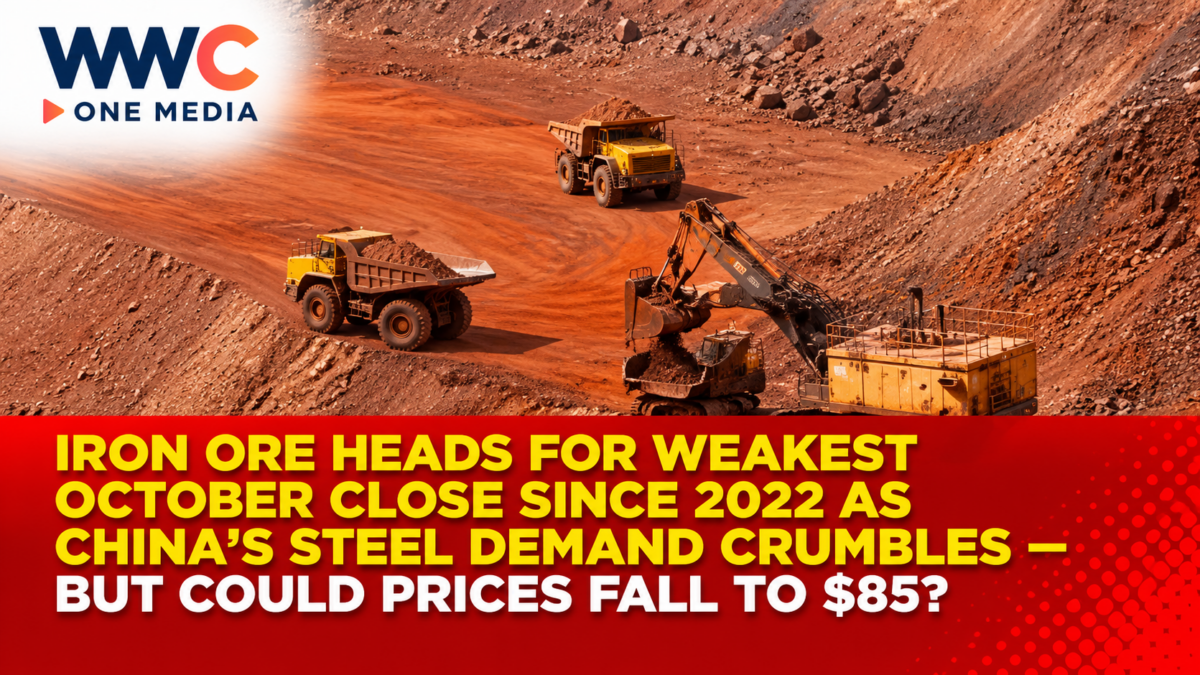
SINGAPORE / BEIJING — October 30, 2026. Global iron-ore prices are heading toward their weakest October month-end finish since 2022 as China’s struggling steel industry cuts back on raw-material purchases while major mining companies prepare to deliver more supply.
The latest downturn is putting pressure on one of the world’s most important industrial commodities, exposing the continuing effects of China’s prolonged property crisis and raising new questions about the outlook for Australia, Brazil and emerging African iron-ore producers.
Benchmark iron-ore futures on the Singapore Exchange fell to an intraday low of $89.25 per metric ton on October 27, their weakest level since September 2024.
By October 29, a separate iron-ore benchmark tracked by Trading Economics was around $90.71 per ton, down approximately 6.1% over the previous month and 14.2% from a year earlier.
Bloomberg’s October 30 report indicates that iron ore is heading toward its lowest October month-end closing level since October 2022.
However, the final October 30 settlement price was not independently confirmed in the accessible sources reviewed.
The market’s most urgent question is whether China’s property downturn and growing global mine supply will drive iron ore toward $85—or whether a recovery in steel demand could stop the slide.
Why iron ore is under pressure again
Iron ore is the primary raw material used to produce most of the world’s steel.
Steel is essential for buildings, bridges, machinery, railways, vehicles and industrial infrastructure.
China is the world’s largest steel producer and iron-ore consumer, meaning changes in its economy can quickly influence global commodity prices.
The country’s construction industry has been struggling with a multiyear property downturn, weak housing demand and falling investment in development projects.
As construction activity slows, demand for steel products such as reinforcing bars weakens.
Steel mills may then reduce production and purchase less iron ore.
The result is a ripple effect that extends from Chinese construction sites to international mining operations.
That dynamic is becoming increasingly visible as October draws to a close.
Singapore iron-ore futures fall below $90
The most closely watched recent price move occurred on October 27.
Bloomberg reported that benchmark futures in Singapore declined as much as 1.4% to $89.25 per ton.
Reuters separately reported that the November Singapore contract traded around $89.45 in early dealings, after reaching approximately $89.30.
Meanwhile, the most-active iron-ore futures contract on China’s Dalian Commodity Exchange fell to approximately 661.5 yuan per metric ton during the session, also a two-year intraday low.
These are different futures contracts quoted in different currencies.
Their prices should not be compared directly without accounting for contract specifications, location, delivery terms and exchange rates.
The declines were accompanied by weakness in Chinese steel products, including rebar and hot-rolled coil.
That broad downturn indicates concerns extending throughout the steelmaking supply chain.
China’s property crisis remains the biggest demand problem
The prolonged weakness of China’s real estate market is central to iron ore’s troubles.
Housing construction consumes large amounts of steel, particularly reinforcing bars used in concrete structures.
When developers delay or cancel projects, demand for construction steel declines.
Many Chinese property companies are also carrying substantial debt, making it difficult to finance new developments.
WWC ONE MEDIA previously examined the structural changes in China’s Property Reset Has Begun: Why Beijing Is Dismantling Housing Presales Without Killing Them Overnight.
The report discussed efforts to reduce developers’ dependence on payments collected from homebuyers before projects are completed.
These reforms could help address some long-term weaknesses in the housing market.
But they may also make financing more difficult for developers already experiencing pressure.
For the steel industry, a prolonged period of cautious investment and subdued construction activity would limit raw-material demand.
Chinese steel output is already showing the damage
Bloomberg reported earlier in October that China’s crude steel production during the first eight months of 2026 was the lowest for that period since 2018.
The decline reflects weak demand and the difficulty mills face in earning acceptable profits.
Iron-ore purchasing is closely linked to blast-furnace activity.
One commonly monitored indicator is hot-metal production, which measures the molten iron produced in the steelmaking process.
Lower hot-metal production generally implies reduced demand for blast-furnace raw materials such as iron ore and metallurgical coal.
By late October, analysts were reporting subdued operating activity and cautious purchasing among Chinese mills.
Some steelmakers were also scheduling maintenance or reducing production because margins had deteriorated.
This matters because lower iron-ore prices do not automatically encourage mills to buy more material.
If steel prices are also weak, producers may have little incentive to increase output.
Only a small share of Chinese steelmakers were profitable
Industry data published earlier in October suggested that steelmaker profitability had become extremely weak.
Trading Economics cited figures showing that approximately 6.9% of Chinese steelmakers were profitable at the end of September.
Average daily hot-metal production had fallen to approximately 2.34 million metric tons, a six-month low at the reporting date.
These indicators help explain the pressure on iron-ore prices.
A steel mill with little prospect of earning a profit may choose to run at lower capacity.
That reduces its immediate need for raw materials.
The result can be a downward cycle in which weaker steel demand leads to production cuts, lower ore consumption and reduced iron-ore prices.
A recovery would likely require improvement in steel demand or stronger production economics.
Higher iron-ore imports do not mean stronger steel production
One of the most surprising developments is that China’s iron-ore imports have continued increasing.
Reuters reported that China imported 954.97 million metric tons of iron ore during the first nine months of 2026, a 4.1% increase from the same period last year.
September imports reached approximately 109.82 million tons, up 1.2% from August.
At first glance, those numbers might suggest stronger demand.
But the additional iron ore has not necessarily been consumed by steel mills.
Much of it has accumulated in inventories.
Data from SteelHome, cited by Reuters, showed Chinese port stocks reaching approximately 152.23 million metric tons in the week ending October 23.
That represented a 14% increase from a year earlier.
High inventories can limit the need for additional imports, especially when steel producers expect prices to decline further.
The contrast between rising imports and weak production is one of the clearest signs that the market faces a supply-demand imbalance.
Global mining companies are preparing to ship more ore
The demand problem is being compounded by expectations of higher supply.
Bloomberg reported that shipments from four major iron-ore producers, including Rio Tinto and BHP, could increase by as much as 18 million tons during the fourth quarter.
That estimate is a forecast rather than a confirmed volume already shipped.
The additional supply could intensify pressure if Chinese steel mills continue purchasing cautiously.
Major mining companies often operate large, capital-intensive assets that can remain economical even during periods of falling commodity prices.
Their production decisions are influenced by operating costs, transport infrastructure, contract commitments and long-term market expectations.
Higher supply is not necessarily negative for every mining company.
Low-cost producers may be better positioned to withstand weaker prices than companies operating higher-cost deposits.
But a prolonged slump can still reduce revenue and pressure investment plans across the industry.
Guinea’s Simandou mine adds a major new source of competition
One of the most important changes in the international iron-ore market is the gradual development of Guinea’s Simandou project.
The West African deposit is among the world’s largest undeveloped high-grade iron-ore resources.
As production and exports increase, Simandou could provide additional supply to international steelmakers, particularly in Asia.
Its emergence may also change the competitive balance among major exporters.
China has long depended heavily on Australian iron ore, with Brazil providing another major source.
Guinean supply offers a potential route toward greater diversification.
However, the market impact will depend on how quickly mining, railway and port infrastructure can support commercial shipments.
The expected production increase should not be treated as if the full long-term capacity is already available.
In the near term, the prospect of additional ore contributes to expectations of a more competitive supply environment.
China is also challenging Australia’s influence over iron-ore pricing
The falling market comes amid an unusual struggle between China’s state-backed iron-ore buyer and some of the world’s largest miners.
China Mineral Resources Group, or CMRG, has been negotiating with suppliers to improve purchasing terms.
The group is intended to use China’s considerable buying power to secure more favorable commercial arrangements.
Reuters reported that Australia supplies approximately two-thirds of China’s iron-ore requirements, while China purchases around three-quarters of global seaborne iron ore.
Those figures illustrate the unusual dependence between the two sides.
China has enormous purchasing power.
But Australian miners also control very large, established sources of supply.
Neither side can easily replace the other.
Rio Tinto agreement eases some uncertainty, but Fortescue talks continue
Recent negotiations have produced mixed results.
Bloomberg reported that CMRG and Rio Tinto reached a multiyear supply agreement in October.
That development eased some concerns about potential trade disruption.
However, negotiations involving Fortescue have remained difficult.
Reuters reported that Fortescue faced uncertainty over sales and profitability because of disagreements involving commercial terms.
A prolonged dispute could cause inventory to accumulate or delay transactions.
But the existence of negotiations does not establish that Australia’s iron-ore exports have stopped.
The broader issue is whether China can use its purchasing influence to obtain lower prices or more favorable contract arrangements.
The continued development of alternative supply sources, including Simandou, could eventually strengthen Beijing’s negotiating position.
Still, major changes to the global supply system would take time.
China’s steel surplus creates problems for overseas producers
Weak domestic demand has encouraged Chinese steel producers to seek export markets.
That can increase competition for manufacturers in countries where local steel production is already under pressure.
WWC ONE MEDIA examined the issue in Global Steel Market Fractures as Trade Barriers Force a New Industry Playbook.
The report discussed China’s steel surplus, growing trade barriers and increasing international competition.
When steelmakers export more because domestic demand is weak, international buyers may benefit from lower prices.
However, producers in importing countries can face greater competition and shrinking profit margins.
Governments may respond through anti-dumping investigations, tariffs or other trade measures.
For iron ore, rising steel exports do not necessarily offset weaker domestic steel consumption.
The impact depends on whether Chinese mills are producing additional steel or redirecting existing output toward foreign buyers.
China’s broader economic weakness adds to the pressure
The steel industry is also affected by China’s wider economic challenges.
The country has relied on manufacturing and exports to support growth as property investment and domestic consumption remain under pressure.
WWC ONE MEDIA explored these issues in China’s Q3 Economic Growth Set to Rebound as Export Boom Drives Manufacturing, but Weak Consumer Spending Raises Concerns.
That article was published before the official third-quarter GDP result and discussed forecasts available at that time.
Its economic projections should not be presented as confirmed outcomes.
However, its discussion of weak property investment and domestic demand remains relevant to the iron-ore market.
A stronger export sector does not automatically revive housing construction or domestic steel consumption.
The economy may therefore continue growing in some advanced manufacturing sectors while traditional construction-related commodities remain under pressure.
Could iron ore fall to $85 per ton?
Some analysts believe additional downside remains possible.
Mengtian Jiang, chief ferrous analyst at Horizon Insights, told Bloomberg that iron ore could decline toward $85–$86 per ton as seasonally weak steel consumption coincides with rising supply.
The final two months of the year are traditionally less favorable for construction activity in northern China because of colder weather.
Steel mills may also delay raw-material purchases if they expect prices to weaken.
But the $85–$86 range is a scenario, not a confirmed future market price.
Several developments could alter the outlook.
Stronger government stimulus, improved housing activity, additional infrastructure spending or unexpected supply disruptions could support prices.
Conversely, further mill production cuts or faster growth in ore shipments could intensify the downturn.
Investors should therefore distinguish a forecast from an established market floor.
The Philippines could see mixed effects
Changes in global iron-ore and steel prices can have different consequences for the Philippines.
Construction companies and infrastructure developers may benefit if lower international raw-material costs eventually contribute to more competitive steel-product prices.
However, domestic retail prices also depend on manufacturing costs, freight, exchange rates, tariffs and local supply conditions.
Cheaper iron ore does not automatically produce an immediate or equivalent drop in the cost of steel bars sold in the Philippines.
Local steel producers could also face stronger competition from imported products if foreign suppliers lower prices.
Mining businesses and commodity investors may experience pressure if international prices remain weak.
The effects will therefore depend on each industry’s position in the supply chain.
China’s overcapacity debate could become even more important
The iron-ore downturn is occurring alongside a broader debate over China’s manufacturing capacity.
Some international governments argue that excessive investment and weak domestic demand encourage Chinese producers to export goods at unusually low prices.
Beijing rejects the idea that its manufacturing competitiveness is simply the result of overcapacity or subsidies.
WWC ONE MEDIA analyzed the opposing arguments in China Is Producing More Cars, Batteries and Goods Than Ever — But the Numbers Reveal Why the West’s ‘Overcapacity’ Case Isn’t So Simple.
The report emphasized the importance of distinguishing genuinely efficient production from investment that exceeds sustainable demand.
That distinction also matters for steel and iron ore.
Large output is not automatically evidence of inefficient production.
But when prices weaken, inventories rise and companies struggle to earn profits, the relationship between supply and demand becomes increasingly difficult to ignore.
What could reverse the iron-ore slump?
A durable recovery would probably require improvement in several conditions.
Chinese steel producers would need better margins and a stronger reason to increase output.
Property construction or infrastructure demand would need to stabilize.
Port inventories might need to decline as mills consume more material.
And additional supply from major miners would need to be absorbed by buyers.
The pace of Simandou’s expansion and the outcome of negotiations between CMRG and major suppliers could also influence market sentiment.
At the same time, broader economic conditions will remain important.
High energy prices, trade tensions and weak global industrial activity can all affect demand for steel and the raw materials used to produce it.
No single policy announcement guarantees a sustained rebound.
The bigger question: Is iron ore entering a longer structural downturn?
Iron ore’s weakness at the end of October 2026 reflects a challenging combination of falling steel demand, high inventories and growing global supply.
China remains the decisive consumer in the market.
Its housing industry is still struggling, steel mills face weak profits, and imports have been accumulating in port inventories rather than translating into strong production growth.
Meanwhile, major mining companies are preparing additional shipments and new African supply is gradually entering the market.
Those trends help explain why iron ore has fallen below $90 and why analysts are considering further declines toward $85.
But commodity markets can change quickly.
A recovery in Chinese construction, a shift in government policy or unexpected disruptions to mine output could alter the balance.
Iron ore is heading toward its weakest October month-end finish since 2022. But the real question is whether this is a temporary downturn in China’s steel cycle—or the beginning of a deeper restructuring that could reshape global mining, manufacturing and commodity prices for years.