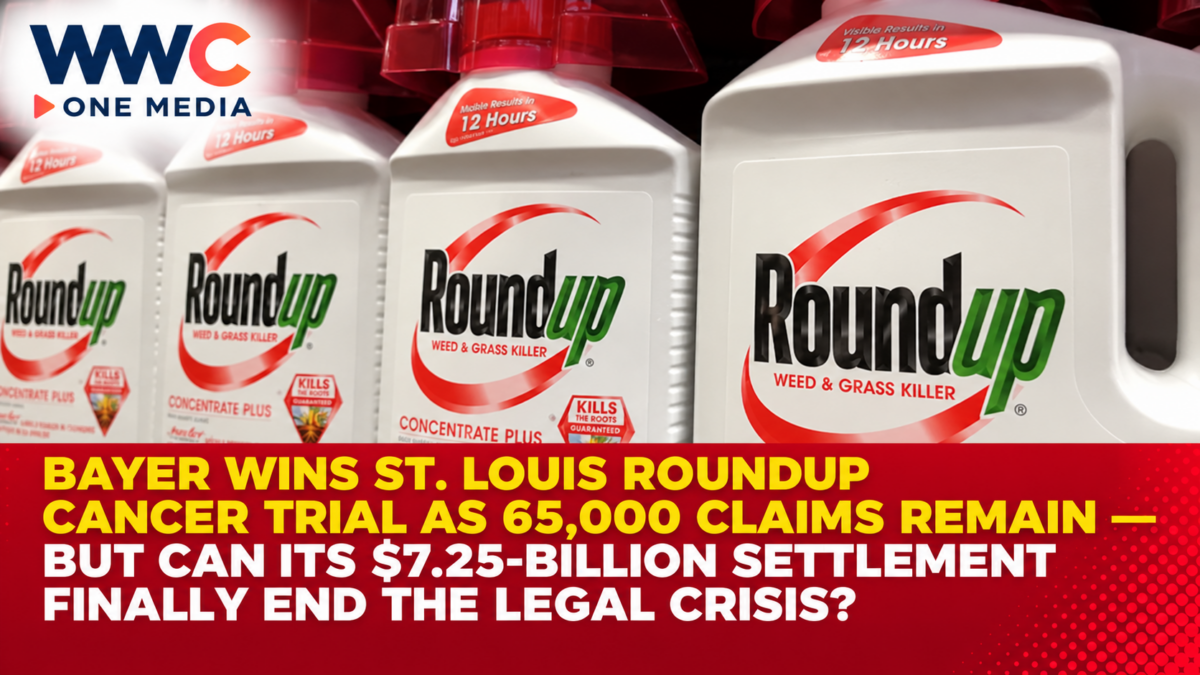
ST. LOUIS, Missouri — October 30, 2026. German chemicals and pharmaceutical giant Bayer has won a closely watched American cancer trial involving its Monsanto subsidiary and the widely used Roundup weedkiller, strengthening the company’s efforts to contain one of the most expensive product-liability battles in the agricultural industry.
A St. Louis jury unanimously ruled in Monsanto’s favor in a lawsuit brought by three women who alleged that exposure to Roundup caused them to develop non-Hodgkin lymphoma, a cancer affecting the lymphatic system.
The verdict represents a significant victory for Bayer, which acquired Monsanto in 2018 and subsequently inherited years of litigation over the herbicide.
It also follows a landmark June 25 ruling by the US Supreme Court limiting certain lawsuits that accuse Monsanto of failing to warn consumers about alleged cancer risks.
But the legal fight is far from over.
Bayer continues to face approximately 65,000 Roundup-related claims across the United States and is seeking final court approval of a proposed $7.25-billion settlement intended to address many existing and future cases.
The biggest question is whether this new courtroom victory will help Bayer finally contain its Roundup liabilities—or whether thousands of remaining claims could continue threatening its finances for years.
St. Louis jury unanimously rejects Roundup cancer claims
The lawsuit was filed in 2020 by three women who alleged that Roundup exposure caused their non-Hodgkin lymphoma.
One of the plaintiffs died before the trial.
Their claims included allegations that Roundup was defectively designed and that Monsanto acted negligently.
The case proceeded in Missouri, a key jurisdiction in the long-running litigation surrounding glyphosate-based herbicides.
After hearing the evidence, the jury returned a unanimous verdict for Monsanto.
The decision means the plaintiffs did not establish liability under the claims considered by the jury in this particular trial.
However, it does not amount to a universal legal finding that glyphosate cannot cause cancer or that every Roundup-related allegation is invalid.
Civil verdicts depend on the evidence, legal theories and instructions applicable to each case.
Other plaintiffs may pursue different claims or present different evidence in separate proceedings.
For Bayer, the verdict is nevertheless significant because it comes at a time when the legal landscape has shifted in the company’s favor.
Why the June Supreme Court decision matters
The October verdict is the first Roundup trial result since the US Supreme Court issued a major decision in Monsanto’s favor on June 25.
In a 7–2 ruling in Monsanto Co. v. Durnell, the justices held that federal pesticide-labeling law prevents certain state-law claims alleging that Monsanto should have placed additional cancer warnings on Roundup products.
The majority concluded that manufacturers cannot be required under state law to use warning labels that conflict with the federal regulatory labeling framework applicable to the product.
The decision has important consequences for thousands of cases centered on alleged failures to warn consumers.
Bayer has argued that the ruling substantially strengthens its legal position.
But the Supreme Court did not eliminate every possible lawsuit involving Roundup.
Claims involving alleged product defects or negligence may still proceed where legally viable.
That distinction explains why the St. Louis trial remained important even after the Supreme Court’s decision.
It tested whether plaintiffs could establish liability on grounds other than the warning-label claims restricted by the high court.
Bayer still faces approximately 65,000 claims
Despite its recent courtroom successes, Bayer’s remaining litigation exposure is considerable.
Reuters reported that the company continues to face approximately 65,000 Roundup-related claims across US courts.
The figure reflects the scale of the legal dispute that followed Bayer’s acquisition of Monsanto.
Over the years, plaintiffs have alleged that exposure to glyphosate-containing Roundup products contributed to their development of non-Hodgkin lymphoma.
Some juries have ruled in favor of plaintiffs and awarded substantial damages.
Others have found for Monsanto.
The mixed results have created uncertainty for Bayer, making legal costs and potential liabilities difficult to predict.
The company’s long-term strategy involves a combination of defending individual cases, seeking settlements and relying on favorable decisions from higher courts.
The latest Missouri verdict strengthens its defense record, but it does not automatically extinguish other pending claims.
$7.25-billion settlement could become the turning point
Bayer is separately pursuing a proposed nationwide class settlement valued at up to $7.25 billion.
Announced on February 17, 2026, the proposal is designed to resolve qualifying current and future claims involving alleged Roundup exposure and non-Hodgkin lymphoma.
Under the agreement, Monsanto would provide capped annual payments over a period of up to 21 years.
The structure is intended to create a more predictable process for compensating eligible claimants while limiting uncertainty over future litigation expenses.
A Missouri court granted preliminary approval in March.
A final approval hearing was held on September 14 before Judge Timothy Boyer.
However, the court had not issued a final approval ruling in the latest verified reporting available on October 30.
That distinction is crucial.
The proposed $7.25-billion settlement has not yet become a finally approved, fully implemented resolution of the litigation.
The arrangement has also faced objections from some claimants and attorneys who argue that the proposed terms may not adequately protect their interests.
The eventual outcome will depend on judicial approval, any further legal challenges and the settlement’s implementation.
Why some cancer plaintiffs oppose the settlement
The proposed settlement is designed to cover different categories of claimants, including some people who have already been diagnosed with non-Hodgkin lymphoma and others who may develop the disease in the future.
That makes it unusually complicated.
Future claimants may not yet know that they have a medical condition or that they could eventually seek compensation.
Some attorneys and affected individuals have argued that compensation limits or procedural conditions could restrict their ability to pursue claims later.
Bayer, meanwhile, maintains that a structured settlement provides a more efficient and predictable alternative to prolonged litigation.
The disagreement highlights a central challenge in mass-tort cases.
Courts must consider whether a proposed agreement fairly addresses the interests of people with different circumstances, including those whose injuries may not yet have been diagnosed.
A favorable jury verdict for Monsanto may improve Bayer’s negotiating position, but it does not resolve every objection to the settlement.
Is Roundup linked to cancer? Scientific agencies disagree
The central scientific issue in the litigation concerns glyphosate, the principal active ingredient in many Roundup herbicide formulations.
In 2015, the International Agency for Research on Cancer, part of the World Health Organization, classified glyphosate as probably carcinogenic to humans.
That classification reflects a hazard assessment based on the agency’s review of scientific evidence.
The US Environmental Protection Agency has reached a different regulatory assessment, concluding that glyphosate is not likely to be carcinogenic to humans under its evaluation.
The EPA is conducting further review of glyphosate’s safety.
Bayer disputes allegations that glyphosate-based Roundup causes non-Hodgkin lymphoma and points to regulatory evaluations supporting its position.
Plaintiffs have relied on other scientific studies and evidence to support their claims.
The disagreement should not be simplified into a claim that cancer risks have been conclusively proved or definitively disproved by one jury verdict.
Different scientific bodies assess evidence using different methods and regulatory standards.
For consumers and agricultural workers, the most responsible approach is to follow applicable product-label instructions, workplace safety requirements and official pesticide guidance.
What the case means for farmers and agricultural businesses
Roundup has been widely used in agriculture and landscaping for weed management.
Its continuing availability is an important issue for farmers who depend on herbicides to control weeds and protect crop production.
Supporters of glyphosate-based products argue that effective weed management helps maintain farm productivity and can reduce labor requirements.
Critics emphasize potential environmental and health risks and the importance of properly evaluating chemical exposure.
The debate is also relevant to the Philippines, where agricultural authorities must balance crop protection, farm productivity and safe pesticide use.
WWC ONE MEDIA recently reported on South Korea’s recall of imported mushrooms after testing detected excessive pesticide residues in These Mushrooms Are Popular in Malatang—Now Korea Has Ordered Them Off Shelves After a Shocking Pesticide Test.
That case involved different chemicals, products and regulatory standards. It should not be confused with the glyphosate litigation.
Nevertheless, it illustrates why agricultural chemical oversight and transparent safety assessments matter for consumers.
Biological pest control offers another agricultural approach
The Roundup controversy also forms part of a broader conversation about how farmers manage weeds, insects and crop diseases.
Some agricultural authorities are pursuing biological control methods that use naturally occurring organisms to suppress harmful pests.
For example, the Philippine government has supported efforts to expand biological control against destructive sugarcane pests.
WWC ONE MEDIA examined these initiatives in Bukidnon Finds a Natural Weapon Against Sugarcane Pests—but Can It Stop the Infestation in Time?.
The development highlights efforts to diversify pest-management strategies.
However, biological control of insect pests is not a direct replacement for glyphosate-based weed control.
Farmers must select appropriate methods according to the specific crop, pest, weed and growing conditions.
An integrated approach may involve a combination of preventive practices, biological controls, mechanical methods and properly regulated chemical products.
Philippine agriculture faces mounting crop-protection pressures
Farmers across the Philippines are already contending with difficult production conditions.
Crop pests, climate risks and high input costs can affect yields and household incomes.
In September, the Department of Agriculture and Sugar Regulatory Administration advanced a proposal to create a national task force addressing sugarcane pests and related agricultural threats.
WWC ONE MEDIA covered the development in Government Moves to Create Sugar Task Force as Pest and El Niño Threats Mount.
The proposed task force reflects the importance of coordinated agricultural support and science-based pest management.
The situation is different from Bayer’s US product-liability litigation, but the underlying policy challenge is related: farmers need effective crop-protection tools, while regulators must assess their safety and environmental effects.
For the Philippine agricultural sector, international disputes over pesticide regulation may offer lessons about transparent scientific evaluation, labeling and safe product use.
Bayer’s Monsanto acquisition remains under scrutiny
Bayer acquired Monsanto in 2018 in a transaction valued at approximately $63 billion, including assumed debt.
The deal was intended to create a global agricultural leader combining Bayer’s crop-protection business with Monsanto’s seed and biotechnology portfolio.
However, the acquisition also brought significant Roundup litigation exposure.
Over subsequent years, Bayer has faced major legal expenses, settlement commitments and investor concern about the financial consequences of the lawsuits.
In February 2026, the company announced that it would increase overall provisions and liabilities relating to Roundup and other litigation from €7.8 billion to €11.8 billion.
That accounting figure reflects a broader litigation provision and liability position; it should not be presented as the value of the October verdict or the cost of the proposed class settlement alone.
Bayer’s current strategy is focused on reducing uncertainty through court decisions and settlement arrangements.
Whether that approach ultimately restores investor confidence will depend on the company’s remaining legal exposure and its ability to maintain strong operating performance.
Could the latest verdict strengthen Bayer’s settlement strategy?
A unanimous defense verdict can affect how both sides assess the likelihood of future trial outcomes.
For Bayer, it may support the argument that plaintiffs face greater legal challenges following the Supreme Court decision.
For plaintiffs, it may highlight the risks and expense of pursuing individual lawsuits rather than accepting a negotiated settlement.
But the consequences should not be overstated.
One verdict does not establish how every future jury will rule.
The precise legal issues, evidence and circumstances vary from case to case.
Likewise, the proposed $7.25-billion settlement must be assessed under the legal requirements governing class actions and the rights of affected claimants.
The trial victory and settlement negotiations are related, but they are separate legal developments.
Bayer still needs a lasting resolution that can withstand further scrutiny.
The bigger question: Is Bayer’s Roundup crisis finally nearing an end?
The October 30 St. Louis verdict gives Bayer another important legal victory at a moment when its strategy for managing the Roundup litigation is approaching a decisive stage.
The company has secured favorable treatment from the US Supreme Court on certain warning-label claims and has now won a trial involving allegations of defective design and negligence.
But the scale of the remaining claims makes it difficult to declare the dispute finished.
Thousands of people continue to pursue allegations involving Roundup exposure and non-Hodgkin lymphoma.
The proposed settlement still requires final judicial approval, and separate lawsuits may continue regardless of its outcome.
For Bayer shareholders, the central question is whether the company’s legal liabilities can become sufficiently predictable to restore confidence in its long-term financial outlook.
For claimants, the issue is whether the judicial process and proposed compensation arrangements provide a fair resolution.
For agricultural regulators and consumers, the underlying debate over glyphosate safety remains important.