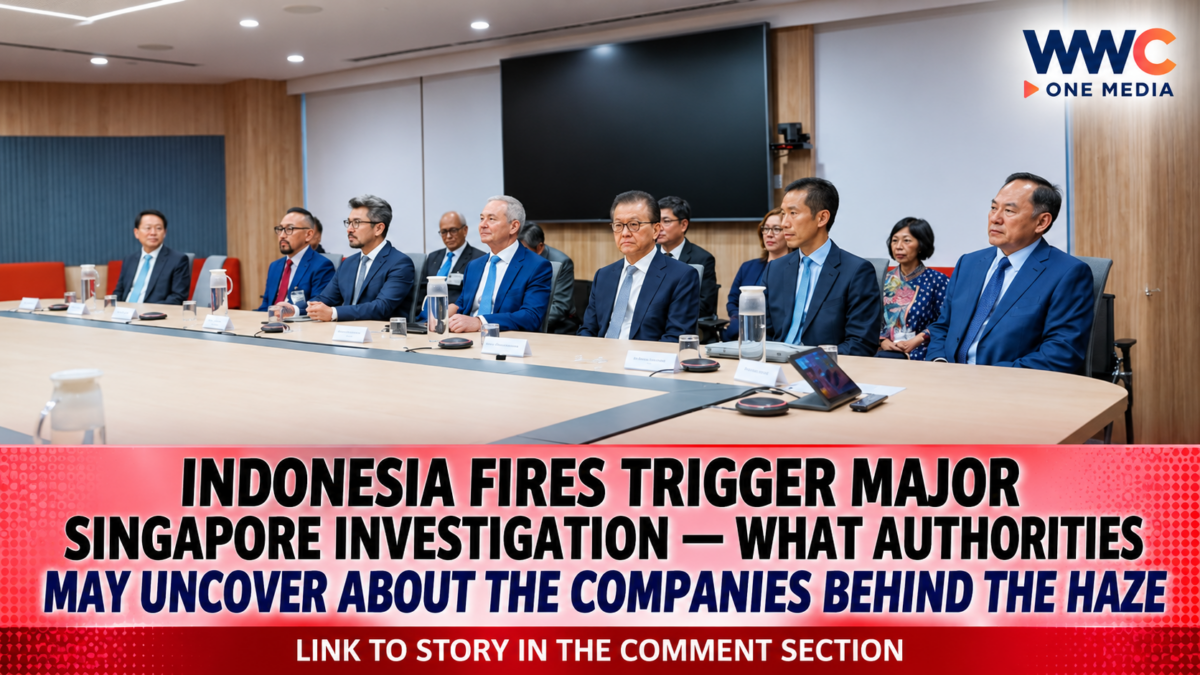
Singapore is stepping up its campaign against transboundary haze, establishing a specialist panel of legal, auditing and investigative experts to examine companies potentially connected to fires in Indonesia that have contributed to unhealthy air quality across the city-state.
Announced on October 23, 2026, by the Ministry of Law (MinLaw), the initiative is designed to strengthen investigations into businesses whose operations, corporate relationships or supply chains may be linked to fires responsible for the recurring haze.
The move signals a more aggressive approach by Singapore to establish corporate accountability, particularly where business operations and ownership structures extend across national borders.
Under the new framework, companies identified by the Government will be required to engage professionals from the specialist panel to conduct detailed investigations into their operations, corporate relationships and supply chains. They must also submit comprehensive audit findings to the authorities.
MinLaw said the companies are expected to provide full access to relevant documents, operational information and other facts needed to determine whether they were involved in causing or condoning the fires.
Cross-border investigations to examine corporate structures
A major challenge in addressing transboundary haze is tracing responsibility when land concessions, plantation operations, parent companies and commercial arrangements span several countries.
Singapore’s new specialist panel will bring together law firms, audit firms and investigative firms with experience in complex cross-border inquiries.
The Government has appointed Davinder Singh Chambers, led by Senior Counsel Davinder Singh, as its adviser to coordinate the panel’s work and help ensure investigations are properly conducted across different jurisdictions.
The findings will subsequently be assessed by relevant government agencies and the Attorney-General’s Chambers.
The Ministry acknowledged that gathering information overseas may involve legal and practical limitations, particularly because Singapore authorities cannot automatically exercise investigative powers within another country’s territory.
This makes cooperation, access to corporate records and the tracing of business relationships particularly important.
Ten Singapore-registered companies already face information requests
The establishment of the specialist panel comes amid a wider investigation by Singapore’s National Environment Agency (NEA).
On October 23, NEA issued notices under the Transboundary Haze Pollution Act to 10 Singapore-registered companies operating in the palm oil and forestry industries.
The companies are:
- Asia Pulp & Paper Company Limited
- Asia Pulp & Paper Company (China) Limited
- Bumitama Agri Ltd
- Golden Agri International Pte Ltd
- First Resources Ltd
- Indofood Agri Resources Ltd
- Kencana Agri Ltd
- TSH Global Plantation Pte Ltd
- TSH Oversea Pte Ltd
- Wilmar International Ltd
The notices require the companies to provide information about their corporate connections in Singapore and Indonesia, the locations of their Indonesian land concessions, and the fire prevention and firefighting measures undertaken during the current dry season.
Importantly, receiving an information notice does not mean a company has been found guilty of causing the haze. The investigation is intended to establish the facts and determine whether any legal responsibility exists.
Indonesian plantation companies also receive preventive notices
Singapore’s investigation is not limited to companies registered within its borders.
NEA also issued preventive measure notices to 10 Indonesian companies over fires in Sumatra and Kalimantan.
These notices require the companies to deploy firefighting personnel where necessary, stop ongoing burning activities, prevent new fires and submit action plans detailing how they intend to extinguish fires and prevent them from recurring.
Authorities are also seeking information about fires within the companies’ concessions, their firefighting efforts and their relationships with associated businesses in Singapore and Indonesia.
The wider investigation reflects Singapore’s intention to examine corporate connections rather than focus exclusively on the individual companies holding land concessions.
A renewed push against a recurring regional problem
The renewed haze episode has once again highlighted the environmental and public-health consequences of land and forest fires in Southeast Asia.
Singapore experienced stretches of unhealthy air quality beginning September 4, 2026, according to CNA’s reporting.
The problem is particularly difficult to resolve because fires can occur outside Singapore’s territory, while their smoke travels across national borders and affects communities thousands of kilometres away.
Singapore introduced the Transboundary Haze Pollution Act in 2014 to provide a legal framework for holding companies accountable for haze pollution affecting the country, including when relevant activities take place outside Singapore.
However, enforcing the law has presented significant challenges. Gathering evidence overseas, identifying the ultimate owners of companies and tracing complicated corporate structures can make investigations lengthy and difficult.
The latest specialist panel is intended to help address some of these obstacles.
What happens next?
The specialist panel’s work could become an important part of Singapore’s broader effort to determine who is responsible for recurring haze pollution.
The investigations will examine not only individual companies but also their corporate relationships, commercial arrangements and supply chains.
The findings will be reviewed by relevant government agencies and the Attorney-General’s Chambers before further action is considered.
For Singapore, the objective is clear: companies must not be allowed to escape scrutiny simply because their operations, land holdings or business relationships extend beyond the country’s borders.
And as investigators begin examining the connections between businesses in Singapore and Indonesia, the biggest question remains: Will this new investigation finally establish accountability for one of Southeast Asia’s most persistent environmental problems?
Further developments as of October 30, 2026
The investigation has since moved beyond the initial announcement.
In a follow-up report published on October 28, AsiaOne reported that senior Singapore ministers had met with representatives of major businesses, including Bumitama Agri, First Resources, Golden Agri-Resources, Indofood Agri Resources, Kencana Agri, TSH Resources, Wilmar International and Sinar Mas Group.
Senior Minister K. Shanmugam stressed that Singapore would pursue available legal and regulatory avenues and that companies must provide meaningful cooperation, not merely technical responses.
He also indicated that legislative amendments to the Transboundary Haze Pollution Act would be tabled in Parliament to strengthen the assessment framework and give authorities additional powers.
This is an important development: the specialist panel is no longer simply an administrative announcement. Singapore is moving towards a more formal process for assessing corporate responsibility.