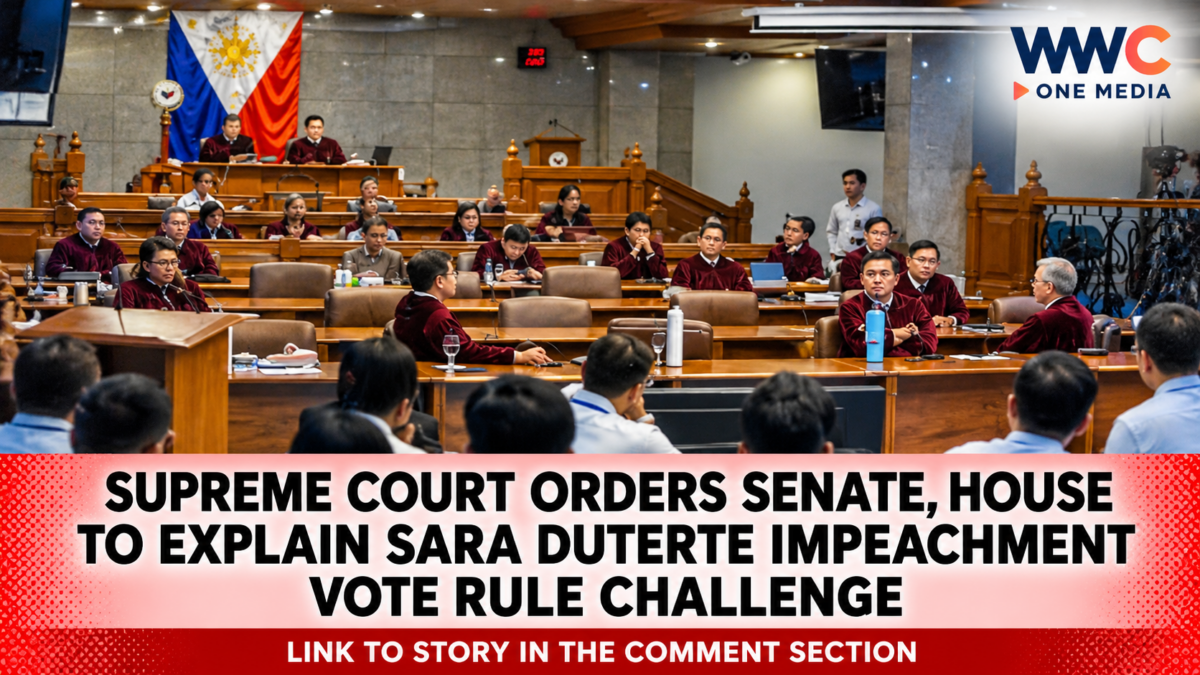
MANILA, Philippines — The Supreme Court has directed the Senate impeachment court and the House of Representatives to respond to a petition challenging the revised voting formula for convicting Vice President Sara Duterte, placing the disputed impeachment rule before the country’s highest court.
In an en banc resolution dated October 14, the Court gave the respondents a non-extendible period of five days from receipt of notice to submit their comments. The order covers the petition and requests for interim relief, including a temporary restraining order (TRO) or status quo ante order. GMA News Online+2
The petition was filed by Senators Robinhood “Robin” Padilla and Christopher Lawrence “Bong” Go, along with the Partido Demokratiko Pilipino-Lakas ng Bayan (PDP-Laban) and other petitioners. They are questioning the Senate impeachment court’s September 23 decision to calculate the two-thirds conviction requirement using only senator-judges legally and factually capable of participating in the proceedings.
The petition asks the Supreme Court to prevent the Senate and House from excluding any senator from the constitutional count of “all members of the Senate.” GMA News Online+2
What the Senate impeachment court changed
The dispute stems from the impeachment court’s September 23 ruling, which overturned an earlier interpretation that required 16 votes to convict Duterte, based on two-thirds of the full 24-member Senate.
Under the revised formula, senators who are legally or factually unable to participate may be excluded from the calculation. These circumstances may include detention, suspension, medical incapacity or other legal restrictions that prevent a senator from performing the duties of a senator-judge.
The court adopted the revised interpretation through a 13-1 vote, with six senator-judges not participating. It also ruled that any fractional result in calculating the two-thirds requirement must be rounded up to the next whole vote. For example, if 20 senator-judges are counted, two-thirds is 13.33, meaning 14 votes would be required for conviction. Philippine News Agency+1
Who must respond to the Supreme Court?
The respondents include the Senate impeachment court, represented by Senate President Sherwin Gatchalian and presiding officer Francis “Chiz” Escudero, as well as the House of Representatives, represented by Speaker Faustino “Bojie” Dy III and its lead prosecution panel.
The Supreme Court’s directive does not mean it has already ruled on the petition’s merits. Requiring the respondents to comment gives the parties an opportunity to present their positions before the justices decide what action, if any, should follow.
The Court has not yet granted the requested TRO or status quo ante order. Until it issues an order changing the situation, the impeachment court’s September 23 voting interpretation remains in effect. GMA News Online+1
Why the constitutional question matters
Article XI, Section 3(6) of the 1987 Constitution states that conviction in an impeachment trial requires the concurrence of two-thirds of all members of the Senate.
The central legal disagreement is how to interpret the phrase “all the Members of the Senate”: should it mean the full 24-member chamber, or only those senator-judges legally and practically able to participate when the final judgment is made?
The issue has drawn differing interpretations from former Supreme Court magistrates who were invited to serve as amici curiae, or friends of the court. Some supported counting only senators able to participate, while retired Associate Justice Adolfo Azcuna argued that the constitutional wording refers to the Senate’s full membership. GMA News Online+1
The Supreme Court’s eventual action could determine whether the impeachment court’s revised formula stands or whether the constitutional voting requirement must be interpreted differently. For now, however, the high court has ordered comments—not issued a final ruling on the dispute.
For readers following the developments, these previously published WWC ONE MEDIA reports provide additional background:
- Sara Duterte Camp Prepares Supreme Court Challenge to New Impeachment Vote Threshold
- Rodriguez Asks Supreme Court to Strike Down Lower Impeachment Conviction Threshold
- Impeachment Court Says New Voting Threshold Applies Only to Sara Duterte Case
- Cayetano Sounds Alarm Over Sara Duterte Impeachment Vote Change