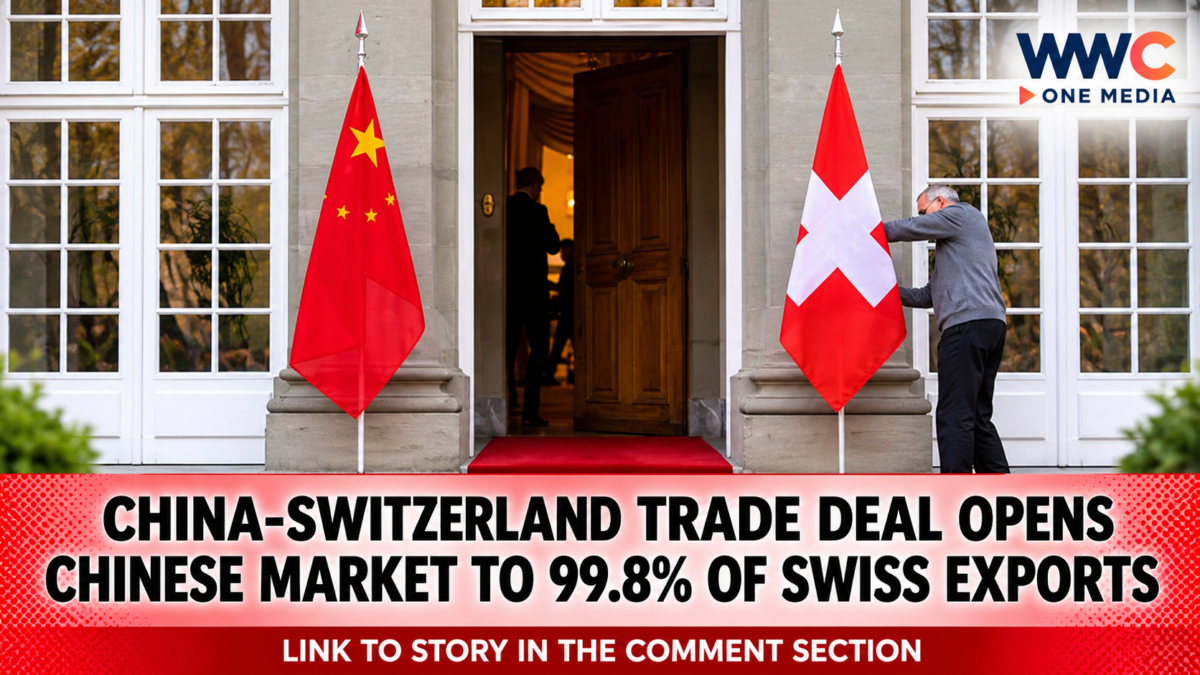
BEIJING/BERN — As major economies increasingly turn to tariffs, trade restrictions and industrial safeguards, China is preparing to deepen its economic partnership with Switzerland through an upgraded free trade agreement that would give almost all Swiss exports duty-free access to the Chinese market.
Chinese President Xi Jinping and Swiss President Guy Parmelin are scheduled to sign the agreement in Beijing on October 30, according to Swiss government announcements and Reuters reporting. The deal would expand duty-free access for Swiss products entering China to 99.8% of Switzerland’s current exports, compared with just over half under the existing arrangement. Reuters+2
The agreement comes at a time when the United States and European Union are increasingly scrutinising Chinese imports, considering trade-defence measures and debating how to protect domestic industries from foreign competition.
For Beijing, the Swiss agreement offers an opportunity to present China as a supporter of market access and international trade cooperation. For Switzerland, it promises better access to one of its most important export markets at a time of growing uncertainty in global commerce.
But the deal also places Switzerland in a delicate position as it seeks to maintain strong economic relationships with China, the European Union and the United States. Reuters+1
What the upgraded China-Switzerland agreement changes
The agreement updates the bilateral free trade deal that took effect in 2014. Negotiations to improve it formally began in September 2024 and concluded after five rounds of talks, with both governments announcing the outcome in August 2026.
Under the existing arrangement, almost all Chinese imports entering Switzerland already benefit from duty-free treatment. However, only around half of Swiss exports entering China received the same advantage.
The revised agreement is intended to address that imbalance by extending duty-free access to 99.8% of Switzerland’s current exports to China.
Swiss exporters in sectors such as watches, pharmaceuticals, chemicals and precision instruments are among those expected to benefit from improved access to the Chinese market.
The updated framework also covers investment access, rules of origin, customs and trade facilitation, services, digital trade, competition, and economic and technical cooperation. Switzerland says the agreement will also strengthen provisions on labour rights and environmental protection. BABS+2
Importantly, the agreement does not introduce new tariff advantages for Chinese industrial goods entering Switzerland. Swiss officials say the principal tariff improvement is on the Swiss export side.
Why the agreement matters to China
The timing gives the deal significance beyond its immediate commercial benefits.
China is facing increasingly difficult trade relations with Western economies. Washington has used tariffs and other trade restrictions against Chinese products, while European governments are debating how to respond to rising Chinese imports and concerns about industrial competition.
Reuters reported that diplomats see the Swiss agreement as part of Beijing’s effort to demonstrate its commitment to international trade and present itself as open to economic cooperation while the United States moves towards a more protectionist approach.
The agreement is particularly notable because Switzerland is a major European economy with close commercial relationships across the continent. A successful deal allows China to strengthen ties with a European trading partner even as tensions with the EU remain unresolved. Reuters+1
Switzerland is also responding to trade uncertainty with Washington
Switzerland has its own reasons for seeking more predictable access to international markets.
In 2025, the Trump administration initially imposed a 39% tariff on Swiss goods, one of the highest rates applied to a developed economy. Switzerland subsequently reached a provisional arrangement with Washington that reduced the rate to 15%, although uncertainty over the longer-term trade relationship remained.
The improved agreement with China therefore gives Swiss exporters another opportunity to diversify their commercial relationships and reduce their exposure to uncertainty in other major markets.
China is Switzerland’s third-largest trading partner after the European Union and the United States, making access to Chinese consumers and businesses particularly important for Swiss manufacturers.
However, Swiss industry representatives have also warned that the country must avoid being caught in the growing economic confrontation between Washington, Beijing and Brussels. Reuters+1
Europe’s tougher trade stance creates a wider contrast
The China-Switzerland agreement comes as the European Union considers a more defensive approach to its trade relationship with Beijing.
European officials have raised concerns about the bloc’s widening trade deficit with China, the competitiveness of Chinese manufacturers and the impact of Chinese imports on European industries.
Reuters reported on October 23 that EU ministers were discussing how to address the growing trade imbalance through negotiations while retaining the option of trade-defence measures.
The dispute extends across several industries, including automobiles, chemicals, machinery and other manufactured goods. European governments are trying to balance access to Chinese products and markets against concerns about domestic manufacturing and competition. Reuters+1
The contrast is striking: while parts of Europe are considering stronger safeguards against Chinese imports, Switzerland is moving towards a broader trade arrangement with Beijing.
That does not mean Switzerland is abandoning its European economic relationships. Swiss officials have said the agreement is not expected to affect the country’s goods trade with the EU, the United States or other partners. They have also rejected suggestions that Switzerland will become a re-export hub for Chinese products entering Europe. Reuters
Could Switzerland become a bridge between China and Europe?
The agreement has attracted attention beyond the two countries.
According to Reuters, the improved trading terms raised questions among some US officials about whether Switzerland could become a route for Chinese goods into European markets. US officials reportedly sought discussions with Swiss counterparts about the agreement.
Swiss officials have pushed back against that interpretation, maintaining that the deal is designed to improve direct trade between Switzerland and China rather than facilitate the rerouting of Chinese products.
The distinction matters because Switzerland is not a member of the European Union and has its own trade arrangements. The new agreement does not automatically give Chinese manufacturers tariff-free access to the EU simply because goods pass through Switzerland.
For Swiss businesses, the immediate attraction is more straightforward: better access to Chinese customers, improved investment opportunities and greater certainty for companies that rely on international supply chains. Reuters+1
Signing is not the same as implementation
Although the agreement is scheduled for signing on October 30, businesses should not assume that all the revised provisions will take effect immediately.
The Swiss government has said that domestic approval procedures must follow the signing. The detailed implementation timetable and the final legal process will determine when companies can begin using the new provisions.
That means the agreement represents an important step towards expanded market access, but its full commercial impact will depend on the completion of those procedures. BABS+1
The bigger picture: Trade is becoming increasingly fragmented
The agreement highlights a growing divide in global economic policy.
Some governments are seeking to protect domestic manufacturers through tariffs, safeguards and tighter controls on imports. Others are pursuing bilateral agreements to secure market access, attract investment and diversify their export destinations.
China is attempting to use its agreement with Switzerland to reinforce its position as a major trading partner, while Switzerland is seeking to preserve access to multiple markets without becoming entangled in geopolitical disputes.
Neither country is insulated from the wider tensions.
Switzerland still depends on its relationships with the EU and the US, while China continues to face trade restrictions and scrutiny from several Western economies.
The deal therefore offers both countries commercial opportunities, but it also illustrates the difficult balancing act facing smaller, export-dependent economies in an increasingly divided global trading system.
The bottom line: China’s upgraded trade agreement with Switzerland is a significant move towards deeper bilateral economic cooperation at a time when protectionist policies are gaining ground elsewhere. The promise of duty-free access for 99.8% of Swiss exports could benefit major Swiss industries, but the agreement’s ultimate impact will depend on domestic approval and implementation. For Beijing, it is also a chance to strengthen its trade credentials in Europe without resolving the broader disputes with Washington and Brussels.
These five WWC ONE MEDIA reports provide relevant background on China’s trade relationships, European trade policy and the wider protectionism debate:
- EU Turns Up the Heat on China Over a €1 Billion-a-Day Trade Gap — But Beijing May Be Preparing for a Bigger Fight
- China Rejects EU Demand to Cap Hybrid Car Exports — Is a New Trade War About to Explode?
- France and Germany Push EU for Rapid-Response Trade Tool, With China in Focus
- US and China Extend Trade Truce to January as Trump-Xi Summit Opens Door to Bigger Deal
- China Is Producing More Cars, Batteries and Goods Than Ever — But the Numbers Reveal Why the West’s ‘Overcapacity’ Case Isn’t So Simple