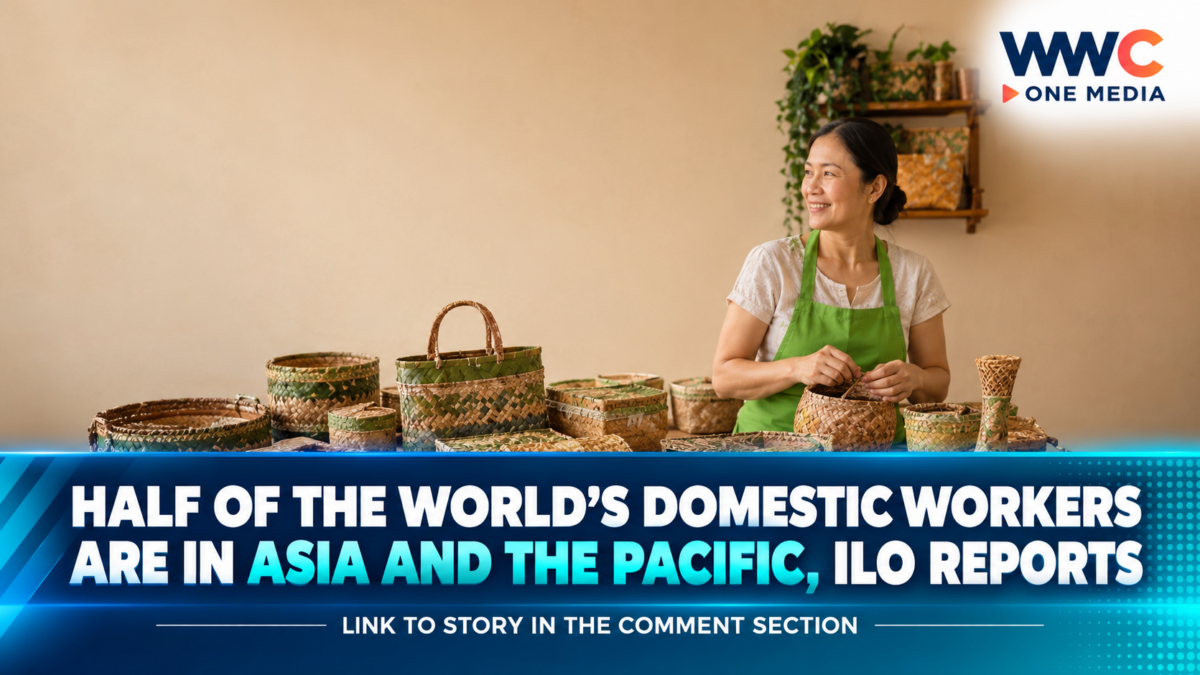
Asia and the Pacific are home to approximately half of the world’s domestic workers, highlighting the region’s central role in household and care services while exposing the widespread lack of formal employment protections affecting millions of workers.
The International Labour Organization (ILO) estimates that the region has around 40.2 million domestic workers. Its latest global assessment warns that informal employment, low wages and excessive working hours remain major challenges, even as some countries make progress in improving labor protections.
The findings come 15 years after the adoption of the ILO Domestic Workers Convention, 2011 (No. 189), an international agreement designed to strengthen the rights and working conditions of people employed in private households.
Globally, an estimated 80 million people were employed as domestic workers in 2025, up from 75.6 million in 2019. Despite the increase, domestic work remained relatively stable as a share of total employment, accounting for approximately 2.2 percent of all employment worldwide.
More Than 66 Million Domestic Workers Lack Formal Protection
One of the most concerning findings is the scale of informal employment in the sector.
The ILO estimates that 66.5 million domestic workers, equivalent to 83.1 percent of the global workforce, were informally employed in 2025. This represents an increase of 5.1 million workers compared with 2019.
Informal employment can leave workers without effective access to essential labor protections, including social security, legally protected working conditions and other employment benefits.
The ILO clarified that the rising global number does not necessarily indicate that working conditions have deteriorated across most countries. Instead, the increase largely reflects the growing concentration of domestic workers in countries where informality has remained persistently high.
Among 140 countries with comparable data, informality declined or remained stable in 91 countries, representing nearly 70 percent of domestic workers worldwide. The remaining 49 countries recorded increases.
These findings suggest that improvements are possible when governments introduce and enforce effective labor policies.
Domestic Workers Earn Far Less Than Other Employees
The report also highlighted a significant wage gap affecting domestic workers.
On average, domestic workers worldwide earn only 53.3 percent of the monthly wages received by other employees. For those working in informal employment, the figure drops to just 48.7 percent.
The wage disadvantage has widened since 2019, when domestic workers earned an average of 56.4 percent of the monthly wages of other employees.
Women face an even greater disadvantage. They account for 77.2 percent of domestic workers worldwide and earn an average of just 48 percent of the monthly wages received by other employees.
Male domestic workers, meanwhile, earn an average equivalent to 65.8 percent of other employees’ monthly wages.
The figures underscore the economic inequalities affecting a workforce largely responsible for cleaning homes, preparing meals, caring for children and supporting older people and individuals with disabilities.
Long Working Hours Remain a Major Concern
Beyond low wages, domestic workers also face difficult working schedules.
The ILO found that 35.2 percent of domestic workers worldwide work at least 49 hours per week. Of that group, 14.6 percent work 60 hours or more.
Other domestic workers experience the opposite problem, with insufficient working hours and unstable income forcing some to move between several households to earn enough to support themselves.
Informal workers are particularly vulnerable to both extremes, making reliable working-time protections an important part of improving employment conditions.
Africa Records the Biggest Increase in Domestic Workers
While Asia and the Pacific account for the largest regional concentration of domestic workers, Africa recorded the biggest increase in the sector between 2019 and 2025, adding approximately 4.2 million workers.
The ILO also identified significant differences in informal employment across regions. In Africa, 93.3 percent of domestic workers are informally employed, while informality is nearly universal in the Arab States.
Europe and Central Asia have the lowest regional informality rate, although more than one in three domestic workers in the region still lack formal employment arrangements.
The Americas remain the most heavily feminized broad region in terms of domestic work.
ILO Calls for Stronger Labor Protection and Fair Wages
The ILO is urging governments to strengthen policies that bring domestic workers into formal employment and provide them with protections comparable to those enjoyed by other employees.
Its recommendations include making worker registration and access to social protection easier, establishing effective minimum wages, protecting working hours and improving enforcement of labor standards.
The organization also called for greater investment in decent care-sector jobs, recognition of workers’ skills, stronger collective bargaining and broader implementation of Convention No. 189 and its accompanying Recommendation No. 201.
ILO officials stressed that domestic workers perform essential services that allow households and economies to function, yet their contributions frequently remain undervalued.
As populations age, migration patterns change and demand for household and care services increases, the need for stronger protections is expected to become even more important.
For Asia and the Pacific, where approximately 40.2 million people work in domestic employment, the findings highlight the scale of the challenge: improving the livelihoods of domestic workers will require more than recognizing their contribution. Governments must also ensure fair pay, social protection and decent working conditions.