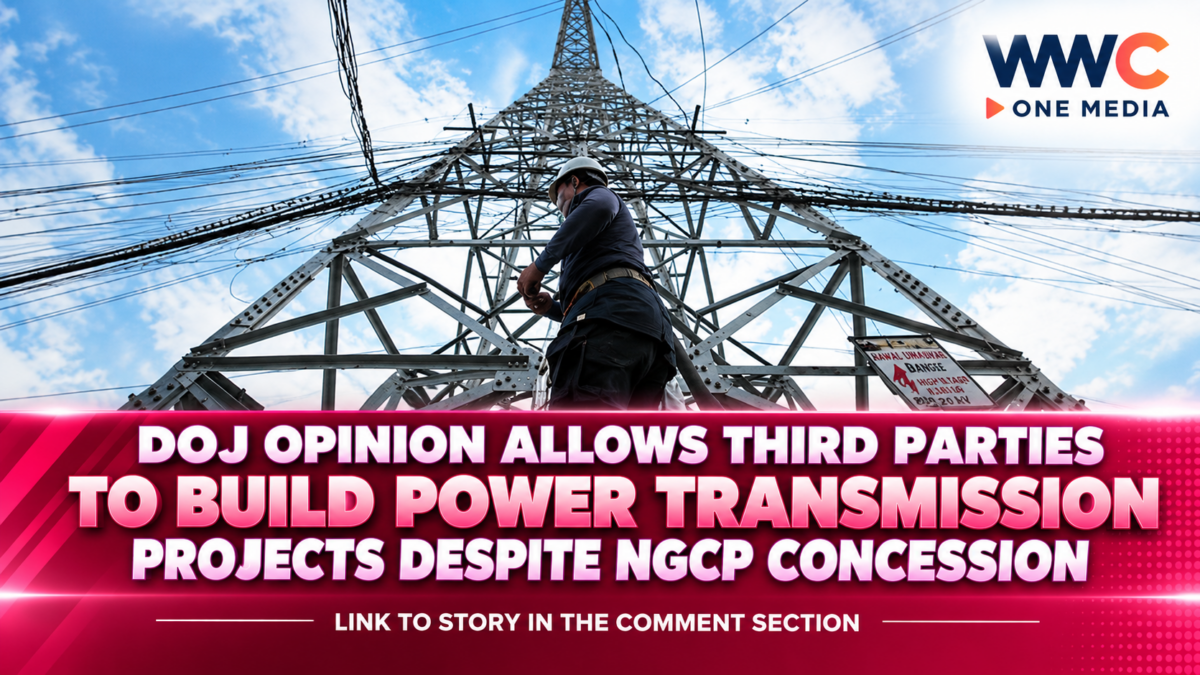
The Department of Justice (DOJ) has affirmed that the Philippine government can allow private companies and other third-party entities to finance and construct power transmission facilities despite the existing concession agreement with the National Grid Corporation of the Philippines (NGCP).
In a seven-page legal opinion, Justice Secretary Fredderick Vida said the President and the Department of Energy (DOE) have the authority to issue executive orders and department circulars permitting third-party participation in transmission infrastructure development.
The opinion was requested by Energy Secretary Sharon Garin, who sought clarification on whether the government could introduce these arrangements without violating NGCP’s existing concession agreement.
The agreement, which took effect in 2009 and runs until 2034, gives NGCP the responsibility of managing and operating the country’s power transmission network.
However, the DOJ stressed that the agreement does not prevent the government from introducing additional measures to address delays in transmission projects, particularly when these affect national energy security.
Government Can Allow Other Companies to Participate
The DOJ explained that the government retains its regulatory and policymaking authority over the power sector under the Electric Power Industry Reform Act (EPIRA).
It said the President may issue executive orders directing government departments to establish mechanisms that accelerate the construction of critical transmission facilities.
The DOE, meanwhile, has rule-making authority under Section 37 of EPIRA, allowing it to issue regulations necessary to implement the law’s objectives.
According to the DOJ, these powers allow the government to establish a framework in which qualified generation companies, distribution utilities and other entities can participate in financing and building transmission infrastructure.
The arrangement would supplement NGCP’s performance rather than automatically terminate or replace its concession agreement.
The DOJ emphasised that NGCP’s agreement remains valid and in effect, subject to government oversight.
Delays in Transmission Projects Raise Energy Security Concerns
The legal opinion comes amid concerns over delays in completing transmission infrastructure needed to support the country’s growing electricity requirements.
Based on information submitted to the DOE, including NGCP’s regular Transmission Project Status Reports, numerous projects have fallen behind their expected completion schedules.
These delays can prevent power plants from delivering electricity to the national grid even when generation facilities are already available.
The problem is particularly significant for renewable energy developers, whose projects may be unable to operate at full capacity without adequate transmission connections.
The government believes allowing other qualified entities to help finance and construct certain facilities could reduce bottlenecks, minimise economic losses and accelerate the integration of new power sources.
Two Draft Executive Orders and DOE Circulars
Garin cited two proposed executive orders as part of the government’s efforts to speed up transmission development.
The first draft executive order seeks to establish regulatory mechanisms and requirements allowing generation companies and distribution utilities to participate in the advance construction of transmission projects critical to the country’s energy transition.
The second aims to promote a whole-of-government approach to accelerating the implementation and completion of priority transmission projects under the National Transmission Corporation (TransCo).
The DOE also prepared two draft circulars outlining frameworks for generation companies to finance and construct transmission projects and for TransCo to implement priority infrastructure projects.
These measures are intended to address delays that could affect electricity supply, investment and the country’s transition towards cleaner energy sources.
However, the DOJ clarified that its opinion was based on the descriptions of the proposed measures because it had not received the complete draft texts of the first executive order and the two department circulars for a comprehensive legal review.
ERC Rules Already Open the Door to Third-Party Projects
The development follows the Energy Regulatory Commission’s adoption of Resolution No. 18, Series of 2026, which established implementing rules for the development, ownership and operation of certain transmission facilities by entities other than NGCP.
Under the framework, qualified generation companies may finance and construct Associated Transmission Projects identified by the DOE.
TransCo may also undertake priority projects or engage government agencies, government-owned and controlled corporations, and private entities to carry out construction on its behalf.
The rules are designed to address transmission bottlenecks that prevent new power plants from delivering their full output to consumers.
NGCP previously said it was reviewing the regulatory framework in relation to its rights and responsibilities under its concession agreement, franchise and other applicable laws.
The new DOJ opinion provides additional legal backing for the government’s position that third-party participation can proceed without automatically invalidating NGCP’s existing contractual obligations.
What the Decision Could Mean for Electricity Consumers
The government’s move could help accelerate the construction of transmission lines, substations and other facilities needed to connect new power plants to the grid.
For consumers, faster infrastructure development could eventually mean fewer transmission bottlenecks, improved electricity reliability and better access to additional power supplies, including renewable energy.
However, allowing third parties to participate does not automatically guarantee lower electricity bills. Project costs, regulatory approvals, construction schedules and the rules governing cost recovery will remain important considerations.
The ERC has said it will continue reviewing the prudence of transmission investments and allow only justifiable and reasonable costs to be recovered from consumers.
Ultimately, the challenge for the government will be ensuring that the expanded participation of private and public entities translates into faster project completion without weakening accountability, regulatory oversight or the reliability of the country’s national power grid.