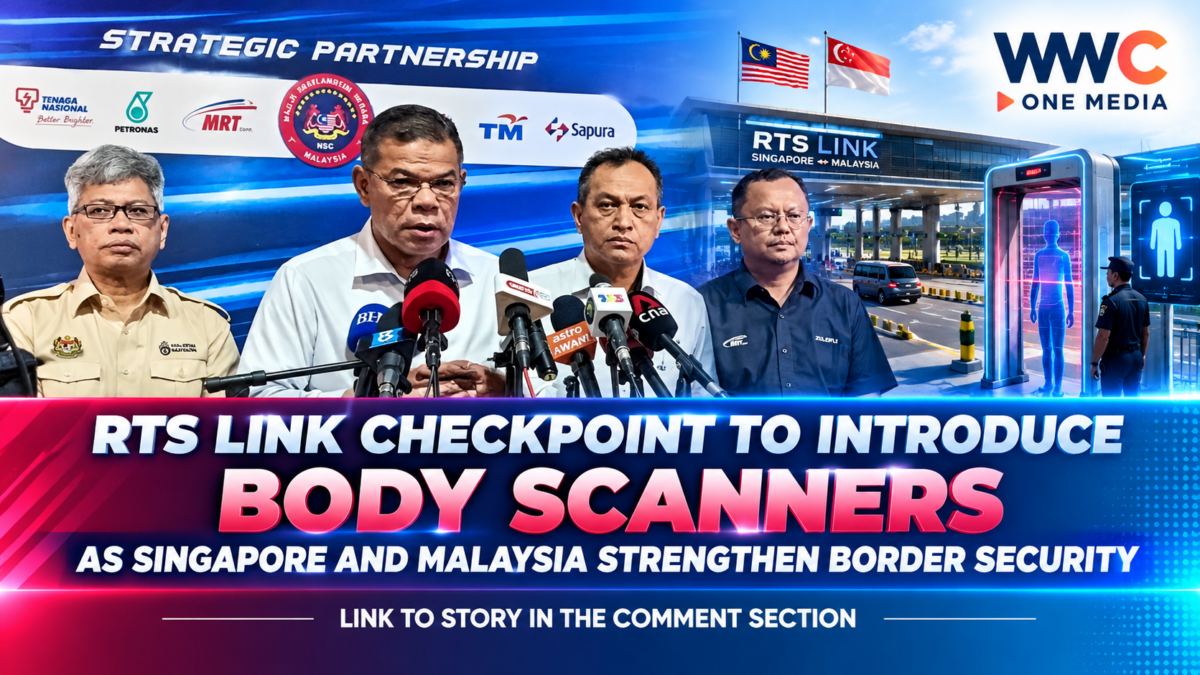
The upcoming Johor Bahru–Singapore Rapid Transit System (RTS) Link will introduce body-scanning technology at its immigration checkpoints as part of efforts to strengthen security and improve passenger screening between the two countries.
Malaysia to Install More Than 100 Advanced Body Scanners at Johor-Singapore RTS Link Checkpoint
Malaysia is preparing to introduce advanced body-scanning technology at the Johor Bahru–Singapore Rapid Transit System (RTS) Link checkpoint, strengthening security measures ahead of the cross-border rail service’s expected opening early next year.
More than 100 scanning units will be deployed at the Immigration, Customs and Quarantine (ICQ) Complex in Bukit Chagar, Johor Bahru. Malaysian Home Minister Saifuddin Nasution Ismail said the technology will mark a first for the country and help authorities detect objects concealed on people’s bodies, including items wrapped in materials intended to avoid conventional screening.
The announcement was made on October 28 during the closing ceremony of the Malaysia-Singapore Cross-Border Joint Security Exercise, held at the RTS Link’s Wadi Hana site in Johor Bahru.
Saifuddin said he had been shown a demonstration of the equipment during preparations for the security exercise. According to him, the scanners can identify not only weapons but also other objects carried or concealed by individuals.
The deployment forms part of Malaysia’s wider effort to tighten controls at major entry points and prevent illegal activities.
Risk-Based Screening and Tighter Border Controls
The additional scanning equipment is among a series of security improvements being developed by Malaysia’s Home Ministry and Transport Ministry following a Cabinet directive.
The two ministries have proposed 17 initiatives covering short-, medium- and long-term improvements to border security.
Authorities plan to introduce more targeted inspections, focusing on passengers and goods arriving from locations identified as high-risk based on established profiles and previous incidents.
Access-pass management will also be tightened. Saifuddin said passes that previously had longer validity periods will now be subject to annual renewal.
These measures are intended to strengthen monitoring and reduce opportunities for smuggling, trafficking and the movement of prohibited items through the country’s entry points.
How the RTS Link Will Screen Passengers
The Bukit Chagar checkpoint is being equipped with modern security and immigration facilities designed to handle the expected increase in cross-border passengers.
Previous briefings on the project outlined the use of millimetre-wave body scanners, which can detect concealed metallic and non-metallic objects without relying on conventional physical searches for every passenger.
The station is also expected to have baggage-screening equipment, security lanes and immigration e-gates. Suspicious items identified during screening can be referred for additional inspection by security officers.
Earlier reports on the facility said the scanners would work alongside Malaysia’s new National Integrated Immigration System, known as MyNIISe, as authorities prepare to replace the older immigration platform.
The upgraded systems are intended to improve passenger processing while maintaining security checks.
Five-Minute Train Journey Between Johor Bahru and Singapore
The RTS Link will connect Bukit Chagar in Johor Bahru with Woodlands North in Singapore through an approximately 4km rail route.
The train journey is expected to take around five minutes, offering commuters an alternative to travelling through the heavily congested Johor-Singapore Causeway.
The service is designed to carry up to 10,000 passengers per hour in each direction, potentially easing pressure on one of the world’s busiest land border crossings.
Under the co-located immigration arrangement, passengers will complete the required Malaysian and Singapore immigration clearances at their departure station before boarding the train.
This means travellers departing from Johor Bahru will clear both countries’ checks at Bukit Chagar, while those travelling from Singapore will undergo the corresponding process at Woodlands North.
The arrangement is expected to make cross-border journeys more convenient, although passengers will still need to complete ticketing, security screening and immigration procedures.
Security Cooperation Between Malaysia and Singapore
The latest measures also highlight the importance of cooperation between Malaysian and Singaporean authorities as the RTS Link approaches its launch.
Both countries have been coordinating security preparations, immigration procedures and the legal arrangements needed to allow their respective officers to carry out border-control duties at the two stations.
The joint security exercise in Johor Bahru was part of those preparations, bringing together officials from both sides to assess their ability to respond to potential cross-border threats.
With the RTS Link expected to begin operations in early 2027, the installation of advanced scanners and upgraded immigration systems will be central to ensuring that faster passenger movement does not come at the expense of border security.
For thousands of commuters who regularly travel between Johor Bahru and Singapore, the new rail connection promises a faster alternative to the Causeway. However, its success will also depend on whether the new screening and immigration systems can handle large passenger volumes efficiently while maintaining effective security checks.